Cervical Contour Pillow vs Traditional Pillow: Height, Sleep Position and Fit
Compare contoured cervical pillows with traditionally shaped pillows by height, neck contour, sleep position and personal comfort without expecting guaranteed pain relief.
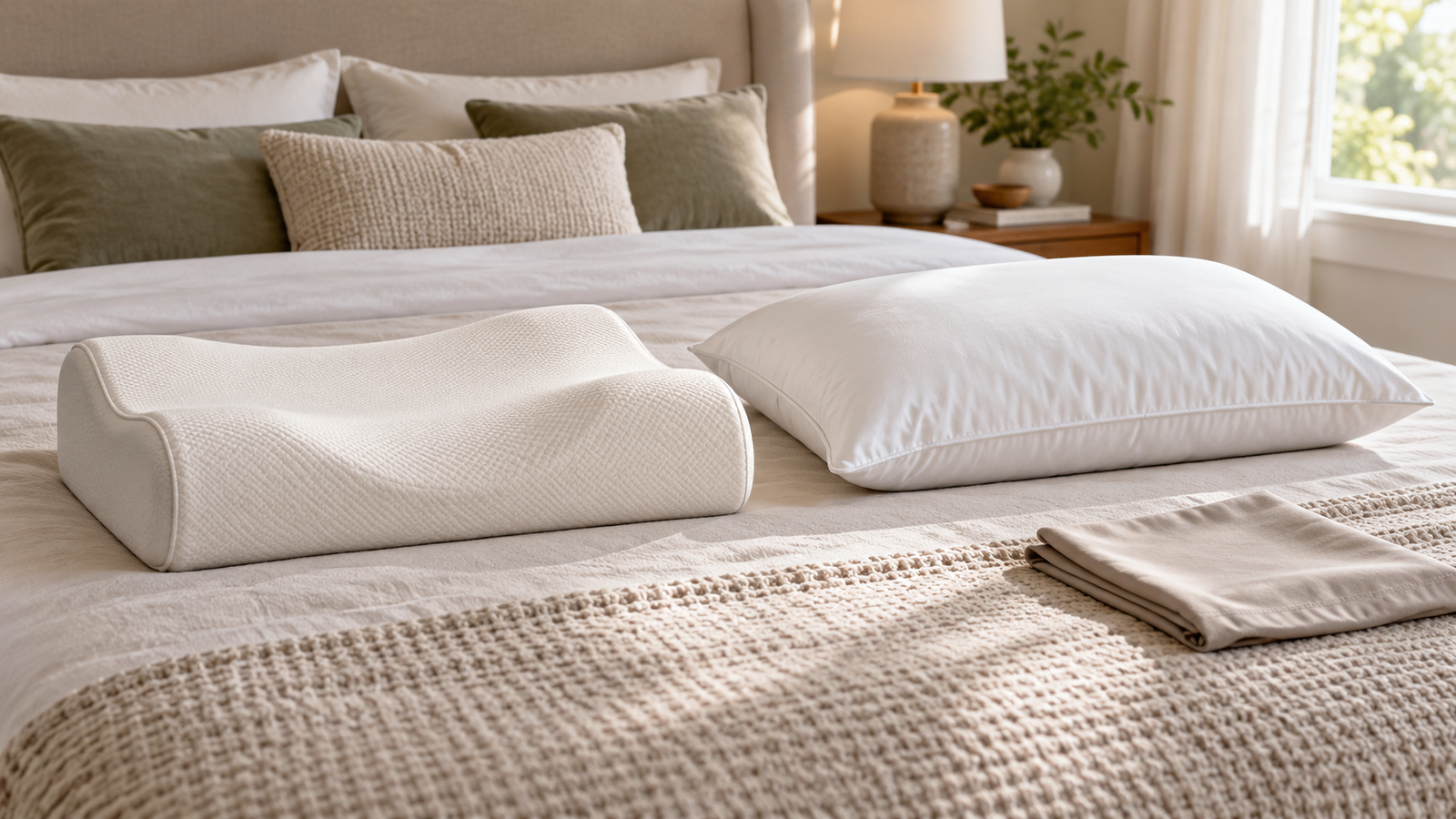
Cervical contour pillows and traditionally shaped pillows can both support the head during sleep, but they do so in very different ways.
A cervical contour pillow usually has a sculpted profile with raised edges and a lower central area intended to support the natural curve between the head, neck and shoulders. A traditional pillow usually has a more even rectangular shape and relies on filling material to create loft and softness.
Neither design is automatically better.
The right pillow depends on your sleeping position, shoulder width, mattress firmness, preferred feel and how much pillow height keeps your head and neck in a comfortable position.
What is a cervical contour pillow?
A cervical contour pillow is shaped rather than uniformly filled.
Common features include:
- Raised neck-support edges.
- Lower central section.
- Wave-shaped profile.
- Different heights on each side.
- Memory-foam construction.
The purpose of the contour is to create a more defined support area beneath the neck while allowing the head to rest slightly lower.
Some designs are symmetrical, while others provide two different edge heights so you can choose the side that feels more comfortable.
What is a traditional pillow?
A traditional pillow is generally rectangular and has a relatively consistent shape across its surface.
It may be filled with:
- Memory foam.
- Shredded foam.
- Polyester fibre.
- Latex.
- Down.
- Feather.
- Cotton or other fibres.
Traditional pillows are usually easier to reposition and compress.
Instead of a fixed neck contour, support comes from the pillow’s overall loft, firmness and filling distribution.
Cervical contour pillow vs traditional pillow at a glance
| Factor | Cervical contour pillow | Traditional pillow |
|---|---|---|
| Shape | Sculpted or wave-shaped | Rectangular and relatively even |
| Neck area | Dedicated raised section | Support depends on loft and filling |
| Head area | Often lower central section | Usually similar height throughout |
| Adjustability | Usually limited | Often easier to reshape |
| Common material | Memory foam or latex | Many filling types |
| Best for | Users who prefer defined support | Users who prefer familiar, flexible comfort |
| Sleep-position flexibility | Moderate | Usually high |
| Travel/storage | Bulkier and shape-specific | Usually easier |
| Learning curve | May require adaptation | Familiar to most users |
The most important difference is shape
A traditional pillow is essentially a cushion.
Its shape changes as your head presses into it.
A contour pillow starts with a specific structure.
The raised portions are intended to fill the space beneath the neck, while the lower middle area holds the head.
That means a contour pillow makes more assumptions about how your body should fit the surface.
This can feel very supportive when the dimensions suit you.
It can feel awkward when they do not.
What does “cervical” mean?
“Cervical” refers to the neck region of the spine.
The cervical spine contains the vertebrae between the skull and the upper back.
A cervical pillow is usually designed around the idea of supporting the natural curve of this area during rest.
However, the word “cervical” on packaging does not prove that a pillow will prevent or treat neck pain.
The actual fit still matters.
Why pillow height matters
Pillow height, often called loft, determines how far your head is raised from the mattress.
If the pillow is too high, the head may be pushed upward or sideways.
If it is too low, the head may drop downward.
The ideal height varies according to:
- Sleep position.
- Shoulder width.
- Body size.
- Mattress firmness.
- Pillow compression.
There is no single ideal pillow height for everyone.
Low, medium and high loft
Low loft
Usually works best when less elevation is needed.
This may suit:
- Some stomach sleepers.
- People with narrow shoulders.
- Softer mattresses where the body sinks deeply.
Medium loft
Often provides a middle ground.
It may suit:
- Many back sleepers.
- Some side sleepers with moderate shoulder width.
High loft
Provides more elevation.
It may suit:
- Side sleepers with broader shoulders.
- Firmer mattresses that allow less shoulder sink.
These are general principles, not rules.
How mattress firmness changes pillow requirements
A pillow cannot be selected independently of the mattress.
On a soft mattress, the shoulders and torso may sink more deeply.
This reduces the vertical distance between the head and mattress.
A lower pillow may therefore feel better.
On a firm mattress, the shoulders stay higher.
A side sleeper may need more pillow height to fill the space beneath the neck and head.
Cervical contour pillow for back sleepers
Back sleepers often need moderate support.
A contour pillow can work well if the lower central area allows the head to rest naturally while the raised edge supports the neck.
The main risk is choosing a pillow with a neck roll that is too high.
If the contour pushes the chin toward the chest, the pillow may be too tall.
If the head feels unsupported or tilted backward, the central section may be too low.
Traditional pillow for back sleepers
A medium-loft traditional pillow can also work very well.
The benefit is flexibility.
The filling can compress under the head and provide a gradual transition toward the neck.
Users who dislike a rigid neck roll may prefer this feel.
Cervical contour pillow for side sleepers
Side sleepers generally need more height than back sleepers because the pillow must fill the space created by the shoulder.
A cervical contour pillow can work if:
- The raised edge matches the needed height.
- The shoulder rests comfortably below the pillow.
- The head remains roughly aligned with the torso.
A contour that is too low may let the head tilt toward the mattress.
One that is too high may push the head away from the mattress.
Traditional pillow for side sleepers
Traditional pillows are often easier for side sleepers to customise.
You can choose:
- Higher loft.
- Firmer fill.
- Adjustable shredded foam.
- Latex.
- Fibre.
Some side sleepers prefer a relatively firm traditional pillow because it resists collapsing overnight.
Cervical contour pillow for stomach sleepers
Stomach sleeping generally requires less pillow height because the head is already rotated to one side.
A thick contour pillow may lift the head excessively.
For this reason, many stomach sleepers prefer:
- Very low pillows.
- Thin soft pillows.
- No pillow under the head in some cases.
A cervical contour pillow is not automatically the best choice for stomach sleeping.
Combination sleepers
Combination sleepers change position through the night.
This creates a challenge because different positions may require different pillow heights.
Traditional pillows often work well for combination sleepers because they are easier to:
- Fold.
- Compress.
- Reposition.
- Pull into different shapes.
A contour pillow can still work, but its fixed structure may feel less adaptable.
Why shoulder width matters
Two side sleepers of the same height may need different pillows.
A person with broader shoulders often needs greater loft to keep the head from tilting downward.
A person with narrow shoulders may need less.
This is why generic terms such as “orthopaedic height” are not enough to determine fit.
Actual dimensions are more useful.
Measure the contour height, not just total pillow thickness
A contour pillow may have two raised sides.
For example, one edge may be lower and the other higher.
These two heights can provide different options.
When comparing products, check:
- Low-edge height.
- High-edge height.
- Centre height.
- Overall width.
- Overall length.
Do not judge by the product photo alone.
Dual-height contour pillows
Many cervical pillows provide two different neck-roll heights.
You rotate the pillow depending on preference.
This is useful because it gives some adjustment without changing the foam.
However, the height difference may still be too small or too large for your needs.
Memory foam contour pillows
Memory foam is one of the most common materials.
It softens slightly with body heat and compresses under pressure.
Advantages can include:
- Defined shape.
- Pressure distribution.
- Consistent contour.
Potential drawbacks include:
- Heat retention.
- Slow response.
- Initial odour in some products.
- Limited adjustability.
Density and firmness can vary significantly between brands.
What does memory-foam density mean?
Density describes how much foam material is present within a given volume.
Higher density does not automatically mean harder.
A dense foam can still feel soft depending on formulation.
Density may influence:
- Durability.
- Weight.
- Slow-response feel.
Unfortunately, many pillow listings do not disclose exact foam density.
Latex contour pillows
Latex can also be moulded into a cervical shape.
Compared with traditional memory foam, latex often feels:
- More responsive.
- Springier.
- Less slow-sinking.
Some users prefer this because the head does not feel as deeply embedded.
Latex pillows may also be heavier and more expensive.
Traditional memory-foam pillows
Traditional pillows can also be made from a solid rectangular piece of memory foam.
These provide the material feel of memory foam without the pronounced cervical contour.
This can be a useful middle ground for users who want:
- Stable support.
- Familiar pillow shape.
- Less sculpted geometry.
Shredded memory-foam pillows
Shredded foam pillows contain small pieces of foam.
Their major advantage is adjustability.
Some models allow you to remove or add filling.
This can help fine-tune loft.
For users unsure about exact pillow height, adjustable fill can be easier than committing to a fixed contour.
Fibre-filled traditional pillows
Polyester fibre pillows are usually soft and lightweight.
Advantages include:
- Low cost.
- Easy washing on some models.
- Familiar feel.
Potential drawbacks:
- Can flatten over time.
- May require frequent fluffing.
- Support can become uneven.
They may suit users who prioritise softness over structured support.
Down and feather pillows
Down pillows are very mouldable.
They allow the sleeper to reshape the pillow around the head and neck.
However, they can compress significantly overnight.
Users who need consistent height may prefer a more resilient material.
Pillow firmness matters as much as height
A tall pillow made from very soft material may collapse into a low pillow under bodyweight.
A lower but very firm contour pillow may hold the head higher than expected.
Always consider both:
- Loft.
- Firmness.
The combination determines actual sleeping position.
Soft contour pillow vs firm contour pillow
Softer contour
Advantages:
- More cushioning.
- Easier adaptation.
- Lower pressure.
Potential drawback:
- Can lose some of the intended shape under load.
Firmer contour
Advantages:
- Maintains neck roll.
- Provides more defined support.
Potential drawback:
- May feel rigid.
- Can create pressure if the height is wrong.
What should the pillow feel like?
A suitable pillow should allow you to relax without constantly noticing it.
You should not feel that your head is being strongly forced into position.
Signs that the fit may be wrong include:
- Chin pushed upward or downward.
- Head tilted sideways.
- Pressure behind the skull.
- Shoulder crowding.
- Persistent stiffness after waking.
A new pillow may feel different initially, but significant discomfort should not be ignored.
Does a cervical pillow fix neck pain?
It should not be assumed to.
Neck pain can have many causes, including:
- Muscle strain.
- Joint irritation.
- Nerve problems.
- Injury.
- Sleep position.
- Work habits.
A pillow may make sleep more comfortable if the previous setup was unsuitable.
But it cannot diagnose or treat every cause of neck pain.
Persistent, severe or neurological symptoms require appropriate assessment.
Can a traditional pillow also support the neck?
Yes.
A traditional pillow does not need a sculpted shape to provide good support.
If its loft and firmness suit your body and sleeping position, it can support both the head and neck effectively.
The word “cervical” should not automatically be interpreted as medically superior.
Is a cervical contour pillow orthopaedic?
“Orthopaedic pillow” is a common marketing term.
It does not necessarily mean that the product has been medically tested or prescribed.
Look at the actual:
- Dimensions.
- Material.
- Firmness.
- Shape.
rather than relying solely on labels.
Cervical contour pillows and pressure relief
A well-fitted contour may distribute pressure comfortably under the neck and head.
But a poorly fitted one can create pressure on:
- Base of the skull.
- Jaw.
- Ear.
- Shoulder.
Fit matters more than the contour concept itself.
Ear comfort for side sleepers
Side sleepers place one ear directly against the pillow.
Some contour pillows have a relatively firm foam surface.
If your ears are sensitive, check:
- Surface softness.
- Cover thickness.
- Whether the pillow has an ear recess.
An ear recess is optional and not necessary for everyone.
Cooling features
Pillows may advertise:
- Cooling gel.
- Ventilation holes.
- Mesh covers.
- Cooling fabric.
These features may improve surface feel, but they do not guarantee a permanently cool pillow.
Heat retention depends on:
- Foam type.
- Room temperature.
- Bedding.
- Pillow cover.
Gel-infused memory foam
Gel particles or layers are often marketed as cooling technology.
They may affect initial surface temperature, but the pillow can still warm over time.
Do not choose based solely on the word “gel.”
Ventilated foam
Some contour pillows contain perforations.
These can increase airflow through the foam.
The real-world effect depends on:
- Hole size.
- Foam density.
- Cover breathability.
Pillow covers
A removable washable cover is useful.
Look for:
- Zip closure.
- Breathable fabric.
- Machine-wash instructions.
The foam core itself may not be washable.
Always separate cover-care instructions from foam-care instructions.
Can memory foam be washed?
Solid memory foam generally should not be machine washed unless the manufacturer explicitly says otherwise.
Water can be difficult to remove from thick foam and may damage its structure.
Usually, only the outer cover is washable.
Spot-clean the foam as directed.
Pillow protectors
A pillow protector can help reduce:
- Sweat.
- Skin oils.
- Dust.
However, a thick waterproof protector can change the feel and breathability of the pillow.
Choose one that does not significantly alter the contour.
Off-gassing and new-pillow smell
Some foam pillows have a noticeable odour when first opened.
This is often associated with volatile compounds released from newly manufactured foam.
The smell usually reduces with airing.
Allow the pillow to ventilate in a well-aired space before use if the odour is strong.
If the smell causes significant irritation, discontinue use.
Vacuum-packed pillows
Memory-foam pillows are often shipped compressed.
After opening, they may need time to:
- Expand.
- Recover shape.
- Release packaging odour.
Follow the manufacturer’s recommended expansion time.
Do not judge the final shape immediately after unpacking.
Standard vs queen vs custom contour dimensions
Contour pillows may not follow traditional pillow sizing perfectly.
Check exact measurements.
This is important for:
- Pillowcases.
- Bed width.
- Shoulder placement.
A standard pillowcase may fit poorly over a thick sculpted shape.
Pillowcase fit
A tight pillowcase can compress the contour and change how the pillow feels.
Use a case with enough room for the pillow to maintain its intended shape.
Stretchy or slightly larger cases may work better.
Should the shoulder rest on the pillow?
Usually, the head and neck are supported by the pillow while the shoulder remains on the mattress.
If too much of the shoulder sits on the pillow, it can raise the torso and change alignment.
Some people prefer the pillow edge close to the shoulder.
Exact positioning depends on body shape and pillow design.
Back-sleeper positioning
For back sleeping, place the neck over the raised support area and allow the head to settle into the central section.
The pillow should not push the head so far forward that the chin approaches the chest.
Side-sleeper positioning
For side sleeping, use the edge that provides enough height to fill the shoulder-to-head gap.
The nose should generally point forward rather than sharply upward or downward relative to the body.
A mirror or partner can help check alignment.
Should you use the high or low side?
Start with the side that feels most natural.
If the neck feels unsupported, try the higher side.
If the head feels pushed upward, try the lower side.
Do not assume the taller edge is automatically more supportive.
Adaptation period
Some people need several nights to adjust to a new pillow.
This is especially true when switching from a soft traditional pillow to a firm contour design.
However, adaptation should not mean tolerating:
- Increasing pain.
- Numbness.
- Severe stiffness.
- Headaches.
If symptoms worsen, the pillow may not suit you.
Can cervical pillows cause headaches?
Any pillow that creates an uncomfortable sleeping position may contribute to morning discomfort in some people.
If headaches begin after changing pillows and repeatedly improve when you stop using it, reassess the pillow height and firmness.
Persistent or severe headaches require proper medical evaluation.
Neck pain with numbness or arm symptoms
Neck discomfort accompanied by:
- Numbness.
- Tingling.
- Arm weakness.
- Severe radiating pain.
should not be managed solely by changing pillows.
These symptoms can involve nerves and need appropriate assessment.
Pillow replacement frequency
There is no single replacement schedule for every material.
Replace a pillow when it:
- Loses shape.
- No longer recovers.
- Develops permanent depressions.
- Becomes uncomfortable.
- Has damaged foam.
- Cannot be cleaned adequately.
Solid foam often retains shape longer than low-cost fibre filling, but quality varies.
Testing a traditional pillow
When testing a traditional pillow, consider whether it:
- Compresses too much.
- Needs constant fluffing.
- Feels too high at first.
- Becomes too low during the night.
A pillow that looks perfect when unused may behave very differently once your head rests on it.
Adjustable-fill pillows
An adjustable pillow can be useful if you are unsure about loft.
You can remove filling gradually.
This allows you to fine-tune height without buying another pillow.
For combination sleepers, this adaptability can be valuable.
Fixed contour vs adjustable loft
This is one of the biggest purchasing decisions.
Choose fixed contour if you:
- Like defined support.
- Know your preferred height.
- Do not reposition the pillow much.
Choose adjustable fill if you:
- Are unsure about loft.
- Change sleep positions.
- Prefer to reshape the pillow.
Cervical pillows for broad shoulders
A side sleeper with broad shoulders may need a higher contour edge.
Check the actual centimetre measurements.
Do not rely on product photos showing a model whose body proportions may be very different from yours.
Cervical pillows for smaller frames
A high contour can feel excessive for people with narrow shoulders or smaller body frames.
A lower-profile model may be more suitable.
Again, dimensions matter.
Pillow choice for soft mattresses
Because your body sinks more deeply, you may need less pillow height.
This applies to both contour and traditional designs.
A high contour that works well on a firm mattress may feel too tall on a soft one.
Pillow choice for firm mattresses
A firm mattress keeps the shoulder higher.
Side sleepers may therefore need more loft.
This is why changing mattresses can also change which pillow feels comfortable.
Two pillows stacked together
Stacking pillows creates significant height.
This can work in specific situations, but it can also lift the head too much.
If you regularly need two pillows, consider whether one appropriately sized pillow would provide more stable support.
Folding a traditional pillow
Some people fold a soft pillow to create extra height under the neck.
This works because traditional pillows are flexible.
A contour pillow already has a defined shape and generally should not be folded.
Stomach sleeping and cervical contours
Many standard contour pillows are too high for stomach sleepers.
If you sleep primarily on your stomach, look for a very low-profile design or a different pillow category.
Do not force yourself to use a contour pillow simply because it is marketed as “orthopaedic.”
Snoring claims
Some pillows are marketed as anti-snore designs.
A pillow may change head and neck position, which can affect snoring in some individuals.
However, snoring can also be associated with sleep-disordered breathing.
A pillow should not be relied upon to diagnose or treat sleep apnoea.
Loud habitual snoring, witnessed breathing pauses or excessive daytime sleepiness should be professionally assessed.
Sleep apnoea and pillow choice
People with diagnosed sleep apnoea should follow their treatment plan.
A cervical pillow should not be used as a substitute for therapies such as CPAP when prescribed.
If a particular pillow improves comfort with CPAP equipment, that can be useful, but it does not replace treatment.
Allergies and pillow materials
If you have sensitivities, check:
- Foam composition.
- Latex.
- Cover material.
- Fragrance treatments.
People with a known latex allergy should be cautious with natural-latex pillows.
Dust mites
Dust mites can live in bedding.
A washable pillowcase and appropriate pillow protector can help with hygiene.
Some foam materials may be marketed as hypoallergenic, but that does not mean zero allergy risk.
How to compare cervical contour pillows
| Factor | What to check |
|---|---|
| Low edge height | Suitable for your preferred position |
| High edge height | Useful alternative loft |
| Centre depth | How low the head rests |
| Material | Memory foam, latex or other |
| Firmness | Soft, medium or firm |
| Dimensions | Length, width and total height |
| Cover | Removable and washable |
| Ventilation | Perforations or breathable cover |
| Shape | Wave, butterfly or conventional contour |
| Return policy | Useful because comfort is highly individual |
How to compare traditional pillows
| Factor | What to check |
|---|---|
| Loft | Low, medium or high |
| Fill | Foam, fibre, latex, down or feather |
| Firmness | Soft, medium or firm |
| Adjustability | Can filling be removed or added? |
| Compression | Does the pillow flatten significantly? |
| Washability | Whole pillow or cover only |
| Size | Standard, queen or king |
| Shape retention | Important for long-term support |
Return policy matters more than usual
Pillow comfort is difficult to predict from specifications alone.
Two people with similar height may still prefer very different pillows.
If possible, check:
- Trial period.
- Return conditions.
- Whether opened pillows can be returned.
This can be especially useful for contour pillows because their geometry is so specific.
Common contour-pillow mistakes
The most common mistakes are choosing by marketing claims instead of dimensions, assuming the tallest side must be more supportive, ignoring mattress firmness, forcing yourself to adapt despite worsening discomfort and buying a contour pillow without considering sleep position.
A cervical shape only works when it matches your body.
Common traditional-pillow mistakes
Typical problems include choosing an extremely soft pillow that collapses completely, stacking multiple pillows unnecessarily, never replacing flattened filling and choosing only by softness without considering height.
Comfort should include both softness and support.
Which is better for back sleepers?
Both can work.
A contour pillow may provide more defined neck support.
A traditional medium-loft pillow may feel more natural and forgiving.
The correct height matters more than the category.
Which is better for side sleepers?
Again, both can work.
Side sleepers usually need enough loft to fill the shoulder-to-head gap.
A high-edge contour can do this well.
A firm traditional pillow can do the same.
Which is better for combination sleepers?
Traditional or adjustable-fill pillows usually offer more flexibility.
A contour pillow can still work if most of your sleep occurs in back and side positions.
Which is better for people who dislike firm pillows?
A traditional fibre, down or shredded-foam pillow is usually easier to soften and reshape.
Many cervical contour pillows feel more structured.
Which is better for people who want a defined neck cradle?
A cervical contour pillow.
Its main advantage is precisely that fixed shape.
Which is easier to travel with?
Traditional pillows are generally easier to compress.
Solid contour foam is bulkier and may not fold well.
Travel-size cervical pillows exist, but they may feel different from the full-size pillow you use at home.
Frequently asked questions
Is a cervical pillow better than a normal pillow?
Not universally.
It provides a more defined neck-support shape, but a traditional pillow can be equally comfortable when its loft and firmness fit you properly.
Do cervical pillows cure neck pain?
They should not be expected to cure neck pain.
They may improve sleeping comfort for some users, but persistent pain can have many causes.
Which side of a contour pillow should I use?
Use the edge that gives you the most comfortable head and neck position. The higher side is not automatically better.
Are contour pillows good for side sleepers?
They can be, especially when the raised edge matches the distance between the shoulder and head.
Are contour pillows good for stomach sleepers?
Often less so because many are too high. Stomach sleepers usually need lower loft.
Is memory foam better than fibre?
Neither is universally better.
Memory foam provides more defined shape retention, while fibre is softer and easier to reshape.
How long does it take to get used to a cervical pillow?
Some users adapt within several nights, but significant or worsening discomfort should not simply be tolerated.
Should the pillow support my shoulders too?
Usually the shoulder remains mainly on the mattress while the pillow supports the head and neck.
Can a pillow stop snoring?
A pillow may influence sleep position but should not be relied upon to treat persistent snoring or sleep apnoea.
How do I know if my pillow is too high?
Possible signs include the head being pushed upward or forward, chin position changing noticeably and morning neck stiffness.
How do I know if my pillow is too low?
The head may tilt downward toward the mattress, particularly during side sleeping, or the neck may feel unsupported.
Choosing between a cervical contour pillow and a traditional pillow
Start with your sleeping position and the height you actually need.
Choose a cervical contour pillow if you prefer a structured surface with a defined neck roll and central head cradle.
Choose a traditional pillow if you prefer a familiar shape, greater softness and the ability to reshape or adjust the pillow during the night.
For side sleepers, shoulder width and mattress firmness are particularly important. For back sleepers, excessive pillow height is a common issue. For stomach sleepers, low loft is usually more relevant than having a pronounced cervical contour.
Do not choose a pillow because it is labelled “orthopaedic,” “cervical” or “pain relief.” Choose it because the dimensions, firmness and material are appropriate for your body and sleep position.
Physical Glow’s Top 5 Cervical Neck Pillows for Bedtime Comfort in India comparison looks at several contour and support-pillow designs with different heights, materials and shapes. Use that comparison alongside this guide, then verify the current pillow dimensions, edge heights, foam type, firmness, cover care and return conditions for the exact pillow you are considering.