Face Masks Explained: How to Choose the Right One for Your Skin
Learn how different face masks work and how to choose one for your skin, with practical guidance on mask type, skin concern, ingredients, frequency and comfort. This beginner-friendly guide helps you make a clear, informed choice without unnecessary complexity.
Face masks are often treated as intensive skincare treatments that can:
- hydrate;
- brighten;
- absorb excess oil;
- soothe;
- exfoliate;
- temporarily improve skin texture.
They can be useful.
But they are also frequently overpromoted.
A face mask usually provides a temporary, concentrated cosmetic effect. It does not replace a consistent routine built around:
- cleansing;
- moisturizing;
- sunscreen;
- targeted treatments when needed.
The most practical approach is:
identify what your skin actually needs → choose the appropriate mask type → use it at a sensible frequency → avoid combining too many strong ingredients → judge the result by how your skin feels afterward
A face mask should leave your skin:
- comfortable;
- smoother;
- better hydrated;
- less oily where appropriate.
It should not routinely leave it:
- burning;
- extremely tight;
- red;
- painfully dry.
What Is a Face Mask?
A face mask is a topical skincare product designed to remain on the skin for a specific period before being:
- rinsed away;
- peeled off;
- removed;
- or, in some overnight formulas, left on.
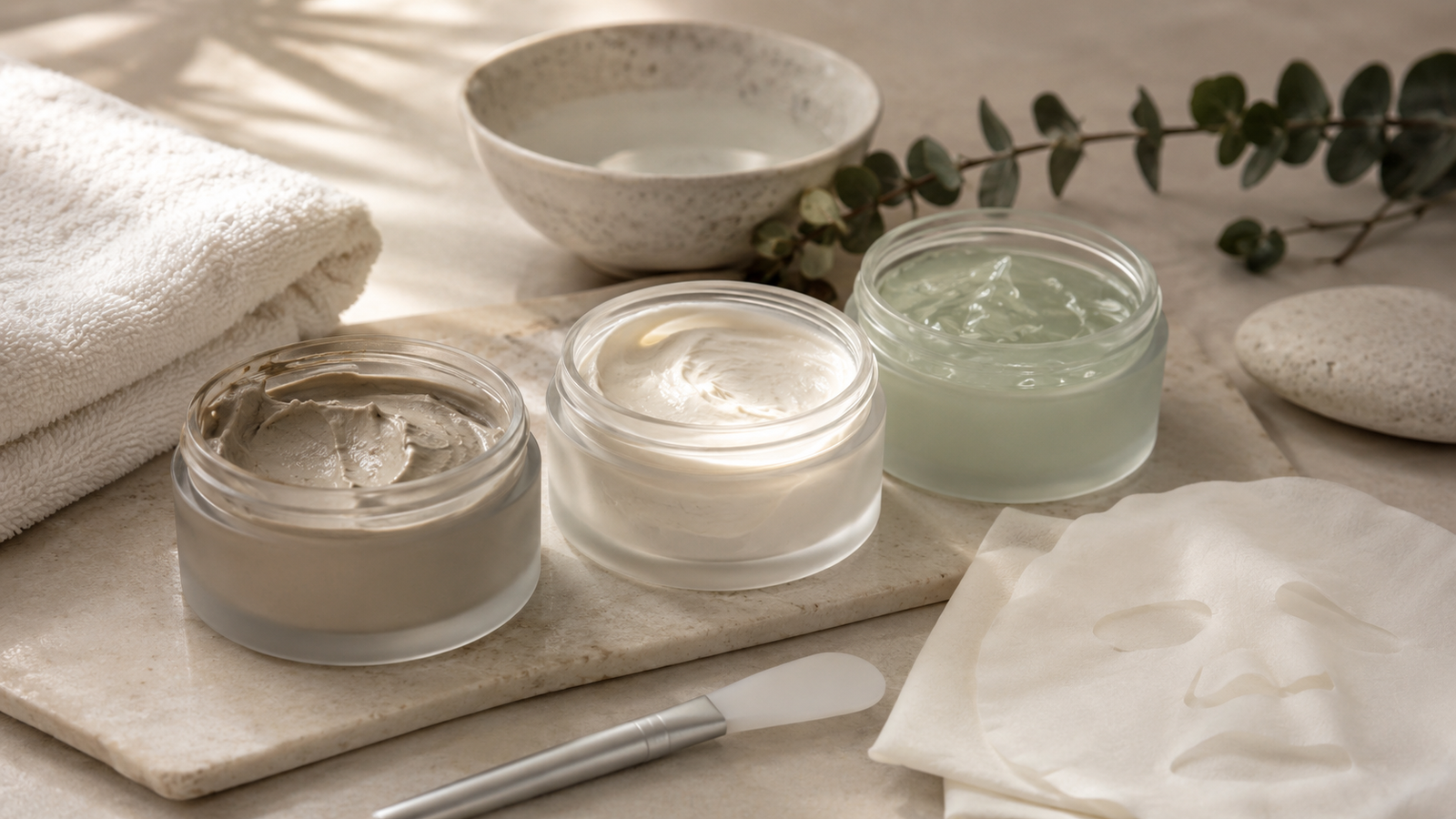
Masks come in many forms, including:
- clay masks;
- cream masks;
- gel masks;
- sheet masks;
- exfoliating masks;
- overnight masks;
- charcoal masks;
- peel-off masks.
Different masks perform very different jobs.
The word mask itself tells you almost nothing about whether the product is right for your skin.
Do You Actually Need a Face Mask?
No.
Face masks are optional.
A simple routine of:
cleanser → moisturizer → sunscreen
can be completely adequate for many people.
If you also have a specific concern, a well-chosen:
- serum;
- exfoliant;
- acne treatment;
- retinoid;
may provide more consistent long-term benefit than an occasional mask.
Masks are best viewed as:
supplementary treatments
rather than essential skincare.
What Can Face Masks Realistically Do?
Depending on the formulation, a mask may temporarily improve:
- hydration;
- surface softness;
- excess oil;
- visible dullness;
- roughness;
- skin comfort.
Some may also deliver active ingredients for concerns such as:
- acne;
- pigmentation;
- exfoliation.
But the effect depends on:
- ingredients;
- concentration;
- contact time;
- frequency.
The mask format itself does not automatically make an ingredient more effective.
What Face Masks Cannot Do
A normal cosmetic face mask cannot reliably:
- permanently shrink pores;
- remove acne scars;
- erase wrinkles;
- permanently tighten skin;
- pull every impurity from the skin;
- completely cure acne;
- permanently brighten skin after one use.
If a product makes dramatic permanent claims after one application, be cautious.
Start With Your Main Skin Concern
Before choosing a mask, ask:
What exactly do I want this mask to do?
Common goals include:
Dryness
Consider:
- cream mask;
- hydrating gel mask;
- sheet mask;
- overnight mask.
Excess Oil
Consider:
- clay mask;
- oil-absorbing mask.
Congested Skin
Consider:
- clay;
- salicylic-acid mask;
- appropriate exfoliating mask.
Dullness
Consider:
- hydrating mask;
- gentle AHA mask;
- brightening ingredients.
Sensitive or Irritated-Feeling Skin
Consider:
- simple soothing mask;
- fragrance-free hydrating formula.
Rough Texture
Consider:
- mild exfoliating mask.
One mask does not need to address every concern.
Clay Masks
Clay masks are among the most common face masks.
They may contain clays such as:
- kaolin;
- bentonite.
These ingredients can absorb:
- oil;
- moisture;
- surface impurities.
They are particularly popular for:
- oily skin;
- shiny T-zones;
- congested-feeling skin.
What Does a Clay Mask Actually Do?
Clay can absorb some excess surface oil.
This may temporarily make the skin look:
- less shiny;
- more matte.
Clay may also make pores appear cleaner because surface oil is reduced.
But clay does not literally vacuum toxins from deep inside the skin.
The concept of “detoxing” the face is often marketing language rather than a precise biological process.
Who May Benefit From Clay Masks?
Clay masks may suit:
- oily skin;
- combination skin;
- people who become shiny quickly.
They can be especially useful as a targeted treatment for:
- nose;
- forehead;
- chin.
You do not need to apply clay to dry cheeks just because the mask is being used on the rest of the face.
Clay Masks for Dry Skin
Dry skin should use clay cautiously.
Clay can worsen:
- tightness;
- flaking;
- discomfort.
If you want to use one, choose:
- gentler kaolin-based formulas;
- shorter contact time;
- targeted T-zone application.
Do not wait until your face feels painfully tight.
Should Clay Masks Dry Completely?
Not necessarily.
Some people wait until a clay mask becomes:
- cracked;
- extremely hard.
This can increase discomfort and dryness.
Follow the manufacturer’s contact time.
More drying does not equal better cleansing.
Kaolin Clay
Kaolin is generally considered one of the milder cosmetic clays.
It may work well for:
- normal;
- combination;
- mildly oily skin.
It tends to be less aggressively absorbent than some stronger clays.
Bentonite Clay
Bentonite can absorb significant amounts of water and oil.
It may feel more intense.
It can be useful for oily skin, but it may be too drying for:
- dry;
- sensitive skin.
Use according to product directions.
Charcoal Masks
Charcoal masks are marketed for:
- impurities;
- oil;
- clogged pores;
- detoxification.
Activated charcoal can adsorb substances onto its surface.
But in a normal cosmetic mask, evidence that it “pulls toxins” from deep within facial skin is limited.
Its most practical benefit may be in formulas that also contain:
- clay;
- oil-absorbing ingredients.
Choose based on the full formulation rather than the charcoal name.
Charcoal Peel-Off Masks
These products can adhere very strongly to the skin.
Removing them may pull away:
- surface cells;
- fine facial hair.
This can create a temporarily very smooth feeling.
But it can also cause:
- irritation;
- redness;
- pain.
If you have sensitive skin, avoid highly adhesive peel-off masks.
Peel-Off Masks
Peel-off masks form a film that is removed from the skin after drying.
They can provide:
- temporary smoothness;
- satisfying removal.
But they are not essential.
If peeling feels painful, the product is probably not worth the irritation.
Do not use peel-off masks over:
- active acne;
- broken skin;
- irritated skin.
Hydrating Masks
Hydrating masks are designed to increase water content at the skin surface and improve comfort.
They may contain:
- glycerin;
- hyaluronic acid;
- panthenol;
- aloe;
- beta-glucan;
- humectants.
They are useful for skin that feels:
- tight;
- dehydrated;
- dull.
Hydrating vs Moisturizing Masks
These terms overlap.
Hydrating
Usually emphasizes ingredients that help attract or hold water.
Moisturizing
Often also includes:
- emollients;
- oils;
- occlusive ingredients.
For very dry skin, a richer moisturizing mask may work better than a lightweight hydrating gel.
Cream Masks
Cream masks tend to be richer.
They may contain:
- fatty alcohols;
- ceramides;
- oils;
- butters;
- emollients.
They are particularly useful for:
- dry;
- mature;
- barrier-stressed skin.
A rich cream mask may simply function as a more occlusive moisturizer.
That can still be useful.
Gel Masks
Gel masks generally feel:
- lightweight;
- cooling;
- refreshing.
They often contain:
- water;
- humectants;
- soothing ingredients.
They can work well for:
- normal;
- combination;
- dehydrated skin.
They may be particularly comfortable in:
- hot weather.
Cooling Does Not Automatically Mean Soothing
Some gel masks contain ingredients such as:
- menthol;
- peppermint.
These can create a cooling sensation.
But cooling sensation is not the same as reducing inflammation.
In sensitive skin, these ingredients may actually increase irritation.
Look beyond the sensation.
Sheet Masks
Sheet masks are fabric or hydrogel sheets saturated with serum.
They primarily work by creating temporary occlusion.
This can increase contact between the serum and skin.
Common ingredients include:
- glycerin;
- hyaluronic acid;
- niacinamide;
- botanical extracts.
What Do Sheet Masks Actually Do?
Their most noticeable effect is usually:
- temporary hydration;
- plump-looking skin;
- softer surface.
They can be useful before:
- makeup;
- events;
- travel;
when you want a temporary boost in hydration.
Do Sheet Masks Provide Better Results Than Serum?
Not necessarily.
A sheet mask may help the serum remain in contact with the skin longer.
But repeated use of a good serum and moisturizer may provide more practical long-term value.
Sheet masks are often more about:
- convenience;
- experience;
- temporary hydration.
Should You Leave a Sheet Mask On Until It Is Completely Dry?
No.
Follow the recommended contact time.
Leaving the sheet on until it becomes completely dry does not necessarily increase benefit.
Remove it when instructed.
Massage or pat remaining serum into the skin if appropriate.
Do You Wash Your Face After a Sheet Mask?
Usually not unless the product specifically says so.
Sheet-mask serum is generally intended to remain on the skin.
After removing the sheet:
- gently pat remaining product;
- follow with moisturizer if needed.
But always follow the specific instructions.
Overnight Masks
Overnight masks are designed to remain on while you sleep.
They are often similar to rich moisturizers.
They may provide:
- occlusion;
- hydration;
- softness.
They are particularly useful for:
- dry;
- dehydrated skin.
Is an Overnight Mask Better Than Moisturizer?
Not necessarily.
Some overnight masks are essentially:
- richer moisturizers;
- occlusive treatment creams.
If your normal moisturizer already keeps your skin comfortable, an overnight mask may not add much.
Can You Use an Overnight Mask Every Night?
Some are designed for frequent use.
But many people do not need them nightly.
If the formula causes:
- greasiness;
- clogged pores;
- discomfort;
reduce frequency.
Exfoliating Masks
Exfoliating masks contain ingredients such as:
- glycolic acid;
- lactic acid;
- salicylic acid;
- enzymes.
They are designed to improve:
- roughness;
- dullness;
- clogged pores.
Because the product may contain stronger concentrations than everyday skincare, follow the contact time carefully.
AHA Masks
AHA masks may contain:
- glycolic;
- lactic;
- mandelic acid.
They primarily target:
- surface texture;
- dullness;
- uneven-looking tone.
They can be effective, but stronger formulas may cause irritation.
Start cautiously.
BHA Masks
Salicylic-acid masks may be useful for:
- oily skin;
- blackheads;
- clogged pores.
They can be helpful if you want an occasional treatment rather than a daily BHA product.
But if you already use salicylic acid regularly, adding a strong BHA mask may be unnecessary.
Enzyme Masks
Enzyme masks may use ingredients derived from:
- papaya;
- pineapple;
- pumpkin.
They are designed to help loosen surface-cell buildup.
They are often marketed as gentler alternatives to acids.
But botanical enzymes can still cause:
- stinging;
- irritation.
Patch testing and cautious use remain sensible.
How Strong Should an Exfoliating Mask Be?
Stronger is not automatically better.
High-strength masks can cause:
- burning;
- redness;
- peeling;
- barrier disruption.
For home use, choose a product with:
- clear directions;
- sensible contact time;
- realistic claims.
Do not attempt to imitate professional peels.
Brightening Masks
Brightening masks may contain ingredients such as:
- niacinamide;
- vitamin C derivatives;
- AHAs;
- licorice extract;
- alpha-arbutin;
- botanical extracts.
These may help create a temporarily brighter appearance.
But meaningful improvement in pigmentation usually requires:
- consistent use;
- sunscreen;
- time.
One mask cannot permanently remove dark spots.
Vitamin C Masks
Vitamin C is an antioxidant and may support routines targeting:
- dullness;
- uneven tone.
But mask contact time is limited.
A well-formulated leave-on vitamin C serum may provide more consistent exposure.
Use vitamin C masks as supplementary products.
Niacinamide Masks
Niacinamide can support:
- skin barrier;
- oil regulation;
- uneven tone.
It works well in many formats.
But again, you do not need a mask specifically to obtain niacinamide.
A leave-on serum or moisturizer may be more convenient.
Soothing Masks
Soothing masks are designed for skin that feels:
- irritated;
- dry;
- uncomfortable.
They may contain:
- panthenol;
- centella;
- beta-glucan;
- aloe;
- colloidal oatmeal;
- allantoin.
Look for relatively simple formulas.
Aloe Vera Masks
Aloe can feel:
- cooling;
- hydrating.
It may help support skin comfort.
But aloe itself is not a treatment for all inflammation.
Also, botanical ingredients can still trigger allergies in some people.
Centella Masks
Centella asiatica is widely used in soothing skincare.
It may support skin comfort and barrier-focused routines.
These masks can be useful for people who prefer:
- gentle;
- low-active products.
Colloidal Oatmeal Masks
Colloidal oatmeal can support:
- soothing;
- skin barrier comfort.
It may be useful for dry or sensitive-feeling skin.
For persistent eczema or inflammatory skin disease, however, proper medical treatment is more important than cosmetic masks.
Barrier-Support Masks
Some masks emphasize:
- ceramides;
- cholesterol;
- fatty acids;
- panthenol.
These may support skin-barrier comfort.
They are particularly useful after:
- dry weather;
- over-cleansing;
- mild irritation.
But do not apply strong actives underneath and then expect a mask to “cancel out” the irritation.
Masks for Oily Skin
A good oily-skin mask should reduce excess oil without leaving the skin painfully tight.
Useful categories:
- clay;
- salicylic acid;
- lightweight gel.
Avoid assuming that oily skin should be stripped completely.
Over-drying can make the skin:
- uncomfortable;
- irritated.
Masks for Dry Skin
Choose:
- cream;
- hydrating gel;
- sheet;
- overnight masks.
Look for:
- humectants;
- emollients;
- ceramides.
Avoid frequent:
- clay;
- strong exfoliating masks.
Masks for Combination Skin
Combination skin often benefits from multi-masking.
For example:
T-Zone
Clay mask.
Cheeks
Hydrating mask.
This allows you to treat different areas differently.
What Is Multi-Masking?
Multi-masking means applying different masks to different parts of the face.
This can be useful when you have:
- oily forehead;
- dry cheeks;
- congested nose.
It is often more logical than using one strong mask over the entire face.
Masks for Sensitive Skin
Prioritize:
- fragrance-free formulas;
- simple hydrating masks;
- soothing ingredients.
Avoid:
- strong acids;
- highly fragranced products;
- peel-off masks;
- essential-oil-heavy formulas.
If your skin is actively irritated, you may be better off skipping a mask entirely.
Masks for Acne-Prone Skin
Depending on the concern, consider:
- salicylic acid;
- clay;
- soothing masks.
But masks are not a complete acne treatment.
Persistent acne may respond better to consistent evidence-based treatments such as:
- salicylic acid;
- benzoyl peroxide;
- retinoids;
- prescription therapy where needed.
Masks can support the routine but should not replace it.
Masks for Blackheads
Clay masks may temporarily reduce oil.
Salicylic-acid masks may help with clogged pores.
But blackheads often require repeated treatment over time.
Do not expect one mask to permanently remove them.
Masks for Whiteheads
Chemical exfoliating masks may help.
But closed comedones may need consistent treatment.
Avoid squeezing.
Repeated physical extraction can increase:
- irritation;
- marks.
Masks for Inflamed Acne
Do not apply strong:
- peels;
- scrubs;
- peel-off masks;
over painful inflamed acne.
Use gentler products.
If acne is:
- painful;
- cystic;
- leaving scars;
professional dermatological treatment is appropriate.
Masks for Post-Acne Marks
Brightening or exfoliating masks may support improvement.
Useful ingredient categories include:
- AHAs;
- niacinamide;
- vitamin C.
But sunscreen remains essential.
Inflammation from overly aggressive masks can make pigmentation worse.
Masks for Hyperpigmentation
Treat pigmentation gradually.
A mask may provide additional treatment, but it is not enough alone.
Long-term management often depends on:
- sunscreen;
- targeted leave-on products;
- professional care where appropriate.
Masks for Dull Skin
Dullness may improve with:
- hydration;
- gentle exfoliation.
Choose according to the cause.
Skin Feels Dry and Tight
Use hydrating mask.
Skin Feels Rough
Consider gentle exfoliating mask.
Do not assume every dull complexion needs acid.
Masks for Mature Skin
Mature skin often benefits from:
- hydration;
- barrier support;
- comfortable textures.
Useful options include:
- cream masks;
- hydrating masks;
- overnight masks.
Be cautious with:
- strong peels;
- excessively drying clay.
There is no age at which exfoliating masks become forbidden, but tolerance matters.
Masks for Dehydrated Skin
Dehydrated skin lacks water.
It can occur even when the skin is oily.
Look for:
- glycerin;
- hyaluronic acid;
- panthenol;
- beta-glucan.
Follow with moisturizer to help reduce water loss.
Masks for Redness
If redness is due to irritation, choose:
- simple soothing;
- barrier-support mask.
Avoid:
- acids;
- fragrance;
- menthol.
Persistent facial redness may have causes such as:
- rosacea;
- dermatitis.
A mask cannot diagnose or treat these conditions appropriately.
Masks for Rosacea-Prone Skin
Rosacea-prone skin can react strongly to:
- acids;
- fragrance;
- essential oils;
- heat.
Use caution.
If you have diagnosed or suspected rosacea, prioritize a gentle routine and professional guidance when needed.
Masks for Eczema-Prone Skin
Avoid applying exfoliating or fragranced masks to active eczema.
Barrier-focused products may be more appropriate.
But eczema is a medical skin condition.
A cosmetic face mask should not replace proper treatment.
Masks for Enlarged-Looking Pores
Masks can temporarily make pores appear less visible by:
- reducing oil;
- smoothing the surface.
But they cannot permanently shrink pores.
Useful options include:
- clay;
- salicylic acid.
Be realistic about the result.
Masks for Fine Lines
Hydrating masks may temporarily make fine dehydration lines appear less noticeable because the skin becomes more hydrated.
This does not erase structural wrinkles.
For long-term anti-ageing goals, a consistent routine is more important.
Masks for Sun-Damaged Skin
Do not apply strong masks to:
- sunburned;
- actively irritated skin.
For chronic sun damage concerns such as:
- pigmentation;
- texture;
use consistent sunscreen and targeted treatments.
Masks After Sun Exposure
If skin feels mildly dry after ordinary sun exposure but is not burned, a gentle hydrating mask may feel comfortable.
If skin is sunburned:
- avoid exfoliation;
- avoid strong actives.
Use soothing care and allow healing.
Face Masks and Sunscreen
Some masks, particularly exfoliating masks, increase the importance of sun protection.
If you are trying to improve:
- pigmentation;
- uneven tone;
daily sunscreen is more important than adding increasingly strong masks.
How Often Should You Use a Face Mask?
It depends on the type.
Hydrating Mask
Possibly:
- 1–3 times weekly;
- or as needed.
Clay Mask
Often:
- once or twice weekly.
Exfoliating Mask
Often:
- once weekly;
- sometimes less depending on strength.
Overnight Mask
May be used:
- occasionally;
- or more frequently if designed for it.
Follow product instructions.
Can You Use a Face Mask Every Day?
Some gentle hydrating masks may be suitable for frequent use.
But daily masking is not necessary.
Daily:
- clay;
- exfoliating masks;
can easily lead to irritation.
More masking does not equal healthier skin.
Morning or Evening?
Either can work.
Morning
Hydrating masks can be useful before makeup.
Evening
Most treatment masks are easiest to use at night.
A simple evening routine:
cleanse → mask → moisturizer
may be enough.
Should You Cleanse Before a Face Mask?
Usually, yes.
A mask works best on skin free from:
- makeup;
- sunscreen;
- excess oil;
- surface dirt.
Use a gentle cleanser.
You do not need to scrub first.
Should You Exfoliate Before a Mask?
Usually not if the mask itself is exfoliating.
Even before a hydrating mask, separate exfoliation may be unnecessary.
Combining:
scrub → acid → mask
can increase irritation.
Keep the routine simple.
Should You Steam Your Face Before a Mask?
Steam can make the skin feel:
- warm;
- softened.
But pores do not literally open and close like doors.
Excessive steam may worsen:
- redness;
- sensitivity;
- rosacea.
There is no requirement to steam before masking.
Do Pores Open With Steam?
No.
Pores do not contain muscles that open and close.
Heat can soften surface material and increase blood flow, but it does not permanently open pores.
Similarly, cold water does not permanently close them.
Should You Use Toner Before a Mask?
Usually unnecessary.
A simple sequence is enough:
cleanser → mask
If your toner is hydrating and gentle, it may be used.
Avoid applying strong acid toner before an exfoliating mask.
Face Mask Before or After Serum?
Most rinse-off masks are used before serum.
Typical routine:
- Cleanser
- Mask
- Serum
- Moisturizer
For sheet masks, the mask itself often functions as a serum step.
Face Mask Before or After Moisturizer?
Most masks are used before moisturizer.
After removing or rinsing the mask:
- apply moisturizer.
This helps maintain hydration.
Overnight masks may sometimes replace the final moisturizer, depending on the formula.
Can You Use Retinol After a Face Mask?
It depends on the mask.
Hydrating Mask
Possibly, if your skin tolerates it.
Exfoliating Mask
Usually better to avoid adding retinoid immediately afterward, especially if the mask is strong.
Combining multiple irritants increases risk.
Simpler is often safer.
Can You Use Vitamin C After a Mask?
After a gentle hydrating mask, usually possible.
After a strong exfoliating mask, extra active layering may be unnecessary.
Your skin does not need every active ingredient in one routine.
Can You Use Niacinamide After a Mask?
Niacinamide generally fits easily into many routines.
After a hydrating mask:
- niacinamide serum;
- moisturizer;
can work.
But it is optional.
Can You Use Salicylic Acid and Clay Mask Together?
You can if the clay mask itself contains salicylic acid and is formulated that way.
But using:
salicylic cleanser + separate BHA + strong clay mask
on the same night may be excessive.
Count the entire routine.
Can You Use AHA and Clay Mask Together?
It may be too drying.
If your skin is oily and tolerant, alternating them on different days is usually simpler.
How Long Should You Leave a Face Mask On?
Follow the label.
Common contact times include:
- 5 minutes;
- 10 minutes;
- 15 minutes;
- 20 minutes.
Leaving a mask on longer does not automatically provide more benefit.
It may increase:
- dryness;
- irritation.
What Happens If You Leave a Clay Mask On Too Long?
Skin may become:
- tight;
- uncomfortable;
- dry;
- irritated.
Remove it according to instructions.
Do not judge effectiveness by how uncomfortable your face feels.
What Happens If You Leave an Acid Mask On Too Long?
This can be more serious.
You may develop:
- burning;
- significant redness;
- irritation;
- chemical injury.
Never exceed the recommended contact time.
If a strong acid product causes intense pain, rinse it off promptly.
How Much Mask Should You Apply?
Enough to create an even layer.
You do not need an extremely thick coating.
For clay:
- a thin, even layer is usually sufficient.
For cream masks:
- enough to coat comfortably.
Excess product often just wastes the mask.
Do You Need a Mask Brush?
No.
You can apply most masks with:
- clean fingers.
A brush can make application:
- neat;
- even.
But it does not improve the skincare effect.
Face Mask Spatulas
A spatula can be useful for jar products because it reduces repeated finger contact.
But clean hands are also acceptable for personal use.
The important part is basic product hygiene.
How to Remove a Face Mask
Clay/Cream Masks
Use:
- lukewarm water;
- gentle circular movements if needed.
Avoid aggressive scrubbing.
Sheet Masks
Lift off and discard.
Peel-Off Masks
Remove gently according to directions.
If it hurts significantly, stop pulling aggressively and use an appropriate method to loosen the product.
Hot or Cold Water?
Use comfortable:
- lukewarm water.
Very hot water can worsen:
- dryness;
- irritation.
Cold water is not necessary to “close pores.”
Should Your Face Feel Tight After a Mask?
A mild temporary change can occur with clay.
But significant tightness usually suggests too much drying.
Hydrating masks should generally leave skin:
- comfortable;
- soft.
Persistent tightness is not a sign of better results.
Is Tingling Normal?
Some active masks can cause mild brief tingling.
But strong:
- burning;
- pain;
- intense itching;
is not something to ignore.
Rinse the product off if it causes significant discomfort.
How to Patch Test a Face Mask
If you have sensitive skin or are using a stronger product:
- Apply a small amount to a limited area.
- Follow the normal contact time.
- Rinse.
- Monitor for irritation.
A patch test cannot guarantee no reaction, but it can identify obvious intolerance.
Face Masks and Fragrance
Many masks contain fragrance because masks are often marketed as an experience.
Fragrance does not increase:
- hydration;
- exfoliation;
- oil control.
If your skin tolerates fragrance, that may be fine.
If you have:
- sensitive skin;
- fragrance allergy;
choose fragrance-free options.
Essential Oils in Face Masks
Masks may contain:
- lavender oil;
- citrus oils;
- peppermint;
- tea tree.
These ingredients may provide fragrance or specific formulation effects.
But essential oils can also cause irritation.
Do not assume natural means gentle.
Menthol in Face Masks
Menthol creates a cooling sensation.
It can make the product feel:
- refreshing.
But it can irritate sensitive skin.
Cooling does not automatically mean calming.
Alcohol in Face Masks
Some lightweight masks contain volatile alcohols.
They may help the formula:
- dry;
- feel lighter.
But alcohol-heavy masks can feel drying for some people.
Judge the entire formula and your skin response.
Face Masks and Parabens
Parabens are preservatives.
Water-based masks need appropriate preservation.
A paraben-free formula still requires another preservative system.
“Paraben-free” does not automatically make a mask safer.
Natural Face Masks
Natural ingredients can be useful.
But natural does not automatically mean:
- safer;
- more effective;
- less irritating.
A properly formulated conventional mask may be more predictable than a homemade mixture.
Homemade Face Masks
Popular homemade masks use ingredients such as:
- honey;
- yogurt;
- turmeric;
- oatmeal;
- lemon;
- egg;
- avocado.
Some may provide temporary cosmetic effects.
But homemade formulations have disadvantages:
- inconsistent concentrations;
- contamination risk;
- irritation;
- poor stability.
Use caution.
Honey Masks
Honey has humectant properties.
It may make skin feel softer.
But pure honey is:
- sticky;
- difficult to spread.
A formulated hydrating mask can provide a more controlled experience.
Yogurt Masks
Yogurt contains:
- water;
- fats;
- naturally occurring lactic acid.
But its acid concentration and pH are not standardized for skincare treatment.
A formulated lactic-acid product is more predictable.
Turmeric Masks
Turmeric is often promoted for:
- brightening;
- inflammation.
But homemade turmeric masks may:
- stain skin;
- irritate;
- stain clothing.
If you want turmeric-derived skincare ingredients, a formulated product is more practical.
Lemon Juice Masks
Avoid applying raw lemon juice to facial skin.
It can be:
- irritating;
- unpredictable;
- potentially photoreactive depending on exposure and compounds present.
Use formulated skincare acids instead.
Baking Soda Masks
Avoid using baking soda as a face mask.
Its alkaline pH can disrupt skin comfort.
It is not an appropriate substitute for cosmetic skincare.
Egg Masks
Egg masks are often marketed as:
- tightening;
- pore-shrinking.
The temporary tight feeling mainly comes from drying proteins.
It does not permanently tighten skin or shrink pores.
Raw egg also creates hygiene concerns.
A formulated mask is more sensible.
Oatmeal Masks
Colloidal oatmeal is a well-established soothing skincare ingredient.
But kitchen oats are not identical to properly processed colloidal oatmeal.
If you want the soothing benefits, a formulated oatmeal product may be more reliable.
Avocado Masks
Avocado contains fats and can feel moisturizing.
But applying food directly to the skin is not necessary.
Cosmetic formulations can deliver:
- emollients;
- oils;
in a more stable and elegant way.
Can Face Masks Cause Breakouts?
Yes, a particular mask may not suit your skin.
Possible reasons:
- heavy occlusive ingredients;
- irritation;
- fragrance;
- individual sensitivity.
If breakouts repeatedly appear after using the same mask, discontinue it.
Can Face Masks Cause Purging?
Some exfoliating masks containing:
- AHA;
- BHA;
may influence skin turnover.
But not every breakout after a mask is purging.
It may be:
- irritation;
- product reaction.
Do not continue a mask indefinitely because someone says worsening is always normal.
Can Clay Masks Cause More Oil Production?
Clay removes surface oil temporarily.
The idea that the skin always “overproduces oil” simply because oil was removed is oversimplified.
However, aggressive drying can make skin:
- uncomfortable;
- dehydrated.
Use enough oil control to improve comfort without stripping excessively.
Can Face Masks Remove Sebaceous Filaments?
Sebaceous filaments are normal structures containing:
- sebum;
- skin cells.
They are commonly visible around the nose.
Clay and oil-control products may temporarily make them less noticeable.
They naturally refill.
They are not the same as dirty pores.
Can Face Masks Remove Blackheads Permanently?
No.
Masks may reduce their appearance temporarily.
Consistent salicylic-acid use may help manage blackheads more effectively over time.
Can Face Masks Shrink Pores?
No.
They may temporarily make pores look smaller by reducing:
- oil;
- surface congestion.
Pore size is largely influenced by:
- genetics;
- skin structure;
- oil production.
Can Face Masks Tighten Skin?
Some masks create a temporary tightening sensation as they dry.
This is not the same as permanently tightening skin.
Do not confuse sensation with structural change.
Can Face Masks Remove Wrinkles?
No.
Hydrating masks may temporarily make fine dehydration lines less visible.
But established wrinkles require more than a temporary mask.
Long-term skincare strategies are more relevant.
Can Face Masks Brighten Skin?
Yes, temporarily.
Hydration and exfoliation can make skin appear brighter.
Some ingredients may support longer-term improvement with repeated use.
But permanent “whitening” or dramatic complexion change from a mask is unrealistic.
Face Masks and Skin Whitening Claims
Be cautious with products promising dramatic skin-lightening results.
Healthy skincare should focus on concerns such as:
- uneven tone;
- pigmentation;
- sun damage;
rather than changing someone’s natural skin colour.
Avoid unregulated products containing unknown or potentially harmful ingredients.
Face Masks Before Makeup
Hydrating masks can work well before makeup.
They may temporarily create:
- smoother;
- plumper-looking skin.
A practical routine:
- Cleanse.
- Use hydrating mask.
- Remove.
- Moisturize if needed.
- Sunscreen.
- Makeup.
Avoid strong exfoliating masks immediately before an important event unless you already know your skin tolerates them.
Face Masks Before an Event
Do not test a new active mask the night before:
- wedding;
- photoshoot;
- important event.
A reaction could leave you with:
- redness;
- peeling.
Use products you already know are safe for your skin.
Face Masks After Travel
Travel can make skin feel:
- dehydrated;
- dull.
A simple hydrating mask may be useful.
You do not need an aggressive “detox” after flying.
Face Masks in Hot Weather
In hot weather:
- gel masks;
- lightweight hydrating masks;
- clay on oily areas;
can feel comfortable.
Avoid storing cosmetics in extreme heat unless the manufacturer recommends it.
Face Masks in Cold Weather
Dry weather may increase the usefulness of:
- cream;
- overnight;
- barrier-support masks.
Use less:
- clay;
- strong exfoliating products;
if your skin becomes dry.
Face Masks for Men
Skin needs determine mask choice, not gender.
Someone with oily skin may prefer:
- clay.
Someone with dry skin may prefer:
- cream.
The same principles apply to everyone.
Face Masks for Teenagers
Teen skin may become:
- oily;
- acne-prone.
A simple salicylic-acid or clay mask may occasionally be useful.
But teenagers do not need complicated masking routines.
A basic routine built around:
- gentle cleansing;
- moisturizer;
- sunscreen;
- appropriate acne treatment;
is more important.
Face Masks During Pregnancy
Pregnancy can alter skin sensitivity.
Most simple:
- hydrating;
- clay masks;
are generally cosmetic products, but active masks may contain ingredients requiring more consideration.
If pregnant or breastfeeding, check the exact product and discuss stronger active treatments with an appropriate healthcare professional when needed.
Face Masks After Facial Procedures
After procedures such as:
- chemical peels;
- microneedling;
- laser treatments;
do not apply random masks.
The skin may be more vulnerable.
Follow the aftercare instructions provided by your treating professional.
Face Masks After Waxing or Threading
Hair removal can temporarily irritate the skin.
Avoid immediately applying:
- acids;
- strong clay;
- fragranced masks.
Use gentle skincare until the area is comfortable.
Face Masks After Shaving
Shaving can create mild mechanical exfoliation.
A soothing hydrating mask may be comfortable.
Strong acid masks immediately afterward may sting.
Face Masks and Retinoids
If you use a retinoid, be careful with exfoliating masks.
You may not need both on the same night.
A safer simple schedule might be:
Retinoid Night
Cleanser → retinoid → moisturizer
Mask Night
Cleanser → mask → moisturizer
Spacing reduces the chance of irritation.
Face Masks and Benzoyl Peroxide
Benzoyl peroxide can be drying.
Combining it with:
- clay;
- exfoliating masks;
may increase dryness.
If you are treating acne, prioritize the treatment that has the strongest purpose rather than stacking products.
Face Masks and Vitamin C
A hydrating mask can generally fit into a vitamin C routine.
But an exfoliating mask plus acidic vitamin C may feel irritating for some skin types.
Use them at different times if necessary.
Face Masks and Niacinamide
Niacinamide usually layers well after:
- hydrating;
- clay masks.
But you do not need to apply every serum after masking.
A moisturizer may be enough.
Face Masks and Exfoliants
If your mask already contains:
- AHA;
- BHA;
- enzymes;
skip other exfoliation that day.
Your skin counts total irritation, not product categories.
Face Masks and Scrubs
Avoid:
scrub → exfoliating mask
in the same session.
That combines mechanical and chemical exfoliation.
Choose one.
Face Masks and Dermaplaning
Dermaplaning removes:
- fine hair;
- surface cells.
The skin may temporarily feel more sensitive.
Avoid immediately applying strong:
- acid;
- peel masks.
Follow professional guidance if dermaplaning was performed professionally.
How to Build a Simple Mask Routine
You do not need several masks.
Choose one based on your main concern.
Dry Skin
Hydrating or cream mask.
Oily Skin
Clay mask.
Congested Skin
Salicylic or clay mask.
Dull/Rough Skin
Gentle exfoliating mask.
Sensitive Skin
Simple soothing mask.
Use:
- once weekly;
- or as needed.
That is enough for most people.
Can You Own More Than One Mask?
Yes, if they perform different jobs.
For example:
Mask 1
Clay for T-zone.
Mask 2
Hydrating for dry days.
That is a practical distinction.
Owning six masks that all claim to “detox and glow” probably adds little value.
Does Expensive Face Mask Work Better?
Not necessarily.
A premium mask may offer:
- elegant texture;
- fragrance;
- packaging;
- luxury experience.
But effective ingredients such as:
- clay;
- glycerin;
- salicylic acid;
- niacinamide;
are available at many price points.
Judge the formula rather than the price.
Sheet Masks and Value
Sheet masks are generally single-use products.
If you use them frequently, they may cost much more over time than:
- serum;
- moisturizer.
For regular hydration, a leave-on product is usually more economical.
Use sheet masks because you enjoy them or want the format—not because they are automatically superior.
Face Mask Packaging
Masks may come in:
- jars;
- tubes;
- sachets.
Tube
Generally:
- convenient;
- less product exposure.
Jar
Useful for thicker formulas but requires good hygiene.
Single-Use Sachet
Convenient for travel but may create more packaging waste.
Jar Hygiene
Use:
- clean fingers;
- clean spatula.
Keep the container closed.
Avoid adding:
- water;
- other products;
into the jar.
This can affect preservation.
Face Mask Expiry
Check:
- expiry date;
- period-after-opening symbol.
Stop using a product if you notice major changes in:
- smell;
- colour;
- texture.
Water-based masks should not be kept indefinitely.
Should You Refrigerate Face Masks?
Only if the manufacturer recommends it.
Refrigeration can make a gel mask feel cooler.
But not every formula is designed for cold storage.
Follow storage instructions.
Common Face Mask Mistakes
Masking Because You Think It Is Essential
It is optional.
Choosing by Trend Rather Than Skin Need
Start with your concern.
Leaving Clay On Until It Cracks
More drying is not better.
Leaving Acid Masks On Longer Than Directed
Can cause significant irritation.
Using Masks Every Day
Usually unnecessary.
Using Clay on Already Dry Skin
Can worsen tightness.
Combining Mask With Scrub and Acids
Too much exfoliation.
Assuming Tingling Means Effectiveness
It does not.
Expecting Permanent Pore Shrinkage
Masks cannot do this.
Treating Acne Only With Masks
Persistent acne needs a consistent treatment strategy.
Using Strong Masks Before an Important Event
Do not experiment at the last minute.
Using Food Ingredients Because They Are “Natural”
Formulated skincare is more predictable.
A Simple Routine for Oily Skin
Once Weekly
- Gentle cleanser.
- Thin clay mask on T-zone.
- Leave for recommended time.
- Rinse.
- Lightweight moisturizer.
If you already use:
- salicylic acid;
- retinoid;
keep the rest of the routine simple.
A Simple Routine for Dry Skin
- Gentle cleanser.
- Hydrating or cream mask.
- Remove according to directions.
- Apply moisturizer.
Use:
- once weekly;
- or whenever skin feels particularly dry.
A Simple Routine for Combination Skin
- Cleanse.
- Apply clay to:
- forehead;
- nose;
- chin.
- Apply hydrating mask to:
- cheeks.
- Remove according to each product’s directions.
- Moisturize.
This is a practical example of multi-masking.
A Simple Routine for Sensitive Skin
- Gentle cleanser.
- Fragrance-free soothing mask.
- Remove gently.
- Simple moisturizer.
Avoid adding:
- acids;
- retinoids;
- scrub;
the same evening.
A Simple Routine for Congested Skin
- Cleanser.
- Salicylic-acid or clay mask.
- Rinse.
- Moisturizer.
Do not then add:
- separate AHA;
- separate BHA;
- scrub.
A Simple Routine for Dull Skin
- Cleanser.
- Mild AHA or hydrating-brightening mask.
- Rinse according to directions.
- Moisturizer.
- Sunscreen the next day.
Signs a Face Mask Is Working
Depending on the type, you may notice:
Hydrating Mask
- softer skin;
- less tightness;
- temporary plumping.
Clay Mask
- reduced surface oil;
- less visible shine.
Exfoliating Mask
- smoother texture;
- brighter appearance over time.
Soothing Mask
- improved comfort;
- reduced dryness.
Your skin should generally still feel comfortable.
Signs a Face Mask Is Too Strong
Stop or reduce use if you notice:
- burning;
- significant redness;
- persistent stinging;
- peeling;
- prolonged tightness;
- rash.
A mask does not need to hurt to work.
Signs You Are Masking Too Often
Possible signs include:
- skin suddenly becoming sensitive;
- moisturizer stinging;
- increased dryness;
- redness;
- excessive oil control followed by tightness;
- repeated peeling.
Reduce frequency.
How Long Does It Take to See Results?
Some effects are immediate but temporary.
For example:
- hydration;
- reduced shine.
Other concerns such as:
- pigmentation;
- clogged pores;
require consistent skincare over weeks.
Do not expect one mask to create permanent transformation.
When Should You See a Dermatologist?
Professional advice is appropriate if you have:
- persistent moderate-to-severe acne;
- painful cysts;
- acne scarring;
- unexplained facial redness;
- persistent eczema;
- suspected rosacea;
- severe pigmentation;
- repeated reactions to skincare.
Face masks are cosmetic tools.
They cannot replace medical diagnosis and treatment.
Face Mask Buying Checklist
Before buying, ask:
1. What is my main concern?
Dryness, oil, congestion, dullness or sensitivity?
2. Does a mask actually solve that problem?
Or would a regular serum or treatment make more sense?
3. What type of mask is it?
Clay, cream, gel, sheet, exfoliating or overnight?
4. Is my skin dry, oily or combination?
Match the formula accordingly.
5. Does it contain strong acids?
If yes, avoid other exfoliation that day.
6. How long should it stay on?
Follow the instructions.
7. How often is it designed to be used?
More frequent is not automatically better.
8. Does it contain fragrance or essential oils?
Relevant for sensitive skin.
9. Am I expecting permanent results from a temporary product?
Keep expectations realistic.
10. Does my skin feel better after using it?
That matters more than how dramatic the mask looks while it is on.
The Physical Glow Takeaway
Face masks are best treated as optional targeted treatments, not essential skincare steps.
Choose according to your actual concern:
- oily skin → clay mask;
- clogged pores → salicylic-acid or appropriate clay mask;
- dry or dehydrated skin → cream, gel, sheet or overnight mask;
- dull or rough skin → gentle exfoliating mask;
- sensitive-feeling skin → simple soothing or barrier-support mask.
Then use it strategically.
You usually need:
cleanse → mask → moisturize
not:
scrub → acid toner → peel → clay → serum stack
all in one evening.
And remember:
- clay does not “detox” your body;
- charcoal does not pull every toxin from your pores;
- masks cannot permanently shrink pores;
- peel-off masks do not permanently remove blackheads;
- hydrating masks cannot replace a good moisturizer;
- exfoliating masks should not routinely burn.
The best face mask is the one that solves a specific problem while leaving your skin comfortable, balanced and easy to maintain.
If your normal skincare routine already does that, you may not need a mask at all.