How to Choose the Right Cleanser for Your Skin
Learn how to choose the right cleanser for your skin, with practical guidance on skin type, cleansing strength, texture and daily routine. This beginner-friendly guide helps you make a clear, informed choice without unnecessary complexity.
A cleanser is one of the simplest products in a skincare routine, but choosing the wrong one can make everything that follows more difficult.
A good facial cleanser should remove what needs to be removed, including:
- excess oil;
- sweat;
- dirt;
- sunscreen;
- makeup;
- environmental residue.
But your skin should not consistently feel:
- painfully tight;
- excessively dry;
- rough;
- irritated;
- itchy;
- or stripped after washing.
For most people, the goal is simple:
clean effectively → maintain skin comfort → avoid unnecessary irritation
You do not need the strongest cleanser.
You need the cleanser that removes what accumulates on your skin while fitting your skin type, routine and tolerance.
What Does a Facial Cleanser Actually Do?
Throughout the day, substances accumulate on the skin.
These can include:
- sebum;
- sweat;
- dead skin cells;
- sunscreen;
- makeup;
- dust;
- pollution particles;
- skincare residue.
Water alone cannot always remove oily substances effectively.
Cleansers contain ingredients called surfactants that help water interact with oils and debris so they can be rinsed away.
Different cleansers use different surfactants and concentrations.
That is one reason some cleansers feel:
- extremely foamy;
- creamy;
- slippery;
- milky;
- gel-like;
- almost lotion-like.
The amount of foam does not tell you how well a cleanser works.
A cleanser can clean effectively with very little foam.
Does Everyone Need to Use a Cleanser?
Most people benefit from cleansing at least once during the day, particularly in the evening.
An evening cleanse helps remove:
- sunscreen;
- makeup;
- excess oil;
- sweat;
- environmental debris.
Morning cleansing is more individual.
Someone with oily skin may prefer cleansing again after waking.
Someone with dry or easily irritated skin may find that:
a water rinse in the morning + cleanser at night
is enough.
There is no universal rule requiring everyone to cleanse twice daily.
Your skin’s response matters.
The Biggest Mistake: Choosing a Cleanser That Is Too Harsh
Many people associate cleanliness with the feeling of completely oil-free skin.
That can lead to choosing cleansers that leave the face feeling extremely tight.
A temporary “squeaky clean” feeling is not necessarily evidence of better cleansing.
Aggressive cleansing can remove more surface lipids than necessary and may contribute to:
- dryness;
- discomfort;
- irritation;
- increased sensitivity.
If your face feels uncomfortable immediately after cleansing and you feel desperate to apply moisturizer, your cleanser may be too harsh for you.
Start With Your Skin Type
Skin type is not a perfect scientific classification, but it is useful when choosing cleanser texture and strength.
Common categories include:
- oily;
- dry;
- combination;
- normal;
- sensitive-feeling.
Your skin can also change because of:
- climate;
- season;
- age;
- hormonal changes;
- skincare treatments;
- medications;
- environment.
The cleanser that works for you in humid summer weather may feel very different during a dry winter.
Best Cleanser Characteristics for Oily Skin
Oily skin produces noticeable amounts of sebum, often particularly through the:
- forehead;
- nose;
- chin.
If you have oily skin, you may prefer a cleanser that leaves the skin feeling fresh without leaving a heavy residue.
Common formats include:
- gel cleansers;
- light foaming cleansers;
- some salicylic-acid cleansers.
Should Oily Skin Use Strong Cleansers?
Not necessarily.
Having oily skin does not mean you need to strip away every trace of oil.
Very aggressive cleansing can leave the skin uncomfortable and may encourage you to compensate with even more products.
Look for a balance:
clean but not painfully tight
What Ingredients Can Be Useful?
Depending on your needs, you may encounter ingredients such as:
- salicylic acid;
- niacinamide;
- zinc-related ingredients;
- mild surfactant systems.
However, your cleanser does not need to contain treatment ingredients.
A simple gentle cleanser can be completely appropriate for oily skin.
Best Cleanser Characteristics for Dry Skin
Dry skin typically produces less natural oil and may feel:
- tight;
- rough;
- flaky;
- uncomfortable after washing.
For dry skin, a cleanser should minimize unnecessary removal of surface oils.
Creamy or lotion-style cleansers can be particularly comfortable.
Look for formulas containing moisturizing or conditioning ingredients such as:
- glycerin;
- ceramides;
- squalane;
- fatty alcohols;
- emollients.
Should Dry Skin Avoid Foaming Cleansers?
Not automatically.
Modern foaming cleansers vary significantly.
Some are quite gentle.
Do not judge only by the word foaming.
Judge by how your skin feels afterward.
Morning Cleansing for Dry Skin
Some people with dry skin do well with:
water rinse in the morning → gentle cleanser in the evening
If your skin feels comfortable doing that, there is no requirement to use cleanser twice daily.
Best Cleanser Characteristics for Combination Skin
Combination skin often means:
- oilier T-zone;
- drier cheeks.
It can be tempting to buy separate cleansers for each area.
Usually that is unnecessary.
Start with a gentle cleanser that works across the entire face.
Then adjust other parts of the routine.
For example:
- use less moisturizer on oily areas;
- use more moisturizer on dry areas;
- apply targeted treatment only where needed.
Avoid choosing an extremely aggressive cleanser simply because your nose becomes oily.
Best Cleanser Characteristics for Sensitive-Feeling Skin
Sensitive-feeling skin may respond easily to:
- fragrance;
- harsh surfactants;
- exfoliating acids;
- essential oils;
- very hot water;
- excessive cleansing.
A simpler cleanser can be a useful starting point.
Look for:
- relatively short contact time;
- low-fragrance or fragrance-free options if fragrance bothers you;
- gentle cleansing systems;
- minimal unnecessary active ingredients.
If your skin already feels irritated, cleanser is usually not the place to introduce several strong treatment ingredients.
What About Normal Skin?
If your skin is generally comfortable and does not become particularly oily or dry, you have more flexibility.
You can choose based on:
- texture preference;
- sunscreen removal;
- makeup use;
- climate;
- how your skin feels after washing.
You do not need a specialized cleanser simply because one exists for every possible skin type.
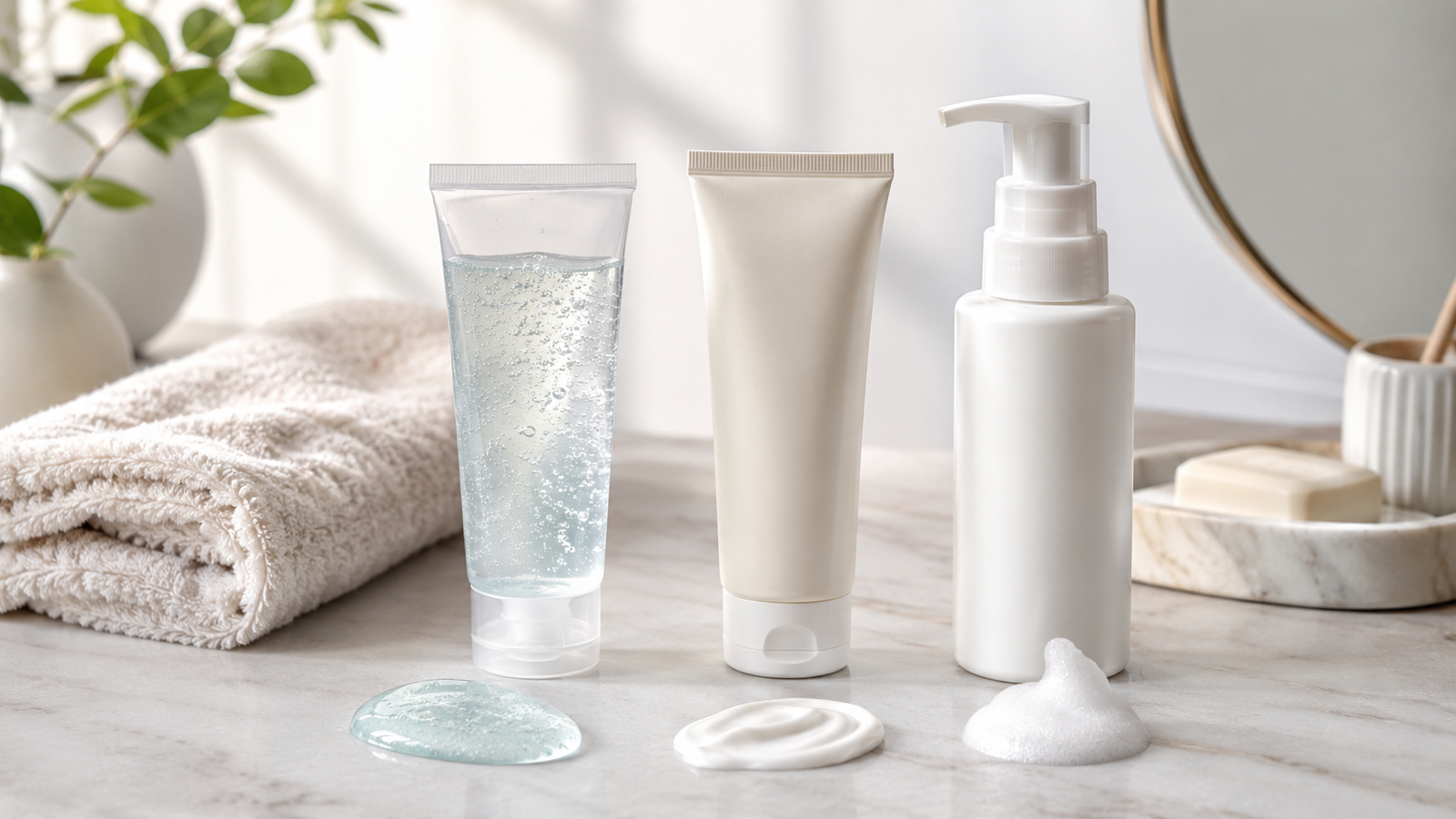
Gel Cleansers
Gel cleansers are popular because they feel lightweight and rinse easily.
They are often preferred by people with:
- oily skin;
- combination skin;
- humid-climate routines.
But gel texture alone does not tell you whether the cleanser is gentle.
Some gel cleansers are mild.
Others are relatively strong.
Always judge the complete formula and your skin’s response.
Foaming Cleansers
Foaming cleansers create lather when mixed with water.
They can feel particularly refreshing.
They may work well for:
- oily skin;
- combination skin;
- people who prefer a clean-rinsing texture.
However, very high-foaming products can feel drying on some skin.
Foam is not a measure of effectiveness.
More bubbles do not automatically mean cleaner skin.
Cream Cleansers
Cream cleansers usually contain a more emollient base.
They may be useful for:
- dry skin;
- mature skin;
- sensitive-feeling skin;
- people who dislike foaming products.
A cream cleanser may leave the skin feeling softer after washing.
Some formulas rinse completely clean.
Others deliberately leave a slight conditioning feel.
Lotion and Milk Cleansers
Milk or lotion cleansers are generally lightweight creamy cleansers.
They can be useful when you want:
- gentle cleansing;
- less foam;
- a softer after-feel.
Some can be rinsed.
Others may also be removed with a soft cloth or cotton pad.
Follow the product instructions rather than assuming every milk cleanser works the same way.
Cleansing Balms
Cleansing balms are usually oil-rich solid or semi-solid products.
They melt when massaged onto the skin.
Balms are particularly useful for removing:
- makeup;
- water-resistant sunscreen;
- long-wear complexion products.
They are frequently used as the first step in double cleansing.
A good balm should emulsify when water is added and rinse away without requiring aggressive rubbing.
Cleansing Oils
Cleansing oils serve a similar purpose.
They can dissolve:
- makeup;
- sunscreen;
- sebum.
Despite the name, oily skin does not automatically need to avoid cleansing oils.
The important question is whether the formula:
- emulsifies;
- rinses properly;
- agrees with your skin.
Some people use cleansing oil alone.
Others follow it with a water-based cleanser.
Micellar Water
Micellar water contains cleansing agents dispersed in water.
It can be convenient for:
- removing light makeup;
- quick cleansing;
- travel;
- removing eye makeup when appropriate.
Some micellar waters are marketed as no-rinse.
However, some people prefer rinsing afterward, particularly if the product leaves residue or feels uncomfortable.
If you use micellar water with cotton pads, avoid repeatedly rubbing the skin aggressively.
Powder Cleansers
Powder cleansers become activated when mixed with water.
Some contain:
- surfactants;
- enzymes;
- exfoliating ingredients.
They can be convenient for travel and allow some control over texture.
But they are not automatically gentler.
If the product contains exfoliating ingredients, treat it accordingly.
Do not assume a powder cleanser is suitable for daily use simply because it looks simple.
Cleansers With Salicylic Acid
Salicylic acid is a beta-hydroxy acid commonly used for:
- oily skin;
- clogged pores;
- blackheads;
- some acne-prone routines.
Because cleanser is rinsed away, the contact time is relatively short compared with a leave-on treatment.
That can make salicylic-acid cleansers easier for some people to tolerate.
Do You Need Salicylic Acid in Both Cleanser and Serum?
Usually not.
If you already use a leave-on salicylic-acid product, adding another strong salicylic-acid cleanser may increase dryness without adding much benefit.
Avoid unnecessary duplication.
Benzoyl Peroxide Cleansers
Benzoyl peroxide cleansers are commonly used in acne-focused routines.
They can be useful for certain forms of acne, but they can also cause:
- dryness;
- irritation;
- bleaching of towels and fabrics.
Follow the specific directions carefully.
Persistent or severe acne should be assessed professionally rather than treated by continuously adding stronger cleansers.
Cleansers With Glycolic or Other AHAs
Some cleansers contain:
- glycolic acid;
- lactic acid;
- other alpha-hydroxy acids.
These can add mild exfoliating action.
But not everyone needs exfoliation during cleansing.
If your routine already contains:
- exfoliating toner;
- exfoliating serum;
- retinoid;
- acne treatment;
an acid cleanser may simply add unnecessary irritation.
Keep track of your total active exposure.
Should a Cleanser Contain Ceramides?
Ceramides are lipids naturally present in the skin barrier.
They are commonly added to:
- moisturizers;
- cleansers;
- barrier-supporting products.
A ceramide-containing cleanser can be pleasant, particularly for dry skin.
But remember that cleanser is a rinse-off product.
The overall mildness of the formula is usually more important than one headline ingredient.
Hyaluronic Acid in Cleansers
Hyaluronic acid is frequently marketed in hydrating cleansers.
It may contribute to the formula’s hydrating feel.
But again, cleanser stays on the skin only briefly.
If hydration is your main concern, your moisturizer generally plays a much larger role than whether your cleanser contains hyaluronic acid.
Fragrance in Facial Cleansers
Fragrance is not automatically harmful to everyone.
Many people use fragranced products without difficulty.
However, people with:
- fragrance sensitivity;
- allergy history;
- easily irritated skin;
may prefer fragrance-free options.
If you already know fragrance bothers your skin, avoid it.
There is no need to fear it purely because social media says every fragranced product is bad.
Essential Oils
Essential oils can also contribute fragrance.
Some people tolerate them.
Others find them irritating.
Ingredients such as:
- citrus oils;
- peppermint;
- eucalyptus;
- lavender;
may be present in cleansers marketed as natural or refreshing.
“Natural” does not automatically mean gentler.
Judge the actual formulation.
What pH Should a Cleanser Have?
Healthy skin has a mildly acidic surface environment.
Modern facial cleansers are often formulated closer to the skin’s natural pH than traditional alkaline soaps.
You generally do not need to test cleanser pH yourself.
Instead, focus on practical indicators.
Does your cleanser repeatedly leave the skin:
- tight;
- rough;
- dry;
- irritated?
If not, the pH is unlikely to be something you need to obsess over.
Facial Cleanser vs Bar Soap
Traditional bar soaps can be more alkaline and may feel drying on facial skin.
However, not every bar cleanser is traditional soap.
Some modern cleansing bars use synthetic surfactants and are designed specifically for facial or sensitive skin.
So the important distinction is not:
bar vs liquid
but:
formula and skin response
Do You Need a Separate Cleanser for Acne?
Not always.
Acne can be treated through several different parts of a routine.
You might use:
- gentle cleanser;
- acne treatment;
- moisturizer;
- sunscreen.
If your acne treatment already contains strong active ingredients, a simple cleanser may actually be preferable.
Do not assume every product in an acne routine needs to contain acne medication.
Do You Need a Separate Cleanser for Sensitive Skin?
If your existing cleanser works without irritation, no.
Product labels such as:
- sensitive;
- gentle;
- dermatologically tested;
can be useful clues, but they do not guarantee suitability.
Look at the formula and your own response.
Do You Need a Separate Cleanser for Men?
No.
Skin does not require a cleanser purely based on gender.
Choose according to:
- oiliness;
- dryness;
- shaving;
- sensitivity;
- sunscreen;
- skincare products.
Marketing categories do not change the basic cleansing requirements of skin.
How Often Should You Wash Your Face?
For many people:
once or twice daily
is adequate.
Morning
Cleanse if:
- you wake up oily;
- you used heavy overnight products;
- you prefer the feeling.
Otherwise, a water rinse may be enough for some people.
Evening
Cleansing is particularly useful to remove:
- sunscreen;
- makeup;
- sweat;
- environmental debris.
After Exercise
If you have been sweating heavily, cleansing or rinsing afterward can be useful.
But repeatedly using a strong cleanser throughout the day can become irritating.
What Is Double Cleansing?
Double cleansing means using two separate cleansing steps.
Usually:
Step 1
Oil cleanser, cleansing balm or makeup remover.
Step 2
Water-based facial cleanser.
The first step primarily helps dissolve:
- makeup;
- water-resistant sunscreen;
- oil-based residue.
The second removes remaining residue and cleans the skin.
Does Everyone Need to Double Cleanse?
No.
Double cleansing is useful when one cleanser does not adequately remove what you wear.
You may benefit from it if you regularly use:
- heavy makeup;
- long-wear foundation;
- waterproof eye makeup;
- water-resistant sunscreen.
But if one cleanser removes everything effectively and your skin feels comfortable, there is no reason to cleanse twice just because it is popular.
Can Double Cleansing Damage Your Skin?
It can become too much if both cleansers are strong.
For example:
strong cleansing balm + harsh foaming cleanser
may leave some people dry and irritated.
If you double cleanse, at least the second cleanser should generally be mild enough for your skin.
Again, monitor the result.
Should You Remove Makeup Before Cleansing?
It depends on the cleanser.
Some facial cleansers remove light makeup effectively.
For heavier makeup, use:
- micellar water;
- cleansing oil;
- cleansing balm;
- dedicated makeup remover.
Avoid repeatedly rubbing around the eyes.
The skin around the eyes is delicate.
Waterproof Sunscreen Removal
Water-resistant sunscreen can be harder to remove than lightweight daily sunscreen.
If your normal cleanser leaves:
- obvious residue;
- greasy film;
- makeup behind;
a first cleansing step can be useful.
But you do not need to perform aggressive scrubbing.
Use a cleanser designed to dissolve those products.
How Much Cleanser Should You Use?
Follow the product instructions.
More cleanser does not mean better cleansing.
Usually, a relatively small amount is enough for the face.
Using excessive product can:
- waste cleanser;
- create unnecessary foam;
- increase dryness.
How Long Should You Cleanse?
You may have seen rules saying you must cleanse for exactly:
- 30 seconds;
- 60 seconds;
- two minutes.
There is no universal scientifically required countdown for every cleanser.
The goal is to gently cover the face long enough to remove residue.
Take enough time to cleanse:
- forehead;
- nose;
- chin;
- jawline;
- around the hairline.
But avoid prolonged aggressive rubbing.
Should You Use Hot or Cold Water?
Use comfortable lukewarm water.
Very hot water can increase:
- dryness;
- discomfort;
- redness.
Very cold water is not necessary to “close pores.”
Pores do not open and close like doors because of water temperature.
Choose a comfortable temperature.
Should You Use a Face Cloth?
You can.
But it is optional.
A soft damp cloth may help remove:
- cleansing balm;
- makeup residue.
However, vigorous rubbing adds physical exfoliation.
If your skin is:
- sensitive;
- irritated;
- acne-inflamed;
be particularly gentle.
Wash reusable cloths regularly.
Cleansing Brushes
Electronic or manual cleansing brushes are not required.
They can provide additional physical exfoliation.
For some people this feels pleasant.
For others it causes irritation.
If your routine already contains:
- acids;
- retinoids;
- exfoliating treatments;
adding aggressive mechanical cleansing may be too much.
Should You Use a Silicone Cleansing Device?
Again, optional.
These devices can help distribute cleanser and provide gentle massage.
But they do not automatically clean better than your hands.
Your hands are perfectly adequate for facial cleansing when clean.
How to Wash Your Face Properly
A simple technique is enough.
Step 1 — Wash your hands
You do not need to transfer unnecessary dirt from your hands to your face.
Step 2 — Wet your face
Use lukewarm water unless the cleanser is designed for dry application.
Step 3 — Apply cleanser
Use the recommended amount.
Step 4 — Massage gently
Move across:
- forehead;
- nose;
- cheeks;
- chin;
- jawline.
Avoid harsh scrubbing.
Step 5 — Rinse thoroughly
Make sure cleanser is not left around:
- hairline;
- nose;
- jaw.
Step 6 — Pat dry
Use a clean soft towel.
Do not aggressively rub.
Step 7 — Continue skincare
Apply your:
- serum;
- treatment;
- moisturizer;
depending on your routine.
Cleanser and Shaving
If you shave facial hair, cleansing beforehand can help remove:
- oil;
- dirt;
- residue.
But avoid combining:
- harsh cleanser;
- abrasive scrub;
- shaving;
- strong aftershave;
all at once if your skin becomes irritated easily.
Shaving itself already creates physical stress on the skin.
Keep the surrounding routine gentle.
Cleanser for Teenagers
Teenage skin often becomes oilier due to hormonal changes.
A basic routine may include:
gentle cleanser → moisturizer → sunscreen
If acne develops, an evidence-based acne treatment may be added.
Avoid assuming teenagers need:
- harsh scrubs;
- alcohol-heavy toners;
- multiple acne cleansers.
Severe or scarring acne should be assessed professionally.
Cleanser for Mature Skin
As skin ages, it often becomes:
- drier;
- thinner;
- more prone to discomfort.
A creamier or milder cleanser can therefore become more comfortable.
You may find that a cleanser you loved in your twenties feels too strong later.
Skincare should change when your skin changes.
Seasonal Changes
Your ideal cleanser may change during the year.
Hot, Humid Weather
You may prefer:
- lighter gel;
- slightly more cleansing action.
Cold, Dry Weather
You may prefer:
- cream cleanser;
- reduced morning cleansing;
- richer moisturizer.
You do not need one cleanser forever.
Cleansing After Swimming
Pools may expose skin to:
- chlorine;
- other water-treatment chemicals.
Rinsing and cleansing gently afterward may help remove residue.
Follow with moisturizer if your skin feels dry.
Cleansing After Heavy Sweating
Sweat itself is not dirty, but leaving sweat mixed with:
- sunscreen;
- oil;
- dirt;
for long periods may feel uncomfortable.
After a workout:
- rinse;
- or use a gentle cleanser.
You do not need to aggressively scrub.
What About “Detox” Cleansers?
Skin does not need a cleanser to pull mysterious toxins out of the body.
The liver, kidneys and other organs handle metabolic waste.
A cleanser’s realistic role is surface cleansing.
Be cautious about exaggerated claims such as:
- detoxifying toxins;
- purifying your bloodstream;
- drawing impurities from deep inside the body.
Judge cleansers on practical performance.
Charcoal Cleansers
Charcoal is often marketed as:
- detoxifying;
- pore-cleansing.
It can contribute to oil absorption depending on the formulation.
But charcoal is not automatically better for acne or pores.
The cleanser’s overall formulation matters far more than the presence of charcoal.
Clay Cleansers
Clay may help absorb surface oil.
People with oily skin may enjoy the feel.
But clay-heavy formulas can feel dry on:
- dry skin;
- sensitive skin.
Again, balance oil control against comfort.
Brightening Cleansers
Many cleansers are marketed for brightening with ingredients such as:
- vitamin C;
- acids;
- plant extracts.
Because cleansers are rinsed off quickly, do not expect them to perform like leave-on treatment products.
If pigmentation is your concern, sunscreen and appropriate leave-on treatments are generally more important.
Anti-Ageing Cleansers
Similarly, cleansers marketed as anti-ageing may contain:
- antioxidants;
- acids;
- hydrating ingredients.
But cleanser is not usually the most important anti-ageing step.
A stronger foundation is:
- appropriate cleansing;
- moisturizer;
- sunscreen;
- evidence-based leave-on treatment when suitable.
Do not overpay for treatment claims that make more sense in products left on the skin.
Does Expensive Cleanser Work Better?
Not necessarily.
Cleanser remains on your face for a short time.
A higher price may reflect:
- packaging;
- fragrance;
- texture;
- branding;
- marketing;
- ingredient sourcing.
You may prefer the experience of a premium cleanser.
That is fine.
But an affordable cleanser that:
- cleans effectively;
- does not irritate;
- fits your routine;
can be completely sufficient.
How to Read a Cleanser Label
Look beyond front-label claims.
Skin-Type Claims
Helpful but not definitive.
Active Ingredients
Do you actually need them?
Fragrance
Relevant if you are sensitive to fragrance.
Directions
Some cleansers require:
- dry application;
- wet application;
- longer contact time.
Makeup-Removal Claims
Useful if you wear makeup or water-resistant sunscreen.
Warnings
Particularly important for medicated acne cleansers.
Signs Your Cleanser May Be Too Strong
Watch for:
- tightness immediately after washing;
- burning;
- persistent stinging;
- flaking;
- rough texture;
- increasing redness;
- worsening sensitivity.
If your cleanser causes these repeatedly, consider using:
- less;
- less frequently;
- or switching to a gentler formula.
Signs Your Cleanser May Not Be Cleansing Enough
You might notice:
- makeup remains after washing;
- sunscreen residue remains;
- skin feels coated;
- persistent visible dirt near hairline.
Before choosing a harsher cleanser, consider:
a separate first cleanse
for stubborn products.
That can be gentler than using one very aggressive cleanser.
Should Skin Feel Tight After Washing?
Ideally, no.
A very mild temporary feeling may happen depending on water and climate.
But significant tightness is usually a sign the routine is removing more oil than your skin comfortably tolerates.
Clean skin does not need to feel stretched.
Common Cleansing Mistakes
Washing Too Often
Repeated washing throughout the day can irritate skin.
Using Very Hot Water
Hot water can increase dryness and discomfort.
Scrubbing Aggressively
Pressure does not necessarily remove more dirt.
Choosing Based on Foam
More foam does not mean better cleansing.
Using Exfoliating Cleansers With Multiple Other Actives
This can increase cumulative irritation.
Double Cleansing When You Do Not Need To
Two cleansers are not automatically better than one.
Never Washing Makeup Tools and Face Cloths
Dirty accessories can undermine an otherwise good routine.
Expecting Cleanser to Treat Every Skin Concern
Cleanser primarily cleans.
It does not need to solve:
- pigmentation;
- ageing;
- acne;
- dryness;
all by itself.
Simple Cleanser Guide by Skin Type
Oily Skin
Look for:
- gel or light foam texture;
- effective oil removal;
- optional salicylic acid if clogged pores are a concern.
Avoid:
- repeatedly stripping the skin.
Dry Skin
Look for:
- cream or lotion texture;
- glycerin;
- ceramides;
- conditioning ingredients.
Avoid:
- aggressively foaming formulas if they leave you tight.
Combination Skin
Look for:
- balanced gentle cleanser.
Avoid:
- using an overly harsh cleanser just for an oily T-zone.
Sensitive-Feeling Skin
Look for:
- simple formula;
- gentle surfactants;
- fragrance-free options if needed.
Avoid:
- unnecessary acids and aggressive scrubbing.
Acne-Prone Skin
Look for:
- gentle cleanser;
- or an evidence-based active cleanser if appropriate.
Avoid:
- using several harsh acne products simultaneously.
Example Morning Cleansing Routine
Option 1 — Oily Skin
- Gentle gel cleanser
- Treatment if needed
- Moisturizer
- Sunscreen
Option 2 — Dry Skin
- Water rinse or gentle cream cleanser
- Hydrating treatment if used
- Moisturizer
- Sunscreen
Example Evening Routine
Without Heavy Makeup
- Facial cleanser
- Treatment
- Moisturizer
With Heavy Makeup or Water-Resistant Sunscreen
- Cleansing oil/balm or makeup remover
- Gentle facial cleanser
- Treatment if used
- Moisturizer
Both routines are valid.
Use the simpler one that removes what you wear.
When Should You Change Your Cleanser?
Consider changing when:
- skin becomes consistently dry;
- skin becomes more oily because your environment changed;
- your sunscreen becomes harder to remove;
- you start a treatment that makes skin more sensitive;
- your cleanser causes irritation;
- the product no longer fits your routine.
Do not change simply because a new cleanser launched.
When Should You See a Dermatologist?
Professional advice can be useful if you experience:
- persistent or severe acne;
- painful breakouts;
- scarring;
- recurrent rashes;
- severe dryness;
- cracking;
- persistent redness;
- burning that continues after stopping products;
- unexplained changes in your skin.
A cleanser can support healthy skincare.
It cannot diagnose or treat every skin condition.
Cleanser Buying Checklist
Before buying, ask:
1. What is my skin type?
Oily, dry, combination or sensitive-feeling?
2. What do I need to remove?
Light sunscreen or heavy makeup?
3. Does my cleanser need active ingredients?
Often, no.
4. Does my skin feel comfortable after washing?
This is one of the most useful tests.
5. Am I already using exfoliating or acne treatments?
If yes, keep the cleanser simpler.
6. Do I need double cleansing?
Only if one cleanser does not remove what you wear.
7. Do I react to fragrance?
Choose accordingly.
8. Will I actually enjoy using it?
Texture and experience matter for consistency.
The Physical Glow Takeaway
The best cleanser is not the one that creates the most foam or leaves your face feeling completely oil-free.
It is the one that removes sunscreen, makeup, sweat, excess oil and daily residue while leaving your skin comfortable.
Choose according to how your skin behaves:
- oily skin → gel or light foaming cleanser may work well;
- dry skin → cream or lotion cleanser may feel more comfortable;
- combination skin → start with a balanced gentle cleanser;
- sensitive-feeling skin → prioritize simplicity and tolerance;
- acne-prone skin → consider an active cleanser only when it fits the rest of your treatment routine.
Double cleansing is useful for stubborn makeup and water-resistant sunscreen, but it is not mandatory.
Treatment ingredients in cleansers can be helpful, but cleanser does not need to solve every skincare concern.
For most people, the best approach remains straightforward:
clean gently → moisturize appropriately → protect with sunscreen during the day
If your cleanser consistently leaves your face feeling clean and comfortable, it is probably doing its job.