Beginner’s Guide to Yoga & Mobility for Everyday Movement
Learn how yoga and mobility work can support everyday movement, with practical guidance on mobility, flexibility, balance, breathing, consistency and beginner practice. This beginner-friendly guide helps you make a clear, informed choice without unnecessary complexity.
Yoga and mobility training can help you move more comfortably through everyday life.
They may support:
- flexibility;
- joint range of motion;
- balance;
- body awareness;
- posture control;
- strength in end ranges;
- relaxation;
- recovery between harder workouts.
But yoga and mobility are not the same thing.
Yoga is a broader practice that may combine:
- physical postures;
- breathing;
- balance;
- strength;
- relaxation;
- mindfulness.
Mobility training is generally more focused on improving your ability to actively move a joint through a useful range of motion with:
- control;
- strength;
- coordination.
Both can be valuable.
The practical approach is:
identify where movement feels limited → choose simple exercises or poses → work within comfortable ranges → practice consistently → gradually improve control rather than forcing deeper positions
You do not need to:
- touch your toes;
- perform advanced backbends;
- hold complicated balances;
- spend an hour stretching every day;
to benefit.
For most people, a short routine performed regularly is more useful than occasional extreme stretching.
What Is Mobility?
Mobility describes your ability to actively move a joint through its available range of motion.
For example, shoulder mobility affects your ability to:
- reach overhead;
- reach behind you;
- rotate the arm.
Hip mobility affects movements such as:
- squatting;
- lunging;
- sitting;
- stepping.
Ankle mobility influences:
- walking;
- squatting;
- stair climbing.
Mobility involves more than simply having flexible muscles.
It depends on several factors, including:
- joint structure;
- muscle flexibility;
- connective tissue;
- strength;
- coordination;
- nervous-system tolerance.
Mobility vs Flexibility
These terms are often used interchangeably, but there is a useful distinction.
Flexibility
Usually refers to how far a tissue or joint can be moved, often with:
- gravity;
- external assistance.
Mobility
Usually refers to how well you can actively control that range.
For example, you might be able to pull your leg high using your hands.
That demonstrates some passive flexibility.
Being able to lift the leg high without using your hands requires more:
- active mobility;
- strength;
- control.
Why Active Mobility Matters
Everyday movement is rarely completely passive.
You need control to:
- reach;
- squat;
- step;
- turn;
- bend;
- lift.
A large passive range without strength or coordination may not be as useful as a slightly smaller range you can control confidently.
What Is Yoga?
Yoga is a broad system with many traditions and styles.
In modern fitness settings, yoga classes often emphasize physical postures known as:
- asanas.
A typical session may also include:
- breathing exercises;
- relaxation;
- meditation.
Different styles can feel completely different.
Some are:
- slow;
- restorative.
Others are:
- physically demanding;
- fast-moving.
Yoga should not be treated as one single type of exercise.
Yoga Is More Than Stretching
Many yoga postures involve significant:
- muscular strength;
- balance;
- coordination.
For example:
- plank;
- chair pose;
- warrior variations;
- side plank;
can challenge strength.
Other poses primarily emphasize:
- flexibility;
- relaxation.
A yoga practice can therefore combine several physical qualities.
Do You Need Yoga for Mobility?
No.
You can improve mobility without practicing yoga.
Dedicated mobility exercises can target:
- ankles;
- hips;
- shoulders;
- spine;
very efficiently.
Yoga simply provides one structured way to combine:
- movement;
- flexibility;
- balance;
- breathing.
Some people enjoy that format more.
Do You Need Mobility Training if You Already Do Yoga?
Not necessarily.
A well-designed yoga practice may already provide enough movement variety.
But targeted mobility work can be useful if you have a specific limitation such as:
- difficulty reaching overhead;
- restricted ankle movement;
- uncomfortable squat depth.
You can combine both approaches.
Why Everyday Mobility Matters
Mobility can affect simple daily activities such as:
- getting down to the floor;
- standing up;
- reaching shelves;
- turning to look behind you;
- putting on shoes;
- climbing stairs;
- sitting comfortably.
You do not need extreme flexibility.
The goal is usually:
enough usable movement for the activities you care about.
More Mobility Is Not Always Better
This is important.
Some people naturally have very large joint ranges.
Increasing mobility further may provide little benefit.
In people with joint hypermobility, the greater need may actually be:
- control;
- strength;
- stability.
Do not assume every joint needs to become more flexible.
Mobility Should Be Goal Specific
Ask:
Which movement am I trying to improve?
For example:
Deep Squat
You may need sufficient:
- hip mobility;
- ankle dorsiflexion;
- trunk control.
Overhead Press
You may need:
- shoulder flexion;
- scapular movement;
- thoracic positioning.
Sitting Cross-Legged
You may need:
- hip rotation;
- comfortable knee position.
Train the range you actually need.
What Can Limit Mobility?
Reduced movement can come from:
- muscle stiffness;
- joint anatomy;
- previous injury;
- pain;
- lack of practice;
- limited strength;
- habitual positions.
Not every limitation can or should be stretched away.
Bone Structure Matters
Joint anatomy varies between individuals.
This affects movements such as:
- squat depth;
- hip rotation;
- shoulder position.
Two people may have different natural ranges even with similar:
- muscle flexibility.
Do not force your body to perfectly copy someone else’s pose.
Pain Can Limit Motion
If a movement hurts, the body may naturally reduce:
- range;
- speed.
Persistent painful restriction should not automatically be treated with more stretching.
The underlying cause may need:
- assessment;
- load modification;
- rehabilitation.
Yoga Styles Beginners May Encounter
Common styles include:
- Hatha;
- Vinyasa;
- Iyengar;
- Yin;
- restorative;
- Ashtanga;
- hot yoga.
The labels can vary between studios.
Hatha Yoga
Modern Hatha classes often use a relatively slower pace.
They may include:
- standing poses;
- seated poses;
- breathing;
- relaxation.
This can be a good starting point for beginners.
Vinyasa Yoga
Vinyasa links postures through continuous movement.
Classes may include:
- repeated transitions;
- sun salutations;
- faster sequencing.
This can become physically demanding.
A beginner can still practice Vinyasa, but choose a:
- beginner;
- foundations;
class initially.
Iyengar-Style Yoga
Often places strong emphasis on:
- alignment;
- precise positioning;
- props.
Props may include:
- blocks;
- straps;
- bolsters.
This can be useful for people who appreciate detailed instruction.
Yin Yoga
Yin yoga generally uses:
- long-held;
- mostly passive positions.
It emphasizes sustained stretching and stillness.
It can feel relaxing, but long holds are not automatically better for everyone.
People with significant joint hypermobility may need to be particularly cautious with deep passive stretching.
Restorative Yoga
Uses props to support the body in comfortable positions.
The emphasis is often:
- relaxation;
- gentle breathing.
This is generally much less physically demanding than strength-oriented yoga.
Ashtanga Yoga
A structured, physically demanding sequence.
It includes repeated:
- strength;
- flexibility;
- transitions.
Usually not the simplest place for a completely untrained beginner to start without instruction.
Hot Yoga
Performed in a heated environment.
Heat can make muscles feel temporarily more flexible.
This does not mean the joints suddenly become capable of safely tolerating unlimited range.
Hot Yoga and Hydration
Heated classes can increase:
- sweating;
- fluid loss.
Drink according to:
- thirst;
- heat;
- session duration.
People who do not tolerate heat well should choose a cooler practice.
Heat Can Mask Stretching Limits
Warm tissues may allow deeper positions.
Do not use this as a reason to aggressively push:
- end range.
Comfortable movement still matters.
Yoga for Beginners
A beginner practice should focus on:
- simple positions;
- comfortable breathing;
- controlled transitions;
- learning how your body responds.
You do not need advanced poses.
Basic Movement Categories
A balanced beginner practice might include:
- standing;
- squatting;
- hinging;
- lunging;
- spinal flexion/extension;
- rotation;
- shoulder movement;
- balance.
You do not need all of them in every session.
Breathing in Yoga
Breathing can help regulate pace and attention.
A simple beginner approach is:
- breathe normally;
- avoid holding your breath unnecessarily;
- slow down if breathing becomes strained.
You do not need complicated breathing techniques to begin.
Nasal Breathing
Many yoga practices encourage breathing through:
- nose.
This can feel calming and controlled.
But if you are congested or working harder, normal comfortable breathing matters more than rigidly following a rule.
Do Not Force Breath Holds
Some advanced practices use deliberate:
- breath retention.
These are not necessary for beginner mobility or fitness.
Yoga Mat
A mat provides:
- grip;
- cushioning;
- defined training space.
For yoga, grip is often more important than extreme thickness.
Thick Mats
Advantages:
- knee comfort;
- cushioning.
Potential disadvantage:
- less stable for balance poses.
Thin Mats
Advantages:
- stable;
- better floor feedback.
Potential disadvantage:
- less comfortable on hard floors.
A moderate thickness usually works well for beginners.
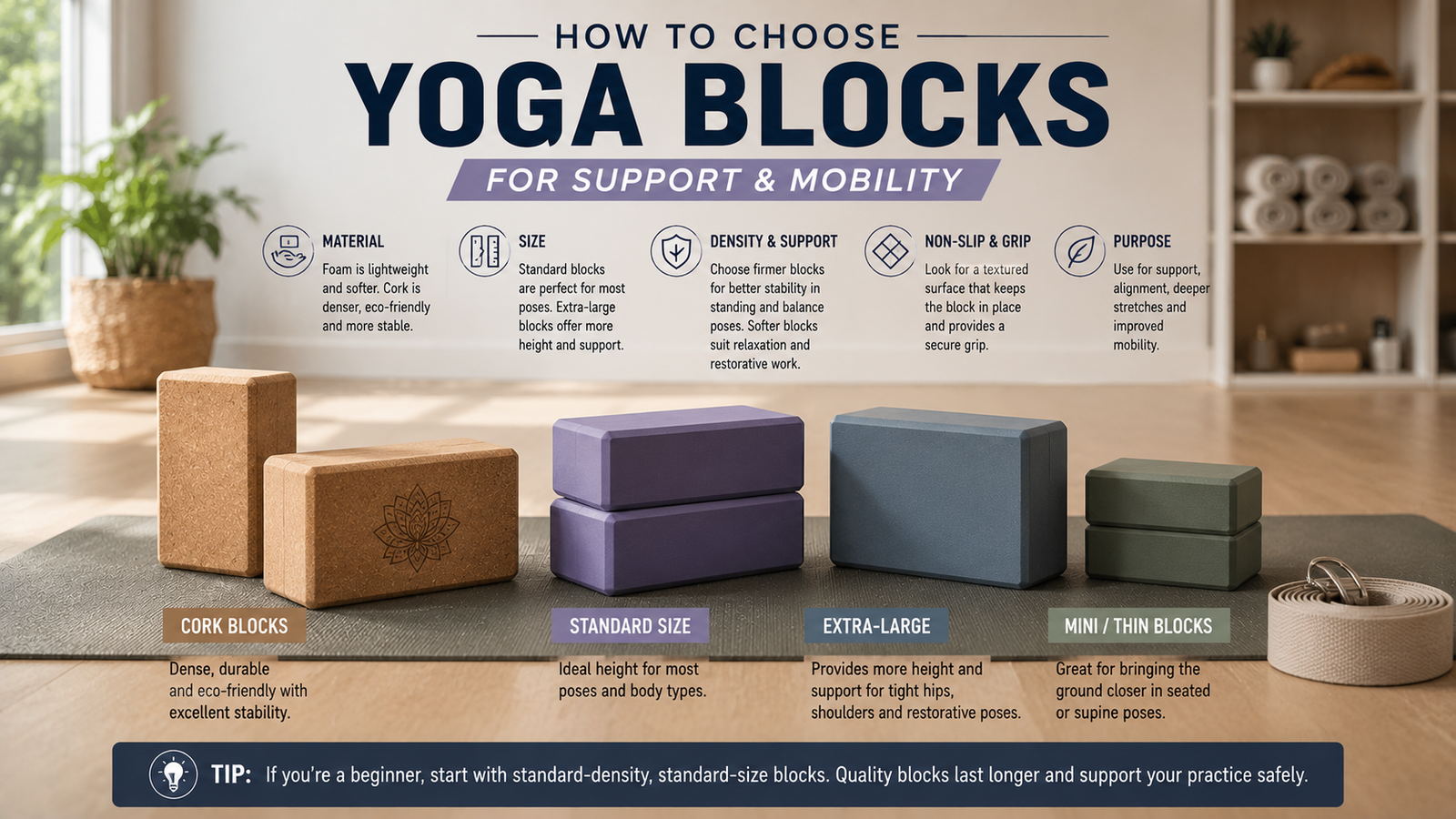
Yoga Blocks
Blocks bring the floor closer to you.
They can make poses more accessible.
Examples:
- supporting hands in lunges;
- modifying forward folds;
- supporting seated positions.
Using a block is not a sign of poor flexibility.
It often improves:
- positioning;
- control.
Yoga Strap
A strap extends your reach.
Useful for:
- hamstring stretches;
- shoulder mobility;
- seated stretches.
It is particularly helpful if you cannot comfortably reach:
- feet;
- hands behind back.
Bolsters
Large cushions used primarily in:
- restorative yoga;
- supported stretches.
They can make long relaxed positions more comfortable.
Blankets
Useful for:
- padding knees;
- supporting hips;
- relaxation.
You do not need specialized yoga blankets initially.
A folded household blanket may work if stable and appropriate.
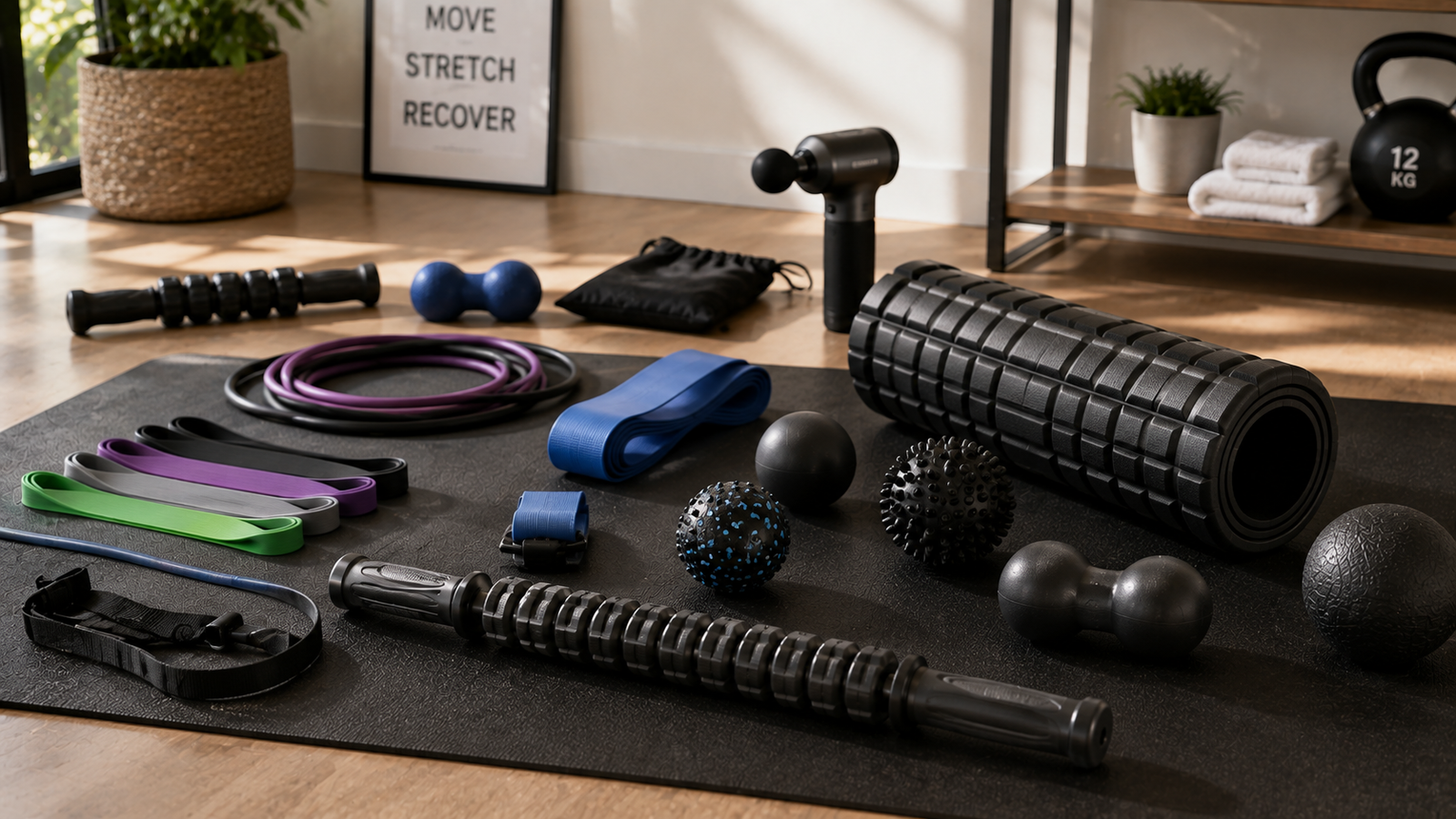
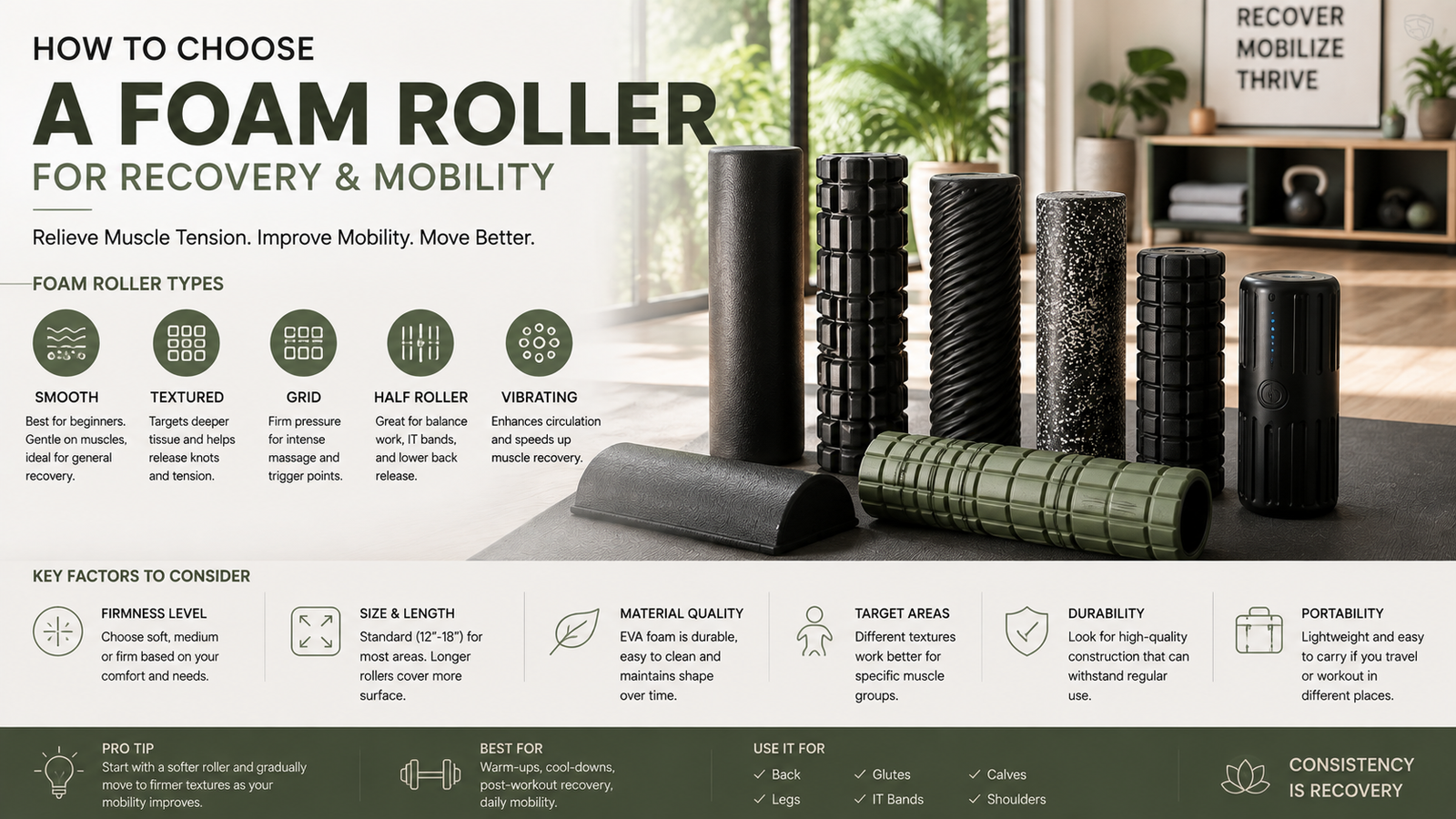
Foam Roller
A foam roller is not required for yoga.
It can be used separately for:
- temporary reduction in muscle stiffness;
- mobility preparation.
Mobility Balls
Small massage balls can target:
- feet;
- glutes;
- upper back.
They are optional.
They do not physically “break up” muscle knots in the literal way often claimed.
How Long Should a Mobility Session Be?
It can be very short.
Even:
- 5–10 minutes;
may be useful when performed consistently.
Longer sessions of:
- 20–30 minutes;
can be appropriate when mobility itself is a major training goal.
How Often Should You Practice Mobility?
Short sessions can be performed frequently.
For example:
- several times per week;
- brief daily practice.
The ideal frequency depends on:
- intensity;
- goals;
- recovery.
Gentle movement generally requires less recovery than aggressive end-range strength work.
How Often Should You Practice Yoga?
For general wellness:
- 2–3 sessions per week;
can provide meaningful practice.
Some people enjoy shorter sessions more frequently.
Consistency matters more than hitting a universal number.
Daily Yoga
Can be appropriate if intensity varies.
Every session does not need to be:
- deep;
- strenuous.
Alternate between:
- stronger practices;
- gentle mobility;
- restorative sessions.
Can You Stretch Every Day?
Gentle stretching is generally fine for many people.
But intense stretching into maximal end ranges every day may create:
- irritation;
- soreness.
Treat mobility work like other training:
enough stimulus → enough recovery.
Stretching Before Exercise
This depends on the type of stretching and workout.
Dynamic Mobility Before Training
Usually well suited to warm-ups.
Examples:
- leg swings;
- controlled lunges;
- arm circles;
- bodyweight squats.
These prepare the body through:
- movement.
Long Static Stretching Before Strength or Power Training
Very long, intense static stretching immediately before maximal performance may temporarily reduce:
- force;
- power;
in some situations.
This does not mean static stretching is dangerous.
It simply means your warm-up should match the task.
A Practical Strength-Training Warm-Up
Use:
- light general movement;
- dynamic mobility if needed;
- progressively heavier warm-up sets.
You do not need a 30-minute stretching routine before every lift.
Stretching After Exercise
You can stretch afterward if it feels:
- comfortable;
- relaxing.
It is not mandatory for preventing:
- soreness.
Does Stretching Prevent DOMS?
Not reliably.
Post-workout stretching does not appear to eliminate delayed-onset muscle soreness.
Use stretching because it helps your:
- mobility;
- comfort;
not as a guaranteed soreness prevention method.
Static Stretching
A static stretch involves holding a position for a period of time.
Examples:
- calf stretch;
- hamstring stretch;
- hip-flexor stretch.
How Long Should You Hold a Stretch?
There is no single perfect duration.
A practical beginner range is often:
- 20–60 seconds;
depending on the stretch and comfort.
Several shorter holds can also work.
Stretch Intensity
Aim for:
- mild-to-moderate tension.
Avoid:
- sharp pain;
- strong joint discomfort;
- numbness;
- tingling.
More discomfort does not equal better flexibility.
Dynamic Stretching
Uses controlled movement through a range.
Examples:
- leg swings;
- arm swings;
- walking lunges.
Useful before:
- sport;
- training.
Ballistic Stretching
Uses bouncing or rapid momentum near end range.
This is more advanced and sport-specific.
Beginners generally do not need it.
Active Stretching
You hold a position using your own muscles rather than external support.
This develops:
- active range;
- control.
Example:
lifting the leg and holding it without using your hands.
Passive Stretching
An external force assists the position.
Examples:
- strap;
- gravity;
- partner.
Passive stretching can improve flexibility but should not be forced.
Loaded Mobility
Uses resistance to strengthen the body through a large range.
Examples may include:
- deep split squat;
- controlled Romanian deadlift;
- weighted calf stretch;
- supported squat.
This can improve both:
- mobility;
- strength.
Strength Training Can Improve Mobility
This is often overlooked.
Exercises performed through comfortable, progressively increasing ranges can improve:
- flexibility;
- movement capacity.
You do not always need separate stretching.
For example:
- deep squats;
- split squats;
- Romanian deadlifts;
- overhead presses;
can challenge mobility while strengthening it.
Mobility Should Include Strength
Being able to reach a position passively is only part of movement.
You also want enough strength to:
- control;
- exit;
that position.
This is why active and loaded mobility can be particularly useful.
Ankle Mobility
Ankle dorsiflexion is the ability to move the shin forward over the foot while keeping the heel down.
It affects:
- squatting;
- lunging;
- stairs.
Signs Ankle Mobility May Be Limiting You
During a squat, you may notice:
- heels lifting;
- difficulty allowing knees forward;
- excessive forward torso lean.
But these signs can also result from:
- technique;
- body proportions.
Knee-to-Wall Ankle Drill
A simple mobility drill:
- Face a wall.
- Keep heel flat.
- Move knee toward wall.
- Keep knee roughly tracking over toes.
- Move foot farther back gradually if comfortable.
Do not force pain at the front or back of the ankle.
Calf Stretch
A straight-knee calf stretch emphasizes the:
- gastrocnemius.
A bent-knee version places more emphasis on:
- soleus.
Both can influence ankle movement.
Ankle Mobility and Squatting
You do not need extreme ankle dorsiflexion to squat.
Your required range depends on:
- stance;
- femur length;
- torso proportions;
- squat style.
Heel elevation can also change mechanics.
Weightlifting Shoes and Ankle Mobility
Shoes with raised heels can make squatting easier for some people by reducing ankle mobility requirements.
This is a training tool, not cheating.
Hip Mobility
The hip moves through:
- flexion;
- extension;
- internal rotation;
- external rotation;
- abduction;
- adduction.
No single stretch covers all of these.
Hip Flexor Stretch
Often performed in a half-kneeling position.
Key point:
avoid simply:
- arching the lower back.
Gently tuck the pelvis and move forward only as far as comfortable.
Why Hip Flexors Feel Tight
A sensation of tightness does not always mean the muscle is physically shortened.
It can be influenced by:
- fatigue;
- posture;
- sensitivity;
- lack of strength.
Stretching may help temporarily, but strengthening may also matter.
90/90 Hip Position
A common mobility position used to explore:
- internal rotation;
- external rotation.
Sit with both knees bent.
Move only within comfortable range.
90/90 Transitions
Slowly rotate between sides.
This adds active control.
Use:
- hands for support;
if needed.
Pigeon Pose
A popular yoga position targeting the hips.
But it places the front hip and knee in a position that may not suit everyone.
If the knee feels uncomfortable, use:
- figure-four stretch;
- supported variation.
Never force the front shin parallel to the mat simply because a photo shows that position.
Figure-Four Stretch
Often a more accessible hip stretch.
Can be performed:
- lying;
- seated.
It emphasizes external rotation.
Deep Squat Hold
A supported deep squat can help practice:
- ankle;
- hip;
- trunk positioning.
Hold onto:
- rack;
- post;
- doorframe;
for balance if necessary.
Do You Need to Sit in a Deep Squat?
No.
It is simply one mobility option.
Your anatomy and goals determine whether it is useful.
Hip Internal Rotation
Often neglected.
It contributes to:
- walking;
- running;
- squatting;
- directional movement.
Simple 90/90 drills can help explore it.
Hip External Rotation
Relevant to positions such as:
- cross-legged sitting.
But forcing extreme external rotation may stress:
- knee.
Let the hip determine the range.
Hamstring Flexibility
Hamstrings cross the hip and knee.
They are commonly stretched by:
- hip flexion;
- knee extension.
Toe Touch Test
Not being able to touch your toes does not automatically mean:
- poor health;
- severe hamstring tightness.
Toe touching depends on:
- hamstrings;
- spinal movement;
- arm length;
- body proportions;
- nervous-system tolerance.
Hamstring Stretch
A strap-assisted lying stretch is often easy to control.
Keep the knee:
- slightly bent;
if needed.
Avoid pulling until you experience:
- pain;
- tingling.
Nerve Tension vs Muscle Stretch
A strong line of tension down the back of the leg accompanied by:
- tingling;
- burning;
- numbness;
may involve neural sensitivity rather than simple muscle tightness.
Do not aggressively stretch through these sensations.
Adductor Mobility
Inner-thigh muscles contribute to:
- hip movement;
- squatting.
Useful drills include:
- side lunges;
- supported wide-knee rocks.
Adductor Rock-Back
From a hands-and-knees position:
- Extend one leg sideways.
- Keep foot supported.
- Gently shift hips backward.
- Return.
Use a comfortable range.
Groin Stretching
Do not force wide straddle positions.
Progress gradually.
Thoracic Spine Mobility
The thoracic spine is the mid-to-upper back.
It contributes to:
- rotation;
- extension.
Mobility here can influence:
- overhead movement;
- posture.
Open Book Rotation
Lie on your side with knees bent.
Rotate the upper arm and torso away while keeping the lower body relatively stable.
Move slowly.
Thread-the-Needle
From hands and knees:
- rotate one arm beneath the body;
- then open upward.
Useful for gentle thoracic rotation.
Thoracic Extension Over a Foam Roller
A foam roller can support the upper back.
Gently extend over it.
Avoid aggressively rolling the:
- lower back.
Cat-Cow
A common yoga movement alternating spinal:
- flexion;
- extension.
Useful for exploring comfortable spinal movement.
Does Cat-Cow “Realign” the Spine?
No.
It simply provides:
- gentle movement;
- awareness.
Your spine does not need to be manually realigned through routine mobility exercises.
Lower-Back Mobility
The lumbar spine naturally moves.
But more lower-back flexibility is not always the goal.
For many exercises, you need the ability to:
- control;
the lumbar spine while movement comes from:
- hips;
- shoulders.
Lower-Back Stretching
Gentle movements such as:
- knee-to-chest;
- child’s pose;
may feel comfortable.
Persistent back pain should not be treated solely through stretching.
Shoulder Mobility
The shoulder has a large natural range.
Overhead movement depends on:
- shoulder joint;
- shoulder blade;
- thoracic spine.
Overhead Reach Test
Raise both arms overhead.
Notice whether you can do so without:
- pain;
- excessive discomfort.
Do not obsess over achieving a perfectly vertical arm relative to every online demonstration.
Wall Slides
Stand with back or forearms near a wall.
Slowly slide arms upward while maintaining comfortable:
- rib;
- shoulder position.
This can help train overhead control.
Shoulder Flexion With a Stick
Hold a dowel or strap with a wide grip.
Raise arms overhead gradually.
Keep the movement:
- pain free.
Band Dislocates / Pass-Throughs
This exercise involves moving a wide-grip band or stick from front to behind the body.
Despite the name, you are not dislocating the shoulder.
Use:
- very wide grip;
- light resistance.
Do not force through shoulder pain.
Shoulder External Rotation
Light band exercises can build control.
Use:
- low resistance;
- controlled repetitions.
Heavy loading is usually unnecessary.
Behind-the-Back Shoulder Stretch
Some people use a strap between the hands.
This can be useful, but do not aggressively force:
- internal rotation;
- external rotation.
Wrist Mobility
Important for:
- push-ups;
- yoga poses;
- front rack positions.
Wrist Extension
Many floor-based yoga poses require the wrist to extend while bearing body weight.
This can be uncomfortable for beginners.
Gradual Wrist Loading
Start with:
- hands on wall;
- hands on bench;
- quadruped position.
Progress toward:
- full plank.
This lets the wrists adapt gradually.
Wrist Circles
Gentle circles can prepare the joint.
They are not a cure for wrist pain.
Yoga Blocks for Wrist Comfort
Placing hands on blocks can change:
- wrist angle.
Push-up handles or fists may also reduce wrist extension in some exercises.
Knee Comfort in Yoga
Some poses place the knees on the floor.
Use:
- folded mat;
- blanket;
- cushion.
Kneeling discomfort does not mean you need to tolerate pain to progress.
Knee Rotation
The knee is not designed for the same rotational range as the hip.
In poses such as:
- pigeon;
- lotus;
do not force the knee downward if hip rotation is limited.
Lotus Pose
Full lotus requires substantial hip rotation.
It is not an essential beginner pose.
Do not force your feet onto opposite thighs if the knees feel:
- pressure;
- pain.
Cross-Legged Sitting
If sitting cross-legged is uncomfortable:
- sit on a block;
- cushion;
- folded blanket.
Raising the hips can reduce demand on:
- hip mobility.
Balance Training
Yoga often includes balance poses.
Balance depends on:
- vision;
- vestibular system;
- strength;
- coordination.
It can improve with practice.
Beginner Balance Pose: Single-Leg Stand
Simply stand on one leg.
Use a wall or chair for:
- support.
This is already useful balance training.
Tree Pose
Place one foot against the:
- ankle;
- calf;
- inner thigh.
Avoid pressing the foot directly into the side of the knee joint.
Use wall support if needed.
Balance Difficulty Progression
You can make balance harder by:
- reducing hand support;
- moving arms;
- turning head;
- closing eyes.
Closing the eyes makes balance much more difficult and should be progressed cautiously.
Do Not Practice Difficult Balance Near Hazards
Avoid:
- sharp furniture;
- stairs;
- glass.
A simple wall nearby improves safety.
Yoga and Strength
Yoga can build strength, especially in beginners.
Poses such as:
- plank;
- side plank;
- chair;
- warrior;
- downward dog;
challenge muscles.
Is Yoga Enough for Strength Training?
It depends on the goal.
For general movement and some strength:
- potentially.
For maximizing:
- muscle;
- strength;
progressive external resistance with:
- dumbbells;
- barbells;
- machines;
is usually more scalable.
Yoga and strength training complement each other well.
Yoga and Cardio
Some fast-flow yoga can elevate heart rate.
But it is not necessarily equivalent to dedicated:
- running;
- cycling;
- rowing;
for cardiovascular development.
If cardio fitness is important, include specific aerobic activity.
Yoga and Weight Loss
Yoga can contribute to overall activity.
But no pose specifically burns:
- belly fat;
- thigh fat.
Fat loss depends mainly on long-term:
- energy balance.
Yoga and Posture
Yoga can improve:
- awareness;
- strength;
- mobility.
But there is no single perfect posture everyone must maintain.
Your body is designed to move through many positions.
“Bad Posture” Is Often Oversimplified
Sitting with a rounded back temporarily is not automatically harmful.
Problems may arise more from:
- prolonged static positions;
- discomfort;
- lack of movement variety.
Regularly changing position is often more useful than trying to sit perfectly upright all day.
Mobility for Desk Workers
People who sit for long periods may benefit from brief movement breaks.
A simple routine:
- stand;
- walk;
- reach overhead;
- rotate gently;
- perform a few squats.
You do not need an elaborate corrective program.
Does Sitting Make Hip Flexors Permanently Short?
This is often overstated.
Sitting may create a feeling of:
- stiffness;
but this does not necessarily mean the hip flexors have permanently shortened.
Movement variety and strength matter.
Movement Snacks
Short bouts of movement throughout the day.
Examples:
- 5 squats;
- overhead reaches;
- calf raises;
- short walk.
These may be easier to maintain than one long mobility session.
Morning Mobility
A short morning routine can help if you wake feeling:
- stiff.
Keep it gentle.
Your body may feel less flexible immediately after waking.
Evening Mobility
Some people prefer evening practice for:
- relaxation.
Avoid turning it into an intense end-range workout if your goal is to wind down.
Yoga Before Bed
Gentle yoga may help some people relax.
Choose:
- slow;
- comfortable;
- low-intensity movements.
Avoid expecting a specific pose to guarantee sleep.
Yoga and Stress
Yoga practices that include:
- breathing;
- movement;
- attention;
may help some people feel calmer.
The effect varies.
Yoga should not be treated as a replacement for professional care when someone has significant:
- anxiety;
- mental-health concerns.
Beginner Yoga Poses
A simple practice can use a small number of positions.
Mountain Pose
Stand tall with:
- feet comfortable;
- knees relaxed;
- arms by sides.
Use it to notice:
- balance;
- breathing.
Chair Pose
Bend knees and hips as if sitting toward a chair.
Challenges:
- thighs;
- glutes;
- trunk.
Use a shallow range initially.
Warrior I
A staggered stance with the front knee bent.
Challenges:
- balance;
- hips;
- legs.
Do not force the back foot into an uncomfortable angle.
Warrior II
A wider stance with arms extended.
Useful for:
- lower-body endurance;
- hip control.
Downward-Facing Dog
Hands and feet on floor with hips elevated.
This can stretch:
- calves;
- shoulders;
- hamstrings.
Do Your Heels Need to Touch the Floor?
No.
Keep knees bent if necessary.
Heel contact is not a requirement.
Child’s Pose
A resting position with hips moving toward heels and arms forward or alongside the body.
If knees or hips are uncomfortable:
- widen knees;
- use support;
- choose another resting position.
Cobra Pose
A gentle spinal extension.
Use:
- back muscles;
- light hand pressure.
Do not force maximal backbend.
Sphinx Pose
A milder alternative supported on:
- forearms.
Often more comfortable for beginners.
Low Lunge
Useful for exploring:
- hip extension;
- balance.
Place hands on blocks if the floor is difficult to reach.
Half-Kneeling Hip Flexor Position
A controlled alternative to a deeper yoga lunge.
Focus on pelvis rather than pushing aggressively forward.
Seated Forward Fold
Often used for hamstring stretching.
You do not need to reach:
- toes.
Sit on a folded blanket and bend knees if needed.
Supine Twist
Lie on back and allow knees to move gently to one side.
Use a comfortable range.
Bridge Pose
Lie on back with knees bent.
Lift hips.
This is both a:
- strength;
- mobility exercise.
Plank
Challenges:
- trunk;
- shoulders;
- arms.
Modify by placing knees down or hands on an elevated surface.
Side Plank
Challenges:
- lateral trunk;
- shoulder;
- hip.
Modify using:
- bottom knee.
Corpse Pose / Savasana
Lie comfortably and relax.
Often used at the end of yoga practice.
No flexibility required.
A 10-Minute Beginner Mobility Routine
You can start with:
1. Cat-Cow
6–8 controlled repetitions.
2. Open Book
5–8 each side.
3. Half-Kneeling Hip Flexor Stretch
20–30 seconds each side.
4. 90/90 Hip Transitions
5 each direction.
5. Knee-to-Wall Ankle Drill
8 each side.
6. Supported Deep Squat
20–30 seconds if comfortable.
Keep the entire routine gentle.
A 15-Minute Beginner Yoga Routine
Mountain Pose
30 seconds.
Chair Pose
20–30 seconds.
Low Lunge
30 seconds each side.
Downward Dog
30 seconds.
Plank
20–30 seconds or modified.
Child’s Pose
30–60 seconds.
Bridge Pose
8–12 controlled repetitions.
Supine Twist
30 seconds each side.
Relaxation
1–2 minutes.
This is enough to begin.
A Morning Movement Routine
Cat-Cow
6 repetitions.
Shoulder Circles
10 each direction.
Bodyweight Squat
8–10 reps.
Alternating Reverse Lunge
5 each side.
Overhead Reach
5 slow breaths.
Calf Raise
10–15 reps.
Short and practical.
A Desk-Break Mobility Routine
Every few hours, if helpful:
Stand and Walk
1–2 minutes.
Wall Reach
5 repetitions.
Bodyweight Squat
5–10 repetitions.
Thoracic Rotation
5 each side.
Calf Stretch
20 seconds each side.
This may be more practical than waiting for one long evening session.
Pre-Workout Mobility Routine
Keep it targeted.
For a lower-body workout:
- bodyweight squats;
- lunges;
- ankle rocks;
- hip rotations.
Then perform:
- warm-up sets.
For upper body:
- arm circles;
- light band rows;
- shoulder rotations.
Then progress into:
- lighter exercise sets.
Mobility Before Running
You generally need:
- movement;
- warmth;
rather than long passive stretching.
Useful options:
- brisk walking;
- leg swings;
- calf raises;
- short easy jog.
Mobility Before Strength Training
Warm up the exact movements you plan to train.
For example before squats:
- bodyweight squat;
- light goblet squat;
- empty bar;
- gradually heavier warm-up sets.
This is usually more specific than spending 20 minutes doing unrelated stretches.
Post-Workout Mobility Routine
If you enjoy stretching afterward, keep it simple:
- calves;
- hip flexors;
- hamstrings;
- chest;
- shoulders.
Hold gently.
Do not turn recovery stretching into another maximal workout.
Yoga on Rest Days
A gentle practice can be an excellent:
- active recovery option.
But an intense power-yoga session is still:
- exercise.
Do not assume all yoga is recovery.
Yoga and Strength Training on the Same Day
Possible.
If strength is your priority:
strength first → gentle yoga/mobility afterward
is often practical.
If the yoga session is intense and strength-based, treat it as a real workout.
Yoga Before Heavy Lifting
A brief mobility-based warm-up can be useful.
A long, fatiguing yoga class immediately before heavy strength training may reduce:
- performance.
Plan according to priorities.
Mobility and Running Schedule
Mobility can be done:
- after easy runs;
- separately;
- on recovery days.
Target only limitations that actually affect you.
Flexibility Takes Time
Meaningful changes usually occur over:
- weeks;
- months.
Do not expect one intense stretching session to permanently improve range.
Temporary vs Long-Term Flexibility
A stretch may immediately make you feel:
- looser.
This short-term change does not necessarily represent permanent structural adaptation.
Long-term improvement requires:
- repeated exposure;
- progression.
How Hard Should Mobility Training Feel?
Generally:
- mild-to-moderate effort.
Some active end-range exercises can feel muscularly hard.
But joint pain should not be the goal.
Stretching Pain Scale
A useful rule:
tension is acceptable; sharp pain is not.
Stop or modify if you experience:
- sharp pain;
- pinching;
- numbness;
- tingling;
- instability.
Stretching Through Pain
Do not assume pain means the stretch is working.
Pain may cause protective muscle tension and make the practice less useful.
Pinching at the Front of the Hip
If a deep squat or hip stretch creates a sharp pinch at the front of the hip:
- reduce depth;
- change stance;
- stop the position.
Do not repeatedly force through it.
Shoulder Pinching
If overhead poses cause a pinch:
- narrow range;
- alter hand position;
- use support.
Persistent symptoms deserve assessment.
Stretching and Soreness
You may feel mild muscular soreness after unfamiliar mobility work.
This is possible because active mobility can challenge muscles.
Severe pain is not expected.
Hypermobility
Some people naturally have very large joint ranges.
Signs may include:
- elbows or knees extending far beyond neutral;
- frequent joint instability;
- unusually large flexibility.
This does not automatically mean a medical condition.
Mobility Training for Hypermobile People
The priority may be:
- strength;
- control;
- avoiding passive hanging at extreme ranges.
Do not chase deeper stretching simply because you can.
Locking Joints
In yoga, avoid repeatedly hanging on fully extended:
- elbows;
- knees;
if you tend to hyperextend.
Maintain active muscular control.
Yoga During Pregnancy
Yoga may be appropriate during pregnancy for many people, but practice may need modification.
Factors include:
- trimester;
- previous experience;
- symptoms;
- medical history.
Prenatal Yoga
Classes specifically designed for pregnancy can provide:
- modified positions;
- appropriate pacing.
Discuss exercise with your healthcare professional when relevant.
Avoid Extreme Heat During Pregnancy
Hot yoga may not be appropriate because excessive heat exposure can be problematic.
Follow individual medical guidance.
Supine Positions During Later Pregnancy
Some people may need modifications for prolonged lying on the back later in pregnancy.
Professional guidance can help.
Postpartum Mobility
Return gradually.
Pregnancy and childbirth can affect:
- pelvic floor;
- abdominal wall;
- joints.
Do not assume you need aggressive stretching after childbirth.
Pelvic Floor Symptoms
Seek professional guidance if exercise causes:
- leakage;
- pressure;
- heaviness;
- pain.
A pelvic-health physiotherapist may be useful.
Yoga With Osteoporosis
Some movements may need modification depending on:
- bone density;
- fracture history.
Deep loaded spinal flexion or extreme twisting may be inappropriate for certain individuals.
Professional guidance may be useful.
Yoga With Arthritis
Gentle movement can be beneficial for many people with arthritis.
But range and loading should match:
- symptom tolerance.
Props and modifications can help.
Yoga With Knee Problems
Avoid forcing:
- deep knee flexion;
- lotus;
- kneeling;
if painful.
Use:
- blocks;
- cushions;
- alternate positions.
Yoga With Wrist Pain
Modify weight-bearing poses by using:
- fists;
- handles;
- blocks;
- elevated surfaces.
Persistent pain should not simply be pushed through.
Yoga With Back Pain
Gentle movement may help some types of back discomfort.
But back pain has many possible causes.
Avoid aggressive stretches simply because a pose is marketed as:
- “for back pain.”
Sciatica-Like Symptoms
If stretching produces:
- shooting pain;
- numbness;
- tingling;
down the leg, stop aggressively stretching the area.
Neural symptoms deserve appropriate assessment.
Yoga After Injury
Return based on:
- healing;
- medical guidance;
- function.
Do not assume yoga is safe simply because it is low impact.
Some poses place substantial stress on:
- shoulders;
- knees;
- wrists.
Yoga and Blood Pressure
Most people can perform ordinary yoga safely.
However, people with certain medical conditions may need guidance regarding:
- prolonged inversions;
- intense breath holds.
Inversions
Advanced poses include:
- headstands;
- shoulder stands;
- handstands.
These are not necessary for mobility or health.
Beginners should not feel pressured to learn them.
Headstands
Place substantial load through:
- neck;
- shoulders.
They require skill and supervision.
Handstands
Require:
- shoulder strength;
- wrist tolerance;
- balance.
Again, completely optional.
Advanced Backbends
Poses such as:
- wheel;
require substantial mobility and strength.
They are not a marker of overall fitness.
Splits
Full front or middle splits are highly specialized flexibility goals.
Most everyday activities do not require them.
Train for splits only if you genuinely want that skill.
Lotus, Headstand and Splits Are Not Beginner Milestones
Progress should not be measured by whether you can perform:
- visually impressive poses.
A better measure is whether everyday movement becomes:
- easier;
- more controlled;
- more comfortable.
Yoga Videos and Online Classes
These can be excellent for beginners if appropriately chosen.
Look for:
- beginner;
- gentle;
- foundations;
- mobility.
Avoid jumping directly into advanced flows.
The Instructor Cannot See You
With recorded videos, the instructor cannot correct your:
- technique;
- range.
Use conservative positions.
Pause when needed.
Live Online Classes
Can provide more interaction.
But camera angle may still limit feedback.
In-Person Classes
Useful for:
- learning modifications;
- understanding props;
- building confidence.
Choose instructors who encourage:
- individual variation;
rather than forcing everyone into identical positions.
A Good Instructor Should Offer Options
For example:
hand to floor → hand to block → hand higher
rather than insisting there is one correct depth.
Be Cautious With Hands-On Adjustments
Some classes use physical adjustments.
You should be able to:
- decline;
- opt out.
A deeper position is not automatically better.
Mobility Apps
Apps can help structure:
- short routines;
- reminders.
They are useful only if you actually follow them.
Do You Need a Mobility App?
No.
A simple written routine is enough.
Technology does not replace:
- consistency.
Mobility Assessments
Online mobility screens may test:
- ankle;
- hips;
- shoulders.
These can provide information but should not be treated as:
- diagnosis.
Failing a mobility test does not automatically mean something is wrong.
The “Perfect Squat” Myth
People squat differently because of differences in:
- anatomy;
- limb length;
- mobility;
- goals.
Some people naturally prefer:
- wider stance;
- more toe angle.
Do not force everyone into one exact position.
Knee Travel Over Toes
Allowing knees to move over toes is not inherently dangerous.
Many everyday and athletic movements require it.
The appropriate amount depends on:
- load;
- tolerance;
- exercise.
Rounded Back in Yoga
Spinal flexion is a normal human movement.
The issue is not that the spine must never round.
Context matters:
- load;
- control;
- symptoms.
Avoid simplistic rules such as:
never round your back.
“Opening the Hips”
This phrase is common in yoga.
It generally means moving through various hip ranges.
The hip does not literally:
- open.
Use the phrase as a movement cue rather than anatomical fact.
“Detox Yoga”
Yoga does not remove unspecified toxins through particular poses.
Your body already uses organs such as:
- liver;
- kidneys;
for normal waste processing.
Yoga can still support:
- movement;
- relaxation;
without detox claims.
“Release Stored Trauma From the Hips”
Strong emotional experiences during movement can occur, but broad claims that specific muscles physically store trauma are oversimplified.
Yoga may help some people feel:
- relaxed;
- emotionally aware.
It is not a substitute for qualified mental-health treatment.
“Fascia Release”
Mobility tools and stretching can alter:
- sensation;
- short-term movement tolerance.
Claims about permanently breaking or reshaping fascia through simple stretching are often overstated.
Foam Rolling and Fascia
Foam rolling may temporarily improve:
- range;
- comfort.
It does not literally melt adhesions.
Does Stretching Make Muscles Longer?
Regular flexibility training can increase range of motion.
Adaptations may involve:
- stretch tolerance;
- muscle architecture;
- nervous-system factors.
It is more complex than simply “lengthening” a muscle.
Mobility and Aging
Maintaining movement variety and strength becomes increasingly valuable with age.
Useful qualities include:
- getting up from floor;
- reaching;
- balance;
- leg strength.
Yoga and mobility can contribute to these.
But strength training remains important.
Floor Transfer Practice
Getting down to the floor and back up is a practical movement skill.
Practice with:
- chair;
- support;
if needed.
Balance and Fall Risk
Balance training can help older adults.
But those with significant fall risk should practice near:
- stable support.
Professional supervision may be appropriate.
Mobility for Strength Athletes
Strength training does not automatically make you inflexible.
Many lifters develop excellent mobility through:
- full-range training.
Add targeted work only where needed.
Mobility for Runners
Runners do not need extreme flexibility.
Useful areas may include:
- ankles;
- hips;
- calves.
But strengthening these areas is also important.
Mobility for Cyclists
Cyclists spend long periods in relatively fixed positions.
Mobility work may focus on:
- hips;
- thoracic spine;
- shoulders.
Again, short regular sessions are sufficient.
Mobility for Swimmers
Shoulder mobility matters, but swimmers often already have large ranges.
Strength and control may be equally important.
Mobility for Office Workers
Prioritize:
- movement frequency;
- walking;
- basic strength.
You do not need to “undo” every hour of sitting with one extreme stretch.
Consistency Beats Intensity
A gentle 10-minute routine performed:
- four times per week;
is usually more useful than a painful 60-minute session once every few weeks.
Track Progress Carefully
You can monitor:
- squat comfort;
- overhead reach;
- ankle knee-to-wall distance;
- pose comfort.
Avoid testing maximum flexibility every day.
Mobility Changes Are Not Always Linear
Some days you may feel:
- stiff.
Factors include:
- sleep;
- temperature;
- training;
- stress.
One poor session does not mean you are losing progress.
Warm Muscles Often Move Farther
Mobility usually feels easier after:
- walking;
- light exercise.
That is normal.
Do not compare your cold morning range with your fully warmed evening range as if they should be identical.
A Simple Weekly Yoga and Mobility Schedule
Monday
Strength training + 5 minutes targeted mobility.
Tuesday
20-minute beginner yoga session.
Wednesday
Walking + brief mobility.
Thursday
Strength training.
Friday
10-minute mobility routine.
Saturday
Longer yoga session if desired.
Sunday
Rest or gentle movement.
There is no requirement to follow this exact schedule.
The idea is to spread movement throughout the week.
Mobility for a Busy Schedule
You can divide the work.
For example:
Morning
5 minutes.
Lunch
Short walk.
Evening
5 minutes.
This may be easier than finding one uninterrupted half hour.
How to Progress a Mobility Exercise
Progress by changing only one factor at a time.
You might:
- increase range slightly;
- hold longer;
- reduce external support;
- add light resistance;
- improve control.
Do not immediately combine:
- maximum range;
- heavy load;
- long duration.
How to Progress Yoga
Progress can mean:
- smoother transitions;
- better breathing;
- improved balance;
- greater control.
It does not have to mean:
- deeper pose.
Props Can Be Part of Advanced Practice
Experienced practitioners still use:
- blocks;
- straps;
- bolsters.
Props are tools, not beginner crutches.
Common Yoga and Mobility Mistakes
Forcing Range of Motion
More depth is not automatically better.
Comparing Yourself With Instructors
Body proportions and anatomy differ.
Treating Pain as Progress
Pain is not a flexibility goal.
Stretching Every Tight Sensation
Tightness can have multiple causes.
Ignoring Strength
Mobility requires control.
Doing Only Passive Stretching
Active movement is valuable.
Holding Your Breath
Keep breathing comfortably.
Starting With Advanced Poses
Build fundamentals first.
Doing the Same Hip Stretch Every Day
Use movement variety.
Ignoring Ankle and Thoracic Mobility
Mobility is not only about hamstrings.
Using Yoga to Replace All Strength and Cardio
A balanced program may need more.
Common Equipment Mistakes
Buying Every Yoga Prop Immediately
You may need only:
- mat;
- blocks;
- strap.
Choosing an Extremely Thick Mat
Can reduce balance stability.
Using Bands That Are Too Strong
Mobility work often needs light resistance.
Using Unstable Household Furniture as Support
A chair used for support should be:
- strong;
- stable.
Sliding on Socks
Practice on a surface with appropriate traction.
Common Beginner Yoga Mistakes
Locking the Knees
Keep muscular control.
Collapsing Into the Wrists
Gradually build wrist tolerance.
Trying to Force Heels Down in Downward Dog
Bend knees if needed.
Forcing Pigeon Pose
Use alternatives.
Pushing Into Full Lotus
Not necessary.
Chasing Deep Backbends
Build strength and control first.
How to Start Yoga and Mobility Step by Step
Step 1 — Identify Your Goal
General movement, flexibility, relaxation or a specific limitation?
Step 2 — Start With 10–15 Minutes
You do not need a long session.
Step 3 — Choose Simple Movements
For example:
- cat-cow;
- lunges;
- ankle rocks;
- 90/90 transitions;
- shoulder reaches.
Step 4 — Use Props
Blocks and straps can make positions more accessible.
Step 5 — Stay Below Pain
Mild stretch is enough.
Step 6 — Add Active Control
Do not only hold passive stretches.
Step 7 — Repeat Several Times Per Week
Consistency matters.
Step 8 — Progress Slowly
Increase range only when it feels controlled.
Step 9 — Combine With Strength and Cardio
For a balanced fitness routine.
Step 10 — Modify Based on Your Body
You do not need to match someone else’s pose.
A Simple Choice by Goal
General Everyday Mobility
Choose:
short full-body mobility routine
Relaxation
Choose:
gentle Hatha or restorative yoga
Flexibility
Choose:
regular static + active mobility practice
Strength + Mobility
Choose:
dynamic yoga + full-range strength training
Specific Joint Limitation
Choose:
targeted mobility drills
Balance
Choose:
standing yoga poses + simple single-leg exercises
A Simple Choice for Beginners
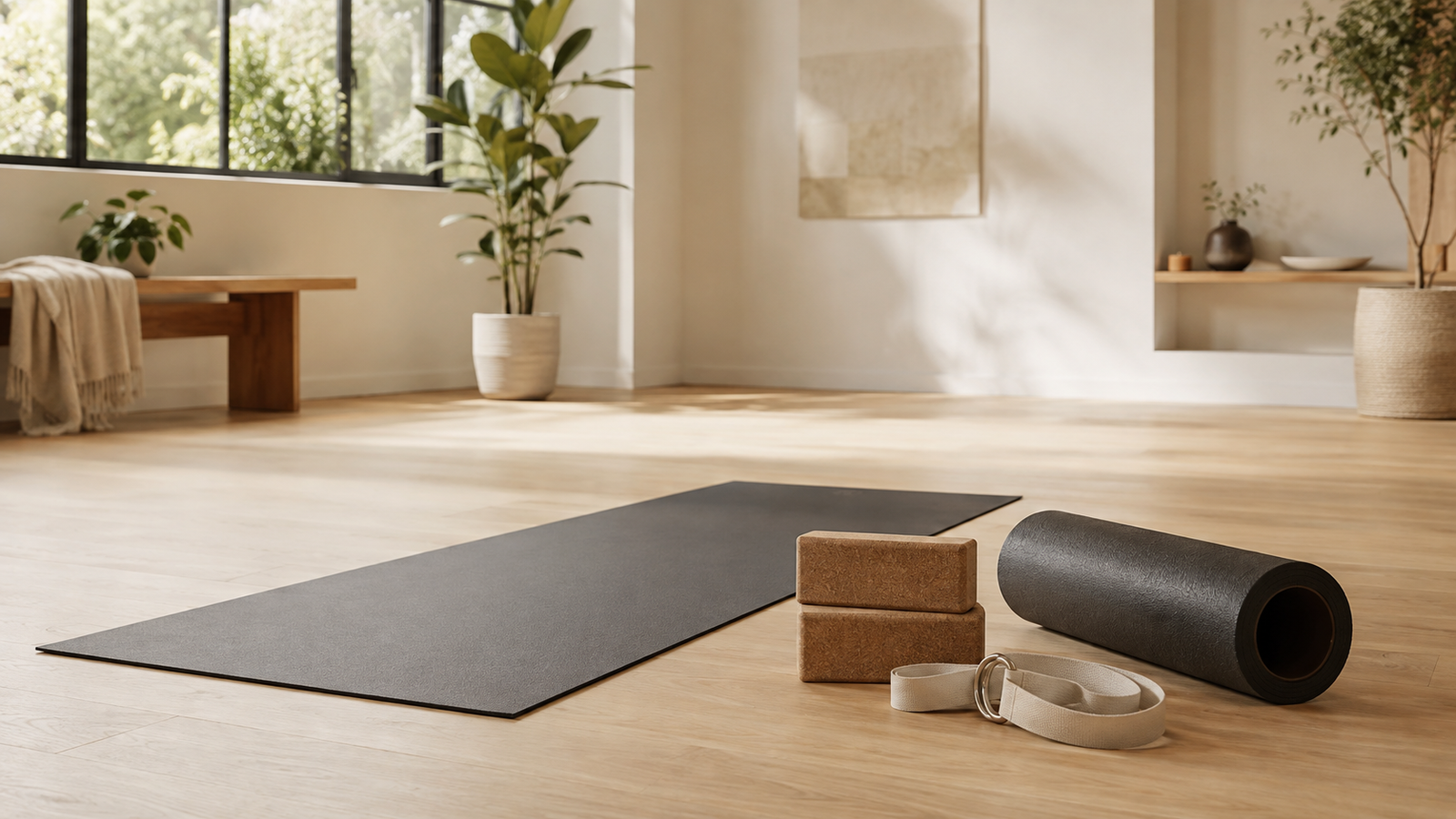
Start with:
- yoga mat;
- two blocks;
- strap if useful.
Then practice basic movements such as:
- cat-cow;
- low lunge;
- supported squat;
- downward dog;
- bridge;
- simple rotation.
That is enough.
A Simple Choice for Desk Workers
Prioritize:
- walking breaks;
- thoracic rotation;
- overhead reach;
- hip movement;
- squats.
You do not need an elaborate corrective program.
A Simple Choice for Strength Trainees
Use mobility to support:
- squat;
- press;
- hinge.
Target only the ranges that genuinely limit your training.
A Simple Choice for Rest Days
Choose:
- gentle yoga;
- light walking;
- relaxed mobility.
Avoid turning every rest day into another hard workout.
Beginner Yoga and Mobility Checklist
Before beginning a routine, ask:
1. What movement do I want to improve?
Be specific.
2. Does the movement feel tight or actually painful?
Pain may require a different approach.
3. Am I using a range I can control?
Mobility is not only passive flexibility.
4. Can I breathe normally?
If not, reduce intensity.
5. Am I forcing the position because of how it looks?
Stop comparing.
6. Would a block or strap make this more comfortable?
Use one.
7. Am I training both flexibility and strength?
A useful combination.
8. Am I repeating one stretch while ignoring the larger movement pattern?
Consider broader mobility.
9. Is my routine short enough to perform consistently?
This matters.
10. Am I progressing gradually?
Avoid sudden jumps in range.
When Should You Stop a Stretch or Pose?
Stop or modify if you experience:
- sharp pain;
- joint pinching;
- numbness;
- tingling;
- dizziness;
- unusual weakness;
- loss of balance you cannot control.
A stretch should not require you to:
- endure;
- push through;
- prove flexibility.
When Should You Seek Professional Guidance?
Professional assessment may be useful if you have:
- persistent joint pain;
- significant restriction after injury;
- recurrent instability;
- numbness;
- weakness;
- major balance problems.
A physiotherapist or appropriate clinician can help determine whether the limitation is mainly related to:
- mobility;
- strength;
- injury;
- another condition.
For yoga technique, an experienced instructor can help you learn:
- modifications;
- prop use;
- safe progressions.
The Physical Glow Takeaway
Yoga and mobility do not need to be complicated.
You do not need extreme flexibility to move well.
For most people, the practical goal is simply to maintain enough:
- ankle movement → for walking, stairs and squatting;
- hip movement → for sitting, lunging and bending;
- thoracic movement → for comfortable rotation and reaching;
- shoulder movement → for reaching and overhead tasks;
- balance and control → for confident everyday movement.
Yoga can provide a structured way to combine:
- movement;
- flexibility;
- balance;
- breathing;
- strength.
Dedicated mobility drills can target specific restrictions more efficiently.
Neither approach needs to replace:
- strength training;
- cardiovascular exercise.
A balanced routine may simply look like:
strength training → regular walking/cardio → 10–20 minutes of yoga or mobility several times each week.
Start with basic movements.
Use:
- blocks;
- straps;
- support;
when they help.
Do not judge progress by whether you can perform:
- splits;
- lotus pose;
- handstands;
- extreme backbends.
A more useful measure is whether you can:
reach more comfortably → squat with better control → move without unnecessary stiffness → get up and down from the floor more easily → perform your normal activities with confidence.
And remember:
mobility is not about forcing your body into the largest possible range.
It is about developing useful movement that you can control.
Practice consistently, stay within tolerable ranges and let flexibility, strength and coordination improve together over time.