How to Choose Mobility Tools for Stretching and Recovery
Learn how to choose mobility tools for stretching and recovery, with practical guidance on target area, pressure, portability, ease of use and recovery goals. This beginner-friendly guide helps you make a clear, informed choice without unnecessary complexity.
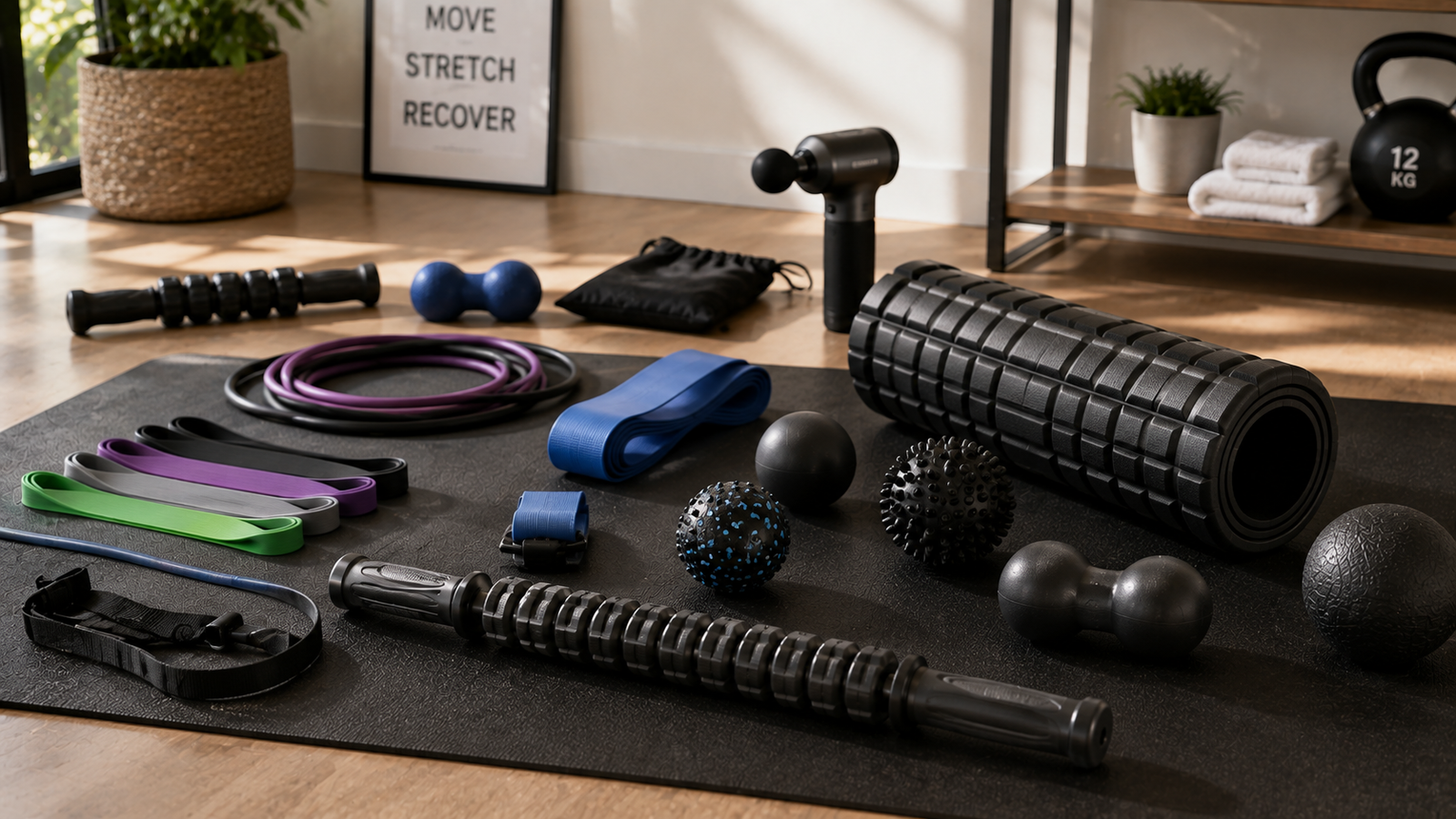
Mobility tools can make stretching, warm-ups and recovery routines easier to perform, but they are often marketed as if every person needs a large collection of specialized equipment.
In practice, most people need only a few simple tools.
Useful mobility equipment may include:
- massage balls;
- mobility sticks;
- resistance bands;
- stretching straps;
- foam rollers;
- yoga blocks;
- wedges;
- sliders;
- massage canes;
- small rollers.
Each tool solves a different problem.
A resistance band can provide:
- assistance;
- resistance;
- joint-positioning options.
A yoga strap can extend your reach without stretching.
A massage ball provides more localized pressure than a:
- foam roller.
A yoga block can reduce the range required during:
- stretching;
- mobility drills.
The practical way to choose mobility tools is:
identify the movement problem → decide whether you need support, resistance, pressure or additional reach → choose the simplest tool that provides it → use it with controlled movement → avoid treating discomfort as proof that the tool is working
The best mobility setup is not the one containing the most equipment.
It is the one that helps you:
move through useful ranges → control those ranges → train consistently → recover comfortably.
What Is Mobility Training?
Mobility is your ability to actively move through a usable range of motion.
It involves more than:
- stretching;
- flexibility.
Useful mobility usually requires a combination of:
- joint range;
- muscular flexibility;
- strength;
- coordination;
- control.
For example, being able to pull your leg into a high position using a strap demonstrates some passive flexibility.
Being able to lift and control the leg in that position without assistance requires:
- active mobility.
Mobility Tools Do Not Create Mobility by Themselves
A tool may make a position:
- easier;
- more comfortable;
- more accessible.
But the long-term adaptation comes from:
- repeated movement;
- strength;
- progressive range;
- practice.
Buying a mobility tool is not the same as improving mobility.
What Are Mobility Tools Used For?
They can generally serve four functions.
1. Provide Support
Examples:
- yoga blocks;
- wedges;
- sliders.
2. Extend Reach
Examples:
- yoga straps;
- stretching straps.
3. Add Resistance or Assistance
Examples:
- resistance bands.
4. Apply Pressure
Examples:
- foam rollers;
- massage balls;
- massage sticks.
Understanding which function you need prevents buying unnecessary equipment.
Start With the Movement You Want to Improve
Do not begin by asking:
Which mobility tool should I buy?
Ask:
Which movement feels limited?
Examples:
Difficulty Squatting Comfortably
Potential factors:
- ankle mobility;
- hip mobility;
- squat technique.
Useful tools might include:
- resistance band;
- wedge;
- yoga block.
Difficulty Reaching Overhead
Potential factors:
- shoulder mobility;
- upper-back movement;
- strength.
Useful tools:
- resistance band;
- yoga strap;
- foam roller.
Tight-Feeling Calves
Potential tools:
- foam roller;
- massage ball;
- wedge;
- resistance band.
Limited Hamstring Flexibility
Potential tools:
- strap;
- yoga block.
The tool should follow the goal.
You Do Not Need to Fix Every Mobility Difference
People naturally have different ranges of motion because of differences in:
- anatomy;
- training history;
- activity;
- body proportions.
You do not need identical mobility in every joint.
Improve the ranges that matter for:
- your training;
- everyday movement;
- comfort.
More Mobility Is Not Always Better
Some people already have large passive ranges.
For them, the more useful goal may be:
- stability;
- strength;
- active control.
Constantly stretching deeper can be counterproductive when you already have more range than you can control.
The Main Categories of Mobility Tools
A practical mobility toolkit may include:
- Resistance bands
- Yoga or stretching straps
- Yoga blocks
- Foam rollers
- Massage balls
- Massage sticks
- Mobility canes
- Wedges
- Sliders
- Small rollers
- Floss bands in specialized situations
Not everyone needs all of them.
Resistance Bands
Resistance bands are among the most versatile mobility tools.
They can provide:
- resistance;
- assistance;
- gentle traction;
- exercise progression.
Common types include:
- long loop bands;
- flat therapy bands;
- tube bands.
For mobility, long loop and flat bands are generally the most useful.
What Resistance Bands Can Do for Mobility
They may help with:
- shoulder mobility;
- hip mobility;
- ankle exercises;
- active range training;
- warm-ups.
They can also add resistance to end-range strength exercises.
Bands for Shoulder Mobility
A light band can be used for:
- pull-aparts;
- external rotation;
- overhead reaches;
- pass-through movements.
Use light resistance.
Mobility work should not require your maximum band strength.
Band Pass-Throughs
Hold a band with a wide grip.
Move the arms:
- overhead;
- slightly behind;
- back forward.
Keep movement comfortable.
Do Not Force Narrower Grip Progression
If the shoulders pinch or hurt:
- widen grip;
- reduce range.
The goal is controlled movement, not getting the hands closer as quickly as possible.
Resistance Bands for Hip Mobility
Bands may be used during exercises such as:
- hip rotations;
- lateral walks;
- active hip flexion.
They can help strengthen muscles through:
- rotational;
- lateral ranges.
Banded Hip Distraction
Some mobility routines anchor a thick band around the upper thigh and use tension while moving the hip.
This is often described as:
- joint distraction.
Is Banded Distraction Necessary?
No.
Some people find it comfortable.
But it is not required for improving hip mobility.
The exact forces created are difficult to control, so avoid:
- extreme tension;
- aggressive stretching.
Banded Ankle Mobilization
A band may be placed around the ankle while performing a knee-forward mobility drill.
Again, this is optional.
Basic ankle mobility can often be trained with:
- knee-to-wall drills;
- calf strength;
- stretching.
Resistance Band Safety
Inspect bands before every high-tension use.
Look for:
- tears;
- cracks;
- thinning;
- damaged seams.
A band can snap suddenly.
Anchoring Resistance Bands
Use:
- sturdy rack;
- dedicated anchor;
- secure door anchor.
Avoid:
- lightweight furniture;
- damaged door handles;
- sharp surfaces.
Resistance Band Resistance for Mobility
Mobility drills usually require:
- light;
- moderate resistance.
Very heavy bands may pull the joint more aggressively than necessary.
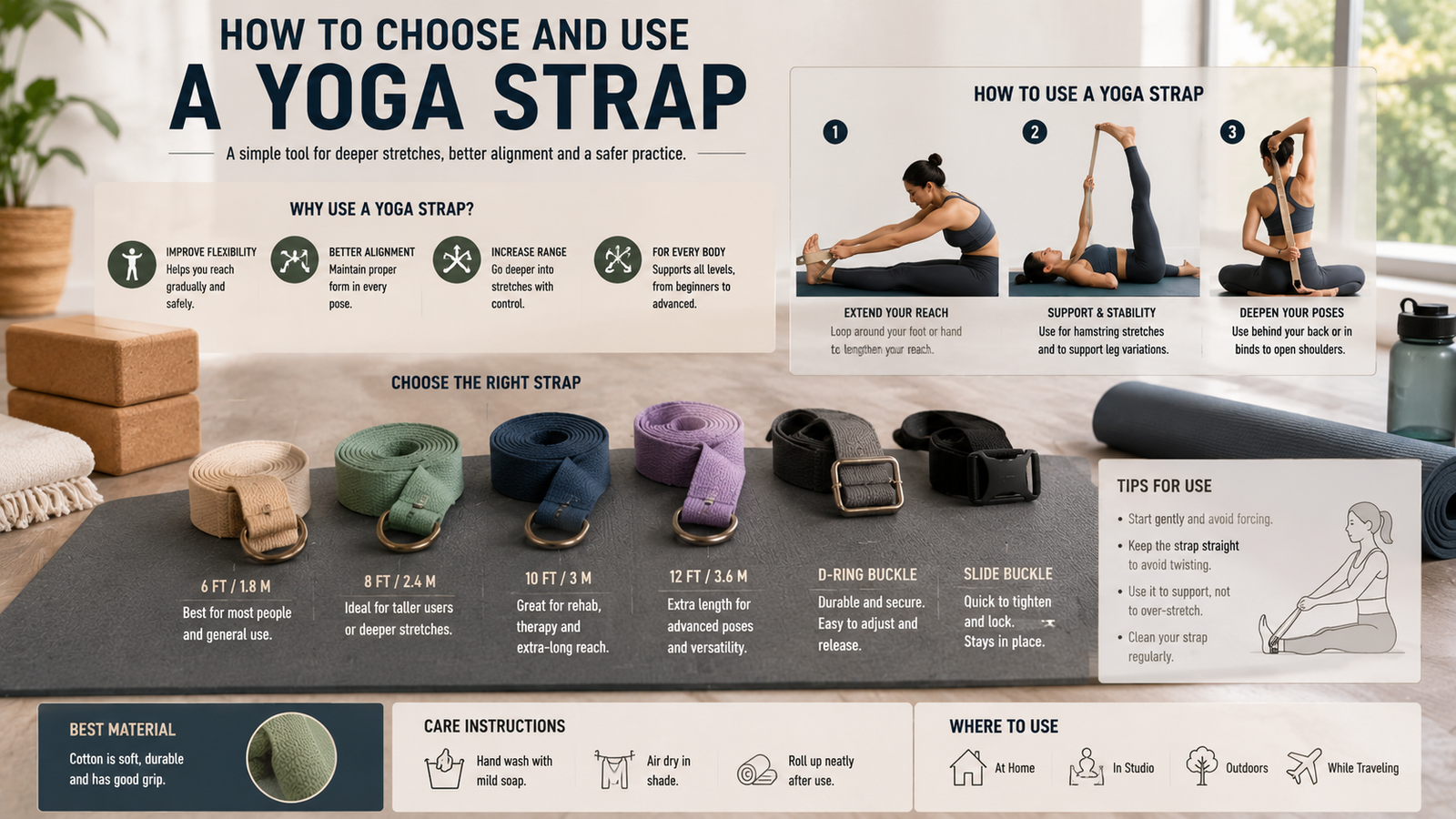
Yoga and Stretching Straps
A stretching strap provides:
- reach;
without significant elasticity.
This makes it useful for:
- hamstrings;
- calves;
- shoulders;
- quadriceps.
Why a Strap Can Be Better Than a Band for Stretching
A strap stays approximately the same length.
That makes it easier to control:
- exact position.
A resistance band stretches and changes tension as you pull.
Strap for Hamstring Mobility
Lie on your back.
Loop the strap around:
- midfoot.
Raise the leg until you feel comfortable tension.
Keep the knee slightly bent if necessary.
Do Not Pull the Leg as Far as Possible
Use the strap to support the position rather than forcing the range.
Strap for Shoulder Mobility
Useful when the hands cannot reach each other behind:
- back.
The strap bridges the gap.
Over time, you may reduce the distance between the hands if comfortable.
Multi-Loop Stretching Straps
These contain sewn loops.
Advantages:
- easy hand placement;
- repeatable positions;
- useful for limited grip.
They can be particularly practical for:
- beginners;
- older adults.
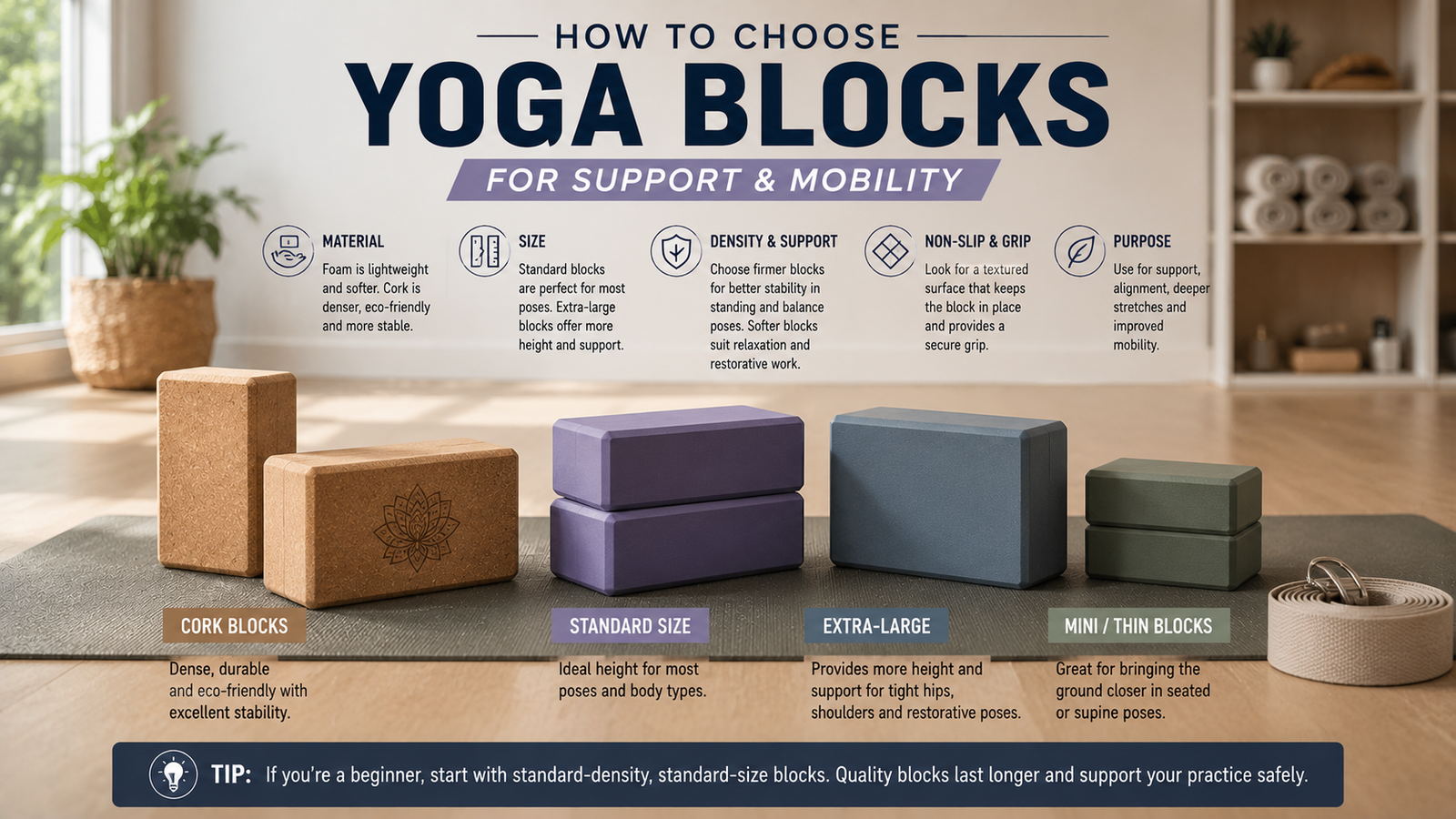
Yoga Blocks
Yoga blocks create a stable surface at different heights.
They are particularly useful when the floor is:
- too far away.
Mobility Uses for Blocks
Examples include:
- hamstring stretching;
- lunges;
- hip mobility;
- adductor work;
- squat support;
- shoulder mobility.
Blocks Reduce Range Requirements
Suppose you are performing a:
- half-kneeling hamstring stretch.
Instead of reaching the floor, place your hands on blocks.
This helps maintain:
- balance;
- trunk position.
Block Height Progression
Blocks usually provide three positions:
- high;
- medium;
- low.
You may gradually move from:
high → medium → low
as mobility improves.
But this progression is not mandatory.
Blocks for 90/90 Hip Mobility
Sitting on a block may reduce the amount of hip rotation required.
This can make the position easier to control.
Blocks for Adductor Mobility
During:
- adductor rock-backs;
- side-lunge mobility;
blocks under the hands reduce balance demands.
Cork vs Foam Blocks for Mobility
Foam
- lighter;
- softer;
- comfortable.
Cork
- firmer;
- more stable.
For mobility drills involving substantial hand pressure, cork often feels more secure.
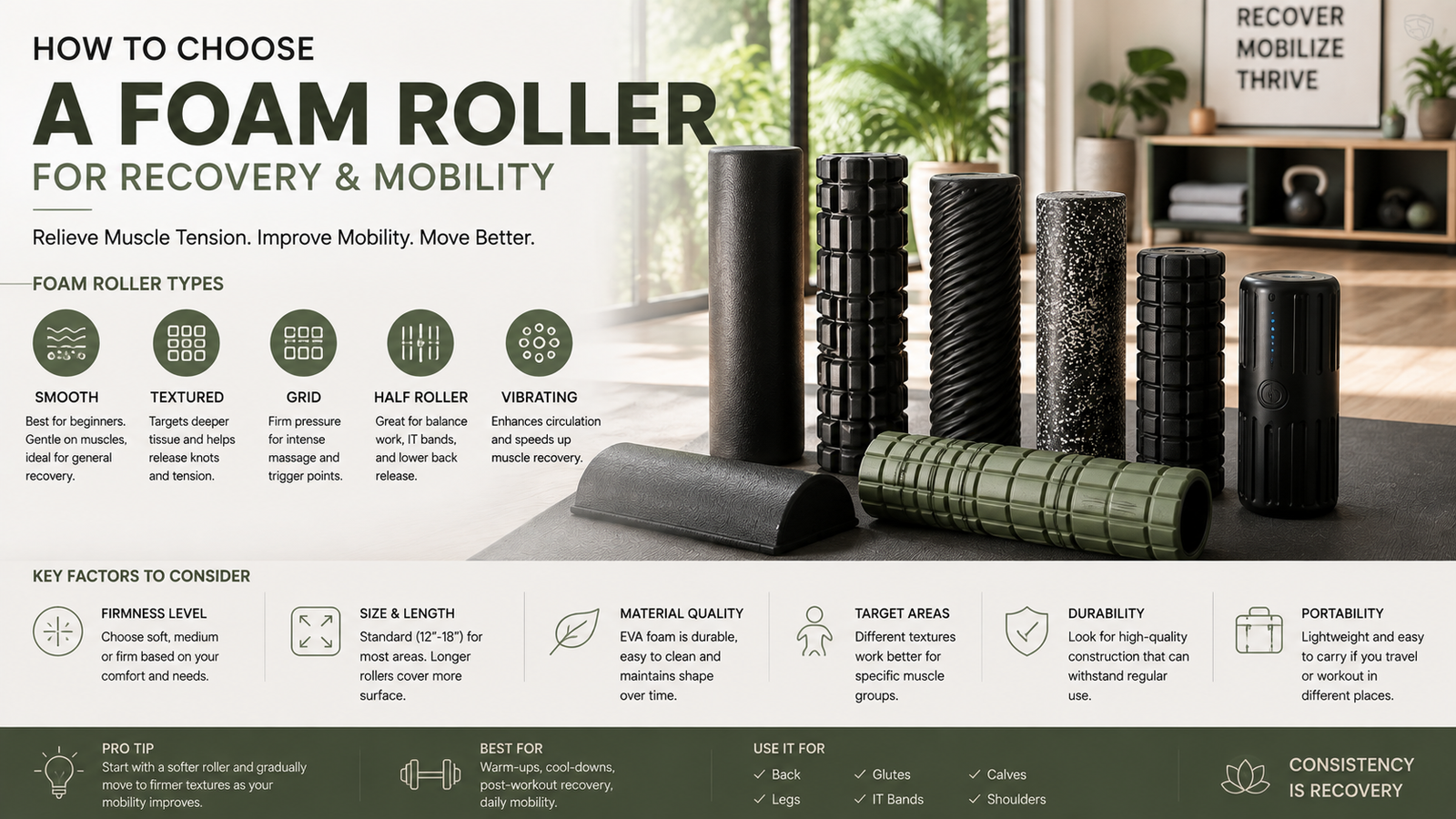
Foam Rollers
Foam rollers apply broad pressure to large muscle groups.
They may help temporarily with:
- stiffness;
- soreness;
- range of motion.
They are useful but should not be treated as:
- mandatory;
- therapeutic cure-all.
Best Areas for Foam Rolling
Common areas include:
- calves;
- quadriceps;
- hamstrings;
- glutes;
- upper back;
- lats.
Foam Rolling Before Mobility
This can be a useful sequence:
roll → mobilize → strengthen
For example:
Calves
- Foam roll.
- Knee-to-wall ankle drill.
- Calf raises.
Upper Back
- Foam roll.
- Thoracic rotations.
- Wall slides.
Hips
- Glute roll.
- 90/90 transitions.
- Split squats.
This combines temporary comfort with active movement.
Smooth vs Textured Rollers
For mobility work, a smooth roller is usually enough.
Aggressive textures are rarely necessary.
Massage Balls
Massage balls provide much more concentrated pressure than a foam roller.
Common types include:
- smooth rubber balls;
- textured balls;
- lacrosse-style balls;
- softer therapy balls;
- peanut-shaped balls.
Where Massage Balls Work Well
They are useful around:
- glutes;
- feet;
- upper back;
- chest;
- shoulders.
They can reach smaller areas that a foam roller cannot.
Massage Ball vs Foam Roller
Foam Roller
Broad pressure.
Massage Ball
Localized pressure.
If you are new to self-massage, start with:
- broader;
- softer pressure.
Hard Massage Balls
A hard lacrosse-style ball can create intense pressure.
It may be useful for experienced users but is often too aggressive for beginners.
Soft Massage Balls
Provide gentler pressure.
Better for:
- sensitive areas;
- beginners;
- wall-based rolling.
Textured Balls
Raised projections do not automatically make the tool more effective.
They simply create different:
- sensory pressure.
Peanut Massage Balls
Two connected balls create a groove in the middle.
They can be useful around the:
- upper back;
because the spine can sit between the two sides.
Do Not Place Excessive Pressure Directly on the Spine
Even with a peanut tool, pressure should remain mainly on the tissues beside the spine.
Massage Ball Against a Wall
This is one of the best beginner methods.
The wall allows you to control pressure by changing how much body weight you lean into it.
Useful for:
- upper back;
- shoulders;
- glutes.
Floor-Based Massage Ball
Creates significantly more pressure.
Use carefully.
Massage Ball for the Glutes
Place the ball between:
- glute;
- wall;
or sit carefully on it.
Move slowly.
Sciatic-Type Symptoms
If pressure produces:
- shooting pain;
- numbness;
- tingling;
stop.
Do not keep pressing because you think you found a “deep knot.”
Massage Ball for the Feet
A small ball works well under the foot.
Roll gently across:
- arch.
Frozen Water Bottle vs Massage Ball for Feet
A cold bottle combines:
- rolling;
- cold sensation.
Some people find it comfortable for temporary foot soreness.
But persistent foot pain may require broader management.
Massage Ball for the Upper Back
Use the wall.
Avoid direct pressure on:
- spine;
- shoulder blade edges.
Move slowly.
Massage Ball for the Chest
A soft ball against the wall may be used around the pectoral muscles.
Avoid direct pressure over:
- breast tissue;
- sternum;
- ribs.
Massage Ball Around the Shoulder
Use gentle wall pressure.
The shoulder contains many smaller structures.
More pressure is not automatically better.
Massage Sticks
Massage sticks are handheld rollers.
They usually contain:
- rotating segments;
- handles on both ends.
You roll the stick manually over the muscles.
Advantages of Massage Sticks
- excellent pressure control;
- easy on calves and thighs;
- no need to get on floor;
- convenient for travel.
Disadvantages
- requires both hands;
- difficult to reach the back.
Who Benefits Most?
They are particularly useful for:
- runners;
- cyclists;
- older adults;
- people who dislike floor foam rolling.
Massage Stick for Quadriceps
Sit comfortably and roll the stick over the front of the thighs.
You control pressure directly through the hands.
Massage Stick for Calves
Excellent because you can easily adjust:
- direction;
- intensity.
Massage Stick for Hamstrings
Use while seated.
The position is usually easier than body-weight foam rolling.
Massage Stick vs Foam Roller
Choose a massage stick if you prioritize:
- portability;
- pressure control;
- easy leg use.
Choose a foam roller if you want:
- upper-back rolling;
- more body-weight pressure.
Mobility Sticks
The term “mobility stick” can refer to different tools.
Some are rigid long poles used for:
- leverage;
- stretching;
- balance;
- movement drills.
These should not be confused with massage sticks.
Long Mobility Poles
A rigid pole may help with:
- shoulder mobility;
- hip rotation;
- balance;
- assisted stretching.
Do You Need a Special Mobility Stick?
Usually not.
A simple:
- dowel;
- PVC pipe;
- broomstick;
may perform many of the same functions if it is:
- strong;
- smooth;
- safe.
Dowel for Shoulder Mobility
Hold the dowel with a wide grip and perform controlled overhead movements.
This is similar to strap pass-throughs but without elasticity.
Dowel for Hip Hinge Practice
Hold the stick along the spine with contact at:
- head;
- upper back;
- pelvis.
Practice hinging while maintaining contact.
This teaches movement awareness.
Dowel for Squat Assistance
Hold a vertical stick for light balance assistance while exploring:
- squat depth.
Do not pull heavily on an unstable object.
Mobility Stick for Rotational Drills
A long stick can provide visual feedback during:
- trunk rotation;
- shoulder movement.
Stretching Wedges
Wedges create an inclined surface.
They may be used beneath:
- heels;
- forefoot.
Heel Wedges
Elevating the heel changes squat mechanics.
It reduces the amount of ankle dorsiflexion required.
Why Use a Heel Wedge?
Useful if you:
- temporarily lack ankle mobility;
- want to practice deeper squatting;
- perform heel-elevated squat variations.
Is a Heel Wedge a Mobility Tool or Exercise Tool?
Both.
It can modify exercise while you separately work on mobility.
Using one does not mean you are avoiding mobility.
Wedge Angle
Common wedges may use:
- 10°;
- 15°;
- 20°;
- steeper angles.
For general use, moderate elevation is usually sufficient.
Too-Steep Wedges
May feel unstable and change squat mechanics substantially.
Start conservatively.
Forefoot Wedges
Can be used for:
- calf stretching;
- ankle mobility.
Calf Stretching With a Wedge
Place forefoot on the incline and heel lower.
Keep support nearby.
Do not aggressively force the ankle.
Wedge Stability
A mobility wedge should have:
- non-slip base;
- sufficient width;
- rigid construction.
Foam Wedges
Lightweight but may compress.
Wooden or Plastic Wedges
More rigid.
Better for:
- loaded squats;
- repeated use.
Slant Boards
A larger version of a wedge.
Often used for:
- calf stretching;
- ankle mobility;
- squat variations.
Adjustable Slant Boards
Allow several angles.
Useful if multiple people use the equipment.
Do You Need a Slant Board?
No.
A wedge is helpful, but basic ankle mobility can be performed without one.
Sliders
Sliders are small discs placed under:
- hands;
- feet.
They reduce friction against the floor.
Mobility Uses for Sliders
They can support:
- adductor mobility;
- hamstring exercises;
- lunges;
- shoulder slides;
- controlled range drills.
Slider Side Lunge
Place one foot on the slider.
Slowly move it outward while bending the supporting leg.
This combines:
- mobility;
- strength.
Slider Hamstring Curl
Lie on your back with heels on sliders.
Lift hips and slide feet away and back.
This is primarily a:
- strength exercise;
but it trains the hamstrings through changing ranges.
Slider Mountain Climbers
More conditioning-focused.
Not primarily mobility.
Slider Shoulder Work
Hands may move along the floor during:
- bodyweight shoulder mobility drills.
Use only where the surface allows smooth movement.
Sliders on Carpet vs Hard Floor
Some sliders are designed for:
- carpet.
Others for:
- wood;
- tile.
Check compatibility.
Towels as Sliders
On smooth floors, small towels may work.
Make sure the floor is:
- clean;
- non-hazardous.
Slider Safety
Movement can become unexpectedly large.
Start with:
- short range;
- slow speed.
Do not allow the foot to slide farther than you can control.
Mobility Balls With Spikes
Some products use large spikes or knobs.
They are often marketed for:
- deep tissue;
- fascia release.
The spikes are not necessary for effective self-massage.
They simply concentrate pressure.
When Spiky Balls May Feel Useful
Some users prefer them on:
- feet;
- glutes.
But beginners should usually start with a smooth ball.
Massage Canes
Massage canes are hooked tools that allow you to press into difficult-to-reach areas.
They often have several rounded pressure points.
Why Use a Massage Cane?
It helps reach:
- upper back;
- shoulders.
without requiring:
- floor work.
Pressure Control
Because the lever is long, it can create substantial force.
Use gentle pressure.
Massage Cane for Upper Back
Position the rounded end on the muscle beside the shoulder blade.
Pull gently with the handles.
Avoid:
- spine;
- neck bones.
Massage Cane Advantages
- targeted;
- good reach;
- useful for desk workers.
Disadvantages
- easy to overdo;
- bulky;
- specialized.
Do You Need One?
Probably not if a:
- massage ball against wall;
already solves the problem.
Small Rollers
Some tools use a small cylindrical roller for:
- feet;
- forearms;
- calves.
Foot Rollers
May have:
- smooth;
- ridged surfaces.
Useful for temporary foot comfort.
Forearm Rollers
Can help people whose forearms feel stiff after:
- gripping;
- climbing;
- racket sports.
But strengthening and load management matter more long term.
Mobility Floss Bands
Floss bands are thick elastic bands wrapped tightly around a limb while movement is performed.
They are sometimes used in:
- sports;
- rehabilitation settings.
What Do Floss Bands Claim to Do?
Common claims include:
- improve mobility;
- increase circulation;
- break adhesions.
Evidence and mechanisms are less clear than many marketing claims suggest.
Floss Band Compression
These bands can create significant circumferential pressure.
That means misuse can interfere with:
- circulation;
- nerve function.
Are Floss Bands Good Beginner Mobility Tools?
Usually not.
Most people can improve mobility without them.
Simpler tools such as:
- resistance bands;
- blocks;
- straps;
are safer and easier to control.
Floss Band Warning Signs
Remove immediately if you experience:
- numbness;
- tingling;
- significant colour change;
- intense pain.
Who Should Avoid Flossing Without Professional Guidance?
Particular caution may be appropriate for people with:
- vascular problems;
- neuropathy;
- clotting concerns;
- pregnancy;
- certain medical conditions.
Percussion Tools
Massage guns are sometimes grouped with mobility tools.
They provide rapid percussive stimulation.
They may temporarily affect:
- comfort;
- range of motion.
But they are more properly considered recovery tools.
Do You Need a Massage Gun for Mobility?
No.
A foam roller or ball is usually enough.
Mobility Tool vs Recovery Tool
There is significant overlap.
For example:
Foam Roller
Often used for recovery but may support mobility.
Resistance Band
Primarily exercise/mobility tool.
Massage Ball
Primarily recovery/self-massage.
The category matters less than whether the tool solves a real problem.
Build Mobility Around Movement, Not Massage
This is the central principle.
A useful mobility session often follows:
pressure or support → active movement → strength
instead of stopping after self-massage.
Example Ankle Mobility Sequence
Step 1 — Calf Roll
30–45 seconds.
Step 2 — Knee-to-Wall Drill
8–10 repetitions.
Step 3 — Loaded Ankle Control
Slow calf raises or split squat.
This helps integrate the new range.
Example Hip Mobility Sequence
Step 1 — Glute Massage Ball
30 seconds.
Step 2 — 90/90 Hip Transitions
6–8 repetitions.
Step 3 — Split Squat
6–10 controlled reps.
Example Shoulder Mobility Sequence
Step 1 — Upper-Back Foam Roll
45 seconds.
Step 2 — Strap or Band Pass-Through
6–8 repetitions.
Step 3 — Wall Slide or Light Overhead Press
6–10 repetitions.
Example Hamstring Mobility Sequence
Step 1 — Strap-Assisted Hamstring Stretch
30 seconds.
Step 2 — Active Leg Raise
5–8 repetitions.
Step 3 — Romanian Deadlift
Controlled repetitions.
Passive Range vs Active Range
Mobility tools often help create passive range.
But useful movement requires active control.
Passive Range
Range achieved with:
- strap;
- gravity;
- external assistance.
Active Range
Range you can reach and control using your own muscles.
Why the Difference Matters
Suppose a strap allows your leg to reach:
- 90°.
But without the strap, you can lift it only:
- 50°.
The difference represents range you cannot yet fully control.
That may be a reason to train:
- active mobility;
- strength.
End-Range Strength
This means producing force near the end of your available range.
Examples:
- active leg raises;
- controlled shoulder flexion;
- deep split squats;
- calf raises through full range.
Mobility tools can help position you there, but strength helps you own the range.
Mobility Tools Before Strength Training
A short targeted routine may improve how an exercise feels.
But avoid turning the warm-up into a 30-minute ritual.
Before Squats
Possible routine:
- calf roll;
- ankle rocks;
- supported deep squat;
- warm-up sets.
Before Overhead Press
Possible routine:
- upper-back roll;
- band pass-through;
- wall slide;
- warm-up presses.
Before Running
Possible routine:
- calf mobility;
- leg swings;
- easy jogging.
You may not need any self-massage tool.
Before Deadlifts
Dynamic movement and warm-up sets usually matter more than deep stretching.
A short hamstring or glute mobility drill may be enough.
Mobility Tools After Training
You may use:
- foam roller;
- massage ball;
- stretching strap;
if they feel good.
But post-workout mobility is optional.
You Do Not Need to “Undo” Training
Strength training does not automatically tighten your body in a harmful way.
Training through appropriate ranges may improve mobility itself.
Recovery Tools Do Not Replace Recovery
The major foundations remain:
- sufficient sleep;
- nutrition;
- training-load management;
- general movement.
Mobility tools are secondary.
How Long Should Mobility Sessions Be?
A useful targeted session may take:
- 5–15 minutes.
Longer sessions are fine if mobility itself is a major goal.
Daily Mobility
Short gentle mobility can be performed frequently.
But intense end-range training may require:
- recovery.
Mobility Snacks
Brief 2–5 minute bouts throughout the day.
Examples:
- ankle rocks;
- shoulder reaches;
- 90/90 transitions.
You do not need equipment every time.
Desk Mobility Tools
A simple band or mobility stick may be enough.
But regular:
- standing;
- walking;
may be more important than constantly using self-massage devices.
Mobility Tools for Runners
A practical setup:
- resistance band;
- massage ball;
- foam roller.
Common areas:
- calves;
- hips;
- hamstrings.
Mobility Tools for Cyclists
Potentially useful:
- foam roller;
- band;
- yoga block.
Focus on:
- hips;
- thoracic spine;
- shoulders.
Mobility Tools for Lifters
Useful:
- long loop bands;
- foam roller;
- yoga blocks.
These can support:
- squat;
- shoulder;
- hip mobility.
Mobility Tools for Yoga
A simple yoga-oriented kit:
- mat;
- two blocks;
- strap.
You may not need:
- massage tools;
unless desired separately.
Mobility Tools for Older Adults
Ease of use matters more than intensity.
Useful options:
- long strap;
- high-density foam blocks;
- light resistance band;
- massage stick.
Floor Access
If getting down to the floor is difficult, avoid tools that require extensive:
- kneeling;
- floor transfers.
A massage stick or wall-based ball may be more practical.
Mobility Tools for Beginners With Limited Balance
Use:
- wall;
- chair;
- blocks;
for support.
Do not make mobility unnecessarily unstable.
Balance Is Not Automatically Improved by Unstable Equipment
Mobility and balance can be trained separately.
A stable support often lets you focus more effectively on:
- joint movement.
Mobility Tools for Larger Bodies
Choose tools that provide:
- wider support surfaces;
- higher-density foam;
- adequate strap length.
Longer Straps
Can provide more room around:
- legs;
- torso.
Wider Blocks
Can provide more secure hand support.
Stronger Foam Rollers
High-density rollers resist excessive compression.
Mobility Tools for Tall Users
You may benefit from:
- longer straps;
- larger mats;
- longer foam rollers.
But tool size should still match the movement.
Mobility During Pregnancy
Some tools can remain useful, especially:
- blocks;
- straps;
- light bands.
They may help accommodate changing:
- balance;
- body position.
Pregnancy-specific exercise guidance may be appropriate depending on:
- stage;
- symptoms;
- medical history.
Avoid Aggressive Compression
Deep abdominal foam rolling or tight compression tools are generally inappropriate during pregnancy.
Mobility and Hypermobility
If you naturally move through very large ranges, mobility tools should not encourage:
- deeper passive stretching.
Use them instead to support:
- controlled range;
- strength.
Blocks as Range Limiters
A block can stop a movement before extreme range.
This can be particularly helpful for hypermobile users.
Bands for Stability
Light resistance may help strengthen around:
- shoulders;
- hips.
Mobility During Rehabilitation
Mobility tools are often used in physiotherapy.
But the tool itself does not determine whether an exercise is appropriate.
Follow individualized guidance for:
- injury;
- post-surgical recovery.
Pain vs Stiffness
This distinction matters.
Stiffness
A sensation of limited or resistant movement.
Pain
An unpleasant sensory experience that may signal irritation or injury.
If the main problem is pain rather than stiffness, repeatedly stretching or rolling harder may worsen the problem.
Mobility Tools Should Not Be Used to Numb Warning Signs
If an area repeatedly hurts during:
- squatting;
- running;
- reaching;
do not simply roll it until the pain temporarily decreases.
The underlying issue may involve:
- load;
- technique;
- injury;
- medical factors.
Numbness and Tingling
These are not normal stretching sensations.
Stop the movement or pressure.
They may indicate:
- nerve compression;
- irritation.
Bruising
Self-massage should not routinely leave significant bruising.
Reduce pressure.
Swelling
Do not aggressively roll an area with unexplained:
- swelling;
- warmth;
- redness.
Appropriate medical assessment may be necessary.
Mobility Tools and Acute Injury
Do not use aggressive:
- massage;
- stretching;
on a freshly injured area.
Examples include:
- acute strain;
- sprain;
- severe bruise.
Massage Tools and Blood Clots
Never massage an area where deep-vein thrombosis is suspected.
Symptoms such as:
- unilateral swelling;
- warmth;
- redness;
- calf pain;
require urgent medical assessment.
Mobility Tools and Anticoagulants
People using blood-thinning medication may bruise more easily.
Professional guidance may be appropriate before intense self-massage.
Mobility Tools and Neuropathy
Reduced sensation makes pressure harder to judge.
Use caution.
Mobility Tools and Osteoporosis
Aggressive pressure directly over:
- spine;
- ribs;
may be inappropriate for some people.
Seek professional guidance where relevant.
Mobility Tools and Arthritis
Gentle support can be useful.
Examples:
- blocks;
- straps;
- light bands.
Avoid forcing joints through painful ranges.
Mobility Tools for Shoulder Pain
A light band may help with strengthening exercises.
But do not assume every painful shoulder needs:
- stretching.
Some shoulders benefit more from:
- strength;
- load modification.
Mobility Tools for Knee Pain
Hip and ankle mobility may influence certain knee movements.
But the knee itself should not be aggressively:
- compressed;
- twisted.
Mobility Tools for Back Pain
Foam rolling the upper back may feel comfortable.
Avoid repeatedly pressing directly into the:
- lumbar spine.
Persistent back pain deserves appropriate assessment.
Mobility Tools for Neck Pain
Avoid aggressive rolling or hard-ball pressure directly on the:
- neck;
- cervical spine.
Gentle movement is usually safer.
Mobility Tool Marketing Claims
Be cautious with products promising to:
- unlock joints instantly;
- break scar tissue;
- melt fascia;
- permanently fix posture;
- detox muscles;
- eliminate pain in minutes.
These claims often oversimplify how mobility works.
“Release Your Fascia”
This phrase is commonly used.
Self-massage may alter:
- sensation;
- movement tolerance.
But you are not physically peeling fascia away from muscle.
“Open Your Hips”
Your hips do not literally open.
The phrase usually means improving movement through:
- flexion;
- extension;
- rotation.
“Realign Your Joints”
Simple mobility tools do not permanently reposition joints into some ideal alignment.
Human movement naturally varies.
“Break Adhesions”
Deep scar tissue or adhesions cannot simply be broken apart with ordinary home massage tools.
“Correct Posture”
No mobility tool can create one universally perfect posture.
Regular movement, strength and comfort matter more.
“Increase Circulation”
Some pressure tools may temporarily alter local blood flow.
But this should not be treated as a unique therapeutic mechanism.
Expensive Mobility Tools Are Not Necessarily Better
The most useful tools are often inexpensive.
Examples:
- resistance band;
- yoga block;
- strap;
- massage ball.
You can build a highly effective setup without premium electronics.
Minimal Mobility Toolkit
For most people:
- one long loop resistance band;
- two yoga blocks;
- one strap;
- one foam roller or massage ball.
That is already enough for many mobility routines.
Ultra-Minimal Setup
If you want only two tools:
Option 1
Resistance band + yoga block.
Option 2
Foam roller + strap.
Choose according to your needs.
Mobility Toolkit for Strength Training
Useful:
- long loop bands;
- yoga blocks;
- foam roller.
Mobility Toolkit for Running
Useful:
- massage ball;
- foam roller;
- light resistance band.
Mobility Toolkit for Yoga
Useful:
- yoga blocks;
- strap.
Mobility Toolkit for Travel
Choose:
- resistance band;
- strap;
- massage ball.
These occupy almost no luggage space.
Mobility Toolkit for a Desk Worker
A simple:
- resistance band;
- massage ball;
is enough.
But daily walking and movement breaks should remain the priority.
Mobility Toolkit for Home Recovery
- foam roller;
- massage ball;
- stretching strap.
Mobility Toolkit for Older Adults
- long strap;
- foam blocks;
- light band;
- massage stick.
Portability
Mobility tools vary greatly.
Very Portable
- straps;
- bands;
- massage balls;
- sliders.
Moderately Portable
- massage sticks;
- short foam rollers.
Less Portable
- full-size foam rollers;
- slant boards.
Home vs Travel Equipment
You do not need the same tool for both.
A long foam roller can stay:
- home.
A massage ball can travel.
Storage
Mobility equipment is small, but collections become cluttered.
Use:
- basket;
- wall hooks;
- shelf.
Band Storage
Hang or loosely coil bands.
Avoid:
- tight knots;
- sharp hooks.
Strap Storage
Store clean and dry.
Foam Roller Storage
Vertical storage saves space.
Massage Ball Storage
Keep in a small container so it does not roll under:
- furniture.
Slider Storage
Keep pairs together.
Wedge Storage
Store flat to prevent:
- warping.
Cleaning Mobility Tools
Cleaning depends on material.
Resistance Bands
Use a:
- damp cloth;
- mild soap where allowed.
Dry completely.
Yoga Blocks
Foam:
- wipe with mild cleaner.
Cork:
- lightly damp cloth.
Straps
Many can be:
- hand washed.
Follow care instructions.
Foam Rollers
Wipe:
- sweat;
- floor dust.
Massage Balls
Usually easy to wash with mild soap.
Massage Sticks
Wipe handles and rollers.
Wedges and Slant Boards
Keep:
- dry;
- free from sweat.
Sliders
Clean the surface that contacts the floor.
Dust can increase or reduce:
- friction unpredictably.
Avoid Harsh Chemicals
Strong solvents may damage:
- rubber;
- latex;
- foam.
Dry Before Storage
Moisture can create:
- odour;
- material degradation.
Mobility Tools in Hot Climates
Heat can damage:
- latex bands;
- foam;
- adhesives.
Do not leave equipment for long periods in:
- hot vehicles;
- direct sunlight.
Mobility Tools in Humid Conditions
Humidity can affect:
- cotton straps;
- cork;
- metal buckles.
Dry after sweaty sessions.
India-Specific Practical Considerations
For warm and humid home environments:
- quick-drying straps;
- washable bands;
- rust-resistant hardware;
- easy-to-clean foam rollers;
can be particularly practical.
Replacement Signs: Resistance Bands
Replace if you see:
- cracks;
- thinning;
- tears;
- damaged seams.
Replacement Signs: Straps
Replace if:
- webbing is torn;
- buckle slips;
- stitching fails.
Replacement Signs: Foam Rollers
Replace if:
- heavily flattened;
- cracked;
- warped.
Replacement Signs: Massage Balls
Replace if:
- split;
- sticky;
- deteriorating.
Replacement Signs: Blocks
Replace if:
- severely compressed;
- cracked;
- warped.
Replacement Signs: Sliders
Replace if the surface becomes:
- deeply damaged;
- unpredictable.
How to Evaluate a Mobility Tool Before Buying
Ask whether it solves a specific problem.
If you cannot identify the purpose, you probably do not need it.
Check Construction
Look for:
- uniform material;
- strong stitching;
- stable surfaces;
- smooth edges.
Check Pressure Level
For massage tools, the tool should feel:
- tolerable;
not like a torture device.
Check Dimensions
Examples:
- strap long enough;
- block wide enough;
- roller suitable for intended body area.
Check Portability
Only if you actually plan to travel with it.
Check Cleaning
You are likely to touch mobility equipment with:
- hands;
- feet;
- sweaty skin.
Easy cleaning matters.
Check Replacement Availability
Particularly for:
- band sets;
- electronic recovery tools.
Common Mobility-Tool Buying Mistakes
Buying a Complete 20-Piece Kit
Most accessories go unused.
Choosing the Hardest Massage Ball
More pain is not more effective.
Buying Heavy Resistance Bands for Stretching
Mobility usually needs lighter resistance.
Buying Specialty Tools Before Basic Equipment
Start simple.
Choosing a Huge Slant Board for a Small Room
Storage matters.
Buying a Massage Gun When a Ball Would Do the Same Job
Solve the need efficiently.
Choosing Products Based on “Fascia Release” Marketing
Focus on actual function.
Buying Multiple Tools That Do the Same Thing
Avoid duplication.
Common Mobility-Training Mistakes
Spending More Time Rolling Than Moving
Mobility requires active movement.
Chasing Maximum Range
Useful control matters more.
Forcing Stretching With Straps
Use support, not leverage to overpower the joint.
Pulling Aggressively With Bands
More traction is not necessarily better.
Pressing Hard on Every Tender Spot
Tenderness does not automatically mean pathology.
Stretching Through Numbness or Tingling
Stop.
Ignoring Strength
Mobility without strength may not transfer well.
Performing the Same Routine Every Day Regardless of Need
Target the movement that matters.
How to Build a Mobility Session
A simple framework works well.
Step 1 — Identify the Limitation
For example:
- ankle movement.
Step 2 — Optional Soft-Tissue Work
Example:
- calf roller for 30 seconds.
Step 3 — Active Mobility
Example:
- knee-to-wall drill.
Step 4 — Strength Through the Range
Example:
- split squat;
- calf raise.
This is more complete than rolling alone.
A 10-Minute Full-Body Mobility Routine
Upper-Back Foam Roll
45 seconds.
Band Pass-Through
8 repetitions.
90/90 Hip Transitions
8 repetitions.
Supported Hip-Flexor Stretch
30 seconds each side.
Knee-to-Wall Ankle Drill
8 each side.
Supported Deep Squat
30 seconds.
Simple and sufficient.
A Lower-Body Mobility Routine
Calf Massage
30 seconds each.
Ankle Rock
10 each side.
90/90 Hip Transition
8 repetitions.
Adductor Rock-Back
8 each side.
Split Squat
8 each side.
An Upper-Body Mobility Routine
Upper-Back Foam Roll
60 seconds.
Shoulder Strap Pass-Through
8 repetitions.
Band External Rotation
10 each side.
Wall Slide
8 repetitions.
Thoracic Open Book
6 each side.
A Desk-Break Mobility Routine
No equipment is even required, but if available:
Band Pull-Apart
10 repetitions.
Wall Reach
5 repetitions.
Thoracic Rotation
5 each side.
Bodyweight Squat
5–10 repetitions.
Short Walk
2 minutes.
A Runner’s Mobility Routine
Calf Roll
30 seconds each.
Knee-to-Wall
8 each side.
Hip 90/90
6 each side.
Split Squat
6 each side.
Calf Raise
12 repetitions.
Mobility Tool Buying Checklist
Before purchasing, ask:
1. Which movement am I trying to improve?
Start here.
2. Do I need support, resistance, reach or pressure?
This determines tool type.
3. Could a basic household item safely do the same job?
Sometimes yes.
4. Do I already own something that serves the same purpose?
Avoid duplicates.
5. Is the tool comfortable enough to use regularly?
Especially massage tools.
6. Is the material durable?
Bands and foam can wear.
7. Is it easy to clean?
Important for frequent use.
8. Can I store it easily?
Large accessories can become clutter.
9. Is it portable enough for my actual routine?
Only relevant if you travel.
10. Does it require an anchor?
If yes, can you anchor it safely?
11. Is the resistance appropriate?
Mobility work rarely requires the strongest band.
12. Is the pressure too aggressive?
Start gentler.
13. Does the block or wedge sit flat?
Stability matters.
14. Is the strap long enough?
Longer is usually more versatile.
15. Is the product solving a real limitation or just offering another gadget?
This is often the deciding question.
A Simple Choice by Goal
General Mobility
Choose:
light resistance band + yoga blocks + strap
Stretching
Choose:
strap + blocks
Recovery / Soreness
Choose:
foam roller or massage ball
Ankle Mobility
Choose:
wedge/slant board + band if desired
Hip Mobility
Choose:
blocks + band
Shoulder Mobility
Choose:
strap or light band
Travel
Choose:
band + strap + massage ball
A Simple Choice by Tool Function
Support
Yoga block.
Additional Reach
Yoga strap.
Resistance
Resistance band.
Broad Self-Massage
Foam roller.
Targeted Pressure
Massage ball.
Hand-Controlled Massage
Massage stick.
Ankle Angle Modification
Wedge.
Low-Friction Movement
Sliders.
A Simple Choice for Beginners
A beginner does not need a large recovery kit.
Start with:
one light-to-medium long resistance band + two yoga blocks + one yoga strap
Then add either:
- foam roller;
- massage ball;
only if self-massage feels useful.
That small setup covers most:
- stretching;
- mobility;
- warm-up needs.
A Simple Choice for Strength Trainees
Use:
- long loop band;
- foam roller;
- yoga blocks.
Then connect mobility work directly to:
- squat;
- hinge;
- press.
A Simple Choice for Runners
Use:
- massage ball;
- foam roller;
- light resistance band.
Focus mainly on:
- calves;
- hips;
- ankle movement.
A Simple Choice for Yoga Practitioners
Use:
- mat;
- two blocks;
- strap.
You may not need dedicated recovery tools at all.
A Simple Choice for Older Adults
Use:
- long stretching strap;
- firm foam blocks;
- light resistance band;
- massage stick.
Prioritize easy access and stability.
When Should You Stop Using a Mobility Tool?
Stop or modify if you experience:
- sharp pain;
- numbness;
- tingling;
- unusual weakness;
- dizziness;
- significant swelling;
- joint instability.
These are not signs that the tool is “working deeply.”
When Should You Seek Professional Guidance?
A physiotherapist or appropriate clinician may be useful if limited mobility is accompanied by:
- persistent pain;
- neurological symptoms;
- recurrent injury;
- weakness;
- significant loss of function.
Professional input can also help after:
- surgery;
- major injury.
A mobility tool should not delay assessment of symptoms that require more than:
- stretching;
- self-massage.
The Physical Glow Takeaway
Mobility tools should make useful movement easier to practice, not turn mobility into an equipment collection.
For most people, the basic categories are enough:
- resistance band → adds resistance or assistance;
- yoga strap → extends your reach;
- yoga block → brings support closer to you;
- foam roller → provides broad self-massage pressure;
- massage ball → provides targeted pressure;
- wedge → changes ankle or foot angle;
- slider → allows controlled low-friction movement.
You do not need all of them.
Start by identifying the actual problem.
If you cannot reach your foot during a hamstring stretch:
use a strap.
If the floor is too far away during a lunge:
use a block.
If your calf feels temporarily stiff:
use a roller or massage ball, then practice ankle mobility.
If you need resistance during shoulder or hip exercises:
use a light band.
The most useful mobility sequence is usually:
optional pressure or support → active movement → strength through the new range
rather than:
roll harder → stretch farther → repeat indefinitely.
For a simple home mobility setup, most people need no more than:
one long resistance band + two yoga blocks + one strap + one foam roller or massage ball.
That small collection can support:
- ankle mobility;
- hip mobility;
- shoulder movement;
- stretching;
- warm-ups;
- post-workout comfort.
The goal is not to become as flexible as possible.
The goal is to build enough controlled movement to make:
- exercise;
- everyday movement;
- reaching;
- squatting;
- walking;
- bending;
feel easier and more confident.
Choose tools that help you move better, use them consistently and let movement—not the equipment—remain the centre of your mobility routine.