How to Choose a Foam Roller for Recovery and Mobility
Learn how to choose a foam roller for recovery and mobility, with practical guidance on density, texture, size, target areas, comfort and portability. This beginner-friendly guide helps you make a clear, informed choice without unnecessary complexity.
A foam roller is one of the most common recovery and mobility tools used in:
- home gyms;
- physiotherapy settings;
- yoga and mobility routines;
- running programs;
- strength-training recovery.
It is often used before or after exercise to apply pressure to muscles and surrounding soft tissue.
People commonly use foam rollers on:
- calves;
- quadriceps;
- hamstrings;
- glutes;
- upper back;
- lats.
A good foam roller can help you:
- temporarily reduce feelings of muscle stiffness;
- improve short-term range of motion;
- warm up tissues before exercise;
- make mobility work feel more comfortable;
- provide a simple form of self-massage.
But foam rolling is also surrounded by exaggerated claims.
A roller does not literally:
- break up scar tissue;
- crush muscle knots;
- flush toxins from muscles;
- permanently lengthen fascia;
- replace rehabilitation;
- prevent every type of muscle soreness.
The practical way to choose one is:
decide where you will use it → choose the right firmness → select a smooth or textured surface → choose an appropriate length and diameter → consider portability and construction → then learn how to use pressure without turning every session into a pain-tolerance test
For most people, the best foam roller is not the:
- hardest;
- most aggressively textured;
- most expensive.
It is the one that lets you apply enough pressure to feel useful while still allowing your muscles to:
relax → breathe → move → tolerate the session comfortably.
What Is a Foam Roller?
A foam roller is a cylindrical self-massage tool.
You place part of your body over the roller and use:
- body weight;
- arms;
- legs;
to control how much pressure is applied.
As you move over the cylinder, the roller applies compression to the tissues beneath it.
This technique is commonly described as:
self-myofascial release
although the exact physiological effects are more complex than the name suggests.
What Does Foam Rolling Actually Do?
Foam rolling appears to be most useful for short-term changes in:
- perceived muscle tightness;
- range of motion;
- comfort.
It may also reduce some post-exercise soreness in certain situations.
The effect is probably related to several factors, including:
- pressure on sensory receptors;
- temporary changes in pain perception;
- nervous-system responses;
- increased local tissue temperature;
- repeated movement under compression.
It should not be understood as physically breaking apart tissue.
Does Foam Rolling Break Up Knots?
The idea of physically crushing a muscle knot is oversimplified.
A sensation of a “knot” may involve:
- muscle tension;
- sensitive tissue;
- trigger-point-like discomfort;
- fatigue;
- local irritation.
Rolling may make the area feel:
- less sensitive;
- more relaxed;
for a period of time.
But the roller is not mechanically untangling muscle fibres.
Does Foam Rolling Break Up Fascia?
Not in the literal way often advertised.
Fascia is strong connective tissue.
The pressure you can safely apply with a foam roller is not enough to simply:
- break;
- reshape;
deep fascial structures permanently.
Foam rolling may influence:
- sensation;
- mobility tolerance;
- local tissue behaviour.
That is useful without needing exaggerated explanations.
Does Foam Rolling Remove Toxins?
No.
Your body uses systems including the:
- liver;
- kidneys;
- lungs;
to process and remove metabolic waste.
A foam roller does not squeeze toxins out of muscle.
Does Foam Rolling Improve Circulation?
Rolling and pressure may temporarily increase local:
- blood flow;
- warmth.
But this does not mean it “flushes lactic acid” or performs a detoxifying function.
Is Lactic Acid Responsible for Next-Day Soreness?
No.
Lactate levels generally return toward normal relatively quickly after exercise.
Delayed-onset muscle soreness, or DOMS, typically develops hours later and is associated with the response to unfamiliar or demanding exercise.
Foam rolling may reduce the perception of some soreness, but not because it removes stored lactic acid.
Foam Rolling vs Massage
Foam rolling provides self-controlled pressure.
Advantages
- inexpensive;
- available anytime;
- easy to use at home;
- pressure controlled by you.
Limitations
It cannot replicate every aspect of professional:
- massage;
- manual therapy.
A therapist can adjust:
- direction;
- pressure;
- joint position;
much more precisely.
Foam Roller vs Massage Gun
Both can be used for recovery and comfort.
Foam Roller
Uses:
- body weight;
- broader compression.
Massage Gun
Uses:
- rapid percussive movement;
- smaller targeted contact area.
A roller is:
- cheaper;
- simpler;
- requires no battery.
A massage gun is easier to use on some areas but costs more.
Neither is essential.
Foam Roller vs Massage Ball
A massage ball provides more concentrated pressure.
Useful for:
- glutes;
- feet;
- upper back;
- smaller muscle areas.
A foam roller spreads force over a larger surface.
Which Is Better?
Use:
- roller for larger muscle groups;
- ball for more targeted pressure.
Many mobility setups benefit from both, but a roller alone is enough to start.
Foam Roller vs Mobility Stick
A massage stick is held in the hands and rolled over the body.
Advantages:
- easier pressure control;
- useful for calves and thighs;
- no need to support body weight.
A foam roller can usually produce stronger pressure because your body weight is involved.
Do You Need a Foam Roller?
No.
You can recover well with:
- sleep;
- nutrition;
- appropriate training volume;
- walking;
- normal movement.
A foam roller is an optional comfort and mobility tool.
It should support recovery habits, not replace them.
Who May Find Foam Rolling Useful?
It can be particularly useful for people who experience:
- post-workout stiffness;
- tight-feeling calves;
- quadriceps soreness;
- restricted-feeling hips;
- upper-back stiffness.
Athletes who frequently:
- run;
- cycle;
- lift weights;
often find it convenient.
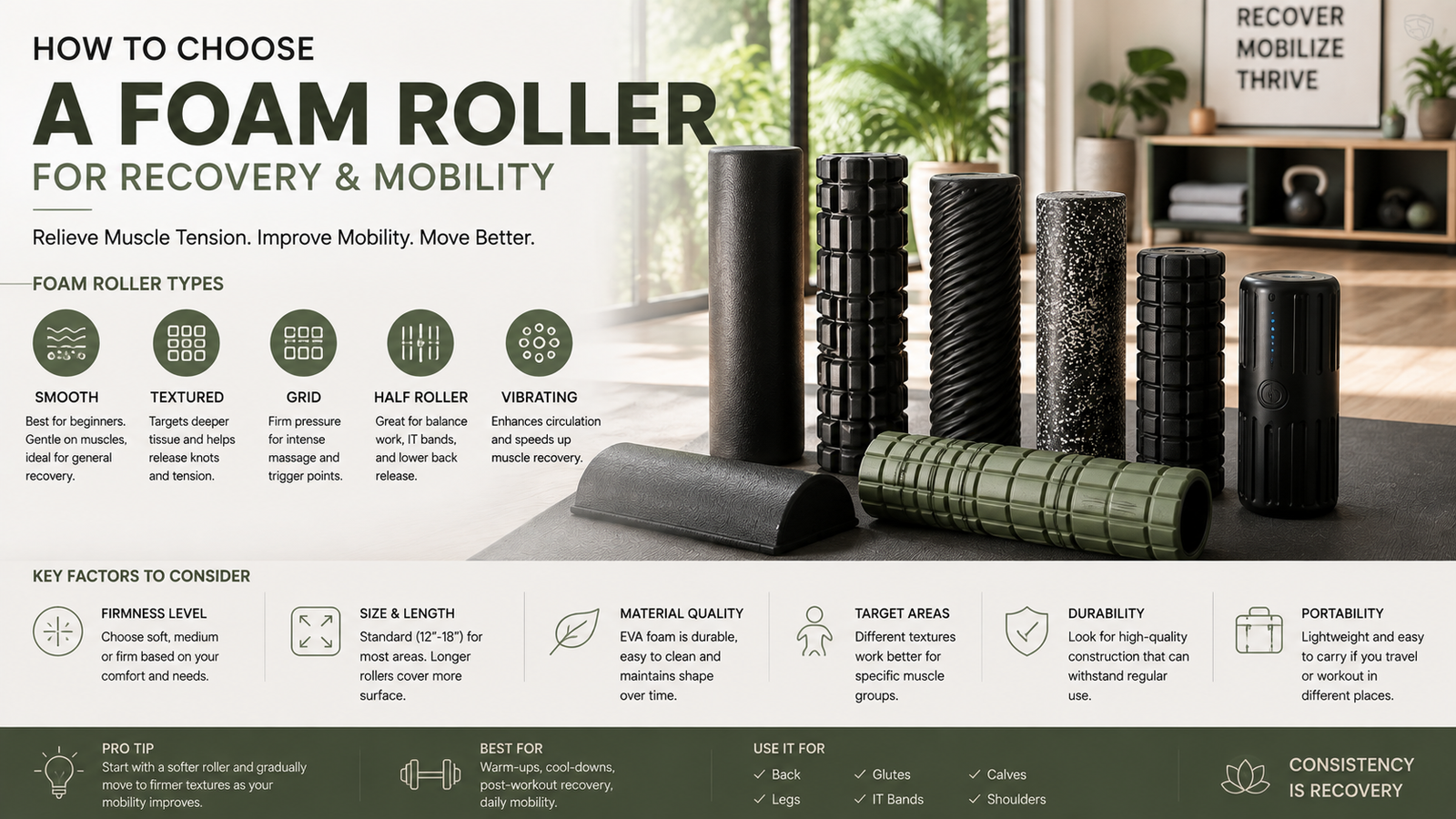
Main Types of Foam Rollers
Foam rollers vary by:
- firmness;
- surface texture;
- length;
- diameter;
- core construction.
Common categories include:
- Soft foam rollers
- Medium-density rollers
- High-density rollers
- Smooth rollers
- Textured rollers
- Hollow-core rollers
- Compact travel rollers
- Vibrating rollers
Soft Foam Rollers
These compress noticeably under body weight.
Advantages
- comfortable;
- beginner friendly;
- suitable for sensitive users;
- useful during gentle mobility work.
Disadvantages
They may feel too soft for:
- larger users;
- experienced rollers;
- dense muscle areas.
They can also deform more over time.
Who Should Choose Soft Foam?
Consider one if you are:
- new to foam rolling;
- very sensitive to pressure;
- recovering under professional guidance.
Medium-Density Foam Rollers
These provide a balance between:
- comfort;
- pressure.
For most beginners and general users, medium density is often the best starting point.
Advantages
- versatile;
- comfortable enough for most areas;
- firm enough for meaningful pressure.
High-Density Foam Rollers
These compress very little.
Often made from:
- dense EPP foam;
- hard EVA;
- rigid outer materials.
Advantages
- durable;
- strong pressure;
- useful for experienced users.
Disadvantages
They can be uncomfortable or excessive for:
- sensitive areas;
- beginners.
Harder is not automatically more effective.
Does More Pain Mean Better Foam Rolling?
No.
This is one of the most important points.
The goal is not to create as much discomfort as possible.
Excessive pressure can cause you to:
- tense muscles;
- hold breath;
- avoid the tool entirely.
Useful pressure should generally feel:
strong but tolerable
rather than:
- sharp;
- unbearable.
Choosing Firmness
A practical rule:
Beginner
Soft-to-medium.
General Fitness
Medium.
Experienced User Wanting Stronger Pressure
Medium-to-firm.
Very Dense / Large Muscle Areas
Firm can be useful.
Sensitive or Painful Areas
Use softer pressure or another approach.
Body Weight Affects Perceived Firmness
A heavier person may compress the same roller more than a lighter person.
This means a roller that feels firm for one person may feel:
- relatively soft;
for another.
Smooth Foam Rollers
A smooth roller has an even cylindrical surface.
Advantages
- predictable pressure;
- easy to control;
- comfortable;
- excellent for beginners.
Why Smooth Rollers Work Well
Pressure is distributed relatively evenly.
This reduces intense focal discomfort.
For most people, smooth rollers are enough.
Textured Foam Rollers
These include surface features such as:
- ridges;
- knobs;
- grooves;
- raised zones.
They are marketed as replicating:
- fingers;
- thumbs;
- massage techniques.
Do Textured Rollers Work Better?
Not necessarily.
They create more concentrated pressure, but there is no reason to assume a heavily textured roller provides superior recovery.
The main difference is:
- sensation;
- pressure distribution.
Advantages of Textured Rollers
- more targeted-feeling pressure;
- less surface contact;
- may feel more stimulating.
Disadvantages
- can be uncomfortable;
- may irritate sensitive tissue;
- harder for beginners to control.
Aggressive Knobbed Rollers
Some products have large hard projections.
These can create significant pressure.
They are rarely necessary.
Textured vs Smooth
Choose Smooth If:
- beginner;
- general recovery;
- upper-back rolling;
- you want predictable pressure.
Choose Textured If:
- experienced;
- you prefer stronger targeted sensation;
- smooth rollers feel too mild.
Hollow-Core Foam Rollers
These use a hard internal cylinder with a foam or rubber outer layer.
Advantages
- very durable;
- resist deformation;
- often firmer.
Disadvantages
- heavier;
- more expensive;
- can feel intense.
Solid Foam Rollers
Made entirely from foam.
Common materials include:
- polyethylene;
- EVA;
- EPP.
Advantages
- lightweight;
- inexpensive;
- simple.
Disadvantages
Soft versions may compress or flatten with heavy use.
EPP Foam
Expanded polypropylene is often used in dense black rollers.
It tends to be:
- lightweight;
- firm;
- durable.
Excellent for home gyms.
EVA Foam
EVA can offer:
- smoother surface;
- varying firmness;
- good durability.
Quality varies significantly.
PE Foam
Polyethylene rollers may be softer and more affordable.
Some eventually develop:
- permanent dents.
Foam Roller Length
Common roller lengths include approximately:
- 30 cm;
- 45 cm;
- 60 cm;
- 90 cm.
Length changes usability significantly.
Short Foam Rollers
Around:
- 30 cm.
Advantages:
- easy to store;
- easy to travel with;
- suitable for legs.
Disadvantages
Less comfortable for:
- upper-back rolling;
- bilateral exercises.
Medium-Length Rollers
Around:
- 45–60 cm.
Excellent general-purpose size.
They remain relatively portable while supporting:
- legs;
- back;
- mobility drills.
Full-Length Rollers
Around:
- 90 cm.
Common in physiotherapy and Pilates settings.
Advantages
- excellent for lying lengthwise;
- useful for spine and balance exercises;
- supports entire torso.
Disadvantages
- harder to store;
- less portable.
Which Length Is Best for Most People?
For general home recovery:
45–60 cm
is usually a strong compromise.
If you specifically want to use the roller for:
- upper-back work;
- lying along the spine;
- Pilates-style exercises;
a longer roller may be more useful.
Foam Roller Diameter
Standard rollers are often around:
- 12–15 cm diameter.
Why Diameter Matters
A larger diameter:
- raises the body farther from the floor;
- creates a broader curve.
A smaller roller creates a more targeted contact angle.
Standard Diameter
Best for most users.
It provides enough height for:
- rolling;
- mobility.
Smaller-Diameter Rollers
May allow:
- more targeted pressure;
- easier use in small areas.
But they can feel more intense.
Large Rollers
May be easier for:
- beginners;
- floor transfers.
But can feel bulky.
Foam Roller Weight
Most foam rollers are lightweight.
Hollow-core or vibrating models may be heavier.
For home use:
- weight rarely matters.
For travel:
- choose light construction.
Compact Travel Foam Rollers
Some are:
- shorter;
- collapsible;
- hollow.
Useful for:
- runners;
- frequent travellers.
Collapsible Foam Rollers
These fold or compress mechanically.
Advantages
- highly portable.
Disadvantages
- moving parts;
- higher cost;
- may feel less solid.
For home use, a normal roller is simpler.
Vibrating Foam Rollers
These combine foam rolling with:
- motorized vibration.
They usually offer several intensity levels.
Do Vibrating Rollers Work Better?
They may alter:
- sensation;
- short-term comfort.
But they are not necessary for effective foam rolling.
Advantages
- additional sensory stimulation;
- some users prefer the feeling.
Disadvantages
- expensive;
- heavier;
- require charging;
- more components to fail.
For most beginners, a standard roller is the better first purchase.
Heating Foam Rollers
Some premium models include:
- heat;
- vibration.
These features may increase comfort but are not essential.
Smart Foam Rollers
Some products connect to:
- apps;
- guided routines.
This can be useful for instruction, but the foam roller itself does not require electronics to work.
How Long Should You Foam Roll?
There is no single perfect duration.
A practical starting point is:
- 30–60 seconds per muscle group.
You may spend longer if an area feels particularly stiff.
A full session may last:
- 5–15 minutes.
Do You Need 30 Minutes of Foam Rolling?
Usually not.
Long sessions can become:
- uncomfortable;
- time consuming;
without adding much benefit.
Foam Rolling Before Exercise
It can be used during the warm-up.
Potential benefits include temporary improvement in:
- range of motion;
- comfort.
How to Use Before Training
Roll relevant muscles briefly.
Then perform:
- dynamic movements;
- exercise-specific warm-up.
Foam rolling should not replace:
- actual warm-up sets.
Example Before Squats
You might roll:
- calves;
- quadriceps;
- glutes;
for 30–60 seconds each.
Then perform:
- ankle mobility;
- bodyweight squats;
- progressively heavier squats.
Example Before Running
Briefly roll:
- calves;
- quadriceps;
if they feel stiff.
Then perform:
- walking;
- light jogging;
- dynamic movement.
Does Foam Rolling Reduce Strength Before Training?
Unlike long aggressive static stretching, brief foam rolling generally does not appear to meaningfully reduce strength performance when used sensibly.
Still, avoid making the warm-up so painful or long that you fatigue yourself.
Foam Rolling After Exercise
Many people use it after training for:
- relaxation;
- perceived soreness.
This is fine.
But it is optional.
Does Foam Rolling Prevent Muscle Soreness?
It may reduce some perceived soreness, but it does not guarantee prevention of DOMS.
The main factors influencing soreness include:
- unfamiliar exercise;
- training volume;
- intensity;
- eccentric loading.
Foam Rolling the Day After Training
This can be useful if muscles feel:
- stiff;
- sore.
Use moderate pressure.
You do not need to attack sore muscles aggressively.
Foam Rolling on Rest Days
A short session can provide:
- movement;
- comfort.
But recovery still depends primarily on:
- sleep;
- nutrition;
- sensible training load.
How Fast Should You Roll?
Slow is generally better.
A practical pace is:
- a few centimetres per second.
Moving quickly may reduce your ability to notice sensitive areas.
Why Slow Rolling Helps
It allows you to:
- control pressure;
- identify sensitive spots;
- breathe normally.
Should You Stop on Tender Spots?
You can pause briefly on a mildly tender area.
For example:
- 10–30 seconds.
But do not remain on intensely painful points for:
- several minutes.
Tenderness Is Not Always a Trigger Point
Sensitive areas are common.
You do not need to diagnose every tender spot as:
- adhesion;
- knot;
- trigger point.
Pressure Scale
A useful subjective scale:
1–3/10
Very mild.
4–6/10
Strong but tolerable.
7+/10
Often unnecessarily intense.
For general rolling, moderate pressure is usually enough.
Breathing During Foam Rolling
Keep breathing:
- slow;
- normal.
If you are holding your breath, reduce pressure.
Relax the Muscle Being Rolled
Try not to aggressively contract the area under the roller.
For example, during quadriceps rolling:
- allow the thigh to relax as much as practical.
Use Your Arms to Control Pressure
You do not need to place full body weight onto the roller immediately.
Support yourself with:
- hands;
- opposite leg.
This lets you adjust pressure gradually.
Foam Rolling the Calves
Sit on the floor with the roller under one or both calves.
Support your body with your:
- hands.
Roll from above the ankle toward:
- below knee.
Do Not Roll Directly Over the Achilles Tendon Aggressively
The Achilles is a tendon rather than muscle belly.
Use much gentler pressure if working around the area.
Calf Pressure Progression
Easiest
Both calves on roller.
Moderate
One calf at a time.
Stronger
Cross one leg over the other.
Use only as much pressure as needed.
Calf Rotation
Turn the leg slightly:
- inward;
- outward;
to explore different calf areas.
Move gently.
Foam Rolling the Quadriceps
Lie face down with the roller under the thighs.
Support yourself on:
- forearms;
- hands.
Roll between:
- upper knee area;
- upper thigh.
Avoid Direct Pressure on the Kneecap
Stay on muscular tissue.
One Thigh vs Both Thighs
Both thighs:
- lower pressure.
One thigh:
- stronger pressure.
Beginners should often start with both.
Quadriceps Side Angles
Rotating slightly can target different regions.
But avoid putting excessive pressure directly on:
- outer knee;
- hip bone.
Foam Rolling the Hamstrings
Sit with the roller under the back of the thighs.
Support yourself with your arms.
Roll between:
- above knee;
- below glute.
Hamstrings Often Feel Less Intense
Because the position does not always place as much body weight onto the roller.
You can increase pressure by rolling:
- one leg at a time.
Foam Rolling the Glutes
Sit on the roller.
Shift weight toward one side.
You may cross the ankle over the opposite knee to change hip position.
Glute Rolling
Useful for broad muscle tissue around:
- buttock;
- outer hip.
Avoid rolling directly onto:
- tailbone;
- bony pelvis.
Sciatic Nerve Caution
If pressure produces:
- shooting pain;
- tingling;
- numbness;
stop.
Do not aggressively roll over areas producing nerve-like symptoms.
Foam Rolling the Upper Back
This is one of the most comfortable and useful applications.
Position the roller horizontally beneath:
- mid-to-upper back.
Support your head with:
- hands;
if needed.
Lift hips slightly and roll through the upper-back region.
Do Not Roll Directly Over the Neck
Avoid loading the cervical spine on a standard foam roller.
Upper Back vs Lower Back
Upper-back rolling is generally more practical because the rib cage provides structural support.
Directly rolling the lumbar spine requires more caution.
Should You Foam Roll the Lower Back?
Aggressively rolling directly over the lumbar spine is generally not necessary.
The lower back has:
- less bony protection;
- internal organs beneath the area.
If you feel lower-back stiffness, consider:
- gentle mobility;
- surrounding muscles;
- professional guidance where needed.
Alternatives for Lower-Back Comfort
Try:
- cat-cow;
- gentle trunk rotation;
- walking;
- hip mobility.
A foam roller may be used around:
- glutes;
- upper back;
rather than directly crushing the lumbar region.
Foam Rolling the Lats
Lie partly on your side with the roller under the side of the upper back near:
- armpit.
Move gently along the latissimus area.
Lat Rolling Can Feel Intense
Use lighter pressure.
Avoid deep pressure directly into:
- armpit;
- breast tissue;
- ribs.
Foam Rolling the IT Band
This is controversial and often misunderstood.
The iliotibial band is dense connective tissue running along the outer thigh.
Can You Lengthen the IT Band With a Foam Roller?
Not meaningfully.
It is a strong connective structure.
Rolling it does not mechanically stretch it into a longer band.
Why Does IT Band Rolling Hurt So Much?
The lateral thigh contains:
- sensitive tissue;
- muscle;
- fascia.
Direct heavy pressure can be very uncomfortable.
Should You Roll the IT Band?
You do not need to.
If the outer thigh feels tight, consider rolling nearby muscles such as:
- glutes;
- tensor fasciae latae region;
- quadriceps.
If you do roll the outer thigh, keep pressure moderate.
IT Band Pain at the Knee
Outer-knee pain during running may involve conditions such as:
- IT band-related irritation.
Aggressive rolling directly over a painful knee area is not treatment.
Persistent symptoms should be assessed.
Foam Rolling the Adductors
Lie face down and position one thigh out to the side with the roller under the:
- inner thigh.
Roll carefully.
Inner-Thigh Sensitivity
The area can be sensitive.
Use light-to-moderate pressure.
Avoid direct pressure near:
- groin;
- genitals.
Foam Rolling the Hip Flexor Region
This is often marketed aggressively.
Be cautious.
The front of the hip contains:
- nerves;
- blood vessels;
- abdominal structures.
A foam roller is generally not ideal for deep pressure into the abdomen or groin.
Better Approach
Use gentle mobility or roll nearby:
- quadriceps;
- upper thigh.
Avoid pressing deeply into the front of the abdomen.
Foam Rolling the Chest
A standard foam roller is rarely necessary for direct chest rolling.
A small massage ball against a wall may provide more controllable pressure.
Avoid pressure over:
- breast tissue;
- ribs;
- sternum.
Foam Rolling the Shoulders
The deltoid is relatively small.
A massage ball or light rolling against a wall is usually easier than placing full body weight on it.
Foam Rolling the Forearms
A small roller or massage ball may be easier.
You can also use the opposite hand to roll a:
- massage stick.
Foam Rolling the Feet
A standard roller is too large for detailed foot massage.
Use:
- massage ball;
- small roller.
Plantar Foot Rolling
Roll gently under the arch.
Do not assume more pain means better treatment.
Foam Rolling and Plantar Fasciitis
Rolling may provide temporary comfort for some people.
But persistent heel pain often requires broader management including:
- load adjustment;
- footwear considerations;
- calf strength;
- clinical assessment.
Foam Rolling the Neck
Avoid using full body weight on the neck with a standard roller.
For neck tension, gentle mobility and appropriate professional guidance may be safer.
Foam Rolling Around Joints
Avoid spending long periods directly over:
- knee;
- elbow;
- ankle.
Foam rollers are generally better suited to:
- muscle tissue.
Avoid Rolling Directly Over Bones
Examples:
- kneecap;
- shin bone;
- hip bone;
- spine.
This is usually painful and not useful.
Foam Rolling the Shins
The front of the lower leg contains relatively little soft tissue over the tibia.
Avoid pressing directly on:
- shin bone.
If working on the muscles beside it, use much lighter pressure.
Shin Splints
Pain along the shin during running should not simply be treated with aggressive foam rolling.
Training load, footwear, bone stress and muscle capacity may all matter.
Persistent pain requires appropriate assessment.
Foam Rolling Before Mobility Work
This can be useful because rolling may temporarily increase:
- range;
- comfort.
Example:
- Roll calves.
- Perform ankle mobility drill.
- Practice squat.
This often feels better than rolling alone.
Pair Foam Rolling With Active Mobility
Temporary range is more useful if you then use it through:
- movement;
- strength.
Example for Ankles
- calf roll;
- knee-to-wall drill;
- calf raises.
Example for Hips
- glute roll;
- 90/90 transitions;
- split squats.
Example for Upper Back
- thoracic roll;
- open book rotations;
- wall slides.
Foam Rolling and Strength Training
Foam rolling should not replace:
- progressive resistance;
- mobility through loaded movement.
Strength training through appropriate range can itself improve mobility.
Foam Roller for Runners
Common areas include:
- calves;
- quadriceps;
- glutes.
When to Use
- before run if stiff;
- after run for comfort;
- later in day during recovery.
Runners Do Not Need to Roll Every Day
Use it according to:
- symptoms;
- preference.
Consistency in running load and recovery matters more.
Foam Roller for Cyclists
Cyclists may find rolling useful around:
- quadriceps;
- glutes;
- calves;
- upper back.
Long periods in cycling posture can also make:
- thoracic mobility;
feel useful.
Foam Roller for Strength Training
Common targets include:
- lats;
- upper back;
- quadriceps;
- glutes.
A short session before training may help movement feel:
- easier.
Foam Roller for Squat Mobility
If ankle or hip stiffness seems limiting:
- roll calves/quads briefly;
- perform mobility drills;
- warm up squat.
Do not assume rolling alone will permanently fix squat depth.
Foam Roller for Deadlifting
Rolling hamstrings or glutes may feel useful, but technique and warm-up sets are more important.
Foam Roller for Upper-Body Training
Upper-back rolling can feel helpful before:
- bench press;
- overhead press.
Follow with:
- arm movements;
- warm-up sets.
Foam Roller for Yoga
It is optional.
It can complement yoga by providing:
- temporary relaxation;
- mobility preparation.
But do not place a hard roller beneath the spine during poses unless the exercise is specifically designed for that setup.
Foam Roller for Pilates
Long foam rollers are sometimes used as unstable supports in Pilates exercises.
This is different from self-massage.
Longitudinal Foam Roller Exercises
A full-length roller can be placed along the spine while lying on it.
This may be used for:
- balance;
- chest-opening exercises.
Stability Warning
A roller is unstable.
Use a:
- wall;
- floor support;
if balance is limited.
Foam Roller for Balance Training
A half roller may be used for balance exercises.
This is specialized.
Beginners should use a stable surface first.
Half-Round Foam Rollers
These are cylinders cut lengthwise.
They have:
- flat bottom;
- curved top.
Common in rehabilitation and balance work.
Uses
- calf stretching;
- ankle mobility;
- balance;
- positioning.
They are not as useful for standard rolling.
Do You Need a Half Roller?
Usually not.
A standard cylindrical roller is more versatile.
Foam Roller for Older Adults
Foam rolling may be useful, but getting down to the floor can be difficult.
Alternatives include:
- massage stick;
- ball against wall.
Floor Transfer Consideration
If getting on and off the floor is difficult, the roller may not be the most practical recovery tool.
Wall-Based Rolling
Some areas can be rolled between:
- body;
- wall.
This reduces body-weight pressure.
A massage ball may work even better.
Foam Roller for Beginners With Higher Body Weight
Start with:
- softer;
- medium-density roller.
Use arms and opposite leg to reduce pressure.
Do not place full body weight on one sensitive area immediately.
Foam Roller for Athletes
More aggressive rollers are not automatically better.
Athletes should choose according to:
- comfort;
- training load;
- intended area.
Foam Rolling and Flexibility
It can temporarily increase range of motion.
But sustained long-term flexibility improvements generally require repeated:
- movement;
- stretching;
- strength through range.
Foam Rolling Alone Is Not Mobility Training
It may prepare you for mobility work.
But mobility requires:
- active control;
- usable range.
Foam Rolling and Injury Prevention
There is not strong justification for claiming foam rolling prevents all injuries.
Injury risk depends on many factors including:
- training load;
- recovery;
- technique;
- previous injury.
Use rolling for:
- comfort;
- mobility support.
Foam Rolling and Performance
A short pre-training session may improve perceived readiness without substantially reducing strength.
But long painful rolling is unnecessary.
Foam Rolling and Soreness
Some users find it reduces DOMS.
This can make:
- movement;
- next training session;
feel more comfortable.
Does Less Soreness Mean Faster Muscle Recovery?
Not necessarily.
Pain perception and tissue recovery are not identical.
Feeling less sore does not automatically mean the muscle is fully recovered.
Recovery Still Depends on Training Load
If you perform too much:
- volume;
- intensity;
foam rolling cannot compensate.
Sleep
One of the most important recovery tools.
Adults generally benefit from sufficient high-quality sleep.
No recovery accessory can replace it.
Nutrition
Adequate:
- protein;
- calories;
- fluids;
also matter.
Foam rolling should be viewed as a small addition.
Walking and Light Movement
Often useful on recovery days.
Gentle movement can reduce feelings of:
- stiffness.
You do not necessarily need to roll.
Pain During Foam Rolling
Some pressure discomfort is common.
But certain sensations should prompt you to stop.
Avoid rolling through:
- sharp pain;
- burning;
- electric sensations;
- numbness;
- tingling.
Numbness
May indicate pressure on:
- nerve;
- circulation.
Shift position immediately.
Bruising
Foam rolling should not routinely leave:
- large bruises.
If you bruise easily, use less pressure and consider whether medical factors may contribute.
Can Foam Rolling Cause Injury?
Yes, if used aggressively or over inappropriate areas.
Potential issues include:
- bruising;
- tissue irritation;
- nerve irritation;
- worsening injury.
Avoid Rolling Acute Injuries
Do not aggressively roll an area that is:
- freshly strained;
- swollen;
- severely bruised.
Early injury management may require a different approach.
Muscle Strain
Deep pressure over an acute strain may:
- irritate tissue.
Return gradually according to recovery guidance.
Sprains
A foam roller is not an appropriate tool for directly rolling a newly sprained:
- ankle;
- knee.
Fractures
Do not roll over or near a suspected or healing fracture without professional clearance.
Varicose Veins
Avoid heavy direct pressure over prominent varicose veins.
If you have significant vascular problems, get medical guidance.
Blood Clot Risk
Do not foam roll over a suspected deep-vein thrombosis.
Symptoms such as unexplained:
- swelling;
- warmth;
- redness;
- calf pain;
require urgent medical assessment rather than massage.
Blood-Thinning Medication
People taking anticoagulant medication may bruise more easily.
Ask a healthcare professional whether aggressive self-massage is appropriate.
Bleeding Disorders
Use similar caution.
Osteoporosis
People with significant osteoporosis should avoid aggressive rolling over:
- spine;
- ribs;
without professional guidance.
Pregnancy
Gentle rolling may be comfortable in some areas during pregnancy.
But avoid:
- abdominal pressure;
- unstable positions;
- excessive intensity.
Professional guidance may be useful.
Neuropathy
Reduced sensation can make it difficult to judge pressure.
People with neuropathy should use caution because tissue could be irritated without normal warning sensations.
Skin Conditions
Do not roll directly over:
- open wounds;
- infected skin;
- severe rash.
Recent Surgery
Do not roll near surgical sites unless:
- clinician;
- physiotherapist;
has cleared it.
Cancer and Medical Conditions
People with complex medical conditions should discuss massage-style tools with their care team when appropriate.
Foam Rolling and Cellulite
A foam roller does not permanently remove cellulite.
Temporary changes in:
- circulation;
- skin appearance;
may occur, but they are not a lasting treatment.
Foam Rolling and Weight Loss
Foam rolling does not meaningfully burn body fat.
It is not a weight-loss exercise.
Foam Rolling and Muscle Growth
It does not directly build significant muscle.
Strength training is required for:
- hypertrophy;
- strength.
Foam Rolling and Recovery Marketing
Be cautious with claims such as:
- flushes toxins;
- breaks adhesions;
- melts fascia;
- accelerates healing dramatically;
- prevents all injuries.
A more realistic description is:
a useful self-massage tool that may temporarily improve comfort, soreness and movement.
Foam Roller Surface Design
Some rollers divide the surface into zones resembling:
- fingers;
- thumbs;
- palms.
This is mostly a marketing analogy.
The roller cannot actually reproduce the adaptive hand pressure of a therapist.
Deep-Tissue Foam Rollers
This usually means:
- hard;
- textured.
“Deep tissue” is not a standardized technical category.
Trigger-Point Rollers
Again, usually a textured roller.
The product does not identify or treat medical trigger points automatically.
Choosing a Roller for Soreness
A smooth medium-density roller is usually enough.
Do not choose extreme texture simply because muscles are sore.
Sore tissue may tolerate:
- gentler pressure;
better.
Choosing a Roller for Mobility
A firm smooth roller is often ideal.
You want enough pressure to feel useful without creating guarding.
Choosing a Roller for Upper Back
Choose:
- smooth;
- medium firmness;
- standard or long length.
Avoid extremely hard sharp knobs against:
- ribs;
- spine.
Choosing a Roller for Legs
Almost any length works.
A 30–45 cm roller is convenient.
Choosing a Roller for Travel
Prioritize:
- short length;
- lightweight construction.
Choosing a Roller for Large Users
A hollow-core or high-density roller may resist:
- compression;
- flattening;
better.
Choosing a Roller for Sensitive Users
Choose:
- soft;
- smooth.
Pressure can always be increased later.
Choosing a Roller for Experienced Users
If a medium roller no longer feels useful, consider:
- firmer smooth roller;
before jumping to extremely textured designs.
Storage
Foam rollers are easy to store but take more space than their weight suggests.
Options include:
- upright corner;
- wall rack;
- shelf.
Long Rollers
Can be stored vertically.
Make sure they do not:
- fall into walkways.
Hollow-Core Rollers
Some allow small accessories to be stored inside.
Useful but not necessary.
Cleaning a Foam Roller
Rollers collect:
- sweat;
- skin oils;
- floor dust.
Wipe them regularly.
Smooth Closed-Cell Foam
Usually easy to clean with:
- damp cloth;
- mild soap.
Textured Rollers
Require more attention because dirt can collect in:
- grooves;
- ridges.
Do Not Soak Unless Approved
Some rollers contain:
- glued layers;
- internal cores.
Follow care instructions.
Strong Solvents
Avoid harsh cleaners that can degrade:
- foam;
- rubber.
Dry Completely
Do not store damp rollers in:
- closed bags.
Shared Gym Rollers
Clean before and after use where appropriate.
A personal roller provides better control over:
- hygiene.
Outdoor Use
Rollers can be used outside.
But rough surfaces can:
- scratch;
- tear foam.
Use a mat beneath it.
Sunlight
Prolonged UV exposure may degrade foam.
Do not leave the roller outdoors.
Heat
Avoid storing foam rollers in very hot:
- cars;
- balconies.
Heat can deform some materials.
Foam Roller Odour
New foam may have an initial smell.
Air it in a:
- ventilated room.
Persistent strong chemical odour may be a quality concern.
Foam Roller Durability
A quality roller may last:
- many years.
Common failures include:
- permanent flattening;
- surface peeling;
- cracked core.
Permanent Compression
Soft foam may gradually lose shape.
If the roller becomes oval rather than cylindrical, replacement may be appropriate.
Surface Cracking
Small marks may be cosmetic.
Large cracks can make rolling uneven.
Hollow-Core Damage
Stop using if the internal tube:
- cracks;
- collapses.
Roller Shape
The cylinder should remain:
- straight;
- round.
A warped roller can move unpredictably.
Warranty
Simple foam rollers may have limited warranties.
For vibrating models, check coverage for:
- motor;
- battery;
- charging components.
Foam Roller Price Categories
Budget
Simple foam cylinder.
Often perfectly adequate.
Mid-Range
Denser materials, better durability and texture.
Usually the best value for frequent users.
Premium
Hollow cores, vibration, branded texture systems.
Useful only if the additional features matter.
Do You Need a Premium Foam Roller?
No.
A basic smooth high-quality foam roller can provide nearly all the practical benefits most users need.
Buying Online
Check:
- length;
- diameter;
- material;
- firmness;
- texture;
- weight capacity where stated.
Firmness Descriptions Are Not Standardized
“Medium” from one manufacturer may feel harder than “firm” from another.
Reviews can help.
Customer Reviews
Look for repeated comments about:
- too hard;
- too soft;
- flattening;
- cracking;
- excessive texture;
- strong smell.
Image Scale Can Be Misleading
A roller may look large in a photo but actually be:
- 30 cm.
Check exact dimensions.
Check Diameter
Some travel rollers have a smaller diameter, which changes pressure.
Price per Feature
Do not pay extra for:
- unnecessary ridges;
- app integration;
if your real need is simple calf and quadriceps rolling.
How to Test a Foam Roller Before Buying
If possible:
Press It With Your Hand
Assess firmness.
Sit Lightly on It
Check compression.
Roll the Upper Back
If permitted, test comfort.
Check Surface
No sharp or uncomfortable edges.
Inspect Shape
It should roll smoothly.
What Should a Good Roller Feel Like?
You should feel:
- clear pressure;
without immediately wanting to get off.
Common Foam Roller Buying Mistakes
Buying the Hardest Roller Because It Seems More Effective
Intensity is not effectiveness.
Buying Extreme Texture as a Beginner
Can be unpleasant.
Choosing a Very Short Roller for Upper-Back Work
Less stable.
Buying a 90 cm Roller When Storage Is Limited
May become inconvenient.
Paying for Vibration Without Knowing You Like It
Try first if possible.
Ignoring Material Density
Soft rollers may flatten.
Buying Based Only on Appearance
Function matters.
Common Foam Rolling Mistakes
Rolling Too Fast
Slow down.
Using Maximum Body Weight Immediately
Control pressure.
Holding the Breath
Reduce intensity.
Rolling Directly Over Joints
Stay mostly on muscular tissue.
Rolling the Lower Back Aggressively
Use other approaches.
Attacking the IT Band Because It Hurts
Pain is not proof of effectiveness.
Staying on One Painful Spot for Several Minutes
Can irritate tissue.
Rolling an Acute Injury
Not appropriate.
Believing Rolling Replaces Warm-Up
Still move and perform warm-up sets.
Believing Rolling Replaces Strength Training
It does not.
A Beginner Foam-Rolling Routine
A simple full-body session can take approximately:
- 8–10 minutes.
Calves
30–60 seconds each side.
Quadriceps
30–60 seconds each side.
Hamstrings
30–60 seconds each side.
Glutes
30–60 seconds each side.
Upper Back
60 seconds.
Move slowly and maintain comfortable pressure.
Lower-Body Recovery Routine
Calves
45 seconds each.
Quadriceps
60 seconds each.
Glutes
45 seconds each.
Adductors
30 seconds each.
Follow with:
- easy walking;
- mobility.
Runner’s Foam-Rolling Routine
Calves
45–60 seconds.
Quadriceps
45–60 seconds.
Glutes
45 seconds.
Outer Hip
30 seconds.
Avoid turning the session into:
- 20 minutes of painful IT-band rolling.
Strength-Training Recovery Routine
Lats
30–45 seconds.
Upper Back
60 seconds.
Quadriceps
45 seconds.
Glutes
45 seconds.
Calves
30 seconds.
Use only areas that actually feel useful.
Pre-Squat Mobility Routine
Calf Roll
30 seconds each.
Quadriceps Roll
30 seconds each.
Glute Roll
30 seconds each.
Then:
- knee-to-wall ankle mobility;
- bodyweight squat;
- warm-up sets.
Upper-Body Warm-Up Routine
Upper-Back Roll
60 seconds.
Lat Roll
30 seconds each.
Then:
- wall slides;
- light band rows;
- exercise-specific warm-up.
Foam Rolling and Mobility Progression
The goal is not to tolerate harder rollers indefinitely.
A better progression may be:
- moderate rolling;
- active mobility;
- strength through the new range.
Example
For ankle mobility:
calf roll → ankle dorsiflexion drill → calf raise → squat
This transfers temporary comfort into useful movement.
A Simple Choice by Experience Level
Beginner
Smooth medium-density roller.
Sensitive Beginner
Soft smooth roller.
Regular User
Medium-to-firm smooth roller.
Experienced User Wanting More Pressure
Firm roller or mild texture.
Advanced User Who Enjoys Intense Pressure
Textured roller if preferred.
A Simple Choice by Body Area
Upper Back
Smooth medium roller.
Quadriceps
Medium-to-firm.
Calves
Medium.
Glutes
Medium-to-firm.
Sensitive Areas
Soft or medium.
A Simple Choice by Length
Travel
30 cm.
General Home Use
45–60 cm.
Pilates / Full-Spine Support
90 cm.
A Simple Choice by Surface
Beginner
Smooth.
General Recovery
Smooth.
Stronger Targeted Sensation
Mild texture.
Very Aggressive Texture
Rarely necessary.
A Simple Choice by Budget
Lowest Cost
Basic EPP or foam roller.
Best Value
Durable medium-density smooth roller.
Premium
Hollow-core or vibrating roller.
Only choose premium features if they solve a real need.
How to Choose a Foam Roller Step by Step
Step 1 — Decide Where You Will Use It
Legs, upper back or full body?
Step 2 — Choose Firmness
Start medium unless you are particularly sensitive.
Step 3 — Choose Surface
Smooth is enough for most people.
Step 4 — Choose Length
45–60 cm works well for general home use.
Step 5 — Check Diameter
Standard 12–15 cm works for most users.
Step 6 — Check Material
High-density foam provides durability.
Step 7 — Consider Portability
Shorter rollers travel better.
Step 8 — Skip Unnecessary Features
You do not need vibration or aggressive texture automatically.
Step 9 — Check Cleaning Requirements
A closed-cell surface is easy to maintain.
Step 10 — Choose Something You Will Actually Use
Comfort matters.
Foam Roller Buying Checklist
Before purchasing, ask:
1. What body areas will I roll most?
This affects length.
2. How sensitive am I to pressure?
Choose firmness accordingly.
3. Am I a beginner?
Start smooth and moderate.
4. Is the roller dense enough not to collapse?
Important for durability.
5. Is the texture comfortable?
Aggressive knobs are not necessary.
6. Is it long enough for upper-back use?
If that matters.
7. Is the diameter comfortable?
Standard size works for most people.
8. Will I travel with it?
If yes, choose shorter.
9. Can it be cleaned easily?
Sweat and floor dust accumulate.
10. Does it have a rigid hollow core?
This may improve durability but also firmness.
11. Do I genuinely need vibration?
Usually not.
12. Can I control the pressure comfortably?
This matters more than intensity.
13. Does it roll smoothly?
No warping.
14. Is the foam already dented or cracked?
Avoid damaged products.
15. Is the price based on useful function rather than marketing features?
Keep the purchase simple.
When Should You Replace a Foam Roller?
Consider replacement when it develops:
- permanent flattening;
- deep cracks;
- peeling surface;
- damaged core;
- severe warping.
Cosmetic:
- scratches;
- stains;
do not necessarily require replacement.
When Should You Stop Foam Rolling?
Stop or modify if you experience:
- sharp pain;
- numbness;
- tingling;
- burning;
- dizziness;
- unusual swelling;
- significant bruising.
Do not continue simply because you believe:
- pain means progress.
When Should You Seek Professional Guidance?
Professional assessment may be appropriate if muscle tightness is accompanied by:
- persistent pain;
- weakness;
- numbness;
- swelling;
- reduced function;
- recurring injury.
A physiotherapist or appropriate clinician can help determine whether the problem is related to:
- mobility;
- strength;
- training load;
- injury;
- neurological or vascular issues.
Foam rolling should not delay evaluation of symptoms that clearly require more than self-massage.
The Physical Glow Takeaway
A foam roller is best viewed as a comfort and mobility-support tool, not a treatment that physically breaks apart muscle or fascia.
Its most useful effects are generally temporary changes in:
- soreness;
- stiffness;
- movement comfort;
- range of motion.
For most people, the best first choice is:
a smooth, medium-density foam roller around 45–60 cm long with a standard 12–15 cm diameter.
That provides enough versatility for:
- calves;
- quadriceps;
- hamstrings;
- glutes;
- upper back.
Choose according to your needs:
- beginner or pressure-sensitive user → softer smooth roller;
- general fitness and recovery → medium-density smooth roller;
- experienced user → firmer roller if desired;
- frequent travel → shorter compact roller;
- Pilates or full-length support → longer 90 cm roller;
- strong targeted sensation → mildly textured roller, if you actually prefer it.
You do not need:
- aggressive spikes;
- extreme hardness;
- motorized vibration;
to get useful results.
And pressure should remain controlled.
A practical session usually means:
30–60 seconds per area → slow rolling → moderate pressure → normal breathing.
Avoid rolling aggressively over:
- joints;
- bones;
- the neck;
- acutely injured tissue;
- painful swollen areas.
Most importantly, use foam rolling as part of a broader movement strategy.
For example:
roll the calves → practice ankle mobility → perform controlled squats
or:
roll the upper back → perform thoracic rotations → warm up your pressing movement.
That is generally more useful than spending 20 minutes trying to crush every tender spot in your body.
Recovery still depends much more on:
- appropriate training load;
- regular movement;
- sufficient sleep;
- adequate nutrition.
A foam roller simply gives you a practical way to make stiff or sore muscles feel more comfortable while you continue doing the things that actually build long-term mobility and fitness.