How to Choose Yoga Blocks for Support and Mobility
Learn how to choose yoga blocks for support and mobility, with practical guidance on material, size, firmness, grip and intended poses. This beginner-friendly guide helps you make a clear, informed choice without unnecessary complexity.
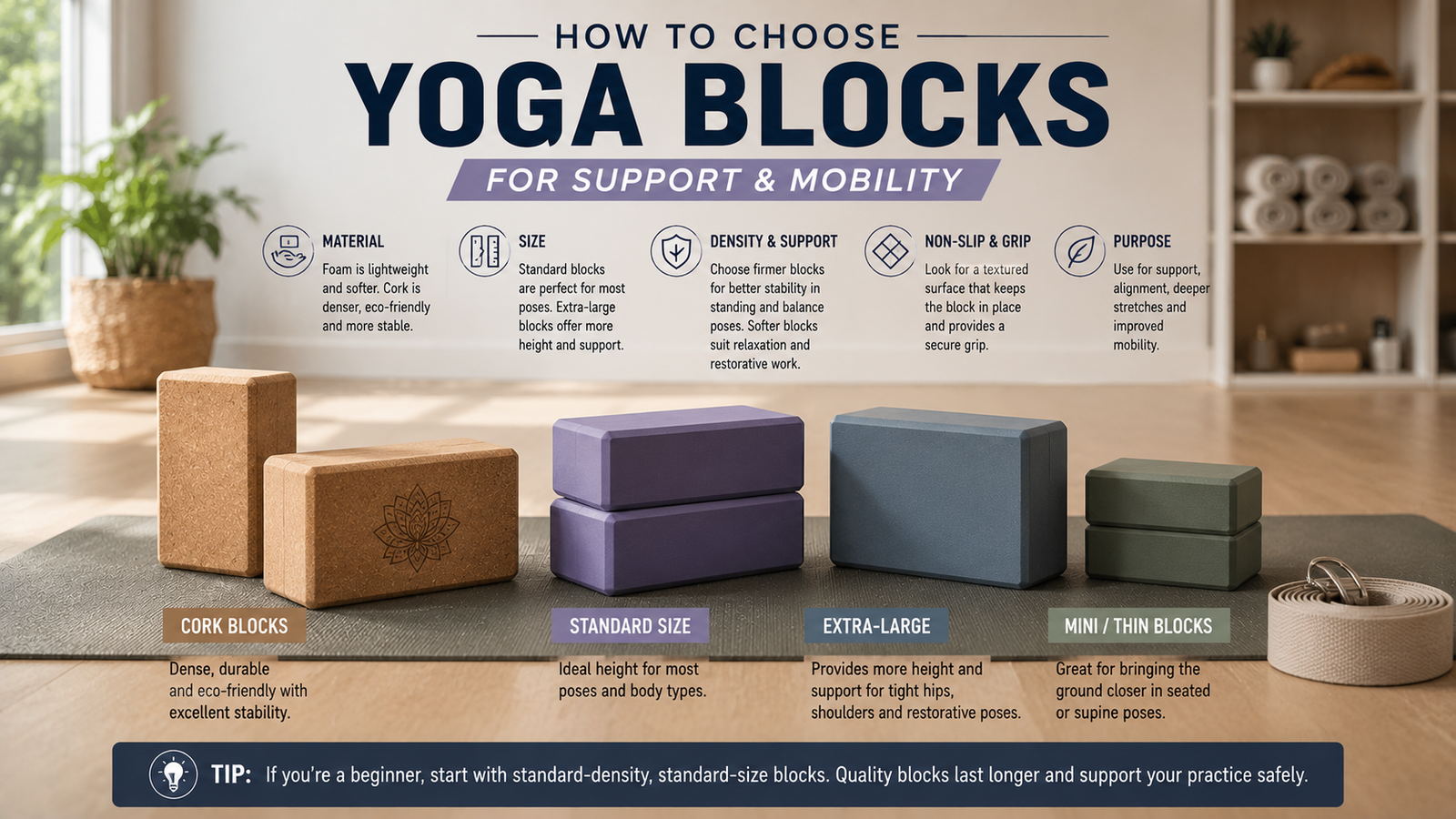
Yoga blocks are among the simplest and most useful props for yoga, stretching and mobility work.
They can help you:
- bring the floor closer;
- reduce the amount of flexibility required in a pose;
- improve balance;
- create more stable positions;
- support the hips, hands or back;
- modify poses around individual mobility limits;
- explore range of motion more gradually.
They are particularly useful for beginners because many yoga positions become easier to control when the hands or body do not have to reach all the way to the floor.
But yoga blocks vary in:
- material;
- firmness;
- dimensions;
- weight;
- edge shape;
- surface texture;
- durability.
A soft foam block may feel comfortable during:
- restorative yoga;
- supported stretches;
but may compress too much when you place significant weight through it.
A cork block may provide excellent stability but feel:
- heavier;
- firmer;
during gentle restorative practice.
The practical way to choose yoga blocks is:
decide how you will use them → choose the right firmness → choose foam or cork depending on comfort and stability → check dimensions → buy a pair when useful → make sure the surface and edges feel comfortable → then consider portability and price
The best yoga block is not automatically:
- the hardest;
- the biggest;
- the most expensive;
- the most environmentally marketed.
It is the block that gives you enough:
height → stability → comfort → confidence
to perform the movement you are actually trying to practice.
What Is a Yoga Block?
A yoga block is a rectangular prop designed to support the body during:
- yoga poses;
- stretching;
- mobility exercises;
- restorative positions.
It is usually made from:
- foam;
- cork;
- wood.
The rectangular shape allows it to be placed in several orientations.
That means one block can provide:
- low;
- medium;
- high;
support simply by turning it.
Why Yoga Blocks Are Useful
Yoga blocks help adjust a pose to fit your body instead of forcing your body to fit the pose.
For example, in a standing forward fold, your hands may not comfortably reach the floor.
Instead of rounding aggressively or forcing your hamstrings, you can place your hands on:
- blocks.
This lets you work within a controlled range.
The block does not make the pose less effective.
It makes the position more appropriate for your current mobility.
Yoga Blocks Are Not Only for Beginners
This is an important misconception.
Experienced practitioners use blocks for:
- deeper range;
- balance challenges;
- strength work;
- alignment;
- restorative support.
The role of the block changes with experience.
For a beginner, it may reduce the range required.
For an advanced practitioner, it may increase:
- precision;
- difficulty;
- leverage.
Using a Block Is Not “Cheating”
Yoga and mobility are not competitions to see who can reach the floor.
If a block allows you to:
- breathe normally;
- stay balanced;
- maintain control;
- avoid pain;
it is doing exactly what it is designed to do.
Yoga Blocks vs Stretching Without Props
Without a block, your options may be:
- reach the floor;
- stop short;
- hold onto another object.
A yoga block provides a stable intermediate surface.
That makes progress easier to control.
Yoga Block vs Yoga Strap
These props solve different problems.
Yoga Block
Brings the support surface closer to you.
Useful when you need:
- height;
- stability.
Yoga Strap
Extends your reach.
Useful when you cannot comfortably reach:
- feet;
- hands behind the body.
Many practices benefit from owning both.
Yoga Block vs Bolster
A bolster is much larger and softer.
It is used mainly for:
- restorative yoga;
- supported relaxation;
- long-held positions.
A block is:
- smaller;
- firmer;
- more structural.
Yoga Block vs Household Objects
You can sometimes use:
- sturdy books;
- stable box;
instead of a yoga block.
But proper blocks are usually safer because they are designed to provide:
- flat surfaces;
- rounded edges;
- predictable dimensions.
Avoid using unstable objects such as:
- stacked loose books;
- cushions;
- lightweight boxes;
when significant body weight will be placed through them.
The Three Main Yoga Block Materials
Most yoga blocks are made from:
- EVA or similar foam
- Cork
- Wood or bamboo
Each feels different.
Foam Yoga Blocks
Foam is the most common material.
Advantages include:
- lightweight;
- affordable;
- comfortable;
- easy to carry.
They are excellent for:
- beginners;
- studio classes;
- home yoga;
- restorative practice.
What Does a Foam Block Feel Like?
A good foam block is:
- firm enough to support body weight;
- slightly forgiving under pressure.
It should not collapse like:
- sponge;
- cushion.
Advantages of Foam Blocks
- lightweight;
- inexpensive;
- soft against the body;
- easy to transport;
- widely available.
They are particularly comfortable when placed under:
- hips;
- back;
- knees.
Disadvantages of Foam Blocks
Lower-quality foam blocks may:
- compress;
- dent;
- become unstable;
- wear at edges.
Very soft foam can be unsuitable when supporting significant pressure through:
- hands.
High-Density Foam
For general yoga, choose:
high-density foam
rather than very soft foam.
High-density material provides better:
- stability;
- durability.
EVA Foam
EVA is commonly used because it provides:
- low weight;
- cushioning;
- water resistance.
Quality varies depending on:
- density;
- manufacturing.
Are All Foam Blocks the Same?
No.
Two blocks with identical dimensions may feel completely different.
One may be:
- firm;
- stable.
Another may compress substantially under hand pressure.
If possible, squeeze the block before buying.
How to Test Foam Density
Press your thumb firmly into the centre.
A quality block may compress slightly but should quickly return to shape.
If your thumb sinks deeply, the block may be too soft for:
- weight-bearing poses.
Cork Yoga Blocks
Cork blocks are heavier and firmer than most foam blocks.
They are popular with people who prioritize:
- stability;
- firmness;
- natural-material feel.
Advantages of Cork Blocks
- very stable;
- firm;
- good traction;
- durable;
- generally resist compression well.
They work particularly well for poses where significant weight passes through:
- hands;
- arms.
Disadvantages of Cork Blocks
- heavier;
- harder against the body;
- often more expensive;
- can chip if poorly manufactured.
For travel, foam may be more convenient.
Cork Grip
Cork usually has a naturally textured surface.
This can provide good traction when:
- hands;
- floor;
are slightly sweaty.
Cork and Moisture
Cork can absorb some moisture.
Allow blocks to:
- dry fully;
after cleaning or sweaty sessions.
Cork Durability
High-quality cork blocks can last for years.
Lower-quality blocks may eventually:
- crumble;
- chip around corners.
Who Should Choose Cork?
Consider cork if you want:
- maximum stability;
- firmer support;
- durable home blocks.
They are excellent for:
- standing poses;
- arm-supported mobility;
- strength-oriented yoga.
Wood Yoga Blocks
Traditional yoga blocks may be made from:
- hardwood;
- bamboo.
They are the firmest option.
Advantages of Wood
- extremely stable;
- highly durable;
- minimal compression;
- attractive appearance.
Disadvantages
- hard;
- heavy;
- less forgiving against the body;
- may become slippery depending on finish.
Hollow Wooden Blocks
Many wooden blocks are hollow to reduce:
- weight.
They can still provide excellent rigidity.
Solid Wooden Blocks
Very durable but often unnecessarily heavy.
They are less common for everyday studio use.
Bamboo Blocks
Bamboo can provide a lighter alternative to some hardwood blocks.
But quality depends on:
- lamination;
- surface finish;
- construction.
Wooden Block Finish
The surface should not be:
- glossy;
- slippery.
Look for a finish with enough texture to maintain:
- hand grip.
Who Should Choose Wood?
Wood blocks are best for users who value:
- maximum rigidity;
- traditional equipment;
- long lifespan.
For most beginners:
foam or cork is easier.
Foam vs Cork Yoga Blocks
This is the most common decision.
Choose Foam If You Want:
- lightweight blocks;
- lower price;
- softer contact;
- easy transport.
Choose Cork If You Want:
- greater stability;
- firmer support;
- less compression;
- durable home use.
Is Cork Better Than Foam?
Not universally.
A good high-density foam block may be more comfortable for restorative work.
A cork block may feel more secure during:
- standing poses;
- lunges.
Choose according to use.
Do You Need Wooden Blocks?
Usually not.
They are excellent but specialized.
For most home users, cork provides similar stability with slightly more:
- comfort;
- grip.
Standard Yoga Block Dimensions
A common block size is approximately:
- 9 × 6 × 3 inches;
or roughly:
- 23 × 15 × 7.5 cm.
But dimensions vary.
Why Dimensions Matter
A block is used in three orientations.
A standard block may provide approximately:
Low Height
Around:
- 7–8 cm.
Medium Height
Around:
- 15 cm.
High Height
Around:
- 23 cm.
This gives you three useful support levels.
Wide vs Narrow Blocks
A wider block provides a larger:
- hand;
- seat;
- body support surface.
Narrow blocks are lighter and easier to carry.
Beginners Often Benefit From Standard or Wide Blocks
A larger surface feels more secure under:
- hands;
- hips.
Avoid extremely small blocks if stability is a priority.
Extra-Large Yoga Blocks
Some blocks are:
- taller;
- wider.
These can be useful for:
- people with limited mobility;
- larger bodies;
- restorative practice.
Smaller Yoga Blocks
Useful for:
- travel;
- small hands.
But they provide less support area.
Block Height and Mobility
If your hands remain far from the floor, using the block at its:
- highest orientation;
reduces the required range substantially.
As mobility improves, you may progress:
high → medium → low → floor
if that progression is useful for your goal.
You Do Not Have to Progress Away From Blocks
A block can remain useful permanently.
Some body proportions or poses simply feel better with:
- support.
The goal is not to eliminate props.
Block Shape
Most blocks are rectangular with:
- rounded edges;
- slightly rounded corners.
Rounded Edges
Improve comfort against:
- hands;
- back;
- hips.
Very sharp edges can become uncomfortable during longer holds.
Too-Rounded Edges
If corners are extremely rounded, the block may have slightly less stable contact when placed on its:
- edge.
A moderate radius is ideal.
Surface Texture
Texture affects:
- grip;
- comfort.
Smooth Foam
Comfortable.
But if too smooth, sweaty hands may slip.
Textured Foam
Provides more friction.
Useful for:
- Vinyasa;
- mobility.
Cork Texture
Naturally offers moderate traction.
Wooden Surface
Depends strongly on finishing.
Highly polished surfaces may feel slippery.
How Many Yoga Blocks Do You Need?
One block is useful.
Two blocks are usually more versatile.
Why Two Blocks Are Better
Many poses involve both sides of the body.
Examples:
- forward fold;
- low lunge;
- triangle;
- supported bridge variations.
Using two equal-height blocks keeps support more:
- symmetrical.
One Block
Enough for:
- seated support;
- some twists;
- bridge;
- certain single-sided stretches.
Two Blocks
Better for general practice.
For most users buying their first blocks:
buy a matching pair.
Matching Blocks
Using identical blocks provides equal:
- height;
- firmness;
- dimensions.
Mixing two very different blocks may feel uneven.
Do You Need More Than Two?
Usually not.
Restorative yoga may occasionally use several props, but two blocks are enough for most practices.
Yoga Blocks for Beginners
Blocks can make many poses immediately more accessible.
Useful beginner applications include:
- forward fold;
- triangle;
- low lunge;
- half split;
- seated positions;
- supported bridge.
Forward Fold
If the hands do not reach the floor comfortably:
place blocks under:
- one hand;
- both hands.
This allows you to maintain a more comfortable:
- spine;
- hip position.
Do You Need Straight Knees?
No.
Bend the knees as much as needed.
Blocks and bent knees can be used together.
Triangle Pose
Place a block beneath the lower hand.
Possible positions:
- outside front foot;
- inside front foot;
depending on technique and comfort.
Why a Block Helps Triangle
Without support, some people collapse their torso simply to reach:
- floor.
The block allows more controlled positioning.
Low Lunge
Place blocks beneath both hands.
This reduces the amount of:
- hip;
- hamstring;
- ankle mobility;
required.
It also reduces balance demand.
Half Split
From a kneeling position, shift hips back and straighten the front leg as comfortable.
Use blocks beside:
- front leg.
This makes the position easier to control.
Revolved Lunge
A block can provide support under one hand while the other arm rotates upward.
This can make rotation more accessible.
Pyramid Pose
Blocks placed on either side of the front foot can reduce:
- hamstring demand.
They also help with balance.
Warrior III
Blocks beneath the hands can turn a difficult single-leg balance into a more manageable:
- strength;
- mobility drill.
Standing Split
Blocks reduce the amount of flexibility required to reach the floor.
You do not need to lift the back leg extremely high.
Seated Forward Fold
A block can sometimes be placed under:
- hips;
to tilt the pelvis slightly and make sitting upright easier.
Sitting on a Block
This is one of the most useful beginner applications.
Elevating the hips can make:
- cross-legged sitting;
- meditation;
- seated stretches;
more comfortable.
Why Hip Elevation Helps
If the hips are higher than the knees, the pelvis may move into a more comfortable position.
This reduces the demand on:
- hip mobility.
Cross-Legged Sitting
If knees remain very high:
sit on:
- one block;
- folded blanket.
Do not push the knees downward.
Hero Pose
Blocks may be used beneath the hips if sitting between the feet feels too intense.
But knee comfort is essential.
Do not use blocks to force a painful kneeling position.
Supported Bridge Pose
Place a block beneath the pelvis while lying on your back with knees bent.
The block supports the pelvis passively.
Block Height for Supported Bridge
Start on the:
- lowest;
- medium;
height.
Avoid immediately using the tallest orientation.
Important Stability Point
The block should rest beneath the:
- pelvis/sacral area;
not directly under the lumbar spine.
If you are unsure of placement, use instruction from a qualified teacher.
Supported Bridge With Foam vs Cork
Foam may feel more comfortable.
Cork is firmer.
Some people prefer:
- foam;
for passive body support.
Legs-Up Support
Blocks can sometimes elevate:
- pelvis;
- legs;
during restorative positions.
But bolsters and cushions may feel more comfortable.
Reclined Chest Opener
Some practices use blocks under:
- upper back;
- head.
This should be set up carefully.
The head must remain supported.
Block Under Upper Back
A cork or wooden block can feel very hard.
Foam is usually more comfortable for:
- restorative chest-opening positions.
Head Support
Never let the head hang unsupported if the position causes:
- neck strain;
- dizziness.
Use another block or blanket.
Yoga Blocks for Downward Dog
You can place hands on blocks to raise the floor.
This reduces some demand on:
- hamstrings;
- shoulders;
- wrists.
Blocks and Wrist Comfort
Raising the hands can reduce the amount of body weight transferred forward.
This may make some poses more comfortable.
Blocks for Plank
Hands on blocks raise the upper body.
This makes plank slightly easier.
You can also place the hands on:
- bench;
- wall;
for a larger modification.
Blocks for Push-Up/Chaturanga Preparation
Blocks can provide height references or support.
But they should not be placed where they can:
- tip;
- interfere;
with movement.
Yoga Blocks for Mobility Training
Blocks are useful beyond formal yoga.
They can support:
- hip mobility;
- ankle mobility;
- thoracic rotation;
- squat practice.
90/90 Hip Mobility
A block under the hips can make 90/90 sitting easier if hip rotation is limited.
Why Elevating the Hips Helps
It reduces the amount of rotation required to sit:
- upright;
- comfortably.
As mobility improves, you may use a lower support.
Hip Internal Rotation Drills
Blocks can support the hands or body during controlled:
- 90/90 transitions.
This allows better focus on:
- active movement.
Deep Squat Support
You can hold a block in front of you or place one beneath the hips in certain assisted squat drills.
But blocks are not designed to support heavy dynamic:
- sitting;
- dropping.
Use them carefully.
Squat Depth Target
A yoga block can sometimes serve as a visual depth target during bodyweight mobility drills.
Do not drop full body weight onto it.
Ankle Mobility
Blocks may elevate:
- heel;
- forefoot;
during certain mobility drills.
But purpose-built wedges may be more stable for repeated loaded exercises.
Calf Stretch
A block can elevate the forefoot slightly.
However, do not stand with full body weight on a block unless it is stable and designed to support that use.
Cork generally performs better than very soft foam here.
Thoracic Mobility
Blocks may support:
- elbows;
- hands;
during upper-back and shoulder mobility drills.
Prayer Stretch With Blocks
Place elbows on blocks or bench while kneeling.
This can increase shoulder flexion demand.
Progress carefully.
Shoulder Mobility
A block can help position the body during:
- overhead reaches;
- chest-opening drills.
But a yoga strap is usually more versatile for shoulder stretching.
Blocks for Hamstring Mobility
Blocks are extremely useful because they let you shorten the range while maintaining controlled posture.
Examples:
- half split;
- standing forward fold;
- pyramid pose.
Blocks for Adductor Mobility
During side lunges or wide-knee drills, blocks can provide:
- hand support.
This reduces balance demand.
Blocks for Balance Training
A block can make a balance pose:
- easier;
- harder;
depending on how it is used.
Easier Balance
Hands on blocks provide extra support.
Examples:
- Warrior III;
- half moon.
Harder Balance
Standing directly on a block is generally not recommended unless the block and exercise are specifically suitable.
Foam blocks can deform or tip.
Use appropriate balance equipment instead.
Half Moon Pose
A block under the lower hand can greatly improve:
- balance;
- alignment.
Place it far enough forward that the torso does not collapse.
Block Height in Half Moon
Start high.
Lower only if:
- balance;
- mobility;
allow.
Yoga Blocks for Strength
Blocks can increase exercise difficulty by increasing range.
For example:
- elevated push-ups;
- L-sit progressions;
- certain arm balances.
These are more advanced uses.
Deficit Push-Ups
Hands on two stable blocks can allow the chest to lower below hand level.
This increases:
- range of motion.
Important Safety Point
For deficit push-ups, use blocks that are:
- very stable;
- firm;
- non-slip.
Cork or wooden blocks are generally more appropriate than soft foam.
Beginners Do Not Need Deficit Push-Ups
Standard push-ups provide plenty of stimulus.
Advanced block use should come after basic technique.
L-Sit Practice
Blocks can create clearance beneath the body.
Place one block beside each hip and press downward.
This is an advanced strength exercise.
Block Stability for L-Sits
Cork or wood may feel more stable.
High-density foam can work for lighter users but may compress.
Arm Balances
Blocks may help with:
- crow preparation;
- hand positioning.
But placing the head or body at height increases consequences of falling.
Practice advanced balances carefully and use qualified instruction where appropriate.
Restorative Yoga With Blocks
Blocks can support the body so muscles can relax more fully.
They may be used beneath:
- head;
- upper back;
- hips;
- knees.
Foam Is Often More Comfortable for Restorative Use
Because it has slight cushioning.
Cork can work but may feel hard during:
- long holds.
Blocks and Bolsters Together
A common restorative setup uses:
- blocks to elevate a bolster.
This creates an inclined support.
Make Sure the Setup Cannot Collapse
Blocks should lie flat and the bolster should sit securely.
Do not build unstable towers of props.
Stacking Yoga Blocks
Blocks can sometimes be stacked.
But stability decreases as height increases.
Safe Stacking
Place blocks:
- flat;
- centred;
- aligned.
Avoid stacking several blocks vertically under significant body weight.
Do Not Build Tall Towers
The higher the support, the greater the tipping risk.
Use:
- chair;
- bolster;
- wall;
if you need substantially more height.
Block Orientation
A rectangular block has three main orientations.
Low Position
Block lying flat.
Advantages:
- most stable;
- least height.
Use when you only need a little assistance.
Medium Position
Block rests on its long edge.
Provides:
- moderate height.
Still reasonably stable.
High Position
Block rests on its shortest end.
Provides maximum height.
But it is the:
- least stable orientation.
High Position Requires More Care
Keep weight:
- centred.
Avoid sudden side loading.
If a high block wobbles, use:
- medium height;
- another support.
Do Not Treat the Tallest Position as a Goal
The block is a tool.
Choose whichever orientation gives you:
- control.
How to Place Your Hand on a Block
Place the palm or fingers securely on:
- broad surface.
Avoid pressing only on the edge unless the exercise specifically requires it.
Fingertip Support
In some standing poses, only fingertips may rest on the block.
This reduces body weight on the block.
But beginners may feel more secure using:
- full hand.
Weight-Bearing Through Blocks
Blocks can support substantial body weight, but their performance depends on:
- material;
- orientation;
- quality.
A cheap soft foam block can buckle under concentrated pressure.
Weight Capacity
Most basic yoga blocks do not list a formal load rating.
This means you should not assume they are suitable for:
- standing;
- jumping;
- heavy weighted exercise.
They are designed primarily as yoga props.
Cork and Wood for Higher Load
These materials generally provide greater structural rigidity.
Use them when stability is more important than softness.
Foam Compression
Some compression is normal.
Too much compression can make the block feel:
- unstable.
If your hand sinks significantly into the block, choose a denser model.
Yoga Blocks and Larger Bodies
The same fundamental rules apply.
Prioritize:
- wide dimensions;
- high density;
- firm construction.
Cork or high-density foam can provide stronger support.
Yoga Blocks for Tall Users
Tall users may benefit from:
- standard or larger blocks;
because long limbs do not automatically mean better flexibility.
Block height is determined by:
- movement needs;
not body height alone.
Yoga Blocks for Shorter Users
Standard blocks still work.
Smaller hands may prefer a block that is not excessively:
- wide.
Yoga Blocks for Older Adults
Blocks can be particularly useful because they reduce the need to reach:
- floor.
A taller support can make transitions more manageable.
High Block Stability for Older Adults
If balance is limited, a yoga block may still be too low or unstable.
Use a:
- stable chair;
- wall;
instead.
Safety is more important than using traditional yoga props.
Yoga Blocks for Pregnancy
Blocks can help modify positions as:
- balance;
- body shape;
- mobility;
change.
They may support the hands during:
- lunges;
- standing poses.
Pregnancy-specific guidance may be appropriate depending on:
- stage;
- symptoms;
- medical history.
Yoga Blocks for Hypermobility
People with naturally large ranges may use blocks to:
- limit depth;
- create clear stopping points.
This can help focus on:
- control;
- strength;
rather than stretching deeper.
Using Blocks to Reduce Range
For example, a block under the hand can stop a stretch before the joint reaches:
- extreme end range.
This is often more valuable than trying to eliminate the prop.
Yoga Blocks During Rehabilitation
Blocks are frequently used in physiotherapy or rehabilitation-style exercise.
But the prop does not make every movement medically appropriate.
Follow professional guidance when recovering from:
- injury;
- surgery.
Block Height Can Change Exercise Load
Even small changes in support height can substantially alter:
- joint angle;
- muscular demand.
This is useful for graded progression.
Blocks and Knee Pain
Blocks may reduce the need to reach deeply into positions that load the knee.
But they do not directly treat:
- knee pain.
Use additional knee padding where appropriate.
Blocks and Back Pain
A block can reduce range in forward folds.
This may feel more comfortable.
But persistent back pain should not simply be managed by adding props indefinitely.
Assess the underlying movement or health issue where appropriate.
Blocks and Wrist Pain
Blocks can elevate the hands and change weight distribution.
This may reduce some wrist load.
But rigid blocks can also change hand angle.
Experiment cautiously.
Sloped Yoga Blocks
Some specialized blocks have:
- angled;
- wedge-shaped surfaces.
These can change wrist or foot positioning.
They are more specialized than standard blocks.
Do Beginners Need Sloped Blocks?
No.
Standard rectangular blocks are much more versatile.
Add wedges only if you have a clear reason.
Half Yoga Blocks
Some products are shorter or thinner than standard blocks.
They provide smaller height adjustments.
Useful for:
- experienced practitioners;
- detailed positioning.
Not necessary for most beginners.
Yoga Eggs / Curved Blocks
Some props use:
- curved;
- oval shapes.
They are designed for:
- spinal support;
- restorative positions.
They are specialized and cannot replace standard blocks for many poses.
Standard Rectangular Blocks Remain the Most Versatile
If buying your first pair:
choose:
normal rectangular blocks.
Portability
If you take blocks to a studio, weight becomes important.
Foam Blocks for Commuting
This is where foam has a major advantage.
A pair weighs relatively little.
Easy to carry with:
- yoga mat.
Cork Blocks for Commuting
A pair can add noticeable weight.
Better suited to:
- home;
- studio storage.
Wooden Blocks for Commuting
Usually the least convenient.
Home Use
Weight matters much less.
Choose based on:
- stability;
- comfort.
Storage
Blocks require very little space.
They can be stored:
- beside yoga mat;
- on shelf;
- in basket.
Keep Them Dry
Especially:
- cork;
- wood.
Avoid sealing damp blocks in storage.
Foam Blocks and Heat
Do not leave foam blocks in extreme heat.
Material may:
- deform;
- degrade.
Cork Blocks and Humidity
Allow good airflow.
Persistent moisture may create:
- odour;
- surface deterioration.
Wooden Blocks and Moisture
Wood can:
- swell;
- warp;
if repeatedly soaked.
Wipe rather than fully soaking unless manufacturer allows it.
Cleaning Yoga Blocks
Cleaning depends on material.
Foam Block Cleaning
Usually:
- damp cloth;
- mild soap.
Avoid strong solvents.
Cork Block Cleaning
Use:
- lightly damp cloth.
Do not soak.
Allow to dry fully.
Wood Block Cleaning
Wipe with:
- damp cloth;
- manufacturer-approved cleaner.
Avoid excessive water.
How Often Should You Clean Blocks?
For home practice:
clean as needed.
For sweaty or shared studio use:
clean more frequently.
Block Surface and Sweat
Hands transfer:
- sweat;
- lotion;
- oils.
This can reduce traction over time.
Hand Lotion
Heavy hand cream may make foam or cork feel:
- slippery.
Avoid applying immediately before practice if grip is important.
Essential Oils
Do not automatically apply essential oils to blocks for fragrance.
They can:
- stain;
- degrade some materials;
- irritate skin.
Disinfectant Sprays
Some strong disinfectants may damage foam or finishes.
Use a cleaner appropriate for:
- material.
Cork Staining
Cork may darken with:
- sweat;
- use.
This is often cosmetic.
Foam Dents
Small marks may appear over time.
They do not necessarily affect function.
Replace if the block becomes:
- deeply compressed;
- cracked;
- unstable.
Cork Crumbling
A small amount of surface wear may occur.
Large pieces breaking away suggest replacement may be appropriate.
Wooden Cracks
Do not use a block with serious structural:
- cracks;
- splinters.
Inspecting Blocks
Occasionally check:
- corners;
- edges;
- surfaces.
A damaged block can become less stable.
Replace a Warped Block
The block should sit flat.
If it rocks significantly on the floor, do not use it for:
- weight-bearing support.
Yoga Block Durability
High-density foam and quality cork can last for years.
Use does not normally require frequent replacement.
Sustainability
Yoga blocks are marketed with many environmental claims.
Consider:
- material;
- durability;
- how long you will use them.
Cork Sustainability
Cork is harvested from the bark of cork oak trees.
The tree can remain alive after harvesting.
This makes cork attractive from a renewable-material perspective.
But product sustainability still depends on:
- manufacturing;
- adhesives;
- transport;
- lifespan.
Recycled Foam
Some blocks contain recycled materials.
This may reduce virgin material use.
But quality and durability still matter.
Bamboo
Often marketed as sustainable because bamboo grows rapidly.
Again, evaluate:
- manufacturing;
- adhesives;
- durability.
The Most Sustainable Block May Be the One You Keep for Years
Avoid replacing perfectly functional blocks because a new colour or design becomes popular.
Block Colour
Colour has no performance effect.
Lighter colours may show:
- dirt;
- sweat;
more easily.
Choose based on preference.
Printed Yoga Blocks
Some blocks feature:
- designs;
- quotes;
- alignment graphics.
These are decorative.
Do not pay a large premium unless the design itself matters to you.
Branding and Grip
Printed coatings may sometimes change surface texture.
Check that decorative printing does not make the block:
- slippery.
Price Categories
Yoga blocks are relatively inexpensive compared with most fitness equipment.
Budget Foam Blocks
Often provide excellent value.
Check:
- density;
- dimensions.
Mid-Range Foam Blocks
May offer:
- higher density;
- better texture;
- stronger edges.
For most users, these are sufficient.
Cork Blocks
Usually cost more than foam.
The premium is mainly for:
- material;
- stability;
- durability.
Wooden Blocks
Often the most expensive.
Useful for users who specifically prefer:
- rigid traditional props.
Do You Need Premium Blocks?
Usually not.
A simple high-density foam or cork pair can perform extremely well.
Buying Online
Check:
- exact dimensions;
- material;
- weight;
- whether price is for one or two blocks.
This last point matters.
One Block vs Pair Listings
Product photos may show:
- two blocks;
while the listing price may be for:
- one.
Verify carefully.
Customer Reviews
Look for repeated comments about:
- softness;
- compression;
- crumbling;
- smell;
- slippery surface;
- incorrect sizing.
Smell
Some foam products have a noticeable initial manufacturing smell.
Air them in a:
- ventilated space.
Strong persistent odour may indicate low-quality material.
Return Policy
Check before removing packaging if you are uncertain about:
- firmness;
- size.
How to Test a Yoga Block Before Buying
If possible:
Press It With Your Palm
It should feel stable.
Lean Some Body Weight Through It
No excessive compression.
Place It on All Three Sides
It should sit flat.
Grip the Edges
They should feel comfortable.
Place Your Hand on Top
The surface should not feel slippery.
Sit on It Briefly
If that is part of your intended use, check comfort and stability.
How Firm Should a Yoga Block Feel?
For general practice:
firm enough that you trust it.
If you worry that it will:
- collapse;
- tip;
you will not use it confidently.
Is a Harder Block Always Safer?
Not necessarily.
Stability matters, but comfort matters too.
A very hard wooden block under:
- back;
- hips;
may be uncomfortable.
Choose material according to use.
Common Yoga Block Buying Mistakes
Buying Only One When Most Poses Would Benefit From Two
A pair is usually more versatile.
Choosing Very Soft Foam
Can feel unstable.
Buying Cork for Travel Without Considering Weight
A pair can become cumbersome.
Choosing Wood Because It Looks Premium
It may be unnecessarily hard.
Ignoring Dimensions
Small blocks may not provide enough support.
Buying Oversized Blocks Without Considering Hand Size
They may feel awkward to grip.
Choosing Based Only on Colour
Firmness matters more.
Paying Extra for Decorative Features
Function comes first.
Common Yoga Block Use Mistakes
Refusing to Use the Block Because It Feels Like a Beginner Prop
It is a training tool.
Using the Lowest Height Before You Are Ready
Use enough support.
Forcing Range Just to Reach the Floor
Keep the block.
Placing the Block on an Unstable Surface
Use a flat floor.
Applying Sideways Force to a High Block
Can make it tip.
Building Tall Stacks
Unstable.
Standing on Soft Foam Blocks
Usually not appropriate.
Using Cracked or Warped Blocks
Replace them.
Yoga Block Safety
Blocks are simple, but poor setup can still create falls.
Use Flat Flooring
Avoid:
- thick carpet;
- uneven surfaces;
when significant weight will be placed through the block.
Place the Block Fully on the Mat
Do not let half the block sit:
- on mat;
- half on floor;
if the surfaces have different heights.
High Orientation
Remember:
more height = less stability.
Use it intentionally.
Do Not Jump Onto Blocks
Standard yoga blocks are not plyometric equipment.
Do Not Use as Step Platforms
They are not designed for repeated stepping with full body weight.
Do Not Use as Weight Bench Supports
Blocks should never replace:
- bench supports;
- rack safeties.
Do Not Place Heavy Dumbbells on Foam Blocks
This can:
- crush;
- damage them.
Keep Blocks Away From Children if Used as Play Objects
They are light but can still be thrown or stacked unsafely.
Pets
Foam blocks can be attractive chew objects.
Store them appropriately.
Yoga Blocks for Studio Practice
If the studio provides blocks, you may not need to bring your own.
But personal blocks offer:
- known firmness;
- familiar dimensions;
- hygiene control.
Shared Blocks
Clean according to studio policy.
Foam Blocks for Group Classes
Often preferred because they are:
- lightweight;
- easy to move;
- affordable.
Cork Blocks for Home Studios
Excellent where they do not need frequent transport.
Building a Basic Yoga Prop Kit
For most beginners:
- yoga mat;
- two yoga blocks;
- one yoga strap;
is enough.
Do You Need a Bolster?
Only if you enjoy:
- restorative;
- Yin practice.
Do You Need a Foam Roller?
No.
It serves a different recovery/mobility purpose.
Do You Need Knee Pads?
Only if kneeling remains uncomfortable despite:
- mat;
- folded blanket.
Basic Beginner Yoga Setup
A practical first kit:
4–5 mm yoga mat + two high-density foam blocks + strap
is inexpensive and versatile.
More Stable Home Setup
If you prefer firmness:
yoga mat + two cork blocks + strap
works extremely well.
Restorative Setup
Consider:
- foam blocks;
- bolster;
- blanket.
Comfort becomes the priority.
Mobility-Focused Setup
Use:
- cork or firm foam blocks;
- resistance band;
- strap.
Firm blocks work well for hand support.
Hot-Yoga Setup
Blocks are less important than:
- mat grip;
- towel.
But if using blocks, choose materials that can be:
- cleaned;
- dried easily.
Blocks and Sweat
Cork and textured foam usually provide sufficient grip.
Wipe after class.
A Simple Choice by Practice Style
Beginner Yoga
Choose:
high-density foam pair
Vinyasa
Choose:
firm foam or cork
Hot Yoga
Choose:
cork or grippy high-density foam
Restorative Yoga
Choose:
foam
Strength-Oriented Yoga
Choose:
cork
Home Mobility
Choose:
cork or firm foam
A Simple Choice by Material
Lightweight
Foam.
Stable
Cork.
Maximum Rigidity
Wood.
Comfortable Body Support
Foam.
Heavy Hand Support
Cork.
A Simple Choice by Portability
Daily Studio Commute
Foam.
Home Practice
Foam or cork.
Travel
Lightweight foam.
Permanent Yoga Room
Cork or wood if preferred.
A Simple Choice by Mobility Level
Limited Flexibility
Choose standard or slightly larger blocks.
Use high position when needed.
Moderate Mobility
Standard blocks remain useful.
Advanced Mobility
Blocks can still support:
- strength;
- deeper active range.
A Simple Choice for Beginners
For most beginners:
two standard-size high-density foam blocks
provide the strongest balance of:
- affordability;
- comfort;
- portability;
- versatility.
Upgrade to cork later only if you discover that you want:
- more firmness;
- more stability.
A Simple Choice for Heavier Weight-Bearing Use
Choose:
- dense cork;
- high-quality firm foam.
Avoid very soft lightweight foam.
A Simple Choice for Restorative Use
Choose:
- foam;
- rounded edges.
Comfort becomes more important than maximum structural rigidity.
A Simple Choice for Travel
Choose smaller or standard lightweight foam blocks.
But remember that reducing dimensions also reduces:
- support height;
- surface area.
Example Beginner Practice Using Blocks
Low Lunge
Blocks under both hands.
Half Split
Blocks beside front leg.
Triangle
One block under lower hand.
Seated Cross-Legged Position
Sit on one block.
Supported Bridge
One block beneath pelvis.
That small number of uses already justifies owning a pair.
Example Mobility Routine With Blocks
Ankle Rock
Hands supported on blocks.
90/90 Hip Position
Sit on block if needed.
Adductor Rock-Back
Hands on blocks for support.
Half-Kneeling Hip Flexor Stretch
Hands on blocks.
Thoracic Rotation
One hand supported.
The blocks reduce balance demands so you can focus on:
- movement.
Progressing With Yoga Blocks
Blocks can create clear progression levels.
For example:
Forward Fold
High block → medium block → low block → floor.
Half Moon
High block → medium → low.
Seated Position
Two blocks/blanket → one block → lower support.
But progress only if the new position remains:
- controlled;
- comfortable.
Progress Is Not Measured by Removing Props
This principle is worth repeating.
If your pose feels better with a block:
keep using it.
Yoga does not award points for reaching the floor.
Yoga Block Buying Checklist
Before purchasing, ask:
1. What will I use the blocks for?
Standing poses, restorative work or mobility?
2. Do I want foam, cork or wood?
Material changes both comfort and stability.
3. Is the foam dense enough?
It should not collapse significantly.
4. Is the cork well finished?
Look for minimal crumbling.
5. Are the dimensions standard enough to provide useful height?
Very small blocks may limit versatility.
6. Is the surface large enough for my hand?
Important during standing poses.
7. Are the edges comfortable?
Rounded edges are generally preferable.
8. Does the surface provide enough grip?
Especially if your hands sweat.
9. Does the block sit flat on all three orientations?
It should not wobble.
10. Do I need one or two?
For most users, buy two.
11. Will I carry them to class regularly?
If yes, foam may be more practical.
12. Will I use them mostly at home?
Cork becomes easier to justify.
13. Do I need soft support against the body?
Choose foam.
14. Do I need maximum hand support?
Choose firmer material.
15. Can the blocks be cleaned easily?
Especially for sweaty practice.
16. Are they structurally intact?
No cracks or warping.
17. Am I paying for function or decoration?
Function should come first.
When Should You Replace Yoga Blocks?
Replace a block when you notice:
- major foam compression;
- deep cracks;
- severe edge damage;
- cork crumbling that affects stability;
- structural wood cracks;
- warping;
- unstable surfaces.
Small cosmetic marks do not automatically require replacement.
When Should You Seek Professional Guidance?
A block can make yoga more accessible, but it cannot determine whether a painful position is appropriate.
Seek suitable guidance if you experience:
- persistent joint pain;
- sharp hip pinching;
- numbness;
- tingling;
- instability.
A qualified yoga instructor can also help determine:
- block height;
- placement;
- pose modifications.
A physiotherapist or appropriate clinician may be more suitable where symptoms involve:
- injury;
- persistent pain;
- neurological symptoms.
The Physical Glow Takeaway
Yoga blocks are not accessories you use because you are “not flexible enough.”
They are tools that let you adjust the practice to your current:
- mobility;
- strength;
- balance;
- body proportions.
For most beginners, the simplest choice is:
two standard-size high-density foam yoga blocks.
They provide a good balance of:
- comfort;
- weight;
- stability;
- affordability.
If you want firmer support, especially for:
- standing poses;
- hand-supported mobility;
- strength-oriented practice;
choose:
cork blocks.
Wood provides maximum rigidity, but it is usually more specialized and less comfortable.
Then focus on the details that matter:
- firmness → enough support without excessive compression;
- dimensions → enough height and hand surface;
- surface grip → blocks should not feel slippery;
- rounded edges → improve comfort;
- weight → important if carrying them to class;
- durability → blocks should remain flat and structurally sound.
Use the three block heights strategically:
high → maximum assistance
medium → moderate assistance
low → smaller adjustment
but do not treat moving toward the floor as mandatory progress.
Sometimes the best version of a pose for your body will continue to use a block permanently.
The purpose of the prop is not to make the pose look easier.
It is to make the movement more useful.
A good yoga block should allow you to:
reach without straining → balance without collapsing → explore range without forcing → stay in the position long enough to breathe and control it.
For most home practices, a mat, two blocks and a yoga strap provide almost everything a beginner needs to start building a practical yoga and mobility routine.