How to Choose a Barbell for Strength Training
Learn how to choose a barbell for strength training, with practical guidance on bar type, length, sleeve design, grip, load capacity and training style. This beginner-friendly guide helps you make a clear, informed choice without unnecessary complexity.
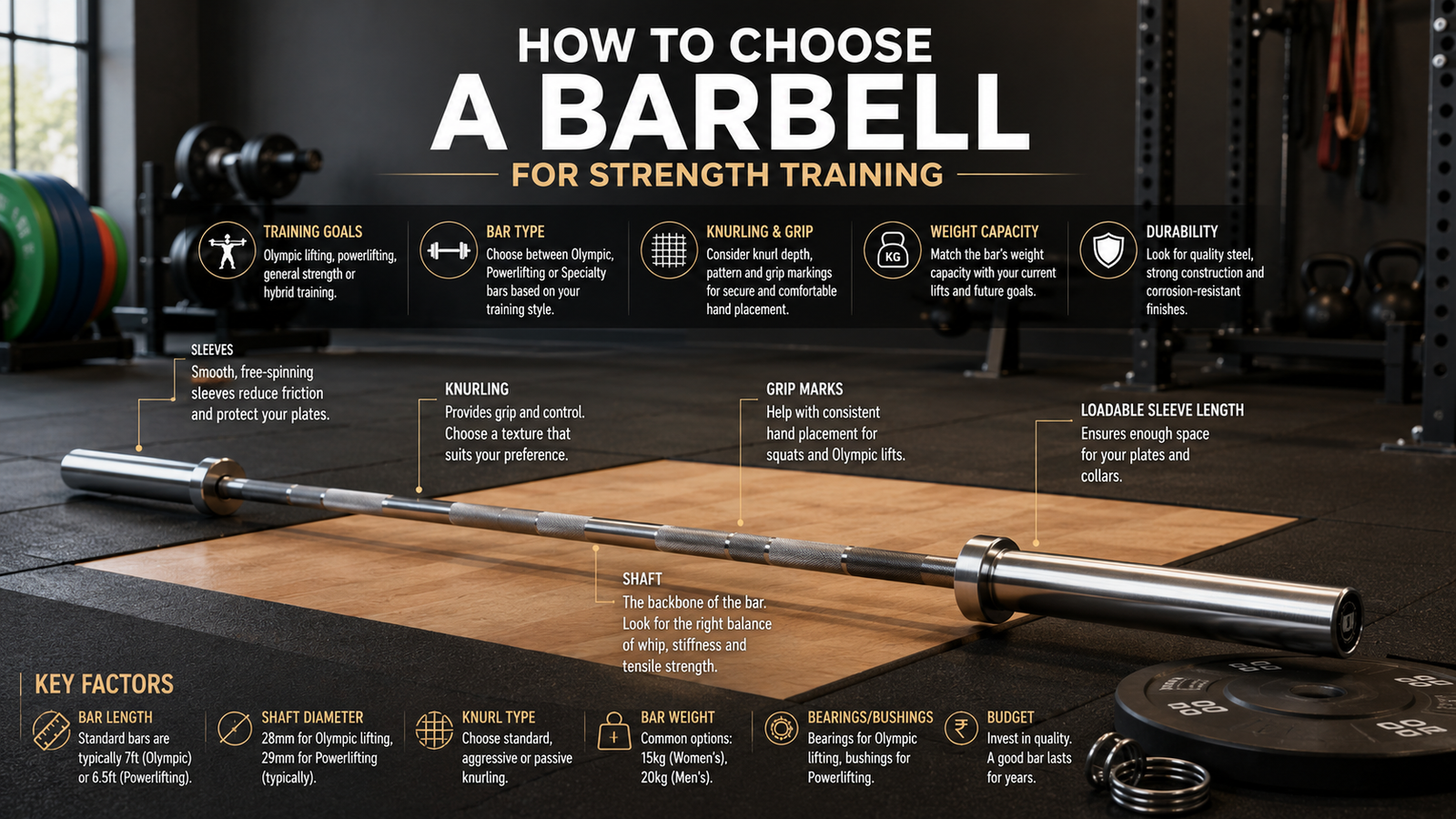
A barbell is one of the most versatile strength-training tools you can own.
With the right barbell and suitable weight plates, you can train:
- squats;
- deadlifts;
- bench presses;
- overhead presses;
- rows;
- cleans;
- snatches;
- carries;
- accessory exercises.
For a dedicated home gym, a barbell can support years of progressive strength training because resistance can usually be increased in relatively small steps simply by adding:
- weight plates.
But barbells are not all the same.
They differ in:
- total length;
- shaft diameter;
- weight;
- maximum load;
- tensile strength;
- knurling;
- centre knurling;
- sleeve length;
- sleeve diameter;
- bearing or bushing system;
- shaft flexibility or whip;
- coating;
- intended sport.
A bar designed primarily for:
- Olympic weightlifting;
may feel very different from one designed for:
- powerlifting.
A short inexpensive bar may fit a small room but fail to work properly with a standard:
- squat rack;
- power rack.
The practical way to choose a barbell is:
decide what type of lifting you will actually do → confirm rack and plate compatibility → choose appropriate dimensions and shaft characteristics → evaluate knurling and sleeve construction → check load rating and materials → then consider finish, maintenance and price
The best barbell is not necessarily:
- the strongest;
- the most aggressively knurled;
- the most flexible;
- the most expensive.
It is the bar that matches your exercises, equipment and progression needs.
What Is a Barbell?
A barbell consists of:
- central shaft;
- sleeves at both ends.
Weight plates are loaded onto the sleeves.
The lifter grips the central shaft during exercises such as:
- squat;
- bench press;
- deadlift;
- overhead press.
Standard full-size Olympic-style barbells are often designed to accept plates with approximately:
- 50 mm centre holes.
These should not be confused with smaller:
- standard 25–30 mm bars and plates.
Compatibility matters.
Why Use a Barbell?
A barbell makes progressive resistance particularly straightforward.
Suppose you squat:
- 60 kg.
You can gradually increase the resistance to:
- 62.5 kg;
- 65 kg;
- 67.5 kg;
depending on your available plates.
This makes barbells especially effective for long-term development of:
- strength;
- muscle;
- power.
Barbell vs Dumbbells
Both are excellent tools.
Barbell Advantages
- easier heavy loading;
- smaller incremental progression;
- efficient bilateral exercises;
- excellent for squats and deadlifts.
Dumbbell Advantages
- independent left and right sides;
- greater freedom of arm position;
- smaller setup;
- useful unilateral training.
For many serious home gyms, the two complement each other.
Barbell vs Kettlebell
Kettlebells are excellent for:
- swings;
- carries;
- compact conditioning.
Barbells generally provide greater scalability for:
- maximal strength;
- heavy squats;
- heavy pulls;
- presses.
If your main goal is increasing absolute strength, the barbell is usually more expandable.
Do Beginners Need a Barbell?
Not necessarily.
Beginners can build strength using:
- bodyweight;
- dumbbells;
- machines;
- resistance bands.
A barbell becomes particularly useful when you want structured progression in exercises such as:
- squat;
- deadlift;
- bench press;
- overhead press.
If you have:
- suitable space;
- appropriate rack;
- proper flooring;
a barbell can be an excellent long-term investment.
Start With Your Main Training Style
Different lifting styles place different demands on a bar.
General Strength Training
A multipurpose bar is usually best.
Powerlifting
Prioritize:
- stiffness;
- strong knurling;
- powerlifting markings;
- high load capacity.
Olympic Weightlifting
Prioritize:
- smooth sleeve rotation;
- appropriate whip;
- weightlifting markings;
- comfortable knurling.
Cross-Training / Mixed Fitness
Choose:
- versatile multipurpose bar;
- durable coating;
- moderate knurling.
Deadlift-Focused Training
A specialized deadlift bar may be useful for advanced lifters.
Squat-Focused Training
Specialized squat bars exist, but most home users do not need one.
For most people:
a good multipurpose 20 kg Olympic bar is the simplest starting point.
Main Types of Barbells
Common categories include:
- Multipurpose bars
- Powerlifting bars
- Olympic weightlifting bars
- Deadlift bars
- Squat bars
- Women’s Olympic bars
- Short bars
- Technique bars
- Specialty bars
Understanding these categories prevents buying something unsuitable.
Multipurpose Bars
A multipurpose bar is designed to handle several forms of training.
It may work for:
- squat;
- bench;
- deadlift;
- overhead press;
- cleans;
- moderate Olympic lifting.
Why Multipurpose Bars Are Good for Home Gyms
Most home users do not train only one strength sport.
A multipurpose bar provides a practical compromise between:
- stiffness;
- sleeve rotation;
- knurling;
- whip.
This makes it suitable for mixed programs.
Who Should Choose a Multipurpose Bar?
Choose one if your training includes:
- general strength;
- bodybuilding;
- some Olympic-style lifts;
- home-gym workouts.
For most recreational lifters, this is the best category.
Powerlifting Bars
Powerlifting bars are designed primarily for:
- squat;
- bench press;
- deadlift.
They are generally:
- stiff;
- heavily knurled;
- built for large loads.
Power Bar Characteristics
Common features include:
- approximately 20 kg weight;
- around 29 mm shaft diameter;
- aggressive knurling;
- centre knurl;
- powerlifting grip marks.
Exact specifications vary.
Why Power Bars Are Stiff
Powerlifting benefits from a relatively stable bar during:
- squat;
- bench.
Excessive flex would make heavy lifts less predictable.
Aggressive Knurling
Power bars often use sharper knurling to improve grip during:
- heavy deadlifts;
- squats.
This can feel uncomfortable for:
- high-repetition training;
- Olympic lifts.
Who Should Buy a Power Bar?
Consider one if your main lifts are:
- squat;
- bench;
- deadlift;
and you train relatively heavy.
If you frequently perform:
- cleans;
- snatches;
a dedicated power bar may feel less suitable.
Olympic Weightlifting Bars
Olympic weightlifting bars are designed for:
- snatch;
- clean and jerk.
These movements require the bar to rotate efficiently and tolerate dynamic loading.
Weightlifting Bar Characteristics
Common features may include:
- smoother sleeve rotation;
- greater whip;
- weightlifting grip marks;
- less aggressive centre knurling depending on model.
What Is Barbell Whip?
Whip refers to how much the shaft:
- flexes;
- oscillates;
under load and during movement.
Weightlifting bars are designed to have controlled elasticity.
This can help skilled lifters during dynamic movements.
Is More Whip Better?
No.
Whip is useful for certain advanced lifting styles.
For:
- bench press;
- general strength training;
excessive flexibility can feel undesirable.
Sleeve Rotation
During a clean or snatch, the plates need to rotate independently of the shaft.
Good sleeve rotation reduces torque transferred to:
- wrists;
- elbows.
This is one reason Olympic bars often use sophisticated:
- bearings;
- bushings.
Bearing Weightlifting Bars
Needle bearings can provide very smooth rotation.
They are commonly found on higher-end weightlifting bars.
Bushing Weightlifting Bars
Some bars use bushings and still provide adequate spin.
For recreational Olympic lifting, premium bearings are not mandatory.
Women’s Olympic Bars
Women’s weightlifting bars commonly differ from standard men’s bars.
Typical characteristics include:
- 15 kg weight;
- approximately 25 mm shaft diameter;
- slightly shorter overall length.
They are standardized for women’s Olympic weightlifting competition.
Who Can Use a 15 kg Bar?
Anyone.
A 15 kg bar can be useful for:
- beginners;
- smaller hands;
- lighter technique work.
It should not be thought of only as a bar for women.
Benefits of a Thinner Shaft
A 25 mm shaft may feel easier to grip for:
- smaller hands;
- Olympic lifts.
For heavy powerlifting, many users prefer the stiffness of a thicker:
- 29 mm bar.
Deadlift Bars
A deadlift bar is specialized for heavy deadlifting.
It is usually:
- longer;
- thinner;
- more flexible;
than a power bar.
Why Deadlift Bars Are More Flexible
During a heavy pull, the centre of the bar begins rising before all plates fully leave the floor.
This can slightly change the starting mechanics.
Experienced powerlifters may prefer this.
Deadlift Bar Knurling
Usually aggressive.
The goal is strong grip during maximal pulls.
Do Home Lifters Need a Deadlift Bar?
Usually not.
A normal power or multipurpose bar is enough.
A dedicated deadlift bar becomes relevant for:
- competitive powerlifters;
- advanced heavy deadlifting.
Squat Bars
Specialized squat bars are:
- longer;
- thicker;
- very stiff.
They are designed for extremely heavy squatting.
Why Are Squat Bars Longer?
Additional length allows:
- more plate loading;
- specialized rack positioning.
They also reduce whip during very heavy squats.
Do You Need a Squat Bar?
Almost certainly not for ordinary home training.
A standard power bar can support extremely heavy squats.
Short Barbells
Short bars are designed for:
- compact home gyms;
- limited space.
They may be useful, but compatibility requires careful attention.
Problems With Short Bars
Some short bars have reduced distance between the sleeves.
They may not fit standard:
- squat racks;
- power racks.
Others reduce only:
- sleeve length;
while maintaining standard rack spacing.
These are very different designs.
Rackable vs Non-Rackable Bars
A bar is rackable if the distance between its sleeves allows it to rest properly on:
- J-cups;
- squat stands.
Before buying a short bar, confirm:
rackable shaft length
not just total bar length.
Short Bars for Small Apartments
A compact rackable bar can be very useful where room width is limited.
But reduced sleeve length means fewer plates can fit.
This may limit future loading.
Technique Bars
Technique bars are lightweight bars used to practice:
- cleans;
- snatches;
- presses.
They may weigh:
- 5 kg;
- 10 kg;
- similar.
Who Needs a Technique Bar?
Useful for:
- beginners learning Olympic lifts;
- children/teen athletes under supervision;
- mobility drills.
They may not be designed for heavy loads.
Training Bars vs Full Barbells
Check maximum load.
A light technique bar may look like a regular bar but may have a much lower:
- load rating.
Do not overload it.
Standard Bars vs Olympic Bars
This distinction is important for home buyers.
Standard Bars
Often use sleeves around:
- 25–30 mm diameter.
Olympic Bars
Usually use sleeves around:
- 50 mm.
Their plates are not interchangeable.
Why Olympic-Style Equipment Is Usually Better for Long-Term Home Gyms
Olympic plates and bars offer:
- greater load capacity;
- broader product compatibility;
- better durability;
- easier expansion.
If you plan to train seriously, Olympic equipment is generally the better ecosystem.
When Standard Bars May Be Enough
For:
- light beginner workouts;
- curls;
- low-load home training;
smaller standard equipment may be adequate.
But you can outgrow it quickly.
Barbell Length
A full-size Olympic-style bar is often approximately:
- 2.2 metres long.
Women’s weightlifting bars are usually somewhat shorter.
Exact dimensions vary.
Measure Your Room First
You need room for:
- bar itself;
- plates;
- hand placement;
- loading plates.
A 2.2 m bar in a 2.4 m-wide room may technically fit but leave almost no room to load plates.
Loading Clearance
Leave enough room on each side to:
- slide plates onto sleeves;
- walk around safely.
A useful room needs more width than the bar’s length alone.
Barbell Length and Rack Compatibility
Check the internal distance between sleeves.
This must match:
- squat rack;
- power rack;
- bench rack.
Most full-size Olympic bars are designed to fit standard racks.
Short bars may not.
Bar Weight
Common bar weights include:
- 20 kg;
- 15 kg;
- lighter technique bars.
Why Bar Weight Matters
Your training load includes:
bar + plates
If the bar weighs 20 kg and you add:
- 10 kg per side;
total weight is:
40 kg
Do not forget to include the bar.
Unmarked Cheap Bars
Some inexpensive bars may not weigh exactly:
- 20 kg.
They could be:
- 18 kg;
- 19 kg;
- another value.
If accurate training logs matter, verify manufacturer specifications.
Shaft Diameter
Shaft diameter influences:
- grip;
- stiffness;
- whip.
Common examples:
Around 28 mm
Often multipurpose or weightlifting-oriented.
Around 28.5 mm
Common in multipurpose/CrossFit-style bars.
Around 29 mm
Common power-bar diameter.
25 mm
Common women’s Olympic bar diameter.
Thinner Shafts
Advantages:
- easier grip;
- more flexibility.
Useful for:
- weightlifting;
- deadlifts.
Thicker Shafts
Advantages:
- greater stiffness.
Useful for:
- heavy squatting;
- benching.
Very Thick Bars
Specialty thick bars exist for:
- grip training.
They are not standard general-purpose barbells.
Knurling
Knurling is the textured pattern cut into the shaft.
It improves friction between:
- hands;
- bar.
Why Knurling Matters
A smooth bar can slip during:
- heavy deadlifts;
- rows.
But excessively sharp knurling can:
- tear skin;
- feel uncomfortable.
The ideal aggressiveness depends on training style.
Passive Knurling
Feels relatively smooth.
Good for:
- high repetitions;
- Olympic lifting.
May provide insufficient grip for maximal deadlifts.
Medium Knurling
A good compromise.
Useful for:
- general strength;
- home gyms.
Aggressive Knurling
Designed for heavy gripping.
Useful for:
- powerlifting.
Can be uncomfortable during:
- cleans;
- high-repetition work.
Knurl Pattern
Knurling can differ in:
- depth;
- sharpness;
- spacing.
Marketing terms are not standardized.
Reviews from experienced users can be useful when buying online.
Centre Knurling
Some bars include knurling in the centre of the shaft.
Why Centre Knurling Exists
During back squats, centre knurl helps the bar grip:
- clothing;
- upper back.
This can reduce sliding.
Power Bars
Usually include:
- centre knurl.
Weightlifting Bars
May have:
- mild centre knurl;
- no centre knurl;
depending on design.
Why Weightlifters May Prefer Less Centre Knurl
Aggressive centre knurl can scrape:
- neck;
- chest;
during cleans.
Do You Need Centre Knurl?
If you perform frequent:
- heavy back squats;
it can be useful.
For general training:
- optional.
Knurl Marks
Bars have smooth rings cut into the knurl.
These help position the hands consistently.
Different sports use different ring spacing.
Powerlifting Marks
Often aligned with powerlifting standards.
Olympic Weightlifting Marks
Use different spacing.
Dual-Mark Bars
Multipurpose bars may include both:
- powerlifting;
- weightlifting marks.
This can be convenient.
Do Ring Marks Matter to Beginners?
Not much.
They are mainly reference points for:
- consistent grip width.
You do not need competition markings for effective training.
Sleeves
The sleeves hold the plates.
Important features include:
- length;
- diameter;
- rotation;
- finish.
Sleeve Length
Longer sleeves allow more plates.
This matters if you use:
- thick bumper plates.
Bumper Plates Take More Space
A 20 kg bumper plate may be much thicker than a:
- 20 kg iron plate.
If you plan heavy deadlifts with bumper plates, sleeve length matters greatly.
Loadable Sleeve Length
This is more useful than total sleeve length.
Collars and internal components reduce the usable area.
Check the manufacturer’s listed:
loadable sleeve length
where available.
Sleeve Diameter
Olympic sleeves are designed for plates with approximately:
- 50 mm holes.
Manufacturing tolerances affect how tightly plates fit.
Tight Plate Fit
Good plates should slide on without:
- excessive wobble;
- excessive force.
A very tight fit can make loading difficult.
Ribbed Sleeves
Some bars use fine grooves along the sleeves.
Advantages:
- plates and collars may grip better.
Disadvantages:
- loading can be noisier.
Smooth Sleeves
Quieter and easier for plates to slide.
Both designs work.
Sleeve Rotation
The sleeve should rotate relative to the shaft.
This matters most during dynamic lifts.
Bushings
Bushings are simple bearing surfaces between:
- sleeve;
- shaft.
Common materials include:
- bronze;
- composite materials.
Advantages of Bushings
- durable;
- simple;
- relatively inexpensive.
Ideal for:
- power bars;
- general training.
Bearings
Bearings provide faster, smoother sleeve rotation.
Common in:
- premium weightlifting bars.
Do You Need Bearings?
If you mainly perform:
- squat;
- bench;
- deadlift;
no.
Bushings are usually better suited.
If you perform serious:
- snatches;
- cleans;
good bearings may be valuable.
Too Much Sleeve Spin
For powerlifting-style bench press, extremely free-spinning sleeves provide little practical advantage.
A controlled bushing system is sufficient.
Sleeve Play
Some slight movement may be normal.
Excessive:
- side-to-side movement;
- rattling;
can indicate poor construction or wear.
Collars
Weight collars secure plates on the sleeves.
They are usually sold separately.
Why Use Collars?
They prevent plates from shifting during:
- squats;
- deadlifts;
- Olympic lifts.
Plate movement can affect balance.
Spring Collars
Simple and inexpensive.
Advantages:
- quick;
- widely available.
Disadvantages:
- can loosen over time.
Clamp Collars
Use a lever mechanism.
Advantages:
- secure;
- easy;
- fast.
Excellent for home gyms.
Competition Collars
Heavy-duty collars used in:
- Olympic lifting;
- powerlifting competition.
They can provide precise plate security.
Most home users do not need them.
Barbell Tensile Strength
Tensile strength describes how much stress the steel can withstand before breaking.
It is usually measured in:
- PSI.
Manufacturers may advertise values such as:
- 150,000 PSI;
- 190,000 PSI;
- 200,000+ PSI.
Is Higher PSI Always Better?
No.
Once a bar is sufficiently strong for your intended training, extremely high tensile strength provides little practical advantage.
Bar quality also depends on:
- steel treatment;
- straightness;
- sleeve construction;
- knurling;
- manufacturing.
Do not choose only by one large PSI number.
Yield Strength
Yield strength refers to the stress at which metal begins to permanently deform.
This can also matter.
But manufacturers often emphasize tensile strength instead.
Load Capacity
Bars may advertise maximum loads such as:
- 300 kg;
- 500 kg;
- 700 kg;
- more.
Do You Need a 700 kg Bar?
Probably not.
For most home lifters, any genuinely high-quality Olympic bar has far more capacity than they will ever use.
Durability and construction matter more than exaggerated maximum-load marketing.
Static Load vs Dynamic Load
A bar may hold a heavy static load but behave differently when:
- dropped;
- bent;
- repeatedly loaded.
A simple maximum-weight number does not fully describe durability.
Barbell Whip and Stiffness
Different sports benefit from different flex characteristics.
Powerlifting
Generally prefers:
- stiff bar.
Olympic Weightlifting
Benefits from:
- controlled whip.
Deadlifting
Some lifters prefer:
- more flexible bar.
Why Bar Flexes
Steel bends elastically under load.
A good bar should return to:
- straight;
after normal loading.
Permanent Bend
A bar that remains visibly bent after unloading may be damaged.
Do not continue heavy lifting on a significantly bent bar.
Causes of Bent Bars
Potential causes:
- excessive loading;
- poor-quality steel;
- dropping onto safety pins;
- improper storage;
- repeated abuse.
Dropping a Loaded Bar Onto Spotter Arms
This can concentrate force in a small area.
It may damage:
- bar;
- rack.
Use proper safeties and controlled lifting.
Barbell Finish
The shaft and sleeves may use several coatings.
Common options:
- bare steel;
- black oxide;
- hard chrome;
- zinc;
- cerakote;
- stainless steel.
Bare Steel
Advantages:
- excellent grip feel;
- natural knurling sensation;
- often lower price.
Disadvantages:
- rusts more easily.
Requires regular maintenance, especially in:
- humid climates.
Black Oxide
Provides some corrosion protection while maintaining:
- good knurl feel.
But protection is limited compared with some stronger coatings.
It may wear over time.
Chrome
Common on commercial bars.
Advantages:
- corrosion resistance;
- attractive finish.
Potential downside:
- heavy chrome may slightly dull knurl feel.
Quality varies significantly.
Hard Chrome
More durable than decorative chrome.
Often used on:
- quality weightlifting bars.
Zinc
Can provide good initial corrosion resistance.
May wear and change appearance over time.
Cerakote
A ceramic-based coating available in many colours.
Advantages:
- good corrosion protection;
- design options.
Potential drawbacks:
- coating may slightly soften knurl feel;
- can scratch.
Stainless Steel
Highly desirable for many premium barbells.
Advantages:
- excellent corrosion resistance;
- direct metal knurl feel;
- premium durability.
Disadvantages:
- expensive.
Stainless Steel vs Coated Steel
Stainless offers corrosion resistance without a surface coating that can:
- wear;
- chip.
For humid home gyms, it can be an excellent long-term choice if budget allows.
Sleeve Finish May Differ From Shaft Finish
For example:
- stainless shaft;
- chrome sleeves.
This is normal.
Sleeves experience constant abrasion from:
- plates;
- collars.
Some coatings are better suited there.
Barbell Rust
Rust is one of the most common maintenance issues.
Risk increases with:
- sweat;
- humidity;
- poor ventilation.
Home Gyms in Humid Climates
If your training space is:
- garage;
- basement;
- humid room;
corrosion resistance becomes more important.
In Indian monsoon conditions, bare-steel bars may require frequent maintenance.
Sweat and Corrosion
Sweat contains:
- moisture;
- salts.
Wipe the shaft after training.
Do not let sweat sit on the bar overnight.
Basic Barbell Maintenance
A simple routine:
- Wipe the bar after use.
- Brush chalk from knurl periodically.
- Inspect sleeves.
- Apply appropriate protective oil if required.
Follow manufacturer recommendations.
Nylon Brush
A stiff nylon brush can remove:
- chalk;
- dirt;
from knurling without aggressively damaging finishes.
Brass Brush
May be appropriate for certain bare-steel bars.
But it can damage some coatings.
Check manufacturer advice.
Oil
Bare-steel bars may benefit from a very light protective oil.
Do not soak the shaft.
Excess oil can make the bar:
- slippery.
Sleeve Lubrication
Do not randomly spray lubricant inside sleeves.
Some bars require:
- little;
- no maintenance.
Others have specific service procedures.
Follow manufacturer instructions.
WD-40-Type Products
Do not assume multipurpose penetrating sprays are appropriate for every bar.
They may:
- alter grip;
- attract dirt;
- affect coatings.
Use products recommended for the bar.
Chalk
Chalk improves grip by absorbing moisture.
It is useful during:
- deadlifts;
- rows;
- Olympic lifts.
But chalk accumulates in knurling.
Brush the bar periodically.
Liquid Chalk
Often better for home gyms because it creates less airborne mess.
Useful where powdered chalk is undesirable.
Barbell Straightness
A quality bar should be straight.
You can test by:
- rolling it on a flat surface.
A visibly wobbling shaft may indicate bending.
Sleeve Rotation Test
Rotate each sleeve.
They should move:
- smoothly;
- consistently.
Some bushing bars will not spin for a long time.
That is normal.
What matters is smoothness, not how many seconds the sleeve continues spinning.
“Spin Test” Marketing
A long free spin is not automatically better.
For a power bar, extremely fast sleeve spin is irrelevant.
Judge sleeve system by intended use.
Knurling Test
Grip the bar with:
- dry hands.
It should feel secure without painful sharp points for your intended training.
Barbell Sound
Some bars rattle slightly.
This may not affect performance.
Excessive sleeve looseness may indicate:
- lower build quality;
- wear.
Barbell and Rack Compatibility
This must be verified before purchase.
Check:
- bar length;
- distance between sleeves;
- rack width.
A standard full-size Olympic bar generally works with standard racks.
Compact bars may not.
J-Cup Compatibility
The bar rests on J-cups.
The shaft should sit securely without the sleeves contacting:
- rack uprights.
Rack Width
If the rack is too wide for the bar’s shaft, the sleeves may land on:
- J-cups.
This is unsafe and can damage the bar.
Bench Press Setup
A rackable bar is essential for barbell bench pressing.
You also need:
- stable bench;
- J-cups;
- safety arms or spotter system where possible.
Power Rack vs Squat Stands
Power Rack
Provides:
- enclosed structure;
- safety bars.
Squat Stands
More compact.
May provide:
- spotter arms.
For home barbell training, a rack with proper safeties significantly improves usability.
Barbell Without a Rack
You can still perform:
- deadlifts;
- rows;
- cleans;
- floor presses;
- landmine exercises.
But heavy:
- back squats;
- bench presses;
become more difficult to set up safely.
Do Not Improvise a Squat Rack
Using:
- chairs;
- tables;
- unstable furniture;
to support a loaded barbell is dangerous.
Use equipment designed for the load.
Bench Press Safety
Bench pressing alone requires careful setup.
Use:
- safety arms;
- spotter pins;
- competent spotter;
where appropriate.
Collars During Bench Press
There is debate about using collars when benching alone.
Some lifters leave collars off so plates can slide away during an emergency.
But this is not an ideal safety strategy.
A better setup uses:
- safety arms;
- spotter rails;
- trained spotter.
Squat Safety
Set safeties just below the lowest position you intend to reach.
They should catch the bar if you:
- fail the rep.
Deadlift Safety
Deadlifts usually begin and end on the floor.
Proper flooring and plate type matter.
Barbell Flooring
A loaded bar can damage:
- tile;
- wood;
- laminate.
Use:
- dense rubber flooring;
- lifting platform.
Bumper Plates
Bumper plates are designed to be dropped more safely from certain heights when used on appropriate flooring.
They are common in:
- Olympic weightlifting.
Iron Plates
More compact.
Excellent for:
- powerlifting;
- general strength.
But they are not designed for repeated dropping.
Barbell Compatibility With Bumper Plates
Any good Olympic bar should accept bumper plates.
But sleeve length determines how much weight can fit.
Plate Diameter
Standard Olympic bumper plates use consistent outer diameter across many weights.
This creates a standard deadlift starting height.
Iron Plate Diameter
May vary by plate design.
Competition powerlifting plates typically use standardized dimensions.
Barbell for Squats
Useful characteristics:
- stiff shaft;
- centre knurl;
- secure grip.
A power bar is ideal, but a multipurpose bar is also excellent.
Barbell for Bench Press
Useful characteristics:
- stiffness;
- secure knurling;
- predictable shaft.
Very whippy bars are less desirable.
Barbell for Deadlifts
Useful characteristics:
- strong grip;
- appropriate shaft diameter.
Both power bars and multipurpose bars work well.
Barbell for Overhead Press
Almost any general-purpose Olympic bar works.
Check ceiling clearance.
Barbell for Rows
Most bars work well.
Grip texture is useful.
Barbell for Olympic Lifts
Prioritize:
- sleeve rotation;
- appropriate whip;
- smooth enough knurl.
Barbell for CrossFit-Style Training
A multipurpose bar is ideal.
You may need:
- moderate whip;
- bushings;
- durable finish;
- dual knurl marks.
Barbell for Bodybuilding
A multipurpose or power bar works well.
Bodybuilding training often includes:
- presses;
- rows;
- squats;
- Romanian deadlifts.
Specialized sport bars are unnecessary.
Barbell for Beginners
Choose:
- multipurpose Olympic bar;
- moderate knurling;
- standard rack compatibility.
Avoid highly specialized:
- deadlift;
- squat;
- competition weightlifting bars;
unless you already know you need them.
Barbell for Women
Do not automatically choose a 15 kg bar simply because of gender.
Choose according to:
- hand size;
- training style;
- strength.
A 15 kg bar may be excellent for Olympic lifting or smaller hands.
A 20 kg power bar may be more appropriate for heavy powerlifting.
Barbell for Small Hands
A thinner shaft may feel easier to grip.
This can be especially helpful for:
- deadlifts;
- Olympic lifts.
Barbell for Large Hands
A 28–29 mm shaft generally works well.
There is little need to choose an unusually thick bar unless grip training is the goal.
Barbell for Older Adults
A lighter 15 kg bar may be easier to:
- handle;
- position.
But individual strength matters more than age alone.
Barbell Training for Teenagers
Barbells can be used under appropriate:
- supervision;
- coaching;
- load progression.
The bar itself may initially be too heavy.
A lighter technique bar can help.
Technique Before Load
The ability to add plates easily is both the strength and danger of barbell training.
Do not increase weight simply because you can.
First maintain:
- controlled technique;
- stable range;
- appropriate bracing.
Progressive Overload With a Barbell
One of the biggest advantages is easy loading progression.
Example:
Week 1
60 kg squat.
Week 2
62.5 kg.
Week 3
65 kg.
Small increases can accumulate significantly over months.
Fractional Plates
Small plates such as:
- 0.25 kg;
- 0.5 kg;
- 1 kg;
allow fine progression.
They are particularly useful for:
- overhead press;
- bench press.
Why Small Increments Matter
Increasing a 40 kg overhead press by 5 kg is a:
- 12.5% increase.
That may be too large.
Adding:
- 1 kg total;
can be much more manageable.
Barbell Plate Math
Total load equals:
bar + plates on both sides
For example:
20 kg bar
plus:
- 10 kg plate each side;
- 5 kg plate each side.
Total:
20 + 20 + 10 = 50 kg
Always Load Both Sides Evenly
Except during specific specialized exercises, plates should be symmetrical.
An uneven bar can:
- tip;
- rotate.
Loading Plates Safely
Keep the bar stable on:
- rack;
- floor.
When loading a rack-mounted bar, do not place a huge stack on one side while the other remains empty.
The bar can tip.
Heavy Loading Sequence
Alternate sides or limit imbalance.
This becomes more important with:
- heavy plates.
Plate Collars
After loading, secure plates where appropriate.
Before lifting, verify:
- both sides match;
- collars are secure.
Barbell Storage
Bars should ideally be stored:
- horizontally;
- vertically;
using a proper rack.
Horizontal Storage
Wall-mounted gun racks or bar holders support the shaft.
Advantages:
- easy access;
- reduced sleeve pressure.
Vertical Storage
Uses less wall width.
The bar rests on one end.
Ensure the holder is:
- stable;
- designed for bars.
Can You Store a Barbell Upright Against a Wall?
It may fall.
Use a proper vertical holder.
A 20 kg steel bar tipping over can cause injury.
Do Not Store a Loaded Bar for Long Periods
Leaving heavy plates permanently loaded can place ongoing stress on:
- shaft;
- rack.
Remove plates after training where practical.
Barbell on the Floor
Do not leave it across:
- walkways.
It becomes a trip hazard.
Barbell in a Garage
Garage gyms can be excellent.
But consider:
- humidity;
- temperature;
- dust.
Corrosion-resistant finishes may be worth paying more for.
Barbell in a Bedroom or Apartment
Space becomes critical.
Measure:
- room width;
- loading clearance.
A compact rackable bar may be useful.
Apartment Noise
Barbell training can be noisy.
Potential sources:
- iron plates;
- sleeve contact;
- bar racking;
- dropping.
Use:
- rubber flooring;
- controlled movement.
Do Not Drop Barbells in Apartments
Even bumper plates can transmit significant:
- vibration;
- impact.
Controlled lowering is essential.
Noise From Ribbed Sleeves
Some sleeves create a metallic:
- zip sound;
when plates slide.
This is normal but may be annoying in quiet homes.
Barbell Cleaning
After training:
- wipe sweat;
- remove chalk;
- check sleeves.
A minute of maintenance can significantly reduce corrosion.
Rust Prevention in India
In humid and monsoon conditions:
- wipe after every session;
- keep room ventilated;
- avoid leaving wet towels near equipment;
- consider corrosion-resistant coating.
Bare steel requires the most attention.
Barbell Warranty
Check coverage for:
- shaft;
- sleeves;
- manufacturing defects.
Some manufacturers exclude damage from:
- dropping onto safeties;
- misuse;
- rust.
Lifetime Warranty
This sounds excellent, but read the conditions.
A lifetime warranty may still exclude:
- normal wear;
- corrosion;
- bending due to misuse.
Replacement Parts
For quality bars, sleeve components may be serviceable.
Cheap bars often have no parts support.
Barbell Certification
Competition bars may be certified by organizations such as:
- IWF;
- IPF;
depending on sport.
Do You Need Certified Equipment?
No, unless:
- you compete;
- want exact competition specifications.
Certification increases cost.
For home training, a high-quality non-certified bar can perform extremely well.
IWF-Type Bars
Designed according to Olympic weightlifting standards.
Useful for:
- serious weightlifting practice.
IPF-Type Power Bars
Designed according to powerlifting standards.
Useful for competitive specificity.
Barbell Price Categories
Prices vary widely.
Budget Bars
May provide:
- basic Olympic dimensions;
- adequate capacity.
Potential compromises:
- weaker finish;
- poor sleeves;
- inconsistent knurling;
- lower steel quality.
Mid-Range Bars
Often the best value for home gyms.
You can get:
- good steel;
- reliable bushings;
- solid knurling;
- better corrosion resistance.
Premium Bars
May offer:
- stainless steel;
- premium bearings;
- competition certification;
- superior machining.
Worthwhile for advanced or high-frequency lifters.
Do Not Buy the Cheapest Bar in the Gym Setup
The bar is the part you:
- hold;
- rack;
- load;
- use for almost every major lift.
It is often worth spending more on a quality bar while saving elsewhere.
Budget Allocation
If building a home gym:
- rack safety;
- bar quality;
- plates;
- flooring;
should usually come before decorative accessories.
Barbell vs Plate Budget
A premium bar paired with a practical set of plates is often better than:
- luxury plates;
- low-quality bar.
The bar directly affects:
- grip;
- rotation;
- safety.
Buying a Barbell Online
Check specifications carefully.
Do not rely only on photographs.
Look for:
- bar weight;
- total length;
- shaft diameter;
- loadable sleeve length;
- sleeve diameter;
- knurl type;
- centre knurl;
- tensile strength;
- coating;
- bearing/bushing system.
Verify Rackability
If buying a compact bar:
- confirm the distance between sleeves.
This is one of the easiest mistakes to make.
Shipping
A barbell is:
- long;
- heavy.
Shipping damage can occur.
Inspect the packaging for:
- bent tube;
- exposed shaft;
- crushed ends.
Check the Bar Upon Arrival
Inspect:
- Shaft straightness.
- Sleeve rotation.
- Knurling.
- Finish.
- End caps.
Report damage immediately.
Used Barbells
A used quality bar can be excellent value.
Inspect carefully.
Check for Permanent Bend
Roll the bar on a flat surface.
Watch the shaft.
If it wobbles visibly, it may be bent.
Check Sleeves
Rotate them.
Look for:
- grinding;
- excessive looseness.
Check Knurl
Worn knurl can reduce grip.
But mild cosmetic wear is not a major problem.
Check Rust
Light surface rust may be manageable.
Severe corrosion or pitting can affect:
- grip;
- long-term durability.
Check Bar Ends
Inspect:
- snap rings;
- bolts;
- end caps.
Loose components can indicate poor maintenance.
Used Bearing Bars
Bearing condition matters more.
If the sleeves:
- grind;
- bind;
repair may be expensive.
Barbell Safety Around Children
A barbell can:
- roll;
- tip;
- fall from storage.
Keep children away from the training area.
Use secure storage.
Pets
Do not allow pets around:
- rack;
- lifting platform;
during training.
A loaded bar has a wide movement path.
Barbell Safety During Squats
Use:
- rack;
- safeties.
Set J-cups at a height that allows you to unrack without:
- tiptoeing;
- squatting excessively.
Squat Unrack Height
The bar should sit slightly below your standing shoulder position.
You should be able to:
- stand up;
- clear hooks.
Squat Walkout
Take controlled steps.
Do not walk several metres backward.
A small stable walkout is more efficient.
Bar Position
Common squat positions include:
- high bar;
- low bar.
Exact placement depends on:
- technique;
- anatomy;
- training style.
Centre knurl can help keep the bar stable.
Bench Press J-Cup Height
You should be able to unrack with:
- shoulder blades maintained in position.
If hooks are too high, you may lose setup.
Bench Press Safeties
Set them so they can catch the bar without interfering with normal repetitions.
This requires:
- testing with empty bar first.
Deadlift Setup
The bar should start over:
- midfoot;
in many conventional deadlift techniques.
Exact mechanics vary.
Learn the movement before chasing heavy numbers.
Deadlifting With Bumper Plates
This provides standardized height and allows controlled drops on suitable platforms.
Deadlifting With Iron Plates
Also completely effective.
Lower the bar under control to protect:
- floor;
- equipment.
Barbell Row Safety
Maintain control.
Do not use weights that force excessive:
- body swing;
- spinal movement.
Overhead Press Safety
Check overhead clearance for:
- ceiling;
- lights;
- fans.
This is critical in home gyms.
Cleaning Chalk From the Bar
Chalk left mixed with sweat can trap:
- moisture.
Brush periodically.
This is especially important on:
- bare steel.
Barbell and Hand Care
Aggressive knurling can create:
- calluses.
Keep them smooth enough to reduce tearing.
Gloves
Workout gloves can be used.
But they reduce direct knurl contact.
Many barbell lifters prefer:
- bare hands;
- chalk.
This is personal preference.
Lifting Straps
Useful during:
- heavy rows;
- Romanian deadlifts;
- deadlifts for volume.
They reduce grip limitation.
Wrist Wraps
May provide support during:
- heavy bench;
- overhead press.
They do not replace:
- proper wrist position.
Lifting Belt
Can help experienced lifters create greater trunk stiffness during heavy:
- squats;
- deadlifts.
It is not required for beginners.
Barbell Pads
Foam squat pads wrap around the bar.
They may improve comfort.
But they can also change:
- bar position;
- stability.
Do You Need a Squat Pad?
Not necessarily.
Many lifters become comfortable with direct bar contact.
If you use a pad, make sure it does not cause the bar to:
- roll;
- sit unpredictably.
Barbell Hip Thrust Pads
Padding can be useful during:
- hip thrusts;
because the bar rests across the pelvis.
A dedicated thick pad can improve comfort.
Barbell Pad Hygiene
Foam pads absorb:
- sweat.
Clean them regularly.
Landmine Attachments
A landmine anchors one end of a barbell.
This enables exercises such as:
- landmine press;
- rows;
- squats;
- rotations.
Do You Need a Special Bar?
Usually no.
A normal Olympic bar can often be used with a compatible landmine attachment.
Landmine Sleeve Protection
Some attachments may scratch the bar’s sleeve.
If cosmetic protection matters, use appropriate:
- insert;
- sleeve.
Rack Pulls
These place the bar on safeties or blocks.
Repeated heavy rack pulls can damage bars if dropped aggressively onto:
- narrow steel pins.
Use appropriate supports and controlled lowering.
Block Pulls
Pulling from sturdy blocks can reduce concentrated bar stress.
Good Mornings
Barbell exercise for:
- posterior chain.
Requires controlled load and technique.
Not usually a beginner’s first barbell movement.
Front Squats
Bar rotates slightly during setup and movement.
A weightlifting or multipurpose bar may feel comfortable.
Aggressive centre knurling may irritate:
- neck;
- shoulders.
Clean Grip Front Squat
Requires:
- wrist;
- shoulder mobility.
Alternative grip styles exist.
Barbell Curls
Any straight bar can be used.
But some users prefer:
- EZ curl bar;
to reduce wrist strain.
Specialty Bars
Once you have a standard barbell, specialty bars may add variety.
Examples:
- safety squat bar;
- trap bar;
- EZ curl bar;
- Swiss bar;
- axle bar.
Safety Squat Bar
Uses padded yoke and forward handles.
Useful for:
- squat variation;
- people with limited shoulder mobility.
It is not a replacement for a standard bar for all exercises.
Trap Bar
Hexagonal frame that you stand inside.
Excellent for:
- deadlifts;
- carries.
It changes the movement compared with a straight bar.
EZ Curl Bar
Curved grip.
Useful for:
- curls;
- triceps work.
Not suitable for general barbell training.
Swiss / Football Bar
Multiple neutral grip handles.
Useful for:
- pressing variations.
Specialized accessory.
Axle Bar
Very thick shaft.
Used in:
- strongman;
- grip training.
Not a beginner general-purpose barbell.
Do You Need Specialty Bars?
No.
Start with one good:
- straight Olympic bar.
Add specialty bars only when you have a clear reason.
Common Barbell Buying Mistakes
Buying a Short Bar Without Checking Rack Compatibility
One of the biggest mistakes.
Buying a Standard-Diameter Bar When Your Plates Are Olympic
They will not fit.
Buying a Weightlifting Bar for Powerlifting Only
Unnecessary whip/spin.
Buying a Power Bar for High-Rep Olympic Lifts
Aggressive knurling may be uncomfortable.
Choosing by Maximum Load Alone
Steel quality involves more than one number.
Ignoring Sleeve Length
Important with bumper plates.
Assuming More Spin Is Better
Depends on training style.
Ignoring Centre Knurl
Relevant for squats and cleans.
Buying Bare Steel in a Humid Environment Without Planning Maintenance
Rust risk.
Buying an Extremely Aggressive Knurl as a Beginner
Can make general training unpleasant.
Common Barbell Training Mistakes
Adding Weight Too Quickly
Progress gradually.
Forgetting Bar Weight
Include it in training logs.
Loading One Side Excessively First
The bar can tip.
Skipping Collars When Plate Movement Is Possible
Secure plates appropriately.
Bench Pressing Alone Without Safeties
Unnecessary risk.
Squatting Without Proper Rack Setup
Use appropriate equipment.
Dropping a Non-Droppable Bar/Plate System
Can damage equipment and floor.
Leaving Sweat and Chalk on the Bar
Encourages corrosion.
Storing the Bar Improperly
A bar leaning unsecured against a wall can fall.
Using a Bent Bar
Inspect first.
How to Choose a Barbell Step by Step
Step 1 — Decide What You Will Train
General strength, powerlifting or Olympic lifting?
Step 2 — Confirm Plate Type
Olympic or standard?
For long-term strength training:
- Olympic is usually preferable.
Step 3 — Confirm Rack Compatibility
Check:
- shaft length;
- rack width.
Step 4 — Choose Bar Weight and Diameter
20 kg / 29 mm for many power/general users.
15 kg / 25 mm may suit weightlifting, smaller hands or lighter starting loads.
Step 5 — Choose Knurling
Moderate for general training.
Aggressive for heavy powerlifting.
Step 6 — Decide Whether You Need Centre Knurl
Useful for:
- heavy squats.
Step 7 — Choose Sleeve System
Bushings for general/powerlifting.
Bearings for serious Olympic lifting.
Step 8 — Check Sleeve Length
Especially if using bumper plates.
Step 9 — Evaluate Steel Quality
Look for credible:
- tensile strength;
- load rating;
- manufacturer reputation.
Step 10 — Choose Finish
Based on:
- budget;
- humidity;
- maintenance willingness.
Step 11 — Plan Storage
Horizontal or vertical rack.
Step 12 — Confirm Warranty and Service
Especially for premium bars.
A Simple Choice by Goal
General Home Strength
Choose:
20 kg multipurpose Olympic bar
Powerlifting
Choose:
29 mm power bar with aggressive knurl and centre knurl
Olympic Weightlifting
Choose:
28 mm bearing or quality bushing weightlifting bar
Smaller Hands / Weightlifting
Consider:
15 kg, 25 mm Olympic-style bar
Limited Space
Choose:
short rackable Olympic bar
not a non-rackable short bar.
A Simple Choice by Home-Gym Size
Small Apartment
Short rackable Olympic bar where appropriate.
Normal Home Gym
Full-size multipurpose bar.
Dedicated Strength Gym
Power bar plus specialty bars later.
Weightlifting Home Gym
Quality bearing weightlifting bar + bumper plates.
A Simple Choice by Knurl
Beginner / General Training
Moderate.
Powerlifting
Aggressive.
Olympic Weightlifting
Moderate/smoother.
High-Repetition Training
Avoid extremely sharp knurl.
A Simple Choice by Finish
Lowest Cost / Best Raw Grip
Bare steel, accepting maintenance.
Moderate Corrosion Protection
Black oxide, zinc or chrome depending on quality.
Durable Coloured Finish
Cerakote.
Premium Corrosion Resistance + Excellent Grip Feel
Stainless steel.
A Simple Choice by Sleeve System
Squat / Bench / Deadlift
Bushings.
General Mixed Training
Quality bushings.
Olympic Lifting
Bearings or high-quality weightlifting bushings.
A Simple Choice for Beginners
A beginner home lifter generally does not need a specialized competition bar.
A practical starting specification is:
- Olympic-style plate compatibility;
- rackable full-size design;
- approximately 20 kg;
- moderate knurl;
- good bushing sleeves;
- reliable corrosion-resistant finish;
- sufficient load capacity.
This can support years of training.
A Simple Choice for Serious Powerlifters
Prioritize:
- 29 mm shaft;
- high stiffness;
- centre knurl;
- strong grip knurl;
- long sleeves;
- high-quality bushings.
If competing, consider a bar matching your federation’s specification.
A Simple Choice for Olympic Lifters
Prioritize:
- appropriate 28 mm or 25 mm shaft depending on category;
- smooth fast sleeve rotation;
- controlled whip;
- weightlifting markings;
- comfortable knurl;
- good warranty.
Example Basic Home Barbell Setup
A minimalist strength-training setup might include:
- one multipurpose Olympic bar;
- weight plates;
- collars;
- power rack or squat stands with safeties;
- flat bench;
- rubber flooring.
This is enough for:
- squat;
- bench;
- deadlift;
- overhead press;
- row.
Example Expanded Home Setup
Later, you may add:
- specialty deadlift bar;
- safety squat bar;
- trap bar;
- EZ curl bar.
But these are secondary.
Barbell Buying Checklist
Before purchasing, ask:
1. What type of strength training will I do?
General, powerlifting or weightlifting?
2. Are my plates Olympic or standard?
Compatibility is mandatory.
3. Will the bar fit my rack?
Check rackable shaft length.
4. Is the bar too long for my room?
Include loading clearance.
5. What does the bar weigh?
Know whether it is 20 kg, 15 kg or another weight.
6. Is the shaft diameter appropriate?
Grip and stiffness depend on it.
7. Is the knurling suitable?
Do not choose aggressive powerlifting knurl for every training style.
8. Do I need centre knurl?
Useful for squatting.
9. Are the grip marks useful for my sport?
Powerlifting, weightlifting or dual.
10. Do I need bushings or bearings?
Most home users need bushings.
11. Is the loadable sleeve length sufficient?
Especially for bumper plates.
12. Is the steel quality credible?
Do not rely only on extreme load claims.
13. Is the bar sufficiently resistant to corrosion?
Important in humid environments.
14. Can I maintain the finish properly?
Bare steel requires more care.
15. Does the manufacturer support replacement or warranty service?
Useful for long-term ownership.
16. Do I have proper storage?
Do not leave a 20 kg bar loose against a wall.
17. Do I have appropriate flooring?
Protect both bar and home.
18. Do I have a safe rack for squats and benching?
The bar is only part of the system.
When Should You Seek Coaching?
Barbell training can be extremely effective, but exercises such as:
- squat;
- deadlift;
- bench press;
- clean;
- snatch;
require technique.
Professional instruction may be particularly useful if you:
- are new to free weights;
- plan to lift heavy;
- experience recurring pain;
- want to learn Olympic lifts.
A qualified trainer can help with:
- setup;
- movement;
- bracing;
- load progression.
When Should You Seek Medical Guidance?
Persistent or significant symptoms during barbell training should not simply be ignored.
Seek appropriate assessment for problems such as:
- persistent back pain;
- recurring shoulder pain;
- unexplained weakness;
- numbness;
- significant joint pain.
Equipment selection cannot compensate for an unresolved injury.
The Physical Glow Takeaway
A barbell can become the foundation of a home strength-training system because it allows you to progressively train:
- squats;
- deadlifts;
- presses;
- rows;
- Olympic-style lifts.
For most people building a general home gym, the best first choice is:
a high-quality rackable Olympic multipurpose bar
rather than a highly specialized competition bar.
Start by matching the bar to your training:
- general strength → multipurpose bar;
- powerlifting → stiff 29 mm power bar;
- Olympic lifting → weightlifting bar with smooth rotation and appropriate whip;
- limited room → short rackable bar, after carefully checking rack compatibility.
Then focus on the specifications that actually affect your workouts:
- bar weight → know exactly what you are loading;
- shaft diameter → affects grip and stiffness;
- knurling → enough grip without unnecessary discomfort;
- centre knurl → useful for heavy back squats;
- sleeve length → enough room for your plates;
- sleeve rotation → bushings for most users, bearings for serious Olympic lifting;
- steel quality → strong enough for long-term loading;
- finish → suitable for your climate and maintenance routine;
- rack compatibility → absolutely essential;
- storage and flooring → planned before the bar arrives.
Do not buy based only on:
- maximum-load numbers;
- extreme tensile-strength claims;
- how many seconds the sleeve spins;
- competition branding.
A barbell is part of a larger system.
You also need:
plates → collars → appropriate flooring → a safe rack when squatting or benching
and, most importantly, a sensible progression plan.
A good bar should remain useful as you move from:
learning the lifts → building technique → adding small amounts of weight → becoming substantially stronger over time.
Choose one that matches the training you actually intend to do, maintain it properly and it can remain one of the most useful pieces of equipment in your home gym for many years.