How to Choose the Right Kettlebell for Home Training
Learn how to choose a kettlebell for home training, with practical guidance on weight, handle size, material, exercise selection and progression. This beginner-friendly guide helps you make a clear, informed choice without unnecessary complexity.
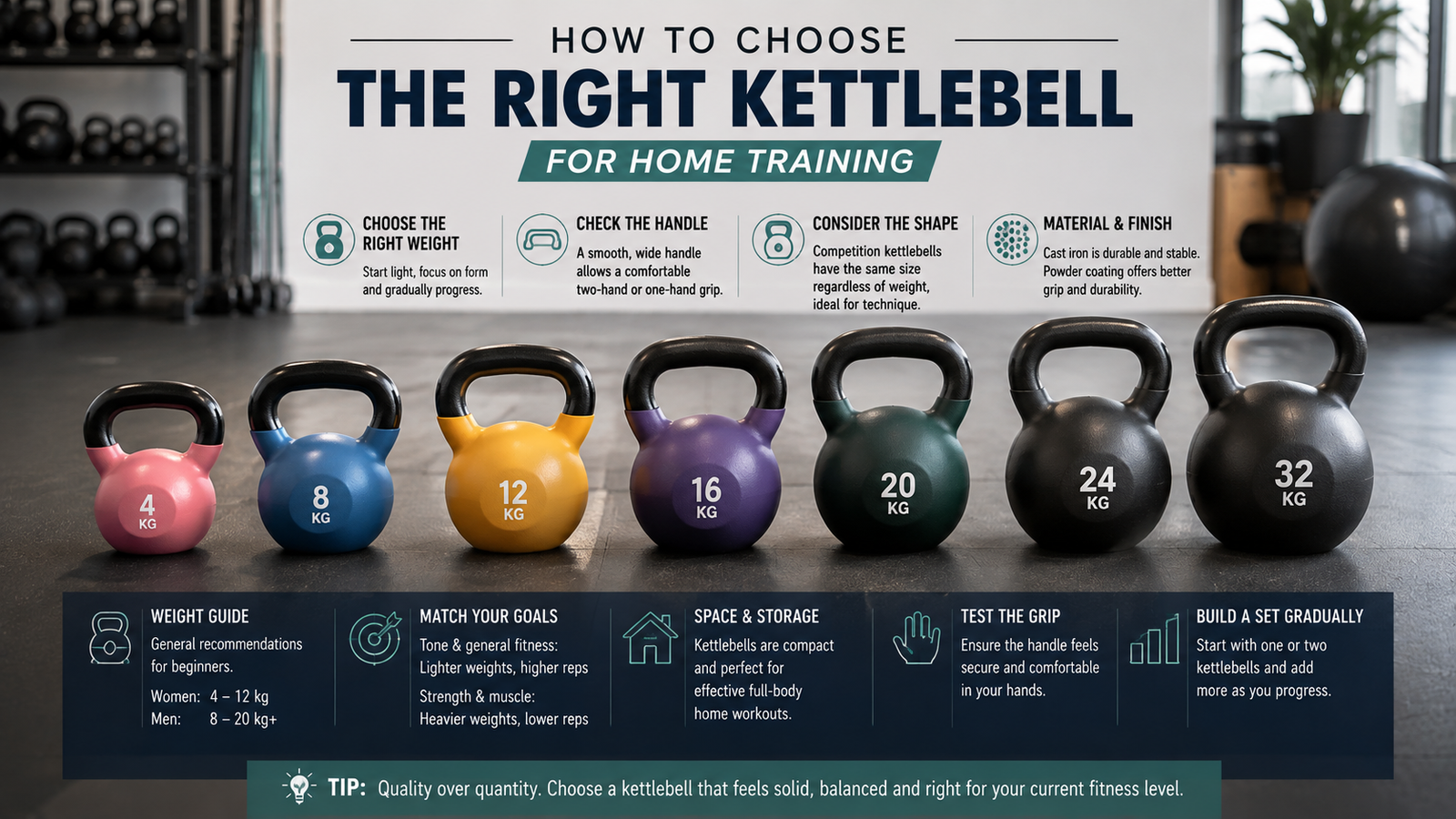
Kettlebells are compact, versatile strength-training tools that can be used for:
- squats;
- deadlifts;
- swings;
- presses;
- rows;
- carries;
- lunges;
- cleans;
- snatches;
- conditioning circuits.
They are especially useful for home training because a small number of kettlebells can provide a large amount of exercise variety without requiring:
- a rack;
- a large machine;
- extensive floor space.
But choosing a kettlebell is not simply a matter of buying the heaviest one you can lift.
The right kettlebell depends on:
- your current strength;
- exercises you plan to perform;
- training experience;
- handle dimensions;
- bell shape;
- fixed vs adjustable design;
- available space;
- progression needs.
The best kettlebell should allow you to:
grip comfortably → move safely → learn technique → increase resistance gradually → perform the exercises you actually intend to use
rather than forcing you into movements that are too heavy or awkward.
What Is a Kettlebell?
A kettlebell is a weighted implement consisting of:
- a rounded or bell-shaped body;
- a handle positioned above the weight.
Unlike a dumbbell, most of the mass sits:
- below;
- away from your hand.
This changes how the weight behaves during movement.
The offset centre of mass is especially noticeable during exercises such as:
- swings;
- cleans;
- presses;
- carries.
That makes kettlebells useful for both:
- conventional strength exercises;
- dynamic ballistic movements.
Kettlebell vs Dumbbell
Both tools can train the entire body, but they feel different.
Dumbbell
Weight is distributed more evenly around the hand.
Excellent for:
- presses;
- rows;
- curls;
- lateral raises;
- conventional strength work.
Kettlebell
Mass hangs below the handle.
Excellent for:
- swings;
- cleans;
- snatches;
- goblet squats;
- carries;
- Turkish get-ups.
Neither is universally better.
They overlap substantially but also have different strengths.
Do You Need Kettlebells if You Already Own Dumbbells?
Not necessarily.
You can build excellent strength using only:
- dumbbells.
A kettlebell becomes particularly useful if you want to include:
- swings;
- ballistic hip-hinge training;
- cleans;
- snatches;
- kettlebell-specific conditioning.
For many home users:
dumbbells + one or two kettlebells
provides an excellent combination.
Why Kettlebells Work Well at Home
They are:
- compact;
- durable;
- easy to store;
- usable without a bench for many exercises.
A single kettlebell can support:
- lower-body strength;
- upper-body strength;
- conditioning;
- carries;
- mobility-style drills.
This makes it useful when space is limited.
Start With Your Training Goal
Before buying, decide what you want the kettlebell to do.
General Strength
Choose a fixed kettlebell with:
- comfortable handle;
- manageable starting weight.
Swings and Conditioning
Prioritize:
- smooth handle;
- stable construction;
- enough weight for meaningful hip-hinge work.
Pressing and Technique Work
You may need:
- lighter resistance;
- smaller increments.
Competition-Style Training
Consider:
- competition kettlebells.
Small-Space Home Gym
Consider:
- adjustable kettlebell.
Beginner Learning
Prioritize:
- correct weight;
- comfortable handle;
- simple fixed construction.
Main Types of Kettlebells
The major categories are:
- Cast-iron kettlebells
- Competition kettlebells
- Coated kettlebells
- Adjustable kettlebells
Understanding these is more useful than choosing by colour or branding.
Cast-Iron Kettlebells
Traditional cast-iron kettlebells are made from:
- solid iron.
As weight increases, the bell usually becomes:
- larger;
- sometimes the handle thicker.
Advantages of Cast-Iron Kettlebells
- durable;
- simple;
- widely available;
- suitable for most home workouts.
They are often excellent value.
Disadvantages
Different weights may have different:
- dimensions;
- handle sizes.
This means technique can feel slightly different when you move from:
- light bell;
- heavy bell.
For general training, this is usually not a major problem.
Competition Kettlebells
Competition kettlebells are designed around standardized dimensions.
The outer size usually remains similar regardless of weight.
For example, a lighter and heavier competition bell may have nearly the same:
- body size;
- handle geometry.
Why Competition Kettlebells Use the Same Size
This makes technique more consistent when changing resistance.
The bell sits in a similar position during:
- clean;
- rack;
- snatch.
This is useful for kettlebell sport and high-volume technical practice.
Advantages of Competition Kettlebells
- standardized shape;
- consistent technique;
- smooth handle;
- predictable rack position.
Disadvantages
- usually more expensive;
- handle may feel narrower for two-handed swings;
- unnecessary for many casual home users.
Who Should Choose Competition Kettlebells?
Consider them if you plan to train seriously with:
- cleans;
- snatches;
- long-cycle kettlebell sport;
- high-repetition technical lifting.
For general home strength:
cast iron is usually sufficient.
Coated Kettlebells
Some kettlebells use:
- vinyl;
- rubber;
- neoprene;
around the bell body.
The handle may remain exposed metal.
Advantages of Coating
It can:
- reduce floor contact noise;
- protect flooring;
- reduce cosmetic damage.
Disadvantages
Poor coatings may:
- tear;
- crack;
- peel.
Thick coatings can also change the shape of the bell.
Vinyl-Coated Kettlebells
Often common in:
- light;
- beginner weights.
They may be attractive and floor-friendly.
But they are usually less common for serious heavier training.
Rubber-Coated Kettlebells
These may provide stronger floor protection.
Useful for:
- home gyms;
- tile;
- finished flooring.
But you should still use:
- appropriate gym flooring.
Neoprene-Coated Kettlebells
Often found at lighter weights.
They can be comfortable and colourful.
Best suited for:
- beginner fitness;
- light resistance.
They may not provide the ideal shape for advanced ballistic training.
Adjustable Kettlebells
Adjustable kettlebells allow the weight to change by:
- adding;
- removing plates;
- using selector mechanisms.
They can replace several fixed bells.
Advantages of Adjustable Kettlebells
- excellent space efficiency;
- lower total storage requirement;
- potentially lower cost than many fixed bells.
This is attractive for:
- apartments;
- small home gyms.
Disadvantages
Potential issues:
- slower weight changes;
- more moving parts;
- altered bell shape;
- less suitable for dropping;
- possible rattling.
Plate-Loaded Adjustable Kettlebells
These use removable plates inside or below the bell structure.
They can offer a wide weight range.
Selectorized Adjustable Kettlebells
These use a:
- dial;
- lever;
- pin;
to select weight quickly.
They are more convenient but also more mechanically complex.
Can Adjustable Kettlebells Be Used for Swings?
Usually yes if designed for dynamic kettlebell exercises.
But check the manufacturer.
Some adjustable systems are more suitable for:
- controlled strength exercises;
than high-speed ballistic movements.
The locking mechanism must be:
- secure;
- reliable.
Can Adjustable Kettlebells Be Dropped?
Usually not.
Many adjustable kettlebells contain:
- internal plates;
- plastic selectors;
- locking mechanisms.
Dropping them may damage the system.
Follow manufacturer instructions.
Which Kettlebell Type Is Best?
General Home Training
Cast iron.
Serious Kettlebell Technique
Competition style.
Floor Protection
Rubber-coated cast iron.
Very Limited Space
Adjustable kettlebell.
Light Beginner Fitness
Coated fixed kettlebell.
How Heavy Should Your First Kettlebell Be?
There is no universal answer.
The correct weight depends on:
- exercise;
- experience;
- strength;
- technique.
A kettlebell appropriate for:
- swings;
may be too heavy for:
- overhead press.
This is why one kettlebell does not perfectly suit every exercise.
Different Exercises Need Different Weights
For example:
Goblet Squat
May use relatively heavy resistance.
Swing
Often uses moderate-to-heavy resistance once technique is learned.
Overhead Press
Usually requires lighter weight.
Turkish Get-Up
Often much lighter while learning.
Lateral-style accessory movements
May require even less.
This is why eventually owning more than one weight can be useful.
Beginners Should Prioritize Technique
If you are new to kettlebells, do not choose your first bell based on:
- ego;
- body size alone.
Learn movements such as:
- deadlift;
- squat;
- swing;
with appropriate control.
A Useful Starting Approach
Instead of asking:
“What is the perfect first kettlebell weight?”
ask:
“Can I perform this specific exercise with stable technique for the target repetitions?”
That is much more useful.
Starting Too Light
A kettlebell that is extremely light may make some ballistic exercises harder to learn correctly because you can:
- lift it with the arms;
instead of generating force from:
- hips.
This is especially relevant for swings.
Starting Too Heavy
A bell that is too heavy can cause:
- poor hinge mechanics;
- excessive back extension;
- uncontrolled pressing;
- unsafe rack positions.
Technique should dictate load.
Kettlebell Weight for Swings
The swing is a hip-hinge movement.
Once technique is established, many people can swing more weight than they can:
- press;
- curl.
The correct swing weight should feel heavy enough that you must use:
- hips;
but light enough to maintain:
- control;
- rhythm.
Kettlebell Weight for Goblet Squats
Goblet squats can often use moderate resistance.
Hold the bell near:
- chest.
The limiting factor may eventually become:
- ability to hold the kettlebell;
rather than leg strength.
Kettlebell Weight for Presses
Overhead pressing usually requires a lighter bell.
The weight should allow you to:
- press without excessive leaning;
- control the lowering phase.
Kettlebell Weight for Turkish Get-Ups
Start lighter.
This exercise involves:
- multiple positions;
- overhead stabilization.
Technique and shoulder control matter more than load.
Many beginners should first practice with:
- no weight;
- very light object.
Kettlebell Weight for Carries
Carries can use relatively heavy resistance.
Examples:
- farmer carry;
- suitcase carry;
- rack carry.
The load depends on:
- grip;
- trunk strength;
- walking space.
Weight Progression
A useful kettlebell system should allow you to gradually increase resistance.
Common fixed kettlebell jumps may be:
- 2 kg;
- 4 kg.
Are 4 kg Jumps Too Large?
For some exercises:
- no.
For others:
- yes.
A jump from:
- 16 kg to 20 kg;
is a 25% increase.
That can be substantial for:
- overhead pressing.
Smaller increments can be valuable.
Smaller Increments
If available, increments such as:
- 2 kg;
make progression easier.
Adjustable kettlebells may provide even smaller jumps.
Progress Without Increasing Weight
If the next kettlebell is too heavy, progress by:
- adding repetitions;
- adding sets;
- slowing the movement;
- improving technique;
- increasing range where appropriate;
- using unilateral variations.
Weight is only one progression variable.
Handle Design Is Critical
The handle is where your body interacts with the kettlebell.
Important factors include:
- diameter;
- width;
- finish;
- spacing.
Handle Diameter
A thick handle increases:
- grip demand.
This can be useful for:
- grip training.
But it may also limit:
- swings;
- cleans;
- high-repetition work.
Small Hands
People with smaller hands may prefer:
- narrower handles.
Competition kettlebells often use standardized handle diameters.
Large Hands
Look for enough handle width to fit:
- one;
- both hands comfortably.
A narrow handle may feel cramped during two-handed swings.
Two-Handed Swing Handle Width
You should be able to place both hands on the handle without:
- fingers overlapping uncomfortably;
- hands being forced against the corners.
This is particularly important with heavy swings.
Handle Window
The space between:
- handle;
- bell body;
affects how the kettlebell sits during:
- cleans;
- presses;
- rack position.
Too small:
- wrist may feel cramped.
Too large:
- bell may move excessively.
Handle Finish
Common finishes include:
- bare iron;
- powder coat;
- painted metal;
- polished steel.
Bare Metal Handles
Often provide:
- direct grip;
- good chalk compatibility.
They may rust if poorly maintained.
Powder-Coated Handles
Can provide useful texture.
Good powder coating may improve grip without becoming extremely rough.
Smooth Competition Handles
Often designed for high-repetition:
- cleans;
- snatches.
Too much texture can tear skin during repeated rotations.
Rough Handles
A poorly finished handle can create:
- blisters;
- skin tears.
Inspect for:
- sharp seams;
- casting imperfections.
Handle Seam
Low-quality cast kettlebells may have a ridge from the manufacturing mould.
This should be:
- smoothly finished.
A sharp seam on the handle is a major problem.
Surface Texture
For swings and deadlifts, a moderate texture can help grip.
For high-repetition snatches, excessive roughness can damage:
- hands.
Choose based on training style.
Kettlebell Body Shape
The bell should have a stable, predictable shape.
It matters especially during:
- rack;
- overhead work.
Flat Base
A flat base allows the kettlebell to sit securely on the floor.
This is useful for:
- storage;
- deadlifts;
- floor exercises.
Why Flat Base Matters
Rounded or uneven bottoms may:
- wobble;
- tip.
Avoid kettlebells that cannot stand securely.
Machined Flat Base
Higher-quality bells may have a precisely machined bottom.
This improves:
- stability.
Useful but not mandatory.
Bell Size
Traditional cast-iron bells grow larger as weight increases.
Competition bells remain similar in size.
Why Bell Size Matters for Rack Position
A larger bell may contact:
- forearm;
- upper arm;
differently.
Technique may need slight adjustment.
Kettlebell Centre of Mass
Because the weight sits below the handle, the bell wants to:
- rotate;
- swing.
This is what makes kettlebell exercises distinctive.
It also means uncontrolled movement can create more force than a static dumbbell exercise.
Fixed vs Hollow-Core Construction
Some premium kettlebells use:
- single-cast;
- hollow-core designs.
Single-Cast Kettlebells
Handle and bell are made as one piece.
This can reduce weak points.
Welded Handles
Some cheaper bells have handles attached separately.
A strong weld can still be durable.
But inspect for:
- cracks;
- poor finishing.
One-Piece Construction
Generally preferable for heavy or dynamic training because there is no separate handle weld.
Competition Kettlebell Internal Construction
Heavier and lighter competition bells may use:
- different internal cavities;
- filler.
The outside remains standardized.
Build quality still matters.
Kettlebell Coating and Floor Protection
A coated bell can reduce:
- scratches;
- impact.
But coating does not make it safe to drop on:
- tile;
- wood.
Use proper flooring.
Rubber Base
Some kettlebells have rubber only on the:
- bottom.
This reduces floor contact while preserving the traditional metal body.
A practical compromise.
Full Rubber Coating
Provides more floor protection.
But may increase:
- size;
- odour.
Rubber Smell
New rubber-coated equipment may have a strong odour.
This often decreases with:
- ventilation;
- time.
If used in a bedroom or small apartment, this may matter.
Colour Coding
Competition kettlebells often use different colours for different weights.
This makes identification faster.
Colours may follow common conventions, but do not rely on colour alone.
Always read the:
- actual weight marking.
Weight Markings
A good kettlebell should clearly display:
- kg;
- lb.
Raised or engraved markings are more durable than:
- stickers.
Kilograms vs Pounds
Approximate conversion:
1 kg ≈ 2.2 lb
Make sure you know which system is being used.
Weight Accuracy
Minor manufacturing variation is normal.
For general fitness, tiny differences do not matter.
Competition or sport-oriented users may care more about:
- precise tolerances.
Kettlebell Handle and Chalk
Chalk can improve grip by absorbing:
- sweat.
It is commonly used during:
- heavy swings;
- snatches;
- cleans.
Powder Chalk
Very effective but can be:
- messy.
Liquid Chalk
Cleaner for home use.
It may be particularly practical in:
- apartments;
- shared spaces.
Do You Need Chalk?
No.
If your grip is secure, you may not need it.
Use it only when:
- sweat;
- grip;
becomes limiting.
Workout Gloves With Kettlebells
Gloves are optional.
For simple exercises such as:
- goblet squats;
- deadlifts;
- carries;
they may be comfortable.
Gloves During Cleans and Snatches
A kettlebell handle rotates within the hand.
An excessively sticky glove can create:
- friction;
- skin pulling.
Many experienced kettlebell users prefer:
- bare hands;
- chalk.
If using gloves, choose a thin pair that allows:
- handle movement.
Wrist Guards
Some kettlebell-specific wrist guards protect the forearm during:
- cleans;
- snatches.
They may help beginners while learning.
But proper technique should reduce:
- bell slamming into forearm.
A pad is not a substitute for learning the movement.
Why Kettlebells Hit the Forearm
During a poorly executed clean or snatch, the bell may:
- flip over the hand;
- crash into wrist.
Good technique guides the bell around:
- hand;
- forearm;
more smoothly.
Kettlebell Rack Position
In the rack:
- bell rests against forearm/upper arm area;
- wrist stays relatively neutral;
- elbow stays near torso.
A well-shaped kettlebell makes this more comfortable.
Competition Bells and Rack Comfort
Standardized competition dimensions often create predictable:
- forearm contact.
This is one reason sport athletes prefer them.
Cast-Iron Bell Rack Position
Different weights may sit slightly differently.
For general fitness, this is usually manageable.
Kettlebell Swing: The Foundational Dynamic Movement
The swing is one of the most iconic kettlebell exercises.
It should primarily be a:
hip hinge
not a squat with front raise.
Swing Movement Pattern
A simplified sequence:
- Hinge at hips.
- Let bell travel back between legs.
- Drive hips forward.
- Allow bell to float.
- Guide it back into the hinge.
The arms mainly connect you to the bell.
Swing Power Comes From the Hips
The bell should not be lifted primarily with:
- shoulders;
- arms.
The hip extension provides most of the power.
Swing Height
For most general training, the bell may rise around:
- chest level;
depending on style.
You do not need to force it higher.
American vs Russian Swing
You may see two common styles:
Russian-Style Swing
Bell typically rises around chest height.
American-Style Swing
Bell travels overhead.
The overhead version requires more:
- shoulder mobility;
- control.
It is not automatically superior.
For many home users, chest-height swings are simpler and sufficient.
Do Not Turn the Swing Into a Squat
Common mistake:
- knees bend deeply;
- hips move downward.
Instead, think:
hips back
rather than:
sit down.
Kettlebell Deadlift Before Swing
Beginners should usually learn:
- kettlebell deadlift;
before the swing.
This teaches the hip hinge with lower speed.
Kettlebell Deadlift Setup
Place the bell between:
- feet.
Hinge at hips.
Grip handle.
Stand by driving through:
- feet;
- hips.
This is a good foundational movement.
Hike Pass
The first swing repetition often starts with a hike.
From slightly in front of you:
- pull the bell back between legs.
This creates momentum.
Do not begin the swing by lifting the bell slowly from directly beneath you.
Swing Breathing
Many kettlebell styles use forceful exhalation during:
- hip extension.
Exact breathing style varies.
The main goal is maintaining:
- control;
- trunk stability.
Swing and Lower Back
A properly performed swing should generate power primarily through:
- hips;
- glutes.
But poor technique can increase lower-back stress.
Common problems:
- rounding excessively;
- leaning backward at top;
- choosing too heavy a bell.
Do Not Hyperextend at the Top
At lockout, stand:
- tall.
Do not lean backward.
Think:
- ribs stacked;
- glutes contracted;
- body vertical.
Kettlebell Goblet Squat
Hold the kettlebell near:
- chest.
It can be held:
- by horns;
- around bell depending on design.
Goblet Squat Benefits
Excellent for:
- beginners;
- lower-body training;
- learning squat pattern.
Goblet Squat Limitation
Eventually, the legs may become stronger than your ability to comfortably hold one kettlebell.
You can progress to:
- double kettlebells;
- barbell;
- split squats.
Kettlebell Press
A single-arm press challenges:
- shoulder;
- triceps;
- trunk.
The offset load requires more stabilization than many dumbbell presses.
Press Technique
Avoid leaning excessively away from the bell.
Maintain:
- controlled torso;
- neutral wrist.
If you need a major body lean to complete the rep, the weight may be too heavy.
Kettlebell Clean
The clean moves the bell from:
- swing/hinge;
- into rack position.
It requires timing.
Common Clean Mistake
Letting the bell:
- swing far away;
- flip over wrist.
This causes the bell to:
- bang into forearm.
Good cleans keep the bell closer to the body.
Kettlebell Snatch
The snatch moves the bell overhead in one continuous movement.
It requires:
- swing skill;
- clean mechanics;
- overhead control.
Beginners should not start here.
Snatch Hand Care
High-repetition snatches create substantial friction.
Handle finish and technique become very important.
Turkish Get-Up
The Turkish get-up moves from:
- lying position;
- to standing;
- back down;
while holding a kettlebell overhead.
It trains:
- coordination;
- shoulder stability;
- trunk control.
Learn the Get-Up Without Heavy Weight
Practice the sequence first.
You can use:
- no load;
- shoe balanced on fist;
- very light kettlebell.
Do not make it a maximal strength test while learning.
Kettlebell Carries
Simple and highly effective.
Types include:
- farmer carry;
- suitcase carry;
- rack carry;
- overhead carry.
Suitcase Carry
Hold one kettlebell by your side.
This challenges:
- grip;
- trunk;
- lateral stability.
Rack Carry
Hold bell in rack position.
Adds demand to:
- upper body;
- trunk.
Overhead Carry
Requires good:
- shoulder stability;
- mobility.
Use lighter weight and clear overhead space.
Kettlebell Rows
A kettlebell can be used like a dumbbell for:
- one-arm rows;
- supported rows.
The handle shape may feel different.
Kettlebell Lunges
You can hold the bell:
- goblet;
- rack;
- suitcase.
Each position changes:
- balance;
- trunk demand.
Double-Kettlebell Training
Using two bells allows:
- front squats;
- double cleans;
- double presses;
- carries.
This significantly expands training options.
Do You Need a Pair?
Not initially.
A single kettlebell can provide excellent workouts.
A pair becomes useful if you want:
- symmetrical loading;
- more total resistance;
- advanced double-kettlebell work.
Matching Pair
For double-kettlebell training, matching:
- weights;
- dimensions;
is helpful.
Competition-style bells are particularly consistent.
Kettlebell Complexes
A complex combines several exercises without putting the bell down.
Example:
- 5 swings;
- 5 cleans;
- 5 presses;
- 5 squats.
These can create intense conditioning.
Complex Weight Selection
Use a weight that is appropriate for the:
- weakest movement;
in the sequence.
Do not choose based on the swing if the press becomes unsafe.
Kettlebell Conditioning
Kettlebells are excellent for short conditioning sessions.
Workouts can combine:
- swings;
- squats;
- carries;
- presses.
Example Beginner Strength Session
Goblet Squat
3 × 8–12
One-Arm Row
3 × 8–12 each side
Deadlift
3 × 8–12
Floor Press or Press
3 × 8–10
Suitcase Carry
Several controlled walks.
Beginner Swing Session
Only after learning the hinge.
Warm-Up
Practice:
- deadlifts;
- hip hinges.
Main Work
10 rounds:
- 10 swings;
- rest 30–60 seconds.
Quality matters more than speed.
Simple Kettlebell Conditioning Workout
5 Rounds
- 10 swings;
- 8 goblet squats;
- 6 rows each side;
- rest as needed.
Use a weight you can control.
Strength-Focused Workout
Goblet Squat
4 × 6–10
One-Arm Press
4 × 5–8
One-Arm Row
4 × 8–10
Romanian Deadlift
3 × 8–12
Carry
3 rounds.
Single-Kettlebell Full-Body Workout
A single bell can cover:
- hinge;
- squat;
- push;
- pull;
- carry.
This is one reason kettlebells are so useful in small spaces.
Do Kettlebells Build Muscle?
Yes, if exercises provide sufficient:
- resistance;
- volume;
- progression.
They can build muscle in:
- legs;
- glutes;
- shoulders;
- back;
- arms.
But loading limitations may eventually make some movements less efficient than:
- barbells;
- dumbbells.
Do Kettlebells Build Strength?
Yes.
They can build substantial strength, especially for:
- beginners;
- intermediate trainees.
For maximal strength development, barbells may eventually allow heavier, easier-to-progress loads.
Do Kettlebells Burn Fat?
No piece of equipment independently burns body fat.
Kettlebell workouts can increase:
- energy expenditure;
- fitness.
Fat loss depends primarily on:
- long-term energy balance;
- nutrition;
- activity.
Can Kettlebells Replace Cardio?
High-repetition swings and circuits can create strong cardiovascular demand.
But kettlebell conditioning is not identical to:
- steady aerobic training.
A balanced program may include both:
- kettlebell strength/conditioning;
- walking, cycling or other cardio.
Kettlebell Swings vs Running
Swings provide:
- hip power;
- muscular conditioning;
- cardiovascular stress.
Running provides:
- locomotion;
- running-specific endurance.
They are complementary rather than interchangeable.
Kettlebell Training vs HIIT
Kettlebells can be used for HIIT.
But not every kettlebell session needs to be:
- maximal;
- fast.
Slow controlled strength work is equally valuable.
Beginners Do Not Need Every Workout to Be a Circuit
A common mistake is treating kettlebells only as:
- cardio tools.
They are also excellent for traditional:
- strength sets;
- rest periods;
- progressive loading.
Kettlebell Training Frequency
For general strength:
- 2–4 sessions per week;
can work depending on program and recovery.
You do not need to perform heavy swings every day.
Swing Volume
High swing volume can fatigue:
- grip;
- hamstrings;
- lower back.
Increase gradually.
Grip Fatigue
Kettlebell work often challenges grip strongly.
This can be useful.
But grip failure should not cause you to lose control of:
- moving bell.
Stop the set before grip becomes unsafe.
Forearm Contact
During rack exercises, the bell rests against:
- forearm.
Some pressure is normal.
Painful impact usually suggests:
- technique;
- bell shape;
- inappropriate weight.
Kettlebell and Wrist Position
Avoid letting the wrist collapse backward excessively.
In rack or press:
- handle should sit diagonally through the hand;
- wrist stays relatively neutral.
Handle Position in the Palm
For cleans and presses, the handle often sits more diagonally across the hand rather than straight across the knuckles.
This can improve:
- wrist alignment;
- control.
Kettlebell and Shoulder Mobility
Overhead exercises require adequate:
- shoulder range;
- trunk control.
If you cannot achieve a comfortable overhead position, do not force heavy presses or snatches.
Kettlebell and Knee Health
Exercises such as:
- squats;
- lunges;
involve knee loading.
The kettlebell itself is not inherently bad for knees.
Use:
- suitable range;
- appropriate load;
- controlled technique.
Kettlebell and Lower-Back Health
Swings and hinges can strengthen:
- posterior chain.
But poor technique or excessive load can irritate the back.
If you have significant back problems, learn the hinge carefully and seek guidance where appropriate.
Kettlebell and Achilles/Calf Load
Kettlebell training is generally lower impact than:
- running;
- jump rope.
But dynamic movements and carries still load the lower body.
Modify according to symptoms.
Older Adults
Kettlebells can be useful for strength and functional training.
Start with:
- manageable weights;
- controlled exercises;
- deadlifts;
- goblet squats;
- carries.
Ballistic movements may be introduced later if appropriate.
Beginners With Balance Limitations
Start with:
- stable bilateral exercises.
For example:
- deadlift;
- goblet squat.
Avoid complex single-leg or overhead movements initially.
Kettlebells During Rehabilitation
They can be used in rehabilitation programs, but resistance and exercise selection should follow:
- clinician;
- physiotherapist guidance.
Do not choose a kettlebell simply because an exercise is described as:
- corrective;
- functional.
Kettlebell Storage
Kettlebells take relatively little space.
But several heavy bells can still become difficult to organize.
Floor Storage
A flat-based kettlebell can sit directly on:
- rubber flooring.
Keep it away from:
- walkways;
- doors.
Kettlebell Rack
Useful if you own several bells.
A rack should be:
- strong;
- stable.
Shelf Weight Capacity
Heavy kettlebells can collectively exceed normal household shelf limits.
Use a rack designed for:
- fitness equipment.
Do Not Store Heavy Bells High Up
Placing a 24 kg kettlebell on a high shelf creates unnecessary risk.
Store heavy equipment:
- low;
- stable.
Adjustable Kettlebell Stand
Some adjustable systems come with:
- base;
- tray.
Keep it on a level surface.
Floor Protection
Kettlebells can damage:
- tile;
- wood;
- laminate.
Use:
- dense rubber matting.
Rubber Flooring
One of the best options.
It protects:
- floor;
- kettlebell;
and reduces noise.
Foam Mats
Soft puzzle mats may compress under heavy bells.
They are less suitable for:
- heavy dynamic training.
Dense rubber is preferable.
Training Outdoors
Kettlebells can be used outside.
But rough concrete can damage:
- coating;
- base.
Use a mat.
Moisture and Rust
Cast iron can rust if exposed repeatedly to:
- sweat;
- humidity;
- rain.
Wipe the bell dry after use.
Kettlebell Cleaning
Use a:
- dry;
- lightly damp cloth.
Remove:
- sweat;
- chalk;
- dust.
Handle Cleaning
Keep the handle free from:
- oil;
- lotion.
A slippery handle is a safety issue.
Chalk Buildup
Some chalk is useful.
Excessive hardened chalk can create:
- rough spots.
Clean periodically.
Rust on the Handle
Minor surface rust can make the handle rough.
Follow manufacturer recommendations for maintenance.
If the handle becomes:
- sharp;
- deeply corroded;
stop using until repaired or replaced.
Coating Damage
Small chips are often cosmetic.
But inspect for:
- cracks;
- structural damage.
Cracked Kettlebell
Do not continue using a bell with:
- structural cracks;
- damaged handle connection.
Dynamic exercises generate high forces.
Handle Integrity
Before swings or cleans, inspect:
- handle;
- bell connection.
Especially important with welded or adjustable designs.
Adjustable Kettlebell Inspection
Check:
- locking mechanism;
- internal plates;
- selector.
Everything should be fully secured before lifting.
Kettlebell Safety Around Children
A kettlebell is:
- compact;
- heavy.
A child can easily injure:
- fingers;
- toes;
trying to move one.
Store securely.
Pets
Keep pets out of the training area.
A moving kettlebell has a wide path during:
- swings;
- snatches.
Swing Clearance
You need enough room:
- in front;
- behind;
- overhead where applicable.
Clear:
- furniture;
- glass;
- people.
Ceiling Clearance
Essential for:
- presses;
- snatches;
- Turkish get-ups.
Check:
- lights;
- fans.
Ceiling Fans
Turn them off and maintain generous clearance during overhead lifting.
Home Workout Surface
Train on a surface that provides:
- stable footing;
- adequate traction.
Avoid slippery tile during ballistic exercises.
Footwear
You do not need specialized kettlebell shoes.
Options include:
- flat training shoes;
- barefoot training where appropriate and safe.
Flat Shoes
Provide:
- stable base;
- floor feedback.
Often useful for:
- swings;
- squats;
- deadlifts.
Highly Cushioned Running Shoes
May feel unstable during:
- heavy swings;
- squats.
A firmer trainer is generally preferable.
Barefoot Kettlebell Training
Some users like it because of:
- direct floor contact.
But this does not protect your feet if a kettlebell falls.
Commercial gyms may also require:
- footwear.
Common Kettlebell Buying Mistakes
Buying One Weight for Every Exercise
Different movements need different loads.
Choosing Too Heavy a First Bell
Technique suffers.
Choosing Extremely Light Weight for Swings
May encourage arm lifting.
Ignoring Handle Width
Important for two-handed swings.
Ignoring Handle Finish
Rough seams can damage hands.
Buying an Adjustable Bell Without Checking Dynamic-Exercise Suitability
Not all are designed for aggressive swings.
Buying Based Only on Colour
Always verify actual weight.
Ignoring Base Stability
Bell should sit flat.
Buying Cheap Welded Construction Without Inspecting It
Handle integrity matters.
Assuming Competition Bells Are Automatically Better
They are specialized.
Common Kettlebell Training Mistakes
Squatting the Swing
Use a hip hinge.
Lifting the Swing With the Arms
Power comes from hips.
Hyperextending the Back at Lockout
Stand tall, not backward.
Letting the Bell Crash Into the Forearm
Improve clean/snatch technique.
Pressing With a Bent Wrist
Maintain better alignment.
Starting With Complex Movements
Learn foundational exercises first.
Doing High-Volume Swings Too Soon
Progress gradually.
Training to Grip Failure
Maintain control.
Dropping Adjustable Kettlebells
Can damage the mechanism.
Training in a Cluttered Space
Clear the swing path.
How to Learn Kettlebell Training Safely
A useful progression:
Stage 1
Learn:
- hip hinge;
- deadlift;
- goblet squat;
- carry.
Stage 2
Learn:
- swing;
- row;
- press.
Stage 3
Learn:
- clean;
- Turkish get-up.
Stage 4
Learn:
- snatch;
- complexes;
- double-kettlebell work.
Do not rush.
Why Coaching Can Be Valuable
Kettlebells involve dynamic movement.
A qualified coach can help identify:
- poor hinge;
- arm-dominant swing;
- bad rack position;
- unsafe overhead mechanics.
A few good coaching sessions can be more useful than buying several additional kettlebells.
How to Test a Kettlebell Before Buying
If possible, try holding it.
Check:
Handle Width
Can both hands fit?
Handle Diameter
Is it comfortable?
Surface
Any rough seam?
Rack Position
Does it sit comfortably on the forearm?
Base
Does it stand flat?
Coating
Does it feel durable?
Test the Handle With Sweaty Hands if Possible
A handle that feels fine when completely dry may become slippery during:
- high-repetition training.
Texture matters.
Test a Two-Handed Grip
Particularly important if swings are your priority.
Your hands should fit naturally without:
- crowding.
Test the Rack Position
If you plan to perform:
- cleans;
- presses;
hold the bell in rack.
Check for:
- painful edges;
- awkward handle geometry.
Fixed Kettlebell vs Adjustable Kettlebell
Choose Fixed If:
- you want maximum durability;
- you perform ballistic exercises;
- you want simple equipment.
Choose Adjustable If:
- space is limited;
- you need many weights;
- you train mainly at home.
One Kettlebell vs Several
One Bell
Enough to start.
Two or Three Bells
Better for progression and exercise variety.
A practical small collection may include:
- light;
- medium;
- heavy.
Exact weights depend on the individual.
Light Kettlebell
Useful for:
- presses;
- technique;
- Turkish get-ups.
Medium Kettlebell
Useful for:
- swings;
- squats;
- rows.
Heavy Kettlebell
Useful for:
- deadlifts;
- carries;
- heavier swings.
Matching Pair
Useful later for:
- double front squats;
- double presses;
- double cleans.
Example Minimal Home Setup
Option 1
One medium kettlebell.
Good for:
- learning;
- basic full-body training.
Option 2
One light + one medium.
Better for:
- presses;
- swings.
Option 3
Adjustable kettlebell.
Best for:
- maximum flexibility in limited space.
Example Expanded Setup
- light bell;
- medium bell;
- heavy bell;
- matching medium pair if needed.
This covers most general training.
Kettlebell Progression Example
Suppose you can goblet squat:
- 12 kg for 8 reps.
Over time:
- Increase to 10 reps.
- Increase to 12 reps.
- Move to 16 kg.
- Return to 8 reps.
This is a simple double-progression method.
Swing Progression Example
Progress by:
- improving hinge;
- increasing sets;
- increasing total reps;
- increasing bell weight.
Do not increase:
- weight;
- speed;
- volume;
all at once.
Beginner Kettlebell Workout
Deadlift
3 × 10
Goblet Squat
3 × 8
One-Arm Row
3 × 8 each side
Carry
3 short rounds
Once technique improves, add:
- swings.
Intermediate Single-Bell Workout
Swings
5 × 15
Goblet Squats
4 × 10
One-Arm Press
3 × 6–8 each side
Rows
3 × 10 each side
Suitcase Carries
3 rounds.
Full-Body Conditioning Session
5 Rounds
- 15 swings;
- 8 goblet squats;
- 6 presses each side;
- 8 rows each side.
Rest as needed.
Use a weight that allows:
- clean technique.
Kettlebell Buying Checklist
Before purchasing, ask:
1. What exercises will I actually do?
Swings, squats, presses, cleans or general strength?
2. Am I a beginner?
If yes, prioritize manageable load and simple construction.
3. Do I need fixed or adjustable?
Space may decide this.
4. Is the handle wide enough for two hands?
Critical for swings.
5. Is the handle diameter comfortable?
Especially for smaller hands.
6. Is the handle surface smooth enough?
Avoid sharp casting seams.
7. Does the bell sit comfortably in rack position?
Important for cleans and presses.
8. Is the base flat?
Useful for safe storage and floor exercises.
9. Is the weight clearly marked?
Prefer durable markings.
10. Are the weight increments appropriate?
Smaller jumps help progression.
11. Is the construction suitable for dynamic training?
Especially with adjustable models.
12. Can it tolerate my intended use?
Check drop restrictions.
13. Will it damage my floor?
Use appropriate matting.
14. Is there enough room to swing it safely?
Clearance matters.
15. Will I eventually need a second or heavier kettlebell?
Plan for progression.
A Simple Choice by Goal
Beginner General Fitness
Choose:
cast-iron fixed kettlebell
Swings and Conditioning
Choose:
durable cast-iron bell with comfortable two-hand handle
Kettlebell Sport
Choose:
competition kettlebells
Small Apartment
Choose:
adjustable kettlebell
Light Mobility and Technique
Choose:
lighter fixed bell
Heavy Carries and Deadlifts
Choose:
heavier durable fixed bell
A Simple Choice by Space
Very Small Space
Adjustable kettlebell.
Small Home Gym
Two or three fixed bells.
Dedicated Gym
Full weight progression or matching pairs.
A Simple Choice by Handle Preference
Two-Handed Swing Focus
Wider handle.
High-Rep Snatch/Clean Focus
Smooth competition-style handle.
General Strength
Moderately textured cast-iron handle.
A Simple Choice for Beginners
Start with a kettlebell that allows you to confidently learn:
- deadlift;
- goblet squat;
- carry.
Then progress to:
- swing.
Do not start with:
- snatches;
- complex flows;
- maximum-weight swings.
A Simple Choice for Intermediate Users
Consider:
- light bell for presses;
- medium bell for swings;
- heavy bell for carries/deadlifts.
This provides far more flexibility than forcing one bell to do everything.
A Simple Choice for Advanced Users
Consider:
- matching pairs;
- competition kettlebells;
- smaller weight increments.
Your needs become more specialized as technique improves.
Kettlebell Price Categories
Budget
Basic cast iron.
Can be excellent if:
- handle finish;
- construction;
are good.
Mid-Range
Better powder coating, more consistent casting, improved handles.
Often the best value.
Premium
Competition bells, urethane/rubber coatings, premium adjustable systems.
Useful for frequent or specialized users.
Do Not Pay Mainly for Appearance
A premium finish does not compensate for:
- uncomfortable handle;
- poor balance;
- unsafe construction.
Function comes first.
Buying Online
Check:
- actual weight;
- handle diameter;
- handle width;
- bell dimensions;
- material;
- coating;
- return policy.
Photos alone do not reveal handle comfort.
Shipping
Kettlebells are heavy.
Check:
- shipping cost;
- delivery damage policy.
A discounted bell can become expensive after freight.
Make Sure the Listing Is for One Kettlebell
Some images show:
- pairs;
- sets.
But price may be for:
- one.
Read carefully.
Used Kettlebells
Fixed kettlebells can be excellent used purchases.
Inspect:
- cracks;
- handle damage;
- severe rust;
- unstable base.
Cosmetic wear usually does not matter.
Used Adjustable Kettlebells
Test:
- every weight setting;
- locking system;
- plate security.
Avoid damaged selector mechanisms.
Warranty
Fixed bells rarely need extensive warranty.
Adjustable systems benefit more from:
- mechanical coverage;
- replacement parts.
The Physical Glow Takeaway
Kettlebells are among the most efficient pieces of equipment for a small home gym because one compact weight can support:
- strength;
- conditioning;
- squats;
- hinges;
- presses;
- rows;
- carries.
But the correct kettlebell should be chosen according to movement and progression, not just the number printed on the bell.
For most users:
- general home strength → cast-iron kettlebell;
- serious cleans, snatches and kettlebell sport → competition kettlebell;
- limited storage → adjustable kettlebell;
- floor-sensitive home gym → rubber-coated or rubber-base kettlebell.
Then focus on the characteristics that affect actual training:
- weight → appropriate for the exercise and your current strength;
- weight increments → small enough for future progression;
- handle width → enough room for two-handed movements where needed;
- handle diameter → comfortable for your hands;
- handle finish → smooth enough to avoid unnecessary skin damage;
- bell shape → comfortable in rack position;
- flat base → stable on the floor;
- construction → durable enough for dynamic movements;
- storage and flooring → appropriate for your home.
Do not expect one kettlebell to be perfect for every exercise.
A bell that is appropriate for:
- swings;
- deadlifts;
may be too heavy for:
- presses;
- Turkish get-ups.
For many users, the most practical long-term setup is:
one lighter bell → one medium bell → one heavier bell
or a well-designed adjustable system that covers the same range.
Most importantly, kettlebell training rewards good technique.
Learn:
hinge → deadlift → squat → carry → swing → clean → press → snatch
progressively.
The best kettlebell is not the heaviest one you can move once.
It is the one that lets you perform controlled, repeatable training and gradually become stronger without turning every session into a battle with the equipment.