How to Choose Dumbbells for Home Strength Training
Learn how to choose dumbbells for home strength training, with practical guidance on weight range, fixed versus adjustable design, grip, space and progression. This beginner-friendly guide helps you make a clear, informed choice without unnecessary complexity.
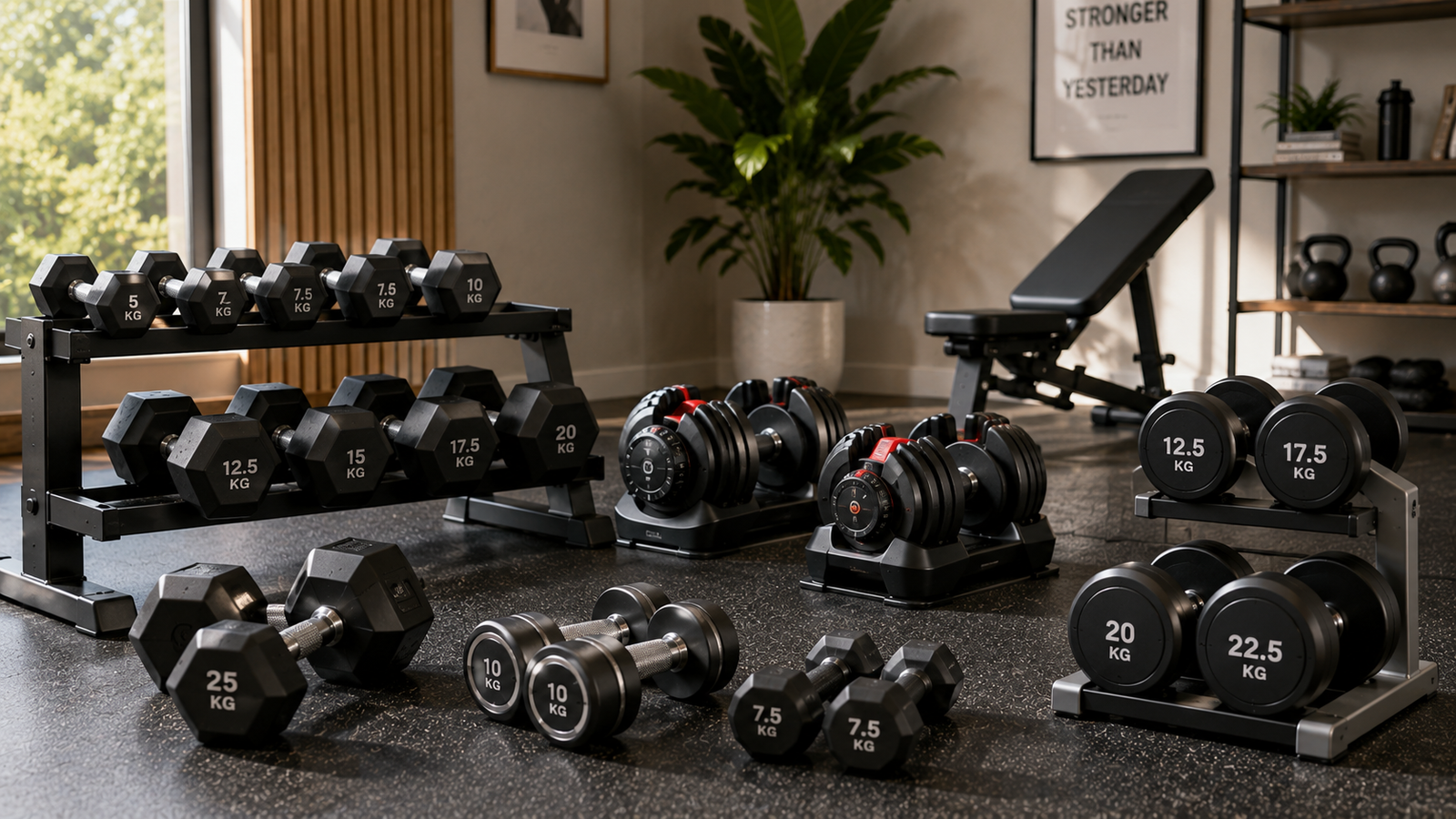
Dumbbells are among the most versatile pieces of strength-training equipment you can own.
With a suitable pair or set, you can train:
- chest;
- back;
- shoulders;
- arms;
- quadriceps;
- hamstrings;
- glutes;
- calves;
- core.
They can be used for:
- beginner strength training;
- muscle building;
- general fitness;
- rehabilitation-style exercise where appropriate;
- unilateral training;
- home workouts;
- high-repetition conditioning.
Unlike many large gym machines, dumbbells require relatively little:
- floor space;
- setup;
- maintenance.
But choosing dumbbells is not as simple as buying the heaviest pair you can afford.
You need to consider:
- fixed vs adjustable design;
- available weight range;
- weight increments;
- handle shape;
- grip diameter;
- material;
- head shape;
- storage;
- durability;
- safety;
- future progression.
The best dumbbells are the ones that allow you to:
start at an appropriate resistance → progress gradually → perform a wide range of exercises → train safely → store them realistically in your home
rather than the ones with the highest maximum weight.
Why Dumbbells Work So Well for Home Training
Dumbbells provide independent resistance for each side of the body.
That makes them useful for identifying and training around natural differences between:
- left;
- right sides.
They also allow movements that are sometimes harder to perform comfortably with a fixed barbell.
For example:
- dumbbell bench press;
- one-arm row;
- split squat;
- lateral raise;
- single-leg Romanian deadlift.
A relatively small collection of dumbbells can support hundreds of exercise variations.
Dumbbells vs Barbells
Both are useful strength-training tools.
Dumbbells
Advantages:
- independent arms;
- greater freedom of movement;
- easier home setup;
- no rack required for many exercises;
- useful for unilateral training.
Barbells
Advantages:
- easier to load very heavily;
- excellent for progressive compound lifting;
- smaller incremental loading can be easier with plates;
- efficient for heavy squats, deadlifts and presses.
For many home users, dumbbells are a simpler starting point.
For advanced strength goals, a combination of:
dumbbells + barbell
may eventually provide more training options.
Dumbbells vs Resistance Bands
Resistance bands are:
- lighter;
- more portable;
- cheaper.
But their resistance usually increases as the band stretches.
Dumbbells provide resistance through gravity, which often makes progression easier to understand.
For many exercises, dumbbells also provide a more consistent:
- feel;
- loading reference.
Bands remain excellent supplementary equipment.
Dumbbells vs Weight Machines
Machines guide the movement through a predetermined path.
Dumbbells require more:
- balance;
- stabilization;
- coordination.
Neither is automatically superior.
Machines may be easier for some beginners.
Dumbbells offer greater:
- exercise variety;
- home-use practicality.
Start With Your Training Goal
Before choosing a dumbbell system, decide how you intend to train.
General Fitness
A moderate weight range may be enough.
Muscle Building
You need enough weight progression to keep exercises challenging over time.
Strength Development
Prioritize:
- higher maximum weight;
- durable construction;
- smaller weight increments.
Beginner Training
Prioritize:
- easy handling;
- manageable starting weights;
- simple weight changes.
Small-Space Home Gym
Adjustable dumbbells may be particularly useful.
Circuit Training
Fixed dumbbells can be faster because you do not need to adjust weight between exercises.
Your goals determine whether convenience or compactness matters more.
The Main Types of Dumbbells
Most home dumbbells fall into two major categories:
- Fixed dumbbells
- Adjustable dumbbells
There are several variations within each.
Fixed Dumbbells
A fixed dumbbell has one permanent weight.
For example:
- 5 kg;
- 10 kg;
- 15 kg.
To change resistance, you choose another dumbbell.
Advantages of Fixed Dumbbells
- immediate weight changes;
- simple;
- durable;
- little mechanical failure risk;
- convenient for supersets and circuits.
They also tend to feel:
- balanced;
- solid.
Disadvantages of Fixed Dumbbells
A complete set requires:
- considerable space;
- higher total cost;
- storage rack.
For example, pairs from:
- 2.5 kg;
- 5 kg;
- 7.5 kg;
- 10 kg;
- 12.5 kg;
- 15 kg;
already represent 12 separate dumbbells.
Who Should Choose Fixed Dumbbells?
They make sense if:
- you have dedicated gym space;
- multiple people train together;
- you frequently change weights;
- you perform circuits or supersets.
They are also excellent if you prefer:
- simple equipment with minimal moving parts.
Adjustable Dumbbells
Adjustable dumbbells allow one handle to provide several resistance levels.
They can use:
- removable plates;
- selector dials;
- sliding pins;
- locking mechanisms.
Advantages of Adjustable Dumbbells
The biggest benefit is:
space efficiency
One pair may replace many fixed pairs.
This can be especially valuable in:
- apartments;
- bedrooms;
- small home gyms.
They may also cost less than buying a large fixed set.
Disadvantages of Adjustable Dumbbells
Potential drawbacks include:
- slower weight changes;
- greater mechanical complexity;
- more fragile components;
- unusual dumbbell shape;
- longer handle length.
Some models may also be unsuitable for:
- dropping.
Plate-Loaded Adjustable Dumbbells
These use short handles with removable weight plates.
They often use:
- threaded spin-lock collars;
- standard collars.
Advantages of Plate-Loaded Designs
- relatively inexpensive;
- durable;
- expandable;
- individual parts replaceable.
They are one of the most economical ways to build a high-weight dumbbell setup.
Disadvantages
Weight changes take longer.
You may need to:
- remove collar;
- remove plates;
- add plates;
- retighten collar.
This can interrupt:
- supersets;
- circuits.
Spin-Lock Dumbbells
Spin-lock handles have threaded ends.
A threaded collar screws onto each side.
Advantages
- secure;
- inexpensive;
- simple.
Disadvantages
The threaded ends can protrude.
This may feel uncomfortable when resting dumbbells on:
- thighs;
- shoulders.
Weight adjustment is also relatively slow.
Standard-Plate Dumbbell Handles
Some adjustable handles use standard weight plates and non-threaded collars.
They may allow faster adjustment.
But collar security becomes important.
Always use suitable:
- locking collars.
Selectorized Adjustable Dumbbells
These allow weight changes through a:
- dial;
- pin;
- selector mechanism.
The dumbbell sits inside a storage cradle.
You choose the weight and lift the selected plates out.
Advantages
- fast weight changes;
- highly space-efficient;
- convenient for structured workouts.
They are particularly attractive for home users who want the feel of a full dumbbell set without the storage requirements.
Disadvantages
- expensive;
- mechanical parts may wear;
- generally should not be dropped;
- some designs become long at light weights.
They require more careful treatment than solid fixed dumbbells.
Dial-Adjustable Dumbbells
You rotate a dial to select the desired weight.
They are among the fastest adjustable systems.
Useful for workouts involving:
- several different exercises;
- frequent load changes.
Pin-Select Dumbbells
These use a pin or slide mechanism to select:
- plates;
- weight blocks.
They can also be very fast.
Evaluate:
- locking security;
- replacement-part availability.
Adjustable Dumbbell Length
This is an overlooked issue.
Some adjustable dumbbells remain the same physical length regardless of selected weight.
For example, a 5 kg setting may still be as long as the maximum-weight dumbbell.
This can feel awkward during:
- curls;
- lateral raises;
- presses.
Other systems become physically shorter when lower weights are selected.
That can improve comfort.
Which Type Is Best?
Choose Fixed Dumbbells If You Want:
- maximum simplicity;
- fast weight changes;
- high durability;
- gym-like experience.
Choose Plate-Loaded Adjustable Dumbbells If You Want:
- low cost;
- expandability;
- high maximum weight.
Choose Selectorized Adjustable Dumbbells If You Want:
- compact storage;
- fast adjustment;
- home convenience.
The correct choice depends largely on:
space + budget + training style.
How Much Weight Do You Need?
This is one of the most important questions.
You need enough weight for both:
- lighter exercises;
- heavier compound movements.
For example:
Lateral Raise
May require relatively light dumbbells.
Goblet Squat
May require much more resistance.
One-Arm Row
Often uses significantly more weight than a:
- biceps curl.
This is why a single light pair rarely supports long-term progression.
Beginners Do Not Need the Heaviest Set Immediately
If you are starting strength training, focus first on:
- exercise technique;
- controlled range;
- appropriate repetitions.
But choose a system with enough future range that you do not outgrow it immediately.
A Practical Beginner Weight Range
There is no universal starting weight because strength varies dramatically.
Factors include:
- body size;
- sex;
- exercise history;
- movement.
A person may use:
- 3 kg for lateral raises;
- 8 kg for curls;
- 15 kg for squats;
in the same workout.
This is why adjustable dumbbells are often useful for beginners.
Choose Weight by Exercise, Not Ego
The correct dumbbell allows you to perform the planned repetitions with:
- controlled technique;
- full intended range.
If technique breaks down immediately, the weight is likely too heavy.
Rep Range and Weight
A weight appropriate for:
- 5 repetitions;
will usually be heavier than one appropriate for:
- 15 repetitions.
Do not think in terms of one “correct dumbbell weight.”
The resistance depends on:
- exercise;
- rep target;
- training goal.
Light Dumbbells Are Still Useful
Even strong trainees may need light dumbbells for:
- lateral raises;
- rear-delt work;
- rehabilitation exercises;
- warm-ups.
A good dumbbell collection includes both:
- light;
- heavy options.
Maximum Weight
When choosing adjustable dumbbells, consider not only what you can lift today, but what you may need after:
- 6 months;
- 12 months;
- several years.
For muscle-building and strength-oriented users, a low maximum may become limiting.
Exercises That Often Outgrow Light Dumbbells Quickly
- goblet squat;
- Romanian deadlift;
- one-arm row;
- dumbbell bench press;
- split squat.
If your adjustable set stops at a relatively low weight, you may need another system later.
Weight Increments
The difference between available settings matters.
For example:
- 5 kg;
- 10 kg;
- 15 kg;
is a very large jump.
Smaller increments allow smoother progression.
Why Small Weight Increases Matter
Suppose you can perform lateral raises with:
- 5 kg;
but 7.5 kg is much too difficult.
A 50% increase is enormous.
Exercises involving smaller muscle groups benefit from smaller jumps.
Useful Weight Increments
For lighter dumbbells, increments around:
- 1 kg;
- 2 kg;
- 2.5 kg;
can be useful.
Exact availability varies by system.
Microloading
Microloading means using very small resistance increases.
This is especially useful when progressing:
- shoulder;
- arm;
- rehabilitation-style movements.
Some adjustable systems do not allow fine enough changes.
Progressive Overload
Strength and muscle development generally require increasing challenge over time.
This can involve:
- more repetitions;
- more sets;
- improved range of motion;
- more weight.
Dumbbell weight increments directly affect how easily you can progress.
Kilograms vs Pounds
Some dumbbells are labelled in:
- kg;
- lb.
Know which measurement you are using.
Approximate conversion:
1 kg ≈ 2.2 lb
Do not accidentally compare two products as if the numbers use the same unit.
Fixed Dumbbell Materials
Common fixed dumbbell styles include:
- rubber hex;
- urethane;
- neoprene-coated;
- vinyl-coated;
- cast iron;
- chrome.
Each suits different users.
Rubber Hex Dumbbells
These are extremely popular for home gyms.
They use:
- metal handle;
- rubber-coated hexagonal heads.
Advantages of Rubber Hex Dumbbells
- durable;
- do not roll easily;
- protect floors better than bare iron;
- good for many exercises.
The hexagonal shape is particularly useful during:
- renegade rows;
- push-ups using dumbbell handles.
Disadvantages
New rubber dumbbells may have a noticeable:
- odour.
Quality of rubber varies.
Lower-quality coatings may:
- crack;
- degrade.
Urethane Dumbbells
Urethane-coated dumbbells are often found in premium gyms.
Advantages:
- highly durable;
- less rubber smell;
- resistant to abrasion.
Disadvantages:
- expensive.
For most home users, urethane is a luxury rather than a necessity.
Neoprene Dumbbells
Usually lighter fixed dumbbells coated in soft material.
Common weights may be suitable for:
- beginner exercise;
- aerobics;
- light resistance training.
Advantages
- comfortable grip;
- easy to identify by colour;
- floor friendly.
Disadvantages
They usually stop at lower weights.
They are not practical for someone progressing toward:
- heavy strength training.
Vinyl-Coated Dumbbells
Similar to neoprene in typical use.
They are common in:
- light-weight sets.
Potential downside:
- coating may tear or become slippery.
Cast-Iron Dumbbells
Traditional iron dumbbells are:
- durable;
- compact.
They may be either:
- fixed;
- plate-loaded.
Advantages
- long lifespan;
- compact size;
- usually inexpensive relative to premium coatings.
Disadvantages
Bare metal can:
- damage floors;
- rust;
- make more noise.
Use suitable flooring.
Chrome Dumbbells
Often use rounded metal heads with:
- contoured chrome handles.
They can look attractive.
But round heads can:
- roll.
The polished grip may also become:
- slippery;
depending on knurling.
Round vs Hex Dumbbell Heads
Hex
Advantages:
- does not roll;
- useful on floor;
- easier storage.
Round
Advantages:
- traditional gym feel;
- often comfortable for heavy pressing.
For most home gyms:
hex heads are extremely practical.
Dumbbell Roll Risk
Round dumbbells can roll across:
- sloped floor;
- uneven surfaces.
This can become a safety issue.
Store them securely.
Dumbbell Handle Design
The handle directly affects grip comfort.
Important features include:
- diameter;
- knurling;
- shape;
- length.
Straight Handles
Same diameter across most of the grip.
Common in:
- powerlifting-style;
- plate-loaded dumbbells.
Contoured Handles
Thicker in the centre or shaped to fit the palm.
Some users find them more comfortable.
Others prefer straight handles for:
- predictable grip.
Handle Diameter
A thicker handle increases grip demand.
A thinner handle may be easier for:
- small hands;
- high-repetition exercises.
Thick-Grip Dumbbells
Can increase:
- forearm;
- hand involvement.
But they may reduce how much weight you can hold.
They should not be chosen accidentally if grip is not your goal.
Small Hands
People with smaller hands may prefer:
- moderate or thinner handles.
Very thick handles can make heavy presses and rows difficult.
Large Hands
A slightly larger diameter may feel more comfortable.
But personal preference matters more than hand size alone.
Knurling
Knurling is the textured pattern cut into metal handles.
It improves:
- grip;
- control.
Light Knurling
Comfortable for:
- general training.
May become slippery during sweaty heavy sets.
Medium Knurling
Good balance of:
- comfort;
- traction.
Often ideal for home use.
Aggressive Knurling
Provides excellent grip.
But may be uncomfortable during:
- high repetitions;
- curls.
It can also increase:
- callus formation.
Fully Knurled vs Partial Knurling
Some handles have knurling only in the centre.
Others across most of the grip.
A wider knurled region can help with different hand positions.
Rubber-Coated Handles
Some dumbbells have soft rubber or neoprene grip surfaces.
Comfortable but may become:
- slippery;
- worn.
For heavier weights, metal knurled handles often provide better durability.
Handle Length
The space between dumbbell heads should accommodate the hand comfortably.
Some selectorized dumbbells have bulky side structures.
Check whether:
- wrist;
- forearm;
contacts the plates during curls or presses.
Dumbbell Balance
A good dumbbell should feel balanced from:
- left;
- right head.
Poor weight distribution can make movements feel awkward.
Selectorized designs should lock all selected plates securely.
Weight Accuracy
Dumbbells may not weigh exactly what the label states.
Small manufacturing tolerances are normal.
For general training, minor variation rarely matters.
For highly controlled training or rehabilitation, more precise weights may be preferable.
Calibration Claims
Competition-grade dumbbells may advertise tighter tolerances.
Most home users do not need this level of precision.
Consistency between pairs is more important.
Adjustable Dumbbell Locking Mechanism
This is critical.
The selected plates must remain securely attached during movement.
Before each session, verify:
- selector position;
- lock engagement.
Do Not Use a Partially Engaged Selector
If the system does not lock fully, do not lift it.
A loose plate could:
- detach;
- fall.
Adjustable Dumbbell Cradle
Many selectorized dumbbells must be adjusted while sitting in their storage cradle.
Keep the cradle:
- level;
- clear of debris.
Misaligned plates can interfere with selection.
Do Not Force the Dial
If an adjustable selector does not move:
- stop;
- check plate alignment.
Forcing it may damage internal components.
Dropping Adjustable Dumbbells
Many adjustable systems are not designed to be:
- dropped.
Even a short fall can damage:
- selector pins;
- plastic components;
- plate alignment.
Always check manufacturer guidance.
Fixed Dumbbells and Dropping
Solid rubber or urethane dumbbells generally tolerate impact better.
But repeated dropping can still damage:
- floor;
- dumbbell;
- nearby objects.
Do not drop weights unnecessarily in a home environment.
Controlled Set Completion
If you cannot lower the dumbbells safely after a set, the load may be inappropriate for your setup.
This matters especially during:
- bench press;
- overhead press.
Dumbbell Bench Press Safety at Home
Without a spotter, dumbbell pressing has some advantages over barbell pressing because the weights can usually be:
- lowered to sides.
However, heavy dumbbells still create risk.
Learn:
- safe setup;
- safe dismount.
Getting Heavy Dumbbells Into Position
For dumbbell bench press, many lifters use the thighs to help position the weights.
This technique becomes more important as weights increase.
Practice with lighter dumbbells first.
Dumbbell Kick-Up Technique
A common approach:
- Sit with dumbbells resting on thighs.
- Lean back.
- Use leg movement to guide dumbbells toward pressing position.
This should be controlled.
Do not attempt heavy weights before learning the setup.
Ending a Heavy Dumbbell Press
Avoid simply throwing weights sideways.
This can damage:
- shoulders;
- floor;
- dumbbells.
Use controlled dismount techniques suited to your environment.
Dumbbell Overhead Press Safety
Make sure the ceiling is high enough.
This sounds obvious, but low ceilings can be a real limitation in:
- basement;
- small rooms.
Also keep clearance from:
- fans;
- lights.
Dumbbell Floor Press
A useful alternative when you do not have a bench.
Advantages:
- simple setup;
- reduced shoulder extension.
It can be performed safely on:
- stable flooring;
- suitable mat.
Dumbbell Squats
Options include:
- goblet squat;
- two-dumbbell front squat;
- suitcase squat.
The limiting factor may eventually become:
- ability to hold enough weight.
This is where higher-capacity dumbbells become useful.
Goblet Squat Limitations
At higher loads, holding one dumbbell at chest level may become uncomfortable before the legs are fully challenged.
You can progress to:
- two-dumbbell squats;
- split squats;
- barbell training.
Split Squats
These are highly effective with dumbbells because each leg works harder relative to the total external load.
This means moderate dumbbells can remain challenging for a long time.
Bulgarian Split Squats
Using dumbbells can significantly increase difficulty.
Because balance demand is already high, start conservatively.
Dumbbell Lunges
Useful for:
- legs;
- glutes;
- coordination.
Ensure enough space to step safely.
For a small room, reverse lunges may require less forward travel.
Dumbbell Romanian Deadlift
An excellent home exercise for:
- hamstrings;
- glutes.
As strength improves, you may need heavy dumbbells.
This is an important consideration when choosing maximum weight.
Dumbbell Deadlift
Dumbbells can be used for conventional or suitcase-style deadlifts.
But dumbbell shape and handle height differ from a barbell.
The movement does not have to replicate barbell technique exactly.
One-Arm Dumbbell Row
One of the most practical home back exercises.
Useful with:
- bench;
- stable support.
This exercise can become strong relatively quickly, so maximum dumbbell weight matters.
Dumbbell Bench Press
A fundamental chest exercise.
Dumbbells allow each arm to move independently.
This may feel more comfortable for some shoulders than a fixed barbell path.
Dumbbell Chest Fly
Requires lighter weight than pressing.
Do not use the same dumbbells simply because they are available.
The long lever increases shoulder demand.
Dumbbell Shoulder Press
Can be performed:
- seated;
- standing.
Use a load that allows controlled movement without excessive:
- back arching.
Lateral Raises
One of the clearest examples of why small increments matter.
A jump from:
- 5 kg;
- 7.5 kg;
can be enormous for this exercise.
Fine adjustment is valuable.
Front Raises
Also generally use relatively light dumbbells.
Avoid letting heavier available dumbbells dictate poor form.
Rear-Delt Raises
These often require:
- light-to-moderate weights.
A home set should ideally include lighter options.
Biceps Curls
Dumbbells allow:
- alternating curls;
- hammer curls;
- incline curls;
- concentration curls.
Handle comfort matters because the wrist changes position.
Hammer Curls
A neutral grip can feel comfortable.
Make sure dumbbell heads do not collide with:
- forearm;
- body.
Long selectorized dumbbells may feel awkward.
Triceps Extensions
Dumbbells can be used for:
- overhead extensions;
- lying extensions;
- kickbacks.
For two-handed overhead extensions, the shape of the dumbbell matters.
Some bulky adjustable systems are difficult to hold safely by one end.
Can You Hold an Adjustable Dumbbell by the Plates?
Only if the manufacturer explicitly allows it.
Do not assume selectorized plate structures are designed to be:
- gripped;
- supported.
Follow intended handle use.
Dumbbell Carries
Examples:
- farmer carry;
- suitcase carry;
- overhead carry.
These are excellent for:
- grip;
- trunk;
- conditioning.
You need sufficient floor space to walk safely.
Farmer Carries in Small Rooms
Alternatives include:
- marching in place;
- static holds.
Make sure heavy dumbbells cannot contact:
- furniture;
- walls.
Dumbbell Conditioning
You can combine exercises into:
- complexes;
- circuits.
For example:
- squat;
- press;
- row;
- lunge.
Fixed dumbbells are convenient because weight changes are immediate.
Adjustable Dumbbells During Circuits
Selectorized systems can also work well if adjustment is fast.
Plate-loaded spin-lock dumbbells may interrupt workout flow.
Supersets
If two exercises require different weights, one adjustable pair must be changed between them.
A fixed set allows immediate transitions.
Consider this if your workouts rely heavily on:
- supersets;
- drop sets.
Drop Sets
These require rapid reductions in weight.
Fixed dumbbells are ideal.
Selectorized adjustable dumbbells can also work.
Spin-lock systems are less convenient.
Multiple Users
If two people train simultaneously, one adjustable pair becomes limiting.
Fixed dumbbells or multiple adjustable sets may be better.
Dumbbells for Couples or Families
Choose a wide weight range.
Different users may need very different loads for the same exercise.
Fine increments become especially valuable.
Dumbbells for Beginners
A beginner set should prioritize:
- multiple weight options;
- manageable increments;
- safe handling.
Avoid buying a single pair because it will be too heavy for some exercises and too light for others.
Dumbbells for Women
There is no special physiological category requiring “women’s dumbbells.”
Many products marketed to women simply use:
- lighter weights;
- different colours.
Resistance should be chosen based on:
- current strength;
- exercise.
Progressive training applies equally.
Dumbbells for Men
Likewise, men do not automatically need heavy dumbbells.
Beginners should start according to actual ability.
Using excessive weight because of gender-based marketing can compromise:
- technique;
- safety.
Dumbbells for Older Adults
Dumbbells can be excellent for strength maintenance.
Important features may include:
- easy grip;
- clearly marked weights;
- manageable increments.
For individuals with:
- arthritis;
- grip limitations;
handle comfort becomes especially important.
Arthritis and Dumbbell Handles
Thicker or contoured handles may feel better for some people.
Others prefer:
- lighter;
- narrower grips.
Individual comfort matters.
Dumbbells During Rehabilitation
Dumbbells are often used in rehabilitation programs.
But resistance selection should follow:
- clinical guidance;
- movement tolerance.
Small increments are particularly useful.
Dumbbells for Teenagers
Age alone does not prohibit resistance training.
Young people can strength train appropriately with:
- supervision;
- suitable technique;
- appropriate load.
They do not need maximal weights.
Dumbbells and Bone Health
Resistance training can contribute to:
- musculoskeletal health;
- bone loading.
Dumbbells can be part of a broader strength program.
Specific exercise guidance may be required for people with:
- osteoporosis;
- high fracture risk.
Dumbbell Storage
Storage becomes important surprisingly quickly.
Even a modest fixed set can occupy significant floor space.
Dumbbell Racks
Common designs include:
- horizontal racks;
- vertical trees;
- A-frame racks.
Horizontal Rack
Excellent for:
- larger fixed sets.
Requires more floor width.
Vertical Dumbbell Rack
Uses less floor space.
Suitable for:
- smaller pairs.
Make sure the rack remains stable when heavier dumbbells are placed near the top.
A-Frame Rack
Popular for home gyms.
Compact.
But handle clearance can sometimes be tight.
Test whether dumbbells can be removed without:
- pinching fingers.
Storage Tray for Adjustable Dumbbells
Selectorized dumbbells usually include a cradle.
Place it on:
- stable;
- level surface.
Some brands offer stands to raise the dumbbells.
Adjustable Dumbbell Stands
These can make weight changes more comfortable by reducing the need to bend toward the floor.
They are particularly useful for:
- heavier dumbbells;
- frequent adjustments.
Floor Storage
Leaving dumbbells directly on the floor may be fine if:
- space is controlled;
- they cannot roll;
- they do not create trip hazards.
Hex dumbbells are useful here.
Do Not Leave Dumbbells in Walkways
This is a common home-gym hazard.
Store them away from:
- doors;
- cardio equipment;
- walking paths.
Flooring
Dumbbells can damage:
- tile;
- wood;
- laminate.
Use suitable:
- rubber gym flooring;
- protective mats.
Rubber Mats
Useful under dumbbell training areas.
They can:
- protect flooring;
- reduce noise;
- improve grip.
Foam Puzzle Mats
These can work for light exercise.
But heavy dumbbells may:
- dent;
- tear;
- separate the tiles.
Dense rubber is better for heavier equipment.
Concrete Floors
Strong, but dumbbells can still:
- chip;
- create noise.
Rubber flooring improves comfort and protects equipment.
Apartment Noise
Heavy dumbbells placed or dropped on the floor can transmit significant:
- impact;
- vibration.
Use:
- rubber flooring;
- controlled lowering.
Do not drop weights in an apartment.
Dumbbell Odour
New rubber-coated dumbbells may smell strongly.
This usually decreases with:
- ventilation;
- time.
Use them in a well-ventilated space initially if odour is significant.
Cleaning Dumbbells
Wipe regularly to remove:
- sweat;
- dust;
- chalk.
Metal Handles
Use a dry or lightly damp cloth.
Do not leave moisture sitting in:
- knurling.
Rubber Heads
Clean with a mild manufacturer-approved solution.
Avoid harsh chemicals that may degrade:
- rubber;
- coatings.
Urethane Heads
Generally easy to clean.
Follow manufacturer care guidance.
Neoprene Dumbbells
Wipe sweat and allow to dry.
Avoid storing them:
- damp;
- in direct sunlight for long periods.
Rust
Bare metal components may rust if exposed to:
- sweat;
- humidity.
Wipe dry after workouts.
Surface Rust
Light rust may sometimes be removed carefully.
But severe corrosion affecting:
- structural components;
requires replacement or professional assessment.
Chrome Handles
Chrome plating may eventually chip.
Sharp damaged areas can:
- cut skin.
Inspect periodically.
Loose Dumbbell Heads
Fixed dumbbell heads should not:
- rotate unexpectedly;
- move independently.
If a dumbbell becomes loose, stop using it until repaired or replaced.
Weld Quality
Some fixed dumbbells use welded construction.
Inspect for:
- cracks;
- separation.
This matters especially with cheaper products.
Adjustable Dumbbell Maintenance
Follow the manufacturer’s maintenance instructions.
Do not add:
- lubricant;
- oil;
to selector systems unless specifically recommended.
Improper lubrication may attract dirt or damage plastics.
Keep Selector Mechanisms Clean
Dust and debris can interfere with:
- locking;
- plate alignment.
Wipe the cradle and plates regularly.
Do Not Store Adjustable Dumbbells Partially Selected
Return them properly to:
- cradle;
- locked position.
This reduces accidental damage.
Adjustable Dumbbells Around Children
Selectorized systems can have:
- removable plates;
- moving mechanisms.
Keep children away.
Heavy plates can injure:
- fingers;
- feet.
Home-Gym Safety
Dumbbells should be treated as heavy equipment.
Basic rules:
- wear stable footwear where appropriate;
- keep floor clear;
- use controlled technique;
- avoid dropping;
- do not allow children into the lifting area during training.
Training Barefoot
Some people lift barefoot at home.
This does not protect the feet if a dumbbell is dropped.
Footwear cannot eliminate this risk either, but heavy weights require caution regardless.
Dumbbells Near Mirrors
Do not train so close that a dropped or swung dumbbell could strike:
- mirror;
- glass.
Ceiling Fans
For overhead pressing:
- turn off;
- maintain clearance.
A dumbbell contacting a ceiling fan can be extremely dangerous.
Pets
Keep pets away from the workout area.
A moving animal can suddenly enter:
- lunge;
- press;
- carry path.
Dumbbell Exercise Technique
The existence of adjustable weight does not mean you should constantly increase load.
First maintain:
- controlled movement;
- appropriate range;
- stable positioning.
Tempo
Slowing an exercise can increase difficulty without immediately adding weight.
For example:
- slower lowering;
- pause at stretched position.
This can be useful when the next dumbbell increment is too large.
Double Progression
A practical progression method:
- Choose a repetition range, such as 8–12.
- Start with a weight you can control.
- Increase repetitions over time.
- Once you reach the top of the range, increase weight.
- Return toward the lower end of the range.
This works particularly well with dumbbells.
Example
Suppose you dumbbell press:
- 15 kg for 8 reps.
Over several sessions you progress to:
- 10;
- 11;
- 12 reps.
Then move to:
- 17.5 kg;
and perhaps return to 8 reps.
This is a simple progressive system.
When the Weight Jump Is Too Large
You can progress by:
- adding repetitions;
- adding a set;
- slowing eccentric;
- improving range;
- using unilateral variation.
Do not force a weight increase if technique collapses.
Unilateral Training
One dumbbell can create very challenging exercises.
Examples:
- one-arm press;
- single-arm row;
- suitcase squat;
- single-leg Romanian deadlift.
This allows relatively modest weight to create substantial difficulty.
Why Unilateral Training Is Useful at Home
It can extend the usefulness of lighter dumbbells.
For example:
- two-leg squat;
may become easy with 20 kg.
But:
- split squat;
with the same weight may remain very difficult.
Dumbbell Grip Fatigue
Heavy dumbbells can challenge grip strongly.
If grip limits exercises such as:
- Romanian deadlifts;
- rows;
you may eventually consider:
- chalk;
- lifting straps.
But maintain some grip training.
Dumbbell Gloves
Optional.
They can reduce:
- friction;
- palm discomfort.
They may also increase effective grip thickness.
Choose according to preference.
Wrist Wraps
Generally unnecessary for most dumbbell training.
Some people use them for:
- heavy pressing.
They should not compensate for persistent wrist pain.
Lifting Belt
Rarely needed for basic dumbbell training.
It may be used during very heavy dumbbell exercises by experienced trainees.
But learning:
- breathing;
- bracing;
comes first.
Dumbbell Bench
A bench significantly increases dumbbell exercise options.
It enables:
- bench press;
- incline press;
- supported rows;
- seated shoulder press.
But dumbbells can still provide an effective workout without one.
Adjustable Bench
A good companion to a dumbbell system.
Useful positions:
- flat;
- incline;
- upright.
Ensure the bench is rated for:
your body weight + dumbbell load
Bench Weight Capacity
Do not consider only your own weight.
Example:
If you weigh:
- 90 kg;
and press:
- two 30 kg dumbbells;
the bench supports substantially more than body weight alone.
Use the manufacturer’s rating.
Floor Training Without a Bench
You can perform:
- floor press;
- glute bridge;
- rows;
- lunges;
- squats;
- overhead presses.
A bench is useful, not mandatory.
Dumbbell Set Space Planning
Measure the room before purchasing a large fixed set.
You need space for:
- storage;
- exercise;
- safe access.
Do not fill the entire room with equipment.
Adjustable Dumbbells for Apartments
These are one of the strongest use cases.
One pair may replace:
- 10;
- 15;
- more fixed pairs.
This can dramatically reduce clutter.
Fixed Dumbbells for Dedicated Home Gyms
If you have enough space, fixed dumbbells provide excellent:
- convenience;
- durability.
They are particularly useful if you train often.
Dumbbells for Superset Training
Fixed dumbbells are excellent.
Example:
Exercise 1
20 kg rows.
Exercise 2
7.5 kg lateral raises.
You simply pick up the next pair.
With adjustable dumbbells, you must change settings.
Adjustable Dumbbells for Traditional Sets
If you perform one exercise at a time with:
- 1–3 minutes rest;
adjustment time is rarely a major issue.
This makes them ideal for many home strength programs.
Dumbbell Shape During Goblet Squats
Some dumbbells are easier to hold vertically than others.
Rubber hex dumbbells often provide clear:
- head surfaces.
Selectorized designs may not be intended to be held by one end.
Check manufacturer guidance.
Dumbbell Shape During Push-Ups
Hex dumbbells can serve as push-up handles because they remain stable.
Round dumbbells may:
- roll.
Do not perform push-ups on rolling dumbbells.
Renegade Rows
Require dumbbells that remain stable on the floor.
Hexagonal heads are particularly useful.
Selectorized dumbbells may not be approved for supporting body weight.
Check instructions.
Dumbbells as Platforms
Do not stand on dumbbells or use them as makeshift:
- steps;
- blocks.
They are not designed for this.
Adjustable Dumbbells and Dynamic Exercises
Be cautious with movements involving rapid:
- swinging;
- dropping;
- impact.
Some selectorized systems may not be suitable for exercises like:
- dumbbell snatches;
depending on design.
Check the manufacturer’s restrictions.
Dumbbell Snatches
Solid fixed dumbbells are usually better suited to dynamic lifting.
Even then, technique matters.
Dumbbell Cleans
These require secure handles and appropriate control.
Bulky adjustable dumbbells may contact:
- wrists;
- shoulders.
Test movement comfort.
Rubber vs Urethane for Home Gyms
Rubber
Better value for most people.
Urethane
Better premium durability and lower odour.
Unless your dumbbells receive commercial-level use, high-quality rubber is usually sufficient.
Cast Iron vs Rubber-Coated Dumbbells
Cast Iron
- compact;
- durable;
- cheaper.
Rubber-Coated
- quieter;
- more floor friendly;
- easier for home environments.
Neoprene vs Rubber Hex
Neoprene
Better for:
- light weights;
- beginner circuits;
- aerobics.
Rubber Hex
Better for:
- progressive strength training;
- heavier weights.
Adjustable vs Fixed for Cost
The answer depends on how many weights you need.
One pair of selectorized adjustable dumbbells may seem expensive.
But compare it with purchasing:
- 10 pairs of fixed dumbbells.
Adjustables may become much cheaper per available weight.
Cost per Kilogram Is Not Everything
A cheap dumbbell that:
- loosens;
- damages floors;
- has poor grip;
may be poor value.
Evaluate:
- construction;
- durability;
- usability.
Budget Dumbbells
Basic cast-iron or plate-loaded adjustable dumbbells can offer excellent value.
Prioritize:
- secure collars;
- accurate enough plates;
- durable handles.
Mid-Range Dumbbells
Rubber hex sets or reliable selectorized adjustables often fit this category.
This is usually the best value for serious home users.
Premium Dumbbells
May include:
- urethane coatings;
- commercial handles;
- sophisticated adjustable mechanisms.
Worth considering for:
- high-frequency training;
- premium home gyms.
But not necessary for effective strength training.
Commercial Dumbbells
Built for:
- repeated daily use;
- gym environments.
They may offer excellent durability but are expensive.
A residential user rarely needs true commercial construction.
Buying Used Dumbbells
Used fixed dumbbells can be excellent value.
They contain relatively little that can fail.
Inspect:
- handle;
- head connection;
- coating.
Used Adjustable Dumbbells
Require more caution.
Test:
- every selector setting;
- locking mechanism;
- plate alignment.
Inspect for:
- drops;
- cracks;
- damaged plastic.
Used Rubber Dumbbells
Check for:
- cracking;
- severe odour;
- loose heads.
Cosmetic marks are usually not important.
Used Cast-Iron Dumbbells
Surface rust may be manageable.
Structural cracks are not.
Used Selectorized Systems
Ask whether:
- replacement parts;
- warranty service;
are still available.
Older discontinued systems may become difficult to repair.
Online Buying
Dumbbells are heavy, so shipping matters.
Check:
- delivery charge;
- floor delivery;
- damage policy.
A cheap product can become expensive after shipping.
Verify Whether Price Is Per Dumbbell or Pair
This is a common mistake.
A listing may show:
20 kg dumbbell
but the price may be for:
- one dumbbell;
- pair.
Read carefully.
Verify Total Weight on Adjustable Sets
A product described as:
40 kg adjustable dumbbells
may mean:
- 20 kg per hand;
- 40 kg per hand;
- total plates combined.
Confirm exactly.
Weight Range Marketing
If a product says:
- 2–24 kg;
check whether both dumbbells can simultaneously be set to:
- 24 kg each.
Avoid assuming.
Delivery Damage
Inspect packages before use.
Heavy dumbbells may arrive with:
- chipped coating;
- bent parts;
- damaged selector systems.
Document damage immediately.
Assembly
Plate-loaded sets may require assembly.
Ensure:
- plates;
- collars;
fit the handle properly.
Selectorized dumbbells should generally arrive mostly assembled.
Replacement Parts
Useful components include:
- collars;
- selector pins;
- handles;
- trays.
Brands with good parts availability can be better long-term purchases.
Warranty
For fixed dumbbells, warranties may cover:
- manufacturing defects.
For adjustable systems, check coverage for:
- selector mechanisms;
- plates;
- handles.
Damage from:
- dropping;
may be excluded.
Service Availability
This matters particularly with complex adjustable dumbbells.
A simple cast-iron dumbbell rarely needs service.
A selectorized mechanism may.
Dumbbells in Indian Home Gyms
For many Indian home users, practical considerations include:
- limited apartment space;
- delivery weight;
- replacement-part availability;
- rubber odour in closed rooms;
- humidity;
- flooring protection.
Adjustable dumbbells can be especially practical where space is limited.
If choosing metal dumbbells, protect against:
- moisture;
- rust.
Humidity
In humid environments, wipe sweat from:
- metal handles;
- plates.
Good ventilation helps prevent corrosion.
Dumbbell Noise in Apartments
Rubber-coated heads and dense mats can reduce:
- contact noise.
But no material makes heavy dropping silent.
Controlled lifting is essential.
Dumbbell Training and Injury Risk
Dumbbells are safe when used appropriately, but poor loading can cause injury.
Common causes include:
- excessive weight;
- uncontrolled repetitions;
- poor setup;
- fatigue;
- dropping.
Shoulder Pain
Dumbbell presses may feel comfortable for some people because hand position can adjust freely.
But persistent pain during:
- pressing;
- raises;
should not simply be trained through.
Modify:
- range;
- load;
- exercise;
and seek assessment where appropriate.
Wrist Position
During pressing and curling, keep the wrist controlled.
Avoid allowing heavy dumbbells to force excessive:
- wrist extension.
Elbow Pain
Too much volume or poor technique can contribute to:
- elbow irritation.
Do not assume heavier dumbbells will solve training plateaus.
Lower-Back Position
Exercises such as:
- rows;
- Romanian deadlifts;
require trunk control.
Use a weight that lets you maintain appropriate:
- spinal position.
Grip Failure
If you cannot safely control the dumbbell, stop the set.
Do not continue because the target muscles “could still do more.”
Equipment must remain secure.
Common Dumbbell Buying Mistakes
Buying Only One Weight
Too light for some exercises, too heavy for others.
Choosing Too Low a Maximum Weight
You may outgrow the set quickly.
Ignoring Weight Increments
Large jumps make progression difficult.
Buying Fixed Dumbbells Without Planning Storage
They accumulate quickly.
Buying Adjustable Dumbbells Without Checking Length
Some feel awkward at light settings.
Assuming Adjustable Dumbbells Can Be Dropped
Many cannot.
Choosing Thick Handles Without Considering Hand Size
Grip may become limiting.
Ignoring Head Shape
Round dumbbells can roll.
Buying a Cheap Selector Mechanism
Locking security matters.
Failing to Check Whether Price Is for One or Two
Common online mistake.
Common Dumbbell Training Mistakes
Increasing Weight Too Quickly
Progress gradually.
Using the Same Weight for Every Exercise
Different muscles and movements require different resistance.
Swinging Dumbbells to Complete Repetitions
If uncontrolled momentum dominates, reduce weight.
Shortening Range Just to Lift More
Load should not replace quality movement.
Dropping Adjustable Dumbbells
Can damage them.
Leaving Dumbbells in Walkways
Trip hazard.
Using Round Dumbbells for Push-Up Handles
They can roll.
Training Too Close to Furniture or Glass
Maintain clearance.
Ignoring Small Increments for Isolation Exercises
Fine progression matters.
How to Choose Dumbbells Step by Step
Step 1 — Define Your Training Goal
General fitness, muscle building or strength?
Step 2 — Decide Fixed vs Adjustable
Base this on:
- space;
- budget;
- workout style.
Step 3 — Estimate Required Weight Range
Include:
- light isolation exercises;
- heavy compound exercises.
Step 4 — Check Weight Increments
Smaller jumps improve progression.
Step 5 — Evaluate Handle Comfort
Grip diameter and knurling matter.
Step 6 — Check Dumbbell Dimensions
Especially adjustable systems.
Step 7 — Consider Head Shape
Hex is especially useful for home training.
Step 8 — Check Durability
Look at:
- coating;
- head connection;
- selector system.
Step 9 — Plan Storage
Rack, stand or cradle?
Step 10 — Protect Your Flooring
Budget for suitable mats if needed.
Step 11 — Consider Future Strength Progress
Do not buy only for today’s ability.
A Simple Choice by Home-Gym Size
Very Small Apartment
Choose:
selectorized adjustable dumbbells
Small Home Gym
Choose:
adjustable dumbbells + stand
Medium Gym
Choose:
combination of adjustable and selected fixed dumbbells
Dedicated Large Gym
Choose:
full fixed dumbbell set + rack
A Simple Choice by Budget
Lowest Cost
Plate-loaded spin-lock adjustable dumbbells.
Moderate Budget
Rubber hex dumbbells or mid-range selectorized adjustable dumbbells.
Premium
High-quality selectorized systems or urethane fixed dumbbells.
A Simple Choice by Workout Style
Traditional Strength Sets
Adjustable dumbbells work extremely well.
Circuits
Fixed dumbbells are faster.
Supersets
Fixed or quick-selector adjustable dumbbells.
Heavy Progressive Strength
Choose a system with:
- high maximum weight;
- durable handles.
Light Fitness and Aerobics
Neoprene dumbbells may be sufficient.
A Simple Choice for Beginners
A beginner should prioritize:
- several resistance options;
- manageable increments;
- easy handling.
A good adjustable system may cover:
- light shoulder work;
- moderate arm work;
- heavier leg and back work;
without requiring a full rack.
A Simple Choice for Muscle Building
Prioritize:
- broad weight range;
- small-to-moderate increments;
- comfortable handles;
- high enough maximum load.
Muscle-building programs frequently require different weights across exercises.
A Simple Choice for Strength Training
Prioritize:
- high maximum weight;
- secure construction;
- good grip;
- durable mechanism.
If you expect to become very strong, fixed heavy dumbbells or plate-loaded systems may provide better long-term scalability.
Example Minimal Dumbbell Home Setup
For a small apartment:
- one adjustable dumbbell pair;
- exercise mat.
This can support:
- squats;
- lunges;
- Romanian deadlifts;
- rows;
- presses;
- curls;
- shoulder work.
Example Expanded Home Setup
- adjustable dumbbells;
- adjustable bench;
- rubber floor mat.
This small setup can support a comprehensive resistance-training program.
Example Fixed Dumbbell Setup
You might choose several useful pairs rather than every available weight.
For example:
- light pair;
- medium-light;
- medium;
- medium-heavy;
- heavy.
Add additional weights as strength progresses.
Dumbbell Buying Checklist
Before purchasing, ask:
1. Do I want fixed or adjustable dumbbells?
Space is often the deciding factor.
2. What exercises will I perform?
The required weight varies enormously.
3. What maximum weight will I realistically need in the future?
Do not buy only for week one.
4. Are the increments small enough?
Especially for shoulder and arm exercises.
5. Is the handle comfortable?
Check diameter and knurling.
6. Does the dumbbell become excessively long?
Important for adjustable systems.
7. Is the locking mechanism secure?
Critical for selectorized dumbbells.
8. Can the dumbbells tolerate my training style?
Do not buy a fragile system if you frequently perform dynamic training.
9. Do I need hexagonal heads?
Very practical for home use.
10. Is the coating appropriate for my floor and environment?
Rubber can reduce damage and noise.
11. Where will I store them?
Plan before purchase.
12. Do I need a stand or rack?
Useful for organization.
13. Are replacement parts available?
Important for adjustable systems.
14. Is the listed weight per dumbbell or total?
Verify carefully.
15. Will this system still challenge me after a year of progress?
One of the most important questions.
When Should You Seek Professional Guidance?
Individualized instruction can be useful if you are:
- completely new to resistance training;
- returning after injury;
- recovering from surgery;
- experiencing persistent joint or back pain.
A qualified trainer or physiotherapist can help determine:
- appropriate exercise;
- starting load;
- progression.
The dumbbell itself is only resistance.
How it is used determines the training effect.
The Physical Glow Takeaway
Dumbbells are one of the strongest investments you can make in a home strength-training setup because a relatively small amount of equipment can train almost the entire body.
Start by choosing the right format:
- limited space → adjustable dumbbells;
- maximum convenience and durability → fixed dumbbells;
- lowest-cost high-weight setup → plate-loaded adjustable dumbbells;
- fast compact weight changes → selectorized adjustable dumbbells.
Then evaluate the specifications that actually matter:
- weight range → enough for both light and heavy exercises;
- maximum weight → sufficient for future progression;
- increments → small enough to progress gradually;
- handle → comfortable diameter and useful grip texture;
- dimensions → not excessively bulky for your movements;
- head shape → hexagonal heads are particularly practical at home;
- locking mechanism → secure on adjustable models;
- durability → appropriate for how you train;
- storage → realistic for your available room;
- floor protection → especially important with heavier dumbbells.
Avoid buying a dumbbell set simply because it has the largest number printed on the box.
A useful home system needs both:
lighter resistance for smaller exercises + heavier resistance for compound movements.
And do not underestimate progression.
A pair that feels heavy today may become your warm-up weight after months of consistent training.
Choose equipment that lets you increase challenge gradually rather than forcing huge jumps.
For many home users, the most practical setup is simply:
a good adjustable pair → a stable bench when needed → appropriate flooring
That combination can support years of:
- presses;
- rows;
- squats;
- lunges;
- hinges;
- carries;
- arm training.
The best dumbbells are ultimately the ones that make progressive strength training simple:
choose the weight → perform controlled repetitions → increase the challenge gradually → repeat consistently.