How to Choose and Use a Yoga Strap
Learn how to choose and use a yoga strap safely and effectively, with practical guidance on strap length, buckle design, grip, stretching and mobility practice. This beginner-friendly guide helps you make a clear, informed choice without unnecessary complexity.
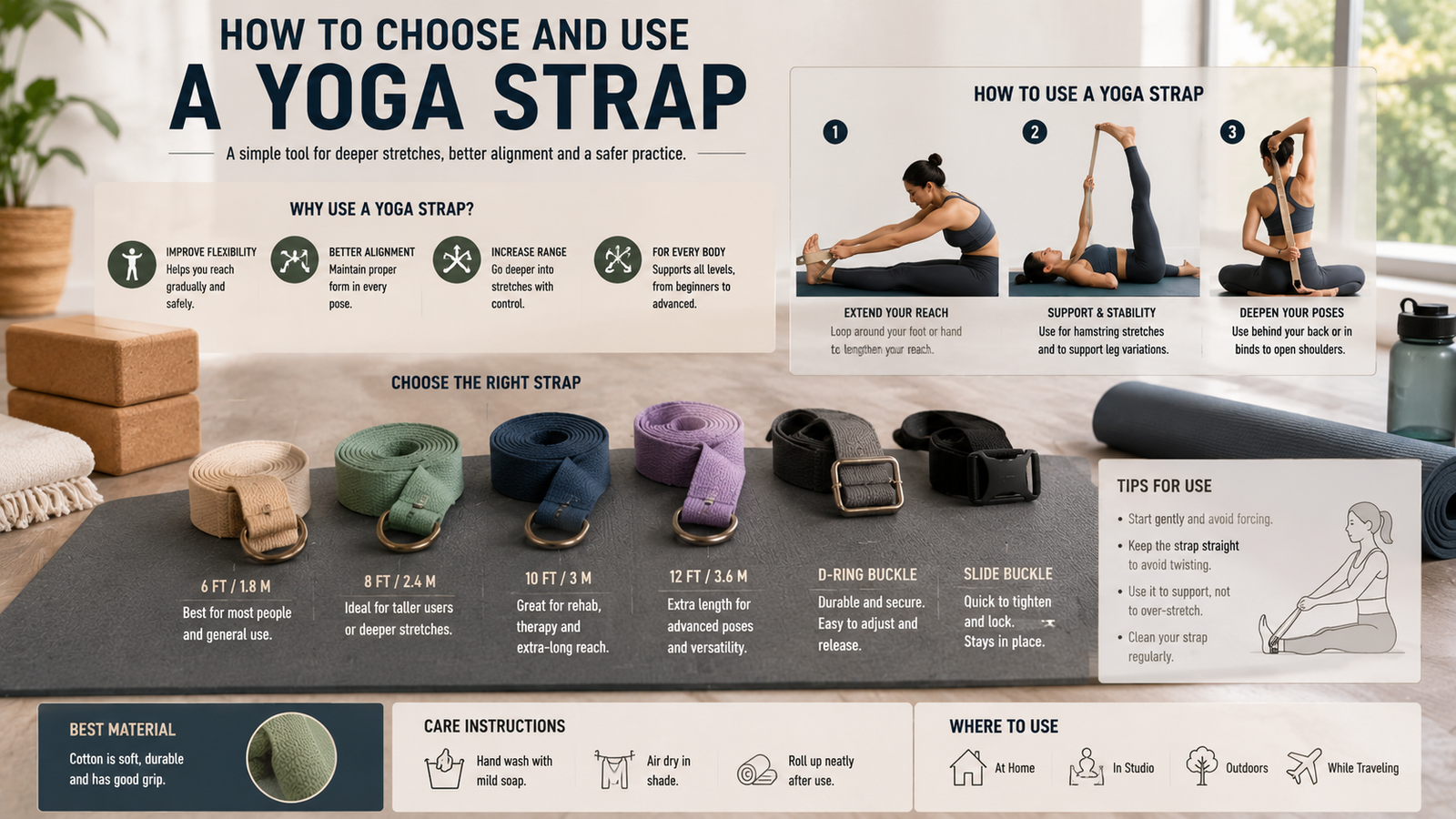
A yoga strap is one of the simplest props you can add to a yoga or mobility routine.
It can help you:
- extend your reach;
- maintain better control in stretches;
- reduce the need to force flexibility;
- support shoulder mobility work;
- improve positioning in seated poses;
- explore hamstring mobility more comfortably;
- maintain posture when your hands cannot yet reach one another.
A yoga strap is especially useful when flexibility is limited because it acts as an extension of your arms.
Instead of forcing yourself to:
- grab your foot;
- reach the floor;
- clasp your hands behind your back;
you can hold the strap and adjust the distance.
The practical approach is:
choose an appropriate length → select a secure buckle → use a comfortable material → keep enough tension for control → never use the strap to force a joint deeper than it can comfortably move
The best yoga strap is not automatically:
- the longest;
- the thickest;
- the most expensive;
- the one with the most complicated buckle.
For most people, a simple durable cotton or polyester strap with a reliable adjustable buckle is enough for years of:
- yoga;
- stretching;
- mobility work.
What Is a Yoga Strap?
A yoga strap is a long woven belt used to provide additional reach or support during yoga and stretching exercises.
It usually consists of:
- a flat fabric strap;
- an adjustable buckle or loop.
Common materials include:
- cotton;
- polyester;
- nylon.
Common closure systems include:
- D-rings;
- rectangular metal buckles;
- plastic quick-release buckles.
Unlike resistance bands, yoga straps are generally:
non-elastic or only minimally elastic.
That distinction is important.
What Does a Yoga Strap Actually Do?
A yoga strap mainly changes the distance between:
- your hands;
- your feet;
- different parts of your body.
For example, imagine lying on your back and raising one leg.
If you cannot comfortably reach your foot with your hands, placing a strap around the foot allows you to hold the leg without:
- rounding excessively;
- straining the neck;
- forcing the hamstrings.
The strap effectively makes your arms:
- longer.
Yoga Strap vs Resistance Band
These tools look similar but behave very differently.
Yoga Strap
Usually:
- non-elastic;
- designed for positioning;
- useful for stretching and mobility.
Resistance Band
Elastic.
Designed to create:
- resistance;
- assistance.
Why the Difference Matters
If you pull on a yoga strap:
- it remains approximately the same length.
If you pull on a resistance band:
- it stretches;
- tension increases.
For controlled stretching, a non-elastic strap often makes it easier to maintain a consistent position.
Can You Use a Resistance Band Instead of a Yoga Strap?
Sometimes.
But it behaves differently.
A resistance band may:
- stretch unexpectedly;
- increase tension as you pull;
- make the position less stable.
For gentle stretching and positioning, a yoga strap is usually easier to control.
Can You Use a Belt Instead?
Possibly.
A sturdy household belt can work for some simple stretches.
But yoga straps usually provide:
- greater length;
- easier adjustment;
- softer edges.
Avoid belts with:
- sharp hardware;
- narrow edges;
- weak stitching.
Can You Use a Towel?
A towel can work for certain stretches.
For example:
- hamstring stretch;
- shoulder stretch.
But towels are usually:
- shorter;
- wider;
- harder to adjust.
A yoga strap is more versatile.
Why Beginners Benefit From a Yoga Strap
Beginners often assume they need to reach farther before they can perform a stretch “correctly.”
A strap changes that.
Instead of forcing your hands toward your feet, you can bring the strap around the foot and maintain:
- comfortable posture;
- controlled breathing;
- appropriate stretch intensity.
This makes the exercise easier to scale.
Yoga Straps Are Not Only for Inflexible People
Experienced practitioners also use them for:
- advanced mobility;
- maintaining specific alignment;
- shoulder opening;
- binding variations;
- restorative poses.
Like yoga blocks, straps are training tools rather than:
- beginner crutches.
The Main Types of Yoga Straps
Most straps fall into a few basic categories:
- D-ring straps
- Cinch-buckle straps
- Quick-release straps
- Loop straps
- Multi-loop stretching straps
Each has advantages.
D-Ring Yoga Straps
These use two metal D-shaped rings.
The strap threads through the rings to create an adjustable loop.
Advantages
- simple;
- durable;
- easy to tighten;
- relatively secure;
- widely available.
Disadvantages
Some beginners need a few attempts to learn how to:
- thread;
- release;
the strap.
Once learned, the system is very simple.
How a D-Ring Buckle Works
Typically:
- Pass the free end through both rings.
- Fold it back over one ring.
- Pass it through the second ring.
- Pull to tighten.
Exact designs may vary.
Why D-Rings Are Popular
There are very few moving parts.
That means fewer components can:
- break;
- jam.
They are excellent for long-term use.
Metal Cinch Buckles
These usually use a rectangular metal buckle that allows the strap to slide through and lock.
Advantages
- secure;
- easy to adjust;
- durable.
Some users find this design slightly easier to understand than D-rings.
Disadvantages
A large metal buckle can feel uncomfortable if it presses against:
- skin;
- floor.
Position the buckle away from the body where possible.
Plastic Quick-Release Buckles
These resemble backpack buckles.
Advantages
- very fast;
- easy to open;
- intuitive.
Disadvantages
Plastic components can potentially:
- crack;
- break.
They may also be less suitable for high-tension use than quality metal systems.
For ordinary yoga, a good plastic buckle can still work well.
Loop Straps
Some straps have a fixed or adjustable loop rather than a traditional buckle.
These are designed for quick use.
Advantages
- simple;
- no complicated threading.
Limitations
They may provide less flexibility in:
- length;
- configuration.
Multi-Loop Stretching Straps
These contain several sewn loops along the entire strap.
You place:
- hands;
- feet;
into different loops.
They are common in:
- stretching;
- rehabilitation-style mobility routines.
Advantages
- easy grip reference;
- multiple fixed positions;
- useful for people with reduced hand grip.
Disadvantages
Less flexible than a completely open strap.
You cannot position your hand at:
- any exact point;
because the loops determine spacing.
Who Benefits From Multi-Loop Straps?
They may be particularly useful for:
- beginners;
- older adults;
- people who find gripping a flat strap difficult.
Which Buckle Type Is Best?
For most people:
D-ring or metal cinch buckle
is the strongest all-purpose choice.
If convenience matters most:
- quick-release buckles;
can be easier.
If grip is difficult:
- multi-loop straps;
may be useful.
Strap Length Matters
Yoga straps commonly come in lengths around:
- 180 cm;
- 240 cm;
- 300 cm.
Exact sizes vary.
Standard-Length Strap
A strap around:
- 180 cm;
is enough for many users and common exercises.
It works well for:
- hamstring stretches;
- shoulder mobility;
- seated forward folds.
Longer Strap
A strap around:
- 240 cm;
provides more flexibility.
Useful for:
- taller users;
- larger bodies;
- bound poses;
- restorative setups.
Extra-Long Strap
Around:
- 300 cm;
or more.
Useful for specialized:
- restorative;
- advanced;
- body-wrapping setups.
Most beginners do not need this much length.
Which Length Should a Beginner Choose?
For most people:
around 240 cm provides the best all-purpose flexibility.
It gives enough length for:
- foot stretches;
- shoulder work;
- looped positions;
without becoming excessively difficult to manage.
When 180 cm Is Enough
Choose a shorter strap if you:
- are smaller;
- mainly use it for simple stretching;
- want something compact.
When a Longer Strap Is Better
Consider longer lengths if you:
- are tall;
- have broad shoulders;
- need more reach;
- use restorative poses.
Tall Users
Longer straps often feel more comfortable because more material remains available after wrapping around:
- feet;
- legs.
Larger Bodies
A longer strap also provides more room around:
- legs;
- torso.
Choose based on practical reach rather than arbitrary size labels.
Strap Width
Most yoga straps are approximately:
- 2.5–4 cm wide.
Narrow Straps
Advantages:
- lightweight;
- easy to pack.
Potential downside:
- can dig into hands;
- feet;
under tension.
Wider Straps
Spread pressure over a larger area.
This can feel more comfortable.
Very Wide Straps
May become harder to:
- thread through buckles;
- grip.
A moderate width is usually best.
Strap Thickness
A good strap should feel substantial enough that it does not:
- twist;
- bunch;
- cut into skin.
Very thin webbing may be uncomfortable.
Cotton Yoga Straps
Cotton is one of the most common materials.
Advantages
- comfortable;
- good hand grip;
- flexible;
- breathable;
- usually affordable.
Disadvantages
- absorbs sweat;
- takes longer to dry;
- can become heavier when wet.
Cotton Grip
One of its biggest strengths.
Cotton usually feels secure without being:
- slippery.
Polyester Yoga Straps
Polyester is also common.
Advantages
- durable;
- resistant to moisture;
- quick drying;
- easy to clean.
Disadvantages
Some smooth polyester straps may feel:
- more slippery;
than textured cotton.
Quality matters.
Nylon Yoga Straps
Nylon is:
- strong;
- lightweight;
- durable.
Potential Disadvantages
It can feel smoother and may become uncomfortable if very thin.
Cotton vs Polyester
Choose Cotton If:
You prioritize:
- softness;
- hand comfort;
- natural feel.
Choose Polyester If:
You prioritize:
- durability;
- faster drying;
- moisture resistance.
Either can work well.
Is Cotton Automatically More Sustainable?
Not necessarily.
Environmental impact depends on:
- how cotton is grown;
- dyeing;
- manufacturing;
- transport;
- lifespan.
Similarly, recycled synthetic materials may reduce some virgin-material use.
Durability matters too.
Organic Cotton
Some straps use certified organic cotton.
This may appeal to users prioritizing:
- material sourcing.
But certification and manufacturing details matter more than vague “natural” marketing.
Recycled Polyester
Can reduce reliance on virgin polyester.
Again, evaluate:
- durability;
- quality.
A strap that lasts many years is generally preferable to one replaced frequently.
Stitching Quality
Inspect where the strap attaches to:
- buckle;
- loops.
Look for:
- dense;
- reinforced stitching.
Weak Stitching
Can fail under tension.
This matters particularly during:
- hamstring stretching;
- bound positions.
Bar-Tack Stitching
Reinforced bar-shaped stitching is commonly used in high-load fabric products.
It can indicate stronger construction.
Frayed Edges
Minor fuzzing may not matter initially.
But significant fraying can weaken the strap.
Replace if structural integrity appears compromised.
Buckle Construction
Metal buckles should feel:
- solid;
- smooth.
Avoid sharp edges.
Sharp Metal Edges
Can:
- cut skin;
- damage the strap.
A quality buckle should have smooth finishing.
Rust
Metal hardware may corrode in:
- humid;
- sweaty environments.
Dry it after use.
Yoga Straps in Humid Conditions
For hot and humid climates, polyester may dry faster than cotton.
If using cotton:
- allow it to air dry completely.
Do not leave a sweaty strap rolled in a bag.
Yoga Straps in Indian Conditions
In warm and humid environments, practical priorities include:
- washable fabric;
- quick drying;
- strong buckle;
- good stitching.
For frequent studio transport, a polyester or tightly woven cotton strap can both work well.
Colour
Colour has no effect on performance.
Lighter straps may show:
- dirt;
- sweat;
more easily.
Choose based on preference.
Printed Straps
Decorative patterns are fine as long as printing does not create:
- stiff;
- slippery areas.
How to Hold a Yoga Strap
Grip the strap firmly but not aggressively.
You do not need to:
- clench;
- white-knuckle.
The strap should provide control, not create unnecessary forearm fatigue.
Hands Should Not Slide
If the strap slips constantly:
- shorten your grip;
- use textured fabric;
- dry your hands.
Wrapping the Strap Around Your Hand
Avoid winding it tightly several times around the hand or wrist.
If you lose balance or need to release quickly, excessive wrapping can make the strap difficult to let go.
Never Tie the Strap Tightly Around a Joint
Do not use it as a tourniquet around:
- wrist;
- ankle;
- knee.
Yoga straps are positioning tools.
Strap Tension
Use enough tension to maintain the pose.
You usually do not need to pull as hard as possible.
The Stretch Should Come From Position, Not Aggressive Pulling
This is one of the most important principles.
If you are using your arms to force the leg farther than it wants to move:
- reduce tension.
The strap should help you maintain a range that feels:
- controlled;
- tolerable.
Yoga Strap and Hamstring Stretching
This is one of the most useful applications.
Supine Hamstring Stretch
Lie on your back.
Loop the strap around one foot.
Raise that leg toward the ceiling.
Hold the strap with both hands.
Keep the opposite leg:
- bent;
- straight;
depending on comfort.
Do You Need the Knee Completely Straight?
No.
A slight bend is completely acceptable.
The goal is not to lock the knee.
How Far Should the Leg Move?
Only until you feel:
- comfortable tension;
through the back of the thigh.
Do not pull until:
- pelvis lifts dramatically;
- back rounds aggressively;
- tingling occurs.
Why Supine Stretching Is Useful
Lying down gives the body more support.
It reduces:
- balance demand;
- spinal compensation.
This makes it a good beginner hamstring stretch.
Strap Position Around the Foot
Place the strap around the:
- ball of the foot;
- midfoot;
depending on the drill.
Avoid placing it around the toes where it may:
- slip.
Foot Position
You can keep the ankle:
- neutral;
- slightly flexed.
Aggressively pulling the toes toward you may increase sensation in the calf and nervous system.
This is not always necessary.
Nerve Sensations
If the stretch creates:
- tingling;
- burning;
- electric sensation;
- numbness;
reduce range.
These symptoms may involve neural tension rather than simple muscle stretching.
Seated Hamstring Stretch
Sit with one or both legs extended.
Loop the strap around the foot.
Hold the strap to help maintain:
- upright posture.
Do Not Use the Strap to Drag Your Torso Forward
Think:
- hinge from hips;
rather than pulling with the arms.
Bending the Knees Is Fine
A slight knee bend may allow a more comfortable:
- hip hinge;
- spinal position.
Standing Hamstring Stretch
A strap is less commonly needed.
A block or elevated surface is often more practical.
Yoga Strap for Calf Stretching
Loop the strap around the forefoot while sitting or lying.
Gently draw the toes toward you.
This can stretch:
- calf;
- ankle.
Do Not Pull Aggressively
The ankle is a relatively small joint.
Use gentle tension.
Yoga Strap for Shoulder Mobility
Straps are especially useful when the hands cannot reach each other behind the body.
Overhead Shoulder Pass-Through
Hold the strap with a wide grip.
Raise it:
- overhead;
- slightly behind;
within comfortable range.
Return forward.
Start With a Very Wide Grip
A wider grip requires less shoulder mobility.
As mobility improves, you may gradually narrow the grip.
Do Not Force the Strap Behind You
If the shoulders:
- pinch;
- hurt;
stop.
This exercise should feel like controlled movement, not a maximal stretch.
Yoga Strap Pass-Through vs Resistance Band Pass-Through
A yoga strap does not stretch.
This makes the movement more:
- predictable.
But it also means you must choose an appropriate grip width before beginning.
Behind-the-Back Shoulder Stretch
One hand reaches over the shoulder.
The other reaches behind the lower back.
Hold the strap between them.
Why the Strap Helps
If your hands cannot meet, the strap bridges the gap.
Each hand can gradually move closer over time if useful.
Do Not Yank the Lower Arm Upward
The shoulder can become irritated if you aggressively force:
- internal rotation.
Use very gentle tension.
Cow-Face Arms / Gomukhasana Arms
This is a common yoga position where the hands reach behind the back.
A strap makes it accessible.
Correct Goal
The goal is not necessarily for the fingers to touch.
The goal is comfortable:
- shoulder movement;
- controlled position.
Shoulder Asymmetry
You may notice one side has much less range.
That is common.
Do not force the tighter side to match immediately.
Yoga Strap for Chest Opening
Hold the strap behind your back with both hands.
Gently move the arms away from the torso.
Important Cue
Avoid:
- aggressively arching the lower back;
- forcing shoulders backward.
Keep the movement controlled.
Yoga Strap for Bound Poses
Advanced yoga poses sometimes involve:
- clasping;
- binding;
the hands around the body.
A strap can extend the reach.
Beginners Do Not Need Bindings
You can practice the main pose without adding a bind.
The strap is helpful only when the bind serves a real purpose.
Bound Angle Pose Support
A strap may be looped around:
- lower back;
- feet;
in certain restorative configurations.
This should be done carefully.
Restorative Strap Setups
Some restorative yoga practices use straps to hold:
- legs;
- feet;
in position without muscular effort.
Why Restorative Straps Work
They reduce the need to actively maintain:
- leg position.
This can allow relaxation.
Avoid Over-Tightening
A restorative strap should not cause:
- compression;
- numbness;
- tingling.
Yoga Strap for Reclined Hand-to-Big-Toe Pose
Also called a variation of:
- Supta Padangusthasana.
Lie on your back and loop the strap around one foot.
This allows several mobility directions.
Variation 1 — Leg Up
Focus on:
- hamstrings.
Variation 2 — Leg Out to the Side
Focuses more on:
- inner thigh;
- hip.
Keep the opposite side of the pelvis grounded as much as comfortable.
Variation 3 — Leg Across the Body
Adds:
- outer hip;
- rotational components.
Move gently.
Do Not Force the Leg Toward the Floor
The strap makes it easy to pull too hard.
Use only enough tension to guide the movement.
Yoga Strap for Quadriceps Stretch
A strap can make it easier to reach the foot behind the body.
Prone Quadriceps Stretch
Lie on your stomach.
Loop strap around one foot.
Bend the knee.
Gently guide the heel toward:
- glute.
Keep the Knee Comfortable
Avoid pulling the foot strongly toward the side.
Side-Lying Quadriceps Stretch
This can be easier for people who dislike prone positions.
The strap again extends reach.
Standing Quadriceps Stretch
A strap can help if you cannot reach the ankle.
But balance becomes more demanding.
Use:
- wall;
- chair;
for support.
Yoga Strap for Hip Flexor Stretching
The strap itself is not usually necessary for basic hip-flexor stretches.
But it may be used to add a quadriceps component to:
- half-kneeling;
- lunge positions.
This is more advanced.
Do Not Overload the Knee
If bending the back knee while stretching the hip flexor causes knee discomfort, remove the strap component.
Yoga Strap for Adductor Stretching
In a reclined leg-out-to-side stretch, the strap supports the foot while the leg moves laterally.
This can be easier than reaching with the hand.
Yoga Strap for Inner-Thigh Mobility
Keep the pelvis stable.
Do not let the strap pull the leg farther than you can actively tolerate.
Yoga Strap for Ankle Mobility
A strap can help guide the foot through:
- dorsiflexion;
- plantar flexion.
But it is not usually necessary for simple ankle mobility drills.
Yoga Strap for Seated Posture
Sitting on a block often helps more than using a strap.
But the strap may support:
- feet;
- legs;
during certain seated positions.
Yoga Strap for Forward Folds
The strap is useful because it allows you to maintain contact with the feet without:
- rounding excessively.
Should You Pull on the Strap During a Forward Fold?
Only gently.
Think of the strap as a point of connection, not a winch.
Yoga Strap for Boat Pose
Some beginners loop the strap around the feet while practicing:
- boat pose.
This can reduce the amount of hamstring flexibility required.
Supported Boat Pose
Sit with knees bent.
Loop the strap around the feet.
Hold the strap while gradually lifting the feet.
This allows you to practice:
- balance;
- trunk position.
Do Not Pull Yourself Upright With Maximum Arm Effort
The core should still contribute.
The strap provides support, not complete suspension.
Yoga Strap for Dancer Pose
Dancer pose involves holding one foot behind the body while balancing.
A strap can extend the reach.
Why a Strap Helps
You can loop the strap around the rear foot and hold the ends overhead.
This reduces shoulder-mobility requirements.
Dancer Pose Safety
It is still a balance pose.
Practice near:
- wall;
- stable support.
Do not aggressively pull the foot upward.
Yoga Strap for King Pigeon Variations
Advanced pigeon variations use a strap to connect the hands to the rear foot.
These require substantial:
- hip;
- spinal;
- shoulder mobility.
They are not necessary for beginners.
Yoga Strap for Wheel or Backbend Preparation
A strap may be placed around the arms to keep elbows from moving excessively outward.
This is more advanced and should be used carefully.
Strap Around Upper Arms
In certain poses, a loop may help maintain:
- arm spacing.
But it should never be so tight that it compresses the arms significantly.
Yoga Strap for Downward Dog
Not normally necessary.
Some advanced setups use straps for:
- alignment;
- assistance.
For beginners, blocks or wall modifications are usually more practical.
Yoga Strap for Crow Pose
Not usually needed.
A strap around the upper arms is sometimes used as a cue, but beginners should prioritize:
- technique;
- stable surface;
- appropriate progression.
Yoga Strap for Headstand or Handstand
Straps are sometimes used around the arms to maintain position.
These are advanced techniques.
They do not make inversion practice automatically safe.
Beginners Should Not Use a Strap to Force Inversions
Learn inversions with:
- appropriate coaching;
- wall support;
- strength progression.
Yoga Strap for Meditation
Some meditation straps or belts help support:
- knees;
- posture.
These are more specialized than standard yoga straps.
Yoga Strap for Sitting Cross-Legged
A strap may sometimes wrap around the legs and back to provide support.
But a block or cushion under the hips is usually the simpler first adjustment.
Yoga Strap for Mobility Drills
Straps work well in general mobility sessions, not just yoga.
Useful applications include:
- hamstring stretches;
- shoulder pass-throughs;
- quadriceps stretches.
Mobility Strap vs Yoga Strap
Often the same thing.
Mobility-specific straps may include:
- multiple loops;
- numbered markings.
Numbered Stretching Straps
These help you track hand position.
For example:
- hand at loop 4;
- later loop 3.
This can make mobility progression easier to monitor.
Tracking Progress
If your strap has loops or markings, record where you hold it.
But remember that flexibility varies with:
- temperature;
- fatigue;
- time of day.
Small day-to-day changes are normal.
Do Not Measure Flexibility Obsessively
Improved comfort and movement quality matter more than moving your hand:
- 2 cm farther.
Yoga Strap and Active Mobility
A strap can support active mobility exercises rather than only passive stretching.
Example: Assisted Leg Raise
Lift the leg actively.
Use the strap only to support the position at the top.
This combines:
- strength;
- flexibility.
Contract-Relax Stretching
Some mobility methods involve alternating:
- muscle contraction;
- relaxation.
A strap can provide stable resistance.
Example
During a hamstring stretch:
- Move to mild stretch.
- Gently press the foot into the strap.
- Hold briefly.
- Relax.
- Explore slightly more range if comfortable.
Do Beginners Need PNF Stretching?
No.
Simple static and active mobility work is sufficient for most people.
Contract-relax methods are optional.
Avoid Maximal Contractions
Use moderate effort.
A stretch should not become a strength competition.
Yoga Strap and Strength Training
A yoga strap is not designed to replace:
- lifting straps;
- suspension trainers;
- resistance bands.
Yoga Strap vs Lifting Strap
Yoga Strap
Long, adjustable and intended for mobility.
Lifting Strap
Shorter and designed to connect the hand to:
- barbell;
- dumbbell.
Do not use a yoga strap as an improvised lifting strap unless explicitly designed for that load.
Yoga Strap vs Suspension Trainer
A suspension trainer supports substantial:
- body weight.
A yoga strap generally does not have that kind of certified load system.
Do not hang full body weight from a normal yoga strap.
Yoga Strap vs Stretching Rope
Stretching ropes may be:
- round;
- non-elastic;
- longer.
They can serve similar mobility purposes.
A flat yoga strap is often more comfortable against:
- hands;
- feet.
Yoga Strap vs Pilates Strap
There is significant overlap.
Pilates equipment may use straps integrated into machines, which are very different from a standalone yoga strap.
How Tight Should a Loop Be?
If making a loop around:
- foot;
- leg;
it should be secure enough not to slide off.
But not so tight that it compresses:
- circulation;
- nerves.
Signs a Strap Is Too Tight
- numbness;
- tingling;
- throbbing;
- skin colour changes;
- deep pressure pain.
Loosen immediately.
Never Tighten Around the Neck
A yoga strap should never be wrapped around the neck in a way that could:
- constrict;
- catch.
Yoga Strap and Balance
A strap can sometimes make balance poses easier by extending reach.
But it does not provide external stability like a:
- wall;
- chair.
If balance is limited, use stable support.
Yoga Strap for Older Adults
A strap can be very useful because it reduces the need to reach far.
Potential benefits include easier:
- hamstring stretching;
- shoulder mobility.
Multi-Loop Straps for Older Adults
These may be easier to hold if grip strength is limited.
Hands can rest inside a loop rather than tightly gripping flat fabric.
Grip Problems
If arthritis or hand pain makes gripping difficult, choose:
- wider;
- softer;
- multi-loop straps.
Yoga Strap for Larger Bodies
Choose:
- longer length;
- wider strap.
A longer strap provides more flexibility around:
- legs;
- torso.
Yoga Strap for Tall Users
Again, a longer strap is usually more practical.
Yoga Strap During Pregnancy
Straps may help maintain reach as:
- body shape;
- balance;
- mobility;
change.
Use comfortable positions.
Pregnancy-specific guidance may be appropriate depending on:
- stage;
- symptoms.
Avoid Aggressive Stretching During Pregnancy
Hormonal changes may increase joint laxity in some people.
Do not use the strap to force deeper passive ranges.
Yoga Strap for Hypermobile Users
A strap can actually help limit range.
Instead of pulling farther, use it to create a clear:
- stopping point.
Focus on active control.
Hypermobility and Stretching
If you already have very large ranges, you may benefit more from:
- strength;
- stability;
than deeper passive stretching.
Yoga Strap During Rehabilitation
A strap may be used in rehabilitation exercises.
Examples include:
- assisted leg movement;
- shoulder range exercises.
But the correct exercise and range should follow:
- professional guidance.
After Surgery
Do not use a strap to force range unless your:
- surgeon;
- physiotherapist;
has specifically recommended the movement.
Yoga Strap and Shoulder Injury
Avoid aggressive stretching through:
- pain;
- instability.
A strap gives you mechanical leverage, which can make it easy to apply too much force.
Yoga Strap and Hamstring Injury
Do not aggressively stretch an acutely injured hamstring.
Early recovery may require:
- rest;
- graded loading;
rather than maximum stretching.
Yoga Strap and Sciatica-Like Symptoms
If hamstring stretching produces:
- shooting pain;
- numbness;
- tingling;
stop pulling deeper.
This may involve neural irritation rather than muscle tightness.
Yoga Strap and Knee Pain
A strap around the foot changes forces at the:
- knee;
- hip.
If knee pain increases, adjust or stop the position.
Yoga Strap and Ankle Pain
Do not pull aggressively on a painful ankle.
Seek appropriate assessment if symptoms persist.
Strap Safety Depends on Anchoring
A yoga strap is generally held by:
- hands;
- body.
Some people anchor straps to:
- doors;
- furniture.
This requires caution.
Standard Yoga Straps Are Not Suspension Systems
Unless a manufacturer specifically approves anchoring, do not load your full body weight through a yoga strap attached to:
- door;
- beam;
- furniture.
Do Not Anchor to Door Handles
A door handle can:
- break;
- open;
- detach.
Use dedicated exercise equipment when anchoring is required.
Do Not Use as a Pull-Up Aid
Yoga straps are not designed to function like:
- resistance bands;
- suspension straps.
Inspect the Strap Before Use
Check:
- buckle;
- stitching;
- webbing.
Look for:
- tears;
- fraying;
- loose stitching;
- bent hardware.
Small Frays
Minor surface fuzz may not matter.
But if fibres are separating significantly, replace the strap.
Buckle Slippage
If the buckle no longer holds tension securely:
- stop using it for loaded stretching.
Replace or repair according to manufacturer guidance.
Cracked Plastic Buckle
Replace the strap.
Do not rely on a damaged quick-release buckle.
Rusty Metal Buckle
Light surface staining may be cosmetic.
But sharp corrosion can damage:
- fabric;
- skin.
Replace if integrity is uncertain.
Cleaning a Yoga Strap
Cleaning depends on:
- material;
- buckle.
Cotton Straps
Some may be:
- hand washable;
- machine washable.
Check care instructions.
Polyester Straps
Often easy to wash and quick to dry.
Remove Hardware?
Some buckles are permanently attached.
Do not attempt to remove them unless designed for it.
Machine Washing With Metal Buckles
Metal hardware can:
- damage washing machine;
- strike drum.
If the manufacturer allows machine washing, place the strap inside a:
- laundry bag;
- pillowcase;
where appropriate.
Hand Washing
A safe general approach for compatible straps:
- Use cool or lukewarm water.
- Add mild detergent.
- Gently wash fabric.
- Rinse thoroughly.
- Air dry.
Avoid Strong Bleach
It may weaken:
- fibres;
- colour.
Use only if manufacturer specifically allows.
Drying
Air drying is generally safest.
Avoid extreme:
- heat;
- tumble drying;
unless approved.
Dry the Buckle
Metal components should not remain wet.
This reduces corrosion risk.
How Often Should You Wash It?
Depends on use.
If you use it for:
- sweaty hot yoga;
- around bare feet;
wash more frequently.
For light home mobility, occasional cleaning may be enough.
Sweat and Odour
Cotton can absorb sweat.
Allow it to dry before storing.
Storage
Store the strap:
- dry;
- loosely rolled;
- folded.
Avoid tightly knotting it.
Why Avoid Knots?
Tight knots can:
- crease fibres;
- make the strap difficult to adjust.
The buckle is designed to create loops.
Strap Storage With Yoga Mat
You can keep it rolled inside or alongside:
- yoga mat.
Yoga Mat Carry Strap Combination
Some products can function as both:
- yoga strap;
- mat carrier.
Is This Useful?
Yes, if the design still provides:
- adequate length;
- secure buckle.
But some carry straps are too short for serious mobility work.
Buy a Dedicated Strap if You Stretch Frequently
A dedicated yoga strap is usually more comfortable and versatile.
Travel
Yoga straps are excellent travel accessories because they:
- weigh very little;
- occupy almost no space.
They pair well with a:
- travel yoga mat.
Hotel-Room Mobility
A strap can support:
- hamstring;
- shoulder;
- quadriceps stretches;
without requiring furniture.
Home Office
A strap can be kept nearby for short:
- shoulder;
- hamstring mobility breaks.
But simple walking and movement breaks are equally valuable.
Yoga Strap for Warm-Ups
You can use it for gentle shoulder pass-throughs.
Keep the range dynamic and controlled.
Yoga Strap Before Strength Training
A short shoulder mobility drill may be useful before:
- overhead pressing.
But do not spend a long time on deep passive stretches unless specifically needed.
Yoga Strap After Training
Can be used for gentle:
- hamstring;
- quadriceps;
- shoulder stretching.
Stretching is optional.
It does not guarantee prevention of:
- soreness.
Yoga Strap for Rest Days
Useful for light mobility.
Keep the session comfortable.
Stretch Intensity
A simple practical scale:
Mild
You clearly feel tension but can relax.
Moderate
Strong stretch sensation while breathing comfortably.
Too Much
- pain;
- grimacing;
- breath holding;
- trembling;
- joint pinching.
Stay mostly in mild-to-moderate ranges.
You Should Be Able to Breathe Normally
If you are holding your breath because the stretch is intense:
- reduce tension.
Longer Is Not Always Better
Holding a painful stretch for:
- several minutes;
does not automatically create better mobility.
Consistency matters more.
How Long Should You Hold Strap-Assisted Stretches?
A practical range for many static stretches is:
- 20–60 seconds.
Repeat as needed.
There is no need to chase extreme durations.
How Many Sets?
One to three holds may be enough depending on:
- routine;
- goal.
Dynamic Strap Mobility
For movements such as shoulder pass-throughs:
- 5–10 controlled repetitions;
may be sufficient.
Do Not Swing Aggressively
Mobility work should remain controlled unless specifically performing sport-specific dynamic training.
Progression With a Yoga Strap
You can progress by:
- reducing the amount of strap between hands and foot;
- increasing active control;
- slightly increasing range;
- holding the position more comfortably.
Example Hamstring Progression
Week 1:
Hold the strap farther from the foot.
Later:
Move hands slightly closer.
But only if pelvis and spine remain controlled.
Example Shoulder Progression
Begin with:
- very wide grip.
Over time:
- narrow the grip slightly.
Do not force large changes quickly.
Progression Is Not Always Necessary
If the strap simply makes a pose more comfortable:
keep using it.
You do not have to eliminate it.
Common Yoga Strap Buying Mistakes
Choosing a Strap That Is Too Short
Limits versatility.
Buying a Very Narrow Strap
Can dig into hands or feet.
Choosing a Weak Plastic Buckle
May fail prematurely.
Ignoring Stitching Quality
Important around hardware.
Buying an Extra-Long Strap Without Needing It
Can become cumbersome.
Choosing Only by Colour or Pattern
Function matters more.
Assuming Resistance Bands and Yoga Straps Are Interchangeable
They behave differently.
Common Yoga Strap Use Mistakes
Pulling Too Hard
The biggest mistake.
Using the Strap to Force Range
It should guide, not overpower.
Wrapping It Tightly Around the Wrist
Can make release difficult.
Pulling on the Toes
Use the midfoot or ball of foot.
Ignoring Tingling or Numbness
Reduce range.
Holding the Breath
Ease off.
Using It as Suspension Equipment
Not designed for bodyweight hanging.
Anchoring to Weak Furniture
Unsafe.
Using Damaged Webbing
Replace it.
How to Choose a Yoga Strap Step by Step
Step 1 — Decide Your Main Use
Hamstrings, shoulders, restorative yoga or general mobility?
Step 2 — Choose Length
For most users:
around 240 cm is highly versatile.
Step 3 — Choose Material
Cotton for:
- comfort;
- grip.
Polyester for:
- durability;
- quicker drying.
Step 4 — Choose a Secure Buckle
D-ring or metal cinch systems are excellent all-purpose choices.
Step 5 — Check Width
Moderate width usually feels best.
Step 6 — Inspect Stitching
Especially around the buckle.
Step 7 — Check Hardware
No sharp edges.
Step 8 — Consider Washability
Especially if you practice frequently.
Step 9 — Choose Multi-Loop Design Only if It Helps Your Grip or Tracking
Not everyone needs it.
Step 10 — Buy for Function, Not Decoration
A simple strap can last for years.
A Simple Choice by User
Beginner
Choose:
240 cm cotton strap with D-ring buckle
Frequent Studio User
Choose:
lightweight cotton or polyester strap
Sweaty Practice
Choose:
quick-drying polyester
Limited Grip Strength
Choose:
multi-loop strap
Tall User
Choose:
longer strap
Restorative Yoga
Choose:
long, soft strap
A Simple Choice by Practice Type
General Yoga
Standard cotton D-ring strap.
Mobility Training
Standard or multi-loop strap.
Shoulder Mobility
Long non-elastic strap.
Hamstring Stretching
Any secure comfortable yoga strap.
Restorative Practice
Longer strap may be useful.
A Simple Choice by Length
Around 180 cm
Simple stretching and smaller users.
Around 240 cm
Best general-purpose option for many people.
Around 300 cm
Specialized restorative or extra-reach use.
A Simple Choice by Buckle
Maximum Simplicity + Durability
D-ring.
Easy Adjustment
Cinch buckle.
Fast Opening
Quick-release buckle.
Grip Assistance
Multi-loop strap.
A Simple Choice by Material
Soft Grip
Cotton.
Quick Drying
Polyester.
High Strength / Lightweight
Nylon or similar synthetic webbing.
Beginner Yoga Strap Routine
A short routine might include:
Supine Hamstring Stretch
30 seconds each side.
Reclined Leg-Out-to-Side Stretch
20–30 seconds each side.
Shoulder Pass-Through
6–8 controlled repetitions.
Behind-the-Back Shoulder Stretch
20 seconds each side.
Seated Forward Fold With Strap
30 seconds.
Keep every movement:
- controlled;
- pain free.
Mobility Routine With Strap
Hamstring Raise
8 slow active repetitions each side.
Calf Stretch
20–30 seconds each side.
Shoulder Pass-Through
8 repetitions.
Cow-Face Arm Position
20 seconds each side.
Quadriceps Stretch
20 seconds each side.
Shoulder-Focused Strap Routine
Wide-Grip Pass-Through
8 repetitions.
Overhead Hold
20 seconds.
Behind-the-Back Strap Hold
20 seconds each direction.
Gentle Chest Opening
20–30 seconds.
Avoid shoulder pinching.
Lower-Body Strap Routine
Supine Hamstring Stretch
30 seconds.
Leg-Out-to-Side Stretch
30 seconds.
Calf Stretch
30 seconds.
Quadriceps Stretch
30 seconds.
Repeat each side.
How to Use a Strap Safely in a Hamstring Stretch
A useful checklist:
- Lie comfortably.
- Place strap around midfoot.
- Hold one end in each hand.
- Raise leg gradually.
- Keep knee slightly bent if needed.
- Stop at mild-to-moderate tension.
- Keep shoulders relaxed.
- Breathe normally.
- Do not pull the leg until the pelvis lifts.
- Release slowly.
How to Use a Strap Safely for Shoulder Mobility
- Hold the strap wider than shoulder width.
- Keep elbows mostly straight but not aggressively locked.
- Raise arms overhead.
- Move only as far behind the body as comfortable.
- Return slowly.
- Widen the grip if shoulders pinch.
Never force a narrow grip simply to make the movement look more advanced.
Yoga Strap Buying Checklist
Before purchasing, ask:
1. How long is the strap?
For many users, around 240 cm is versatile.
2. Is the material comfortable against my hands?
It should not feel sharp.
3. Is the strap wide enough?
Avoid excessive digging.
4. Is the buckle secure?
Critical.
5. Is the hardware smooth?
No sharp edges.
6. Is the stitching reinforced?
Especially around the buckle.
7. Does the buckle slip under tension?
It should hold reliably.
8. Is the strap non-elastic?
Usually preferable for yoga and stretching.
9. Do I need multiple sewn loops?
Useful for grip or progression tracking.
10. Can it be washed?
Important for frequent use.
11. Does it dry easily?
Important in humid climates.
12. Is the length suitable for my height and body size?
Longer may be more comfortable.
13. Will I carry it to class?
Weight is usually minimal, but buckle bulk may matter.
14. Can the buckle be adjusted quickly?
Convenience helps during practice.
15. Is it durable enough to use for years?
A basic strap should last a long time.
When Should You Replace a Yoga Strap?
Replace it when you notice:
- major fraying;
- torn webbing;
- loose stitching;
- damaged buckle;
- buckle slippage;
- severe corrosion;
- cracked plastic hardware.
Minor fading is usually cosmetic.
When Should You Stop Using the Strap During a Pose?
Release or reduce tension if you experience:
- sharp pain;
- joint pinching;
- numbness;
- tingling;
- cramping;
- dizziness;
- instability.
A yoga strap gives you additional leverage.
That means it can help you control a stretch, but it can also make it easier to:
- pull too hard.
Use that leverage conservatively.
When Should You Seek Professional Guidance?
Professional guidance may be useful if you are using a strap because of:
- persistent shoulder restriction;
- chronic hamstring pain;
- post-surgical stiffness;
- neurological symptoms;
- recurring joint pain.
A qualified yoga instructor can help with:
- strap positioning;
- pose modifications.
A physiotherapist or appropriate clinician is more suitable when the limitation involves:
- injury;
- persistent pain;
- numbness;
- weakness.
The Physical Glow Takeaway
A yoga strap is one of the simplest ways to make yoga and mobility work more accessible because it extends your reach without requiring you to force your body deeper into a position.
For most beginners, a practical choice is:
a durable non-elastic strap around 240 cm long, made from comfortable cotton or polyester, with a secure D-ring or metal cinch buckle.
Choose according to your needs:
- general yoga → standard cotton D-ring strap;
- hamstring and lower-body mobility → comfortable non-elastic strap;
- shoulder mobility → longer strap with enough width for a broad grip;
- sweaty or humid practice → quick-drying polyester;
- limited hand grip → multi-loop stretching strap;
- taller or larger users → longer strap for more adjustment room.
Then use it according to one central principle:
the strap should extend your reach, not force your range.
During a stretch, aim for:
- mild-to-moderate tension;
- comfortable breathing;
- stable joint position;
- slow controlled movement.
Do not pull until:
- the joint hurts;
- the pelvis twists;
- breathing becomes difficult;
- numbness or tingling appears.
A strap works best when it helps you replace strain with control.
Instead of thinking:
“How far can I pull?”
think:
“What position can I comfortably maintain and gradually control better?”
Used this way, a simple yoga strap can support years of:
- hamstring mobility;
- shoulder flexibility;
- seated stretching;
- restorative yoga;
- beginner pose modifications.
Combined with a yoga mat and a pair of yoga blocks, it forms one of the simplest and most useful mobility setups for everyday home practice.