How to Choose a Weight Bench for Home Workouts
Learn how to choose a weight bench for home workouts, with practical guidance on bench type, adjustability, stability, load capacity, padding and footprint. This beginner-friendly guide helps you make a clear, informed choice without unnecessary complexity.
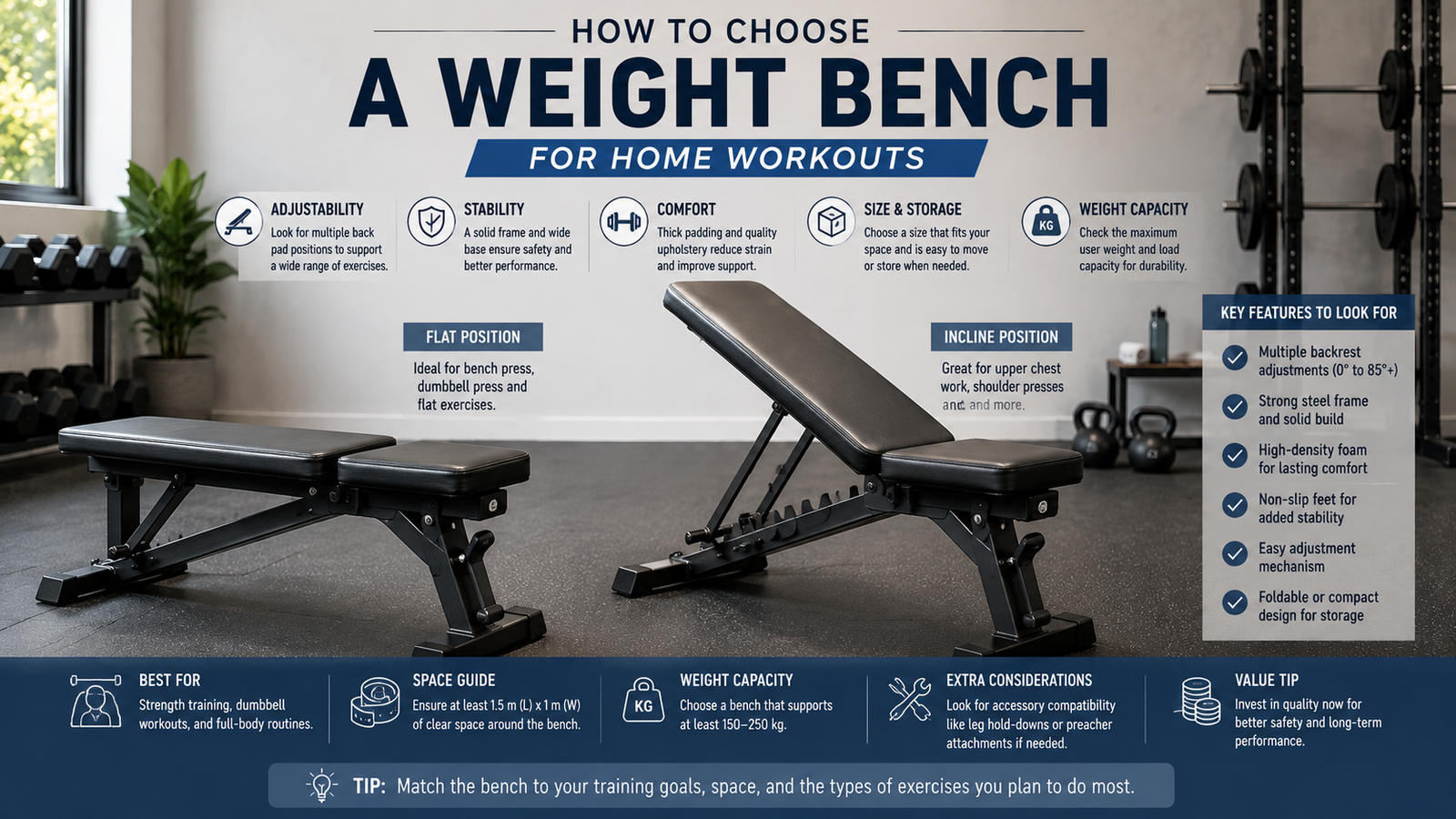
A weight bench can turn a basic home strength setup into a much more versatile training space.
With the right bench, you can perform or improve exercises such as:
- dumbbell bench presses;
- incline presses;
- seated shoulder presses;
- supported rows;
- split squats;
- step-ups;
- hip thrusts;
- chest-supported exercises;
- triceps work;
- core exercises.
But weight benches vary significantly in:
- size;
- adjustability;
- stability;
- padding;
- backrest angle;
- seat adjustment;
- weight capacity;
- frame construction;
- storage;
- compatibility with racks.
A bench that looks compact and convenient may become unstable under heavier dumbbells.
A heavily built commercial-style bench may be extremely stable but too large for a small apartment.
The practical way to choose one is:
decide which exercises you want to perform → choose flat or adjustable → verify real load capacity → evaluate frame stability and dimensions → check pad size and adjustment mechanism → confirm rack compatibility and storage requirements → then compare price
The best weight bench is not automatically:
- the heaviest;
- the most adjustable;
- the most expensive;
- the one with the thickest padding.
It is the bench that provides a stable surface for the exercises you actually perform and remains appropriate as your training becomes stronger.
What Is a Weight Bench?
A weight bench is a stable padded platform used to support the body during resistance training.
Depending on its design, the bench may support:
- lying positions;
- seated positions;
- inclined positions;
- upright positions.
The two major categories are:
- flat benches;
- adjustable benches.
There are also specialized benches for exercises such as:
- decline pressing;
- abdominal training;
- Olympic bench press stations.
For most home users, the main decision is:
flat vs adjustable.
Do You Need a Weight Bench?
Not necessarily.
You can perform effective home strength training with:
- dumbbells;
- kettlebells;
- resistance bands;
- bodyweight exercises;
without owning a bench.
Exercises such as:
- floor press;
- standing shoulder press;
- bent-over row;
- squat;
- lunge;
- Romanian deadlift;
do not require one.
A bench becomes valuable when you want:
- greater pressing range;
- incline pressing;
- seated support;
- chest-supported exercises;
- more exercise variety.
Weight Bench vs Floor Training
A floor press is an excellent exercise.
But the floor limits how far the elbows can travel below the torso.
A bench allows greater:
- shoulder extension;
- range of motion;
during pressing.
This can change:
- muscle stimulus;
- exercise feel.
Neither is automatically better.
The bench simply provides additional options.
Start With Your Main Training Style
Your routine should determine the bench.
General Dumbbell Training
An adjustable bench is usually the most versatile.
Heavy Barbell Bench Press
Prioritize:
- stability;
- appropriate bench height;
- rack compatibility;
- high load capacity.
Minimalist Home Gym
A high-quality flat bench may be enough.
Bodybuilding
An adjustable bench is especially useful for:
- incline presses;
- seated exercises;
- chest-supported movements.
Small Apartment
Consider:
- compact adjustable bench;
- vertical-storage design;
- folding model if sufficiently stable.
Powerlifting
A competition-style flat bench may be preferable.
Main Types of Weight Benches
Common designs include:
- flat bench;
- adjustable bench;
- flat-incline bench;
- flat-incline-decline bench;
- folding bench;
- Olympic bench station;
- specialty benches.
Flat Weight Bench
A flat bench has:
- fixed horizontal pad;
- no backrest adjustment.
It is the simplest design.
Advantages of a Flat Bench
- highly stable;
- fewer moving parts;
- usually lighter;
- often cheaper;
- easy to store.
For barbell bench pressing, a quality flat bench can be excellent.
Disadvantages
It cannot provide:
- incline;
- upright backrest;
- decline;
positions.
This reduces exercise variety.
Who Should Choose a Flat Bench?
A flat bench is a strong choice if your training focuses on:
- flat dumbbell press;
- barbell bench press;
- step-ups;
- supported rows;
- split squats;
- hip thrusts.
It is also ideal if you value:
- maximum stability;
- simplicity.
Adjustable Weight Bench
An adjustable bench has a movable backrest.
It may support positions such as:
- flat;
- low incline;
- medium incline;
- high incline;
- nearly upright.
Some also adjust the:
- seat.
Advantages of Adjustable Benches
They allow many more exercises.
Examples:
- incline dumbbell press;
- seated shoulder press;
- incline curl;
- chest-supported row;
- incline rear-delt raise.
For most home gyms, this versatility makes an adjustable bench very attractive.
Disadvantages
They usually:
- cost more;
- weigh more;
- take more space;
- have more moving parts.
Poor-quality adjustment systems may also develop:
- wobble;
- looseness.
Flat-Incline Bench
Sometimes called an:
- FID without decline;
- FI bench.
It offers:
- flat;
- incline positions.
For many users, this is enough.
Do You Need Decline?
Not necessarily.
A decline position can support:
- decline presses;
- certain abdominal exercises.
But it is less commonly used than:
- flat;
- incline.
If decline adds substantial:
- cost;
- complexity;
- instability;
you may prefer a flat-incline bench.
Flat-Incline-Decline Bench
An FID bench typically provides:
- flat;
- incline;
- decline.
This maximizes versatility.
Who Benefits From Decline?
Consider it if you specifically perform:
- decline dumbbell press;
- decline sit-ups;
- certain chest exercises.
Otherwise, it may be an unused feature.
Decline Bench Safety
A decline position may require:
- leg rollers;
- foot anchors;
to keep you secure.
Check that these components are:
- strong;
- comfortable.
Do not use a steep decline without a reliable way to prevent sliding.
Folding Weight Bench
Folding benches are designed to reduce storage size.
They may fold:
- backrest;
- legs;
- entire frame.
Advantages
- compact storage;
- useful in apartments;
- can fit under beds or in closets.
Disadvantages
Folding joints introduce additional potential movement.
A poorly designed folding bench may feel:
- unstable;
- flexible.
Should You Buy a Folding Bench?
Yes, if storage is a major constraint.
But prioritize:
stability over folding convenience.
A bench that disappears under the bed but moves during every press is not a good compromise.
Olympic Bench Press Station
This combines:
- bench;
- barbell uprights.
It is designed primarily for:
- bench pressing.
Advantages
- integrated setup;
- simple;
- often affordable.
Disadvantages
Usually less versatile than:
- separate rack + bench.
The uprights may not support:
- squats;
- overhead work;
- pull-ups.
For a long-term home gym, a separate bench and rack are usually more flexible.
Separate Bench vs Integrated Bench Station
Separate Bench + Rack
Advantages:
- more exercises;
- easier upgrades;
- bench can move freely;
- rack can support squats.
Integrated Bench Station
Advantages:
- simple;
- compact in some cases.
For most serious home strength setups:
separate equipment provides better long-term flexibility.
Adjustable Bench Backrest Angles
Different angles emphasize different movement patterns.
Common positions may include approximately:
- 0° flat;
- 15°;
- 30°;
- 45°;
- 60°;
- 75°;
- 85°.
Exact positions vary.
Do You Need Many Adjustment Angles?
No.
A useful bench does not need:
- 12;
- 15;
- 20 settings.
For most users, a handful of well-selected angles is enough.
Useful Positions
0°
Flat pressing.
15–30°
Low incline chest work.
30–45°
Incline pressing.
60–75°
Higher incline pressing.
Near 80–90°
Seated shoulder work.
Is 90° Upright Necessary?
Not always.
A completely vertical backrest can feel:
- uncomfortable;
- restrictive.
Many people prefer a slight recline for shoulder pressing.
A top position around:
- 80–85°;
may feel more natural.
Low Incline Is Important
A bench that jumps directly from:
- flat;
- 45°;
misses useful lower-angle positions.
For chest training, many users prefer an incline around:
- 15–30°.
Check the actual angle range before buying.
Backrest Adjustment Mechanisms
Common designs include:
- ladder system;
- pop-pin;
- telescoping support;
- plate-and-pin system.
Ladder Adjustment
The backrest support rests in different notches.
Advantages:
- quick;
- simple;
- durable.
This is common on high-quality commercial benches.
Pop-Pin Adjustment
A pin locks into holes.
Advantages:
- secure;
- many settings.
Potential downside:
- slower adjustment.
Telescoping Adjustment
A support slides inside a frame and locks with:
- pin;
- knob.
Can work well.
But cheap designs may develop:
- play;
- wobble.
Which Adjustment System Is Best?
For home use, both:
- ladder;
- high-quality pin systems;
can be excellent.
The important factor is:
minimal movement once locked.
Seat Adjustment
Some adjustable benches allow the seat pad to tilt.
This is particularly useful during:
- incline pressing;
- upright shoulder pressing.
Why Adjust the Seat?
When the backrest is inclined steeply, a flat seat may allow you to:
- slide downward.
Tilting the seat upward can improve:
- stability;
- positioning.
How Many Seat Angles Do You Need?
Usually only:
- flat;
- one or two raised positions.
More is not necessarily useful.
Seat Gap
Adjustable benches usually have a space between:
- seat;
- back pad.
This is often called the:
pad gap.
Why Pad Gap Matters
In flat position, a large gap may sit directly beneath:
- hips;
- lower back.
This can feel uncomfortable.
Small Pad Gap
Generally preferable.
Some premium benches use designs that nearly eliminate the gap when flat.
Zero-Gap Benches
These allow the seat and back pad to move so there is almost no space between them.
Advantages:
- comfortable flat position;
- premium feel.
Disadvantages:
- more expensive;
- more mechanical complexity.
Do You Need Zero Gap?
No.
A modest gap is usually fine.
Avoid benches where the gap is so large that it noticeably interferes with:
- lying position.
Bench Pad Width
Pad width affects:
- shoulder support;
- stability;
- freedom of arm movement.
Narrow Bench Pad
Can allow greater shoulder movement.
But may feel less stable for:
- broader users.
Wide Bench Pad
Provides more support.
Can be comfortable for:
- heavy pressing.
But if excessively wide, it may restrict:
- shoulder blade movement.
Typical Home Bench Width
Many benches use pads in a range around:
- 25–30 cm;
though wide-pad options may be larger.
The correct size depends on:
- body size;
- training style.
Powerlifting Bench Pad Width
Competition-style bench dimensions are standardized within relevant federations.
If you compete, training on similar dimensions may help.
For general home use, exact competition width is unnecessary.
Bench Pad Length
A bench should support your:
- upper back;
- head;
comfortably.
Very short benches may leave:
- head unsupported.
Tall Users
Check backrest and total pad length carefully.
A compact bench designed for small rooms may feel cramped for someone tall.
Shorter Users
An excessively long bench usually causes less of a problem, but height may matter more.
Bench Height
Bench height affects:
- foot placement;
- stability;
- barbell bench mechanics.
Why Height Matters
During a bench press, your feet should usually be able to contact the floor securely.
If the bench is too tall, shorter users may struggle to:
- plant feet;
- create stable setup.
Typical Flat Bench Height
Many serious benches are roughly in the range of:
- 42–45 cm;
though exact designs vary.
Competition standards may specify particular limits.
Very High Benches
Can be uncomfortable for shorter users.
They may need:
- blocks;
- plates;
under the feet, which adds complexity.
Very Low Benches
May make:
- getting on;
- getting off;
more difficult.
They may also position you unusually relative to:
- rack hooks.
Bench Height and Dumbbell Pressing
For dumbbells, you need enough height to comfortably:
- sit;
- position dumbbells on thighs.
A very low bench can make heavy dumbbell setup awkward.
Bench Height and Step-Ups
Do not automatically use a weight bench as a high step.
Many benches are taller than an appropriate beginner:
- step platform.
Step height should match your ability.
Bench Pad Thickness
Padding should provide enough comfort without being excessively soft.
Too Thin
Can create pressure from:
- frame;
- board underneath.
Too Thick and Soft
Can reduce:
- stability;
- force transfer.
For strength training, a relatively firm pad is generally preferable.
Firm Padding
Advantages:
- stable;
- supportive;
- does not compress excessively.
This is especially useful for:
- heavy bench press.
Soft Padding
May feel comfortable initially.
But excessive softness can make the torso:
- sink;
- move.
Avoid mattress-like benches.
Pad Density
Foam density matters more than simple thickness.
A thinner high-density pad can feel better than a thick soft one.
Pad Surface Material
Common covers include:
- vinyl;
- synthetic leather;
- textured polyurethane.
Vinyl
Common and practical.
Advantages:
- easy cleaning;
- relatively durable.
Potential downside:
- can become slippery with sweat.
Textured Vinyl
Often provides better:
- grip.
This can help keep the shoulders from sliding during pressing.
Grippy Bench Pads
Some premium pads deliberately use high-friction surfaces.
This can improve:
- upper-back stability;
- powerlifting setup.
Is Maximum Grip Always Better?
For bench pressing, good traction is useful.
For exercises where you need to reposition easily, very sticky material may feel less convenient.
For most users, moderate-to-high grip is ideal.
Stitching
Pad seams should be:
- strong;
- positioned away from high-pressure areas.
Poor stitching may eventually split.
Pad Edge
Rounded pad edges can improve comfort around:
- shoulders;
- thighs.
Very sharp square edges may dig into the body.
Frame Construction
The frame determines whether the bench feels:
- solid;
- safe.
Look for:
- steel tubing;
- strong welds;
- stable foot design.
Steel Gauge
Manufacturers may list steel thickness or gauge.
This can provide some indication of:
- structural strength.
But frame geometry also matters.
A poorly designed bench with thick steel can still:
- wobble.
Weld Quality
Inspect for:
- continuous;
- clean;
- consistent welds.
Cracked or poorly finished welds are concerning.
Bolted Frames
Some benches arrive partially assembled with bolts.
This is normal.
Bolted joints should remain:
- tight;
- secure.
Check Bolts Periodically
Repeated exercise can gradually loosen hardware.
Inspect:
- frame bolts;
- pivots;
- adjustment points.
Tighten according to manufacturer guidance.
Bench Stability
A bench should remain stable during:
- pressing;
- sitting;
- getting on and off.
It should not:
- rock;
- twist;
- shift.
Three-Point vs Four-Point Base
Some benches use:
- three contact points;
- four contact points.
Three-Point Design
Often uses:
- wide rear foot;
- narrow front foot.
Advantages:
- easier foot positioning during bench press;
- less interference with legs.
Four-Point Design
Uses wider front and rear supports.
Advantages:
- can feel very stable.
Potential disadvantage:
- front feet may interfere with foot placement.
Both can work well.
Front Foot Width
This matters more than many buyers expect.
A very wide front stabilizer can interfere with your:
- feet;
during barbell bench pressing.
Narrower front support is often preferable.
Rear Foot Width
A wide rear stabilizer improves:
- lateral stability.
It usually does not interfere much with the lifter.
Rubber Feet
Useful for:
- traction;
- floor protection.
They reduce the bench sliding during:
- setup;
- exercise.
Hard Plastic Feet
Can work.
But may slide more easily on:
- smooth flooring.
Stability on Rubber Flooring
Dense rubber gym flooring usually provides excellent traction.
Stability on Tile
Smooth tile can be slippery.
Use:
- rubber feet;
- gym matting.
Uneven Floor
Even a good bench may rock if the floor is uneven.
Some benches include:
- adjustable feet;
- levelling features.
These can be useful in:
- garages;
- older rooms.
Weight Capacity
This is one of the most important specifications.
But it is often misunderstood.
Total Load Includes Your Body Weight
Suppose:
- you weigh 90 kg;
- you dumbbell press two 30 kg dumbbells.
The bench is supporting approximately:
150 kg
before considering dynamic forces.
Barbell Bench Press Example
If you weigh:
- 90 kg;
and bench press:
- 100 kg;
the system is dealing with approximately:
190 kg combined static load
distributed across the bench and rack.
This is why a bench rated only for:
- 120 kg;
would be inappropriate.
Look for Total Weight Capacity
Manufacturers may list:
- user capacity;
- total capacity;
- dynamic capacity.
Make sure you understand which number is being quoted.
User Weight Capacity vs Total Load Capacity
User Capacity
May refer only to body weight.
Total Load Capacity
Should include:
- person;
- weights.
For strength training, total load is the more useful number.
Inflated Weight Ratings
Be cautious with extremely high marketing claims on very light inexpensive benches.
A bench weighing:
- 10 kg;
that claims to support enormous commercial loads deserves scrutiny.
Look for:
- frame construction;
- steel dimensions;
- user reviews;
- testing information.
How Much Capacity Should You Buy?
Choose significantly more than your current expected combined load.
This creates room for:
- progress;
- dynamic forces;
- heavier users.
For serious dumbbell or barbell training, a robust capacity is worth prioritizing.
Bench Weight
Heavier benches often feel more stable.
But heavier is not automatically better.
A very heavy bench can become difficult to:
- move;
- store.
Commercial-Style Bench Weight
May be:
- 30 kg;
- 40 kg;
- more.
Excellent stability.
But inconvenient in small homes.
Lightweight Home Bench
May weigh:
- 10–20 kg.
Easier to move.
But frame design must compensate for lower mass.
Transport Wheels
One of the most useful features on heavy benches.
You lift one end and roll the bench on:
- wheels.
Why Wheels Matter
A 35 kg adjustable bench is difficult to drag repeatedly.
Wheels make it much easier to:
- reposition;
- store.
Handle
Many benches include a front handle.
Combined with rear wheels, this provides easy movement.
Wheel Placement
Wheels should not interfere with:
- stability;
- foot placement.
They should contact the floor only when the bench is tilted.
Vertical Storage
Some benches can stand upright on one end.
This can save substantial:
- floor space.
Is Vertical Storage Safe?
Only if the bench is specifically designed for it.
A heavy bench leaning unsecured against a wall can:
- fall.
Use manufacturer-approved storage position.
Folding vs Vertical Storage
Folding
Reduces overall size more dramatically.
Vertical Storage
Faster and usually preserves a stronger fixed frame.
For serious training, vertical-storage capability is often preferable to a heavily folding design.
Under-Bed Storage
Possible with some folding benches.
Measure:
- folded height;
- bed clearance.
Do not assume it will fit.
Wall Storage
Some flat benches can be mounted or hung from:
- wall brackets.
Check wall capacity and manufacturer recommendations.
Room Space
Measure both:
- bench footprint;
- working area around it.
You need enough space for:
- dumbbell setup;
- arms;
- plates;
- rack access.
Bench Length and Room Layout
A 130 cm bench placed inside a rack requires additional space behind and in front.
Plan the complete system.
Weight Bench and Power Rack Compatibility
If barbell training is planned, the bench must fit inside or around your:
- rack;
- squat stands.
Bench Width vs Rack Uprights
Check that the bench can roll between:
- uprights;
- lower stabilizers.
Some racks have crossmembers that interfere with bench positioning.
Rack Depth
A shallow rack may not provide enough space to position a long adjustable bench correctly.
This becomes especially relevant during:
- incline barbell bench press.
Incline Barbell Press Inside a Rack
When the backrest rises, the bench may need to move farther:
- forward;
- backward;
relative to the bar.
A large bench may hit:
- rear crossmember.
Check your rack dimensions.
Bench and Smith Machine Compatibility
Adjustable benches can work with Smith machines.
But check whether:
- frame;
- wheels;
- backrest;
allow positioning under the bar path.
Bench and Half Rack
Usually straightforward.
The open design provides easier positioning.
Bench With Squat Stands
Make sure the bench fits between:
- stand legs.
Wide base designs may conflict.
Bench and Dumbbell-Only Training
Rack compatibility matters less.
Prioritize:
- angle adjustment;
- stability;
- comfort;
- storage.
Backrest Width for Dumbbells
A moderately narrow upper back pad can allow the shoulders to move naturally.
But it still needs enough support.
Test if possible.
Dumbbell Bench Press Setup
Heavy dumbbells require stable positioning.
A useful approach:
- Sit on the bench.
- Place dumbbells on thighs.
- Use controlled leg assistance to guide them into position.
- Lie back.
Bench stability is critical during this transition.
Do Not Kick Dumbbells Onto a Weak Bench
The dynamic load can be substantial.
A lightweight bench may shift if:
- feet;
- frame;
lack traction.
Finishing a Heavy Dumbbell Set
Avoid throwing dumbbells sideways.
Use a controlled method to:
- return to thighs;
- lower safely;
when possible.
Dumbbell Hooks
Some advanced accessories allow dumbbells to hang from a bar.
They are specialized and unnecessary for most users.
Flat Dumbbell Bench Press
The most basic bench exercise.
The bench should provide:
- stable head support;
- shoulder support;
- secure foot position.
Incline Dumbbell Press
One of the main reasons to buy an adjustable bench.
A moderate incline generally emphasizes the upper chest more than a flat press.
Is a Higher Incline Better for Upper Chest?
Not necessarily.
As the angle becomes steeper, the movement increasingly resembles:
- shoulder press.
A low-to-moderate incline is often preferred for chest emphasis.
Seated Dumbbell Shoulder Press
Raise the backrest close to upright.
A slightly reclined angle may feel more comfortable than:
- 90°.
Use seat incline if available to reduce sliding.
Chest-Supported Dumbbell Row
Set the bench at an incline.
Lie chest-down.
This reduces the need to hold a bent-over torso position.
Why Chest Support Is Useful
It can reduce:
- lower-back fatigue;
during rowing.
It also makes it harder to generate momentum.
Incline Rear-Delt Raise
Performed chest-supported.
Excellent for:
- rear shoulders;
- upper back.
Use light weights.
Incline Dumbbell Curl
The incline position places the arms behind the torso.
This changes the biceps training position.
An adjustable bench is required.
Seated Lateral Raises
Bench provides stability.
Useful for reducing:
- body momentum.
Supported One-Arm Row
Place:
- hand;
- knee;
on the bench.
This is a common dumbbell back exercise.
Bench Width for Rows
The bench should be stable enough that placing body weight on one side does not make it:
- tip;
- rock.
Bulgarian Split Squat
The rear foot is elevated on the bench.
This is a common use.
Is a Weight Bench the Ideal Rear-Foot Support?
Often yes, but bench height may be relatively high.
Some users may prefer a lower:
- pad;
- roller;
- box.
A high rear-foot position is not automatically better.
Step-Ups
A weight bench can sometimes be used for step-ups.
But this depends on:
- bench stability;
- height;
- manufacturer instructions.
Important Step-Up Warning
Not every bench is designed for dynamic stepping.
An adjustable bench with wheels or moving backrest may not be appropriate.
Use only if the manufacturer allows it.
Bench Height for Step-Ups
Many weight benches are relatively high.
Beginners may need a lower platform.
Excessively high steps can make the exercise:
- awkward;
- difficult.
Hip Thrusts
The upper back can rest against the side or pad of a bench.
Bench stability is critical because horizontal force can push it:
- backward.
Hip Thrust Bench Setup
Place the bench against something stable or use a bench designed to resist sliding.
Rubber flooring can help.
Bench Height for Hip Thrusts
A typical weight bench can work well.
But very high benches may feel uncomfortable for some users.
Bench Sliding During Hip Thrusts
This is a common issue.
Solutions include:
- wall support;
- rack contact;
- non-slip flooring.
Do not rely on a lightweight bench that moves freely.
Triceps Dips on a Bench
Bench dips are common.
But they place the shoulder in substantial extension.
Some users may find them uncomfortable.
There are often better triceps exercises using:
- dumbbells;
- cables;
- push-ups.
Bench Dips Are Not Required
Do not buy a bench specifically for this exercise.
Push-Ups With Bench
A bench can modify push-up difficulty.
Hands on Bench
Makes push-ups easier.
Feet on Bench
Makes them harder and changes emphasis.
Ensure the bench does not move.
Core Exercises
Possible options:
- incline sit-ups;
- reverse crunches;
- supported leg raises.
A flat bench also provides a stable platform for:
- dead bug variations.
Decline Sit-Ups
Use a proper decline setup with:
- secure leg support.
Avoid slipping.
Bench for Mobility
A bench can support:
- split-stance stretches;
- elevated mobility drills.
But this is secondary.
Flat Bench vs Adjustable Bench for Barbell Pressing
A flat bench often provides:
- greater simplicity;
- potentially better stability.
An adjustable bench provides:
- versatility.
Powerlifters Often Prefer Dedicated Flat Benches
Reasons include:
- standardized height;
- wide pad;
- minimal movement;
- no seat gap.
General Home Users Often Prefer Adjustable
Because one bench can support many exercises.
Could You Own Both?
Yes.
A dedicated home gym may eventually include:
- adjustable bench;
- competition flat bench.
But most users do not need both.
Bench Pad Grip During Barbell Bench Press
Your upper back should remain stable.
A slippery pad can make it difficult to maintain:
- shoulder position;
- leg drive.
Textured material helps.
Leg Drive
During bench pressing, the feet provide a stable base.
This does not mean aggressively pushing the body off the pad.
A stable bench and floor help transfer force.
Bench Wobble During Heavy Pressing
Any movement under load is undesirable.
Check:
- feet;
- adjustment mechanism;
- bolts.
If the frame itself flexes noticeably, the bench may be unsuitable for heavy work.
Lateral Wobble
Side-to-side movement is particularly concerning during:
- heavy dumbbell presses;
- barbell bench.
Backrest Wobble
Some adjustable benches have slight play.
Minimal movement may be unavoidable.
Excessive movement is a quality problem.
Test the Backrest
With the bench locked:
- push side to side;
- press backward.
It should feel secure.
Test the Seat
The seat should not:
- rock;
- rotate;
once locked.
Adjustment Pins
Pins should:
- fully engage;
- be difficult to accidentally release.
Safety Pins
Some benches use secondary locking mechanisms.
These can improve confidence in high-angle positions.
Ladder Catch Design
Notches should be deep enough that the support cannot easily:
- jump out;
during normal movement.
Decline Lock
If the bench goes below flat, confirm that the backrest is positively secured.
Gravity alone should not be the only thing holding it.
Upholstery Durability
Look for:
- tear-resistant covering;
- reinforced seams.
Home benches experience friction from:
- clothing;
- dumbbells;
- shoes.
Avoid Placing Dumbbells on the Pad
Heavy dumbbell heads can:
- dent;
- cut;
- tear upholstery.
Place them on appropriate flooring or stands.
Sweat and Bench Pads
Wipe the bench after training.
Sweat contains:
- moisture;
- salts.
It can eventually damage:
- upholstery;
- stitching.
Cleaning a Weight Bench
A simple routine:
- Remove sweat.
- Wipe with a damp cloth.
- Use a mild manufacturer-approved cleaner.
- Dry the surface.
Avoid soaking the pad.
Strong Disinfectants
Some harsh chemicals can:
- dry;
- crack;
vinyl.
Use products compatible with the material.
Alcohol-Based Cleaners
May damage some synthetic coverings with repeated use.
Check manufacturer guidance.
Cleaning the Frame
Wipe dust and sweat from:
- steel;
- adjustment points.
Keep moving mechanisms clean.
Lubricating Adjustment Mechanisms
Do not randomly apply:
- grease;
- oil.
Some mechanisms require specific lubrication.
Others should remain dry.
Follow instructions.
Rust
Exposed steel can rust in humid environments.
Inspect:
- bolts;
- scratches;
- frame.
Bench Use in Indian Conditions
For humid climates and monsoon seasons, consider:
- powder-coated steel;
- good ventilation;
- regular wiping.
Avoid leaving a bench in a damp:
- balcony;
- garage;
without protection.
Padding in Hot Environments
Vinyl can become:
- warm;
- sweaty.
A towel may improve comfort.
But make sure it does not slide during pressing.
Bench Hygiene
Shared benches should be cleaned more frequently.
For a personal home bench:
- wiping after sweaty workouts;
is usually enough.
Bench Assembly
Many home benches arrive:
- flat-packed;
- partially assembled.
Follow instructions carefully.
Tighten Bolts Correctly
Under-tightened bolts can cause:
- wobble.
Over-tightening may damage:
- threads;
- moving joints.
Follow torque specifications where provided.
Recheck After Initial Use
Hardware may settle after the first several workouts.
Inspect and retighten as necessary.
Missing Washers
Small assembly mistakes can significantly affect:
- stability.
Use every specified:
- washer;
- spacer;
- bolt.
Do Not Substitute Random Hardware
Load-bearing equipment should use correct:
- grade;
- size;
- length.
If parts are missing, obtain proper replacements.
Bench Weight Ratings After Assembly
The manufacturer’s rating assumes:
- correct assembly.
A loose or incorrectly assembled bench may not perform as intended.
Moving the Bench
Use:
- handle;
- wheels;
where available.
Avoid dragging the frame across flooring.
Carrying Heavy Benches
Do not lift awkwardly alone if the bench is too heavy.
Use assistance.
Storage Position
Follow manufacturer instructions.
Do not store an adjustable bench in a position that places strain on:
- backrest mechanism.
Children and Weight Benches
Adjustable benches have:
- pinch points;
- moving parts.
Keep children away while adjusting.
Pinch Points
Common around:
- backrest hinge;
- seat hinge;
- ladder support.
Keep fingers clear.
Pets
Do not allow pets beneath or around the bench during training.
A bench may move or weights may be lowered nearby.
Bench Placement
Leave enough clearance around it for:
- arms;
- dumbbells;
- barbell;
- walking.
Bench Near Walls
A wall can interfere with:
- dumbbell movement;
- incline adjustment.
Measure the actual working area.
Bench Near Mirrors
Maintain enough distance that:
- dumbbells;
- barbell;
cannot strike glass.
Ceiling Height
An upright bench used for shoulder presses requires enough overhead space.
Check:
- ceiling fans;
- lights.
Bench Inside a Power Rack
Make sure you can centre it beneath the bar.
Some benches include:
- alignment markers;
- narrow front feet;
to help.
Bench Alignment for Barbell Press
The bench should be centred so the bar is directly above the:
- chest/shoulder line;
according to your setup.
Wheels and Rack Alignment
Wheels make repeated repositioning much easier.
This is especially helpful if you alternate between:
- squats;
- bench;
- incline press.
Bench Foot Interference
A wide front stabilizer may stop you placing the feet where you prefer.
This is one reason three-post benches are popular among serious bench pressers.
Flat Bench Dimensions for Powerlifting
If competitive specificity matters, check the current rules of your federation regarding:
- height;
- width;
- length.
For ordinary home training, exact competition measurements are unnecessary.
Adjustable Bench for Chest-Supported Rows
This is one of the most valuable reasons to own one.
Set the backrest around:
- moderate incline.
Lie chest-down.
Row dumbbells toward:
- torso.
Bench Backrest and Face Position
For chest-supported exercises, your face may extend above the pad.
A very tall back pad can feel uncomfortable.
Some users position:
- chin;
- upper chest;
slightly above the top.
Seated Exercises
An upright bench supports:
- shoulder press;
- curls;
- triceps work.
Lower-Back Support
A backrest can reduce the need to stabilize the torso.
But it should not encourage excessive:
- spinal arching.
Seated Shoulder Press Seat Position
A slightly tilted seat can prevent sliding.
Keep feet stable.
Incline Curl Setup
A moderate incline allows the arms to hang behind the torso.
A backrest that is too upright reduces this effect.
Prone Incline Curl
Lying face-down can create another curl variation.
Adjustable benches increase exercise diversity.
Dumbbell Pullover
Can be performed on a bench.
Some people lie:
- lengthwise;
- crosswise.
Use caution with heavy loads and shoulder range.
Chest Fly
A bench allows greater range than the floor.
But this also increases shoulder stretch.
Use controlled loads.
Do Not Chase Maximum Range
More stretch is not always better.
Stop where you can maintain:
- control;
- comfort.
Adjustable Bench for Lower-Body Exercises
Possible uses include:
- split squats;
- hip thrusts;
- single-leg squats to bench;
- supported lunges.
Bench as a Squat Depth Target
You can squat toward the bench as a depth reference.
Do not collapse onto it.
Use it as a:
- target;
- safety cue;
rather than resting between repetitions unless programmed.
Box Squats
A true box squat has a specific technique.
A weight bench may sometimes serve as a box if height and stability are appropriate.
But many benches are too:
- high;
- padded.
Single-Leg Sit-to-Stand
A bench can support progressions toward:
- pistol-type squats.
Again, height matters.
Bench for Calf Raises
Standing on a weight bench is generally unnecessary and may be unsafe.
Use a stable:
- step;
- platform;
designed for standing.
Do Not Stand on Adjustable Bench Pads Unless Intended
Many benches are not designed for concentrated standing loads.
A backrest may shift.
Bench as a Step Platform
Same principle.
Use manufacturer guidance.
Bench Attachments
Some home benches accept attachments such as:
- leg developer;
- preacher curl;
- abdominal roller;
- leg hold-down.
Are Attachments Useful?
Sometimes.
But they can also add:
- clutter;
- cost;
- setup time.
Leg Developer Attachment
May allow:
- leg extensions;
- leg curls.
However, home attachments often have limitations in:
- resistance curve;
- pad position;
- loading.
Useful, but not equivalent to a commercial machine.
Preacher Curl Attachment
Adds a dedicated arm-training position.
For most users, this is optional.
You can perform curls with:
- dumbbells;
- incline bench.
Leg Hold-Down Attachment
Useful for:
- decline work.
If you do not use decline positions, it may remain unused.
Removable Attachments
Better than permanently fixed hardware because they preserve:
- space;
- movement.
Proprietary Attachment Systems
Consider replacement availability.
If the manufacturer discontinues the bench, compatible attachments may become hard to find.
Bench With Resistance Bands
Some benches include band pegs.
These can add resistance to certain exercises.
This is specialized and unnecessary for most users.
Bench With Built-In Rack
Again, integrated systems can work, but they reduce:
- modularity.
Think about whether you will want to upgrade separately later.
Compact Multi-Gym Benches
Some inexpensive products try to combine:
- bench;
- curl station;
- leg extension;
- squat rack;
- fly arms.
These can appear good value.
But each component may be compromised.
More Features Can Mean Less Stability
A simple strong bench is often better than a lightweight device trying to perform:
- ten functions.
Choose the exercises that matter most.
Commercial vs Home Benches
Commercial benches are designed for:
- frequent;
- heavy use.
They often use:
- thicker steel;
- heavier frames;
- premium padding.
Advantages of Commercial Benches
- excellent stability;
- high durability;
- high load capacity.
Disadvantages
- expensive;
- heavy;
- large.
For a small home, they may be excessive.
Home-Grade Benches
Can still be excellent.
Look for:
- strong frame;
- reliable adjustments;
- appropriate capacity.
“Home use” does not automatically mean:
- low quality.
Budget Bench
May work well for:
- beginners;
- light dumbbells.
But inspect:
- frame;
- pivots;
- weight rating.
Mid-Range Bench
Often offers the best balance of:
- stability;
- adjustability;
- storage.
For regular home strength training, this is often the most sensible category.
Premium Bench
May provide:
- near-zero pad gap;
- commercial construction;
- high-quality vinyl;
- many angle settings;
- excellent wheels.
Worthwhile for serious long-term home gyms.
Price Should Reflect Use
If you train:
- five days per week;
- with heavy dumbbells;
a stronger bench is worth prioritizing.
If you use light weights occasionally, a commercial bench may be unnecessary.
Do Not Buy Only by Weight Capacity
A high rating does not guarantee:
- good pad;
- correct dimensions;
- minimal wobble.
Judge the entire design.
Bench Weight vs Capacity
A bench that weighs more generally has more material, but this is not a perfect measure of strength.
Still, extremely light benches with enormous claimed capacities deserve scrutiny.
Customer Reviews
Look for repeated comments about:
- wobble;
- loose backrest;
- narrow pad;
- high seat;
- difficult assembly;
- poor vinyl.
These often reveal practical problems not obvious from specifications.
Reviews From Similar Users Matter Most
A 60 kg beginner using 10 kg dumbbells may love a bench that feels unstable to a 100 kg experienced lifter pressing heavy dumbbells.
Interpret reviews in context.
Video Reviews
Useful for seeing:
- adjustment speed;
- pad gap;
- wobble;
- movement.
They can be more informative than product photos.
Weight Bench for Beginners
A beginner usually benefits from an adjustable bench because it supports many exercises.
Prioritize:
- stable frame;
- flat + several incline positions;
- manageable size;
- simple adjustment.
Weight Bench for Dumbbell Training
This is perhaps the strongest use case for an adjustable bench.
Choose:
- good angle range;
- firm pad;
- high enough load rating.
Weight Bench for Barbell Training
Prioritize:
- rack compatibility;
- appropriate height;
- narrow front foot;
- stable pad;
- strong frame.
Weight Bench for Powerlifting
Consider:
- dedicated flat bench;
- wide grippy pad;
- competition-like height.
Weight Bench for Bodybuilding
Adjustability matters greatly.
Useful positions include:
- flat;
- low incline;
- medium incline;
- upright.
Weight Bench for Small Apartments
Look for:
- vertical storage;
- wheels;
- compact footprint;
- moderate weight.
Avoid sacrificing stability solely for folding.
Weight Bench for Shared Family Use
If multiple users have different:
- heights;
- strength levels;
adjustability becomes more valuable.
A robust load capacity is also important.
Weight Bench for Tall Users
Check:
- total pad length;
- backrest length;
- seat position.
Your head should not hang awkwardly beyond the pad during pressing.
Weight Bench for Short Users
Prioritize:
- lower bench height.
Stable foot contact matters.
Wide-Pad Bench for Broad Users
A wider pad may provide better:
- shoulder;
- upper-back support.
But try to avoid restricting shoulder movement excessively.
Weight Bench for Older Adults
Useful features may include:
- manageable height;
- stable frame;
- easy adjustment.
Complicated low-to-floor folding designs may be harder to:
- enter;
- exit.
Weight Bench After Injury
Exercise choice should be based on professional guidance when relevant.
Do not buy a bench expecting it to fix:
- shoulder;
- back;
- knee pain.
Bench and Shoulder Comfort
An adjustable bench lets you experiment with pressing angles.
Some users find a slight incline more comfortable than:
- flat pressing.
Others prefer:
- neutral-grip dumbbells.
Persistent pain should be assessed rather than simply changing equipment.
Bench and Lower-Back Comfort
An upright backrest can support seated exercises.
But you should still maintain appropriate:
- trunk position.
Do not force your lower back flat against the pad if the exercise does not require it.
Bench and Neck Position
Keep the head supported comfortably.
Do not repeatedly lift the head during heavy pressing unless required for a particular setup.
Barbell Bench Press Setup Basics
A typical setup includes:
- eyes approximately beneath or slightly behind the bar depending on rack;
- upper back supported;
- feet stable;
- bar reachable without excessive shoulder protraction.
Exact setup varies.
Unrack Position
If you must reach dramatically backward to unrack, the bench may be positioned incorrectly.
Adjust:
- bench position;
- J-cup height.
J-Cup Height
Should allow the elbows to retain some bend while unracking.
Hooks that are too high may force you to lose:
- shoulder position.
Safety Arms
For solo barbell bench pressing, proper safeties are strongly recommended.
Set them so:
- the bar does not touch during normal reps;
- they can catch a failed lift.
Test with an empty bar first.
Weight Bench Without a Rack
Still useful for:
- dumbbell exercises;
- floor-to-bench movements;
- supported rows.
You do not need a rack unless performing:
- barbell bench press;
- rack-based lifts.
Common Weight Bench Buying Mistakes
Buying Only by Price
A bench is load-bearing equipment.
Choosing Too Low a Weight Capacity
Remember to include body weight and external load.
Ignoring Bench Height
Shorter users may struggle with foot position.
Ignoring Pad Width
Can affect shoulder support.
Buying Too Many Adjustment Positions
More is not necessarily useful.
Buying a Decline Bench When You Never Use Decline
Adds unnecessary complexity.
Buying a Folding Bench Without Checking Wobble
Storage convenience should not undermine stability.
Ignoring Pad Gap
Can reduce flat-bench comfort.
Buying a Bench Too Large for the Rack
Measure first.
Ignoring Front-Foot Design
Can interfere with bench-press stance.
Buying a Bench Too Heavy to Move
Consider wheels.
Buying a Bench Too Light for Heavy Pressing
Stability matters.
Common Weight Bench Use Mistakes
Using It on a Slippery Floor
Bench can shift.
Failing to Lock Adjustments Fully
Always confirm the mechanism.
Standing on the Backrest
Usually not intended.
Using It as an Unstable Step Platform
Use proper equipment.
Throwing Dumbbells Onto the Pad
Can damage upholstery.
Allowing Bolts to Loosen
Inspect periodically.
Leaving Sweat on the Pad
Clean after use.
Performing Hip Thrusts With an Unsecured Bench
It may slide.
Letting Children Play With Adjustment Mechanisms
Pinch hazard.
How to Test a Bench Before Buying
If possible, test it physically.
Sit on It
Check:
- height;
- seat comfort.
Lie Flat
Check:
- head support;
- pad gap;
- shoulder position.
Set to Low Incline
Check whether the angle feels useful.
Set Upright
Check whether the seat prevents:
- sliding.
Push Side to Side
The frame should feel stable.
Shake the Backrest
Excessive movement is undesirable.
Sit on the Edge
The bench should not feel like it will:
- tip.
Simulate Dumbbell Setup
Sit with your feet planted and imagine holding heavy dumbbells on the thighs.
The bench should feel secure.
Check Adjustment Speed
If changing the angle is annoying, you may avoid using the feature.
How to Choose a Weight Bench Step by Step
Step 1 — List the Exercises You Will Perform
This determines whether you need:
- flat;
- adjustable;
- decline.
Step 2 — Calculate Required Capacity
Add:
body weight + external weight
and leave a substantial safety margin.
Step 3 — Measure Available Space
Include:
- rack;
- bench;
- movement;
- storage.
Step 4 — Choose Bench Type
Flat or adjustable?
Step 5 — Check Height
Make sure you can plant your feet.
Step 6 — Check Pad Dimensions
Width and length should suit your body.
Step 7 — Inspect Adjustment Mechanism
It should lock securely.
Step 8 — Check Frame Stability
No meaningful rocking or twisting.
Step 9 — Evaluate Rack Compatibility
If barbell training is planned.
Step 10 — Decide Storage Strategy
Wheels, vertical storage or folding?
Step 11 — Inspect Upholstery
Firm, durable and grippy.
Step 12 — Consider Future Strength
Buy for where your training is going, not only where it is today.
A Simple Choice by Training Goal
Dumbbell Home Workouts
Choose:
adjustable flat-incline bench
Powerlifting
Choose:
high-quality flat bench
Bodybuilding
Choose:
adjustable bench with low-to-high incline range
Mixed Strength Training
Choose:
robust adjustable bench compatible with your rack
Very Small Apartment
Choose:
compact bench with vertical storage or a stable folding design
Light Beginner Training
Choose:
simple adjustable bench with reliable frame
A Simple Choice by Adjustment Range
Flat Only
Best for:
- simplicity;
- barbell benching.
Flat + Incline
Best for most users.
Flat + Incline + Decline
Choose only if you actually use decline.
A Simple Choice by Home-Gym Size
Very Limited Space
Compact vertical-storage bench.
Small Home Gym
Adjustable bench with wheels.
Large Home Gym
Commercial-style adjustable bench.
Dedicated Powerlifting Gym
Flat competition-style bench + separate adjustable bench if desired.
A Simple Choice by User Size
Shorter User
Prioritize:
- lower bench height.
Taller User
Prioritize:
- long backrest.
Broad Shoulders
Consider:
- wider pad.
A Simple Choice for Beginners
For most beginners, a good first bench should have:
- flat position;
- several incline positions;
- near-upright setting;
- adjustable seat;
- firm padding;
- stable steel frame;
- sufficient load capacity.
You probably do not need:
- decline;
- leg developer;
- preacher curl attachment;
- complex multi-gym accessories.
A Simple Choice for Heavy Dumbbell Training
Prioritize:
- high total capacity;
- stable base;
- wide enough back pad;
- minimal backrest wobble;
- transport wheels.
A Simple Choice for Barbell Bench Press
Prioritize:
- correct height;
- grippy pad;
- narrow front foot;
- rack compatibility;
- strong frame.
A Simple Choice for Bodybuilding
Prioritize useful angles:
- flat;
- 15–30°;
- 30–45°;
- 60°;
- near upright.
This provides enough variety without excessive settings.
Example Minimal Home Setup
A compact but highly capable setup:
- adjustable dumbbells;
- adjustable bench;
- exercise mat.
This can support a broad full-body routine.
Example Strength Home Setup
- barbell;
- plates;
- rack with safeties;
- adjustable bench;
- rubber flooring.
This supports:
- squat;
- bench press;
- deadlift;
- overhead press;
- row;
- dumbbell accessory work.
Example Small Apartment Setup
- selectorized adjustable dumbbells;
- vertically stored adjustable bench.
This can replace a large amount of commercial gym equipment.
Example Powerlifting Setup
- power rack;
- power bar;
- calibrated or iron plates;
- competition-style flat bench.
Weight Bench Buying Checklist
Before purchasing, ask:
1. Do I genuinely need an adjustable bench?
For most home users, yes; for powerlifting, maybe not.
2. Do I need decline?
Do not pay for it automatically.
3. What is the total weight capacity?
Not just user capacity.
4. Does that capacity include my body weight and weights?
Verify.
5. Is the frame stable?
No excessive rocking.
6. How much does the bench weigh?
Heavy improves stability but affects mobility.
7. Does it have wheels?
Very useful on heavier benches.
8. Can it store vertically?
Useful for small rooms.
9. Is the flat position actually flat?
Check backrest and seat alignment.
10. How large is the pad gap?
Smaller is generally better.
11. Is the pad firm?
Avoid excessive softness.
12. Is the pad wide enough for me?
Especially if broad-shouldered.
13. Is the bench height appropriate?
Feet should reach the floor securely.
14. Does it offer a useful low incline?
Important for chest training.
15. Does the upright position feel comfortable?
A slight recline can be useful.
16. Does the seat adjust?
Helpful for incline pressing.
17. Does the front stabilizer interfere with foot placement?
Important for barbell benching.
18. Will it fit inside my rack?
Measure first.
19. Will it fit my room when fully extended?
Not just when stored.
20. Is the upholstery durable and easy to clean?
It will be exposed to sweat.
21. Are the adjustment pins or ladders secure?
Critical.
22. Are the bolts and welds robust?
Inspect construction.
23. Is there enough capacity for future progression?
Do not buy only for your current dumbbells.
24. Will I actually move or store it easily?
Practicality affects use.
When Should You Replace a Weight Bench?
Stop using or replace the bench if you notice:
- cracked welds;
- bent frame;
- damaged load-bearing bolts;
- adjustment mechanisms that no longer lock;
- severe lateral instability;
- structural cracks.
Cosmetic problems such as:
- scratched paint;
- small upholstery scuffs;
do not automatically make the bench unsafe.
Torn Upholstery
Small tears can sometimes be repaired.
But exposed foam can absorb:
- sweat;
- moisture.
Repairing it early prevents further damage.
Loose Backrest
Inspect:
- bolts;
- bushings;
- adjustment mechanism.
Do not perform heavy pressing if the backrest is unexpectedly moving.
Bent Adjustment Pin
Replace it with the correct manufacturer-approved part.
Do not improvise with a random:
- bolt;
- screwdriver.
When Should You Seek Professional Guidance?
A qualified trainer can help if you are unsure about:
- bench-press setup;
- dumbbell positioning;
- rack safety;
- exercise selection.
Medical or physiotherapy guidance may be appropriate if pressing or bench-supported exercises consistently produce:
- shoulder pain;
- neck pain;
- back pain;
- numbness.
Changing bench angles can alter comfort, but equipment should not be used to mask persistent symptoms.
The Physical Glow Takeaway
A weight bench should provide a stable platform for strength training, not simply more exercise positions.
For most home users, the strongest all-round choice is:
a robust adjustable flat-incline bench with several useful backrest angles, an adjustable seat, firm padding and enough capacity for future strength progression.
Choose according to your training:
- dumbbell training → adjustable bench;
- bodybuilding → adjustable bench with low, medium and high inclines;
- powerlifting → stable competition-style flat bench;
- small apartment → compact bench with wheels and vertical storage;
- mixed barbell and dumbbell home gym → robust adjustable bench that fits correctly inside your rack.
Then focus on the details that determine whether the bench is actually pleasant and safe to use:
- load capacity → must include your body weight plus external resistance;
- frame stability → minimal side-to-side movement;
- bench height → allows secure foot placement;
- pad width and length → appropriate for your body;
- padding → firm enough for stable pressing;
- pad grip → helps prevent upper-back sliding;
- adjustment mechanism → quick and secure;
- pad gap → small enough not to interfere in flat position;
- seat adjustment → useful for steeper inclines;
- rack compatibility → essential for barbell bench pressing;
- wheels or vertical storage → particularly valuable in home gyms.
Do not assume the bench with the most settings is the best.
Most people use only a few positions repeatedly:
flat → low incline → moderate incline → upright.
And do not underestimate load capacity.
A person weighing:
- 85 kg;
while pressing two:
- 30 kg dumbbells;
already places around:
- 145 kg;
of combined static load on the bench.
As strength improves, that number can rise quickly.
Choose a bench that gives you room to progress.
A high-quality bench paired with:
dumbbells → adjustable weights → or a properly configured rack and barbell
can become one of the most useful pieces of equipment in a home gym, supporting years of controlled strength training without requiring a room full of machines.