How to Choose Weight Plates for Your Home Gym
Learn how to choose weight plates for your home gym, with practical guidance on plate type, diameter, material, compatibility, noise and storage. This beginner-friendly guide helps you make a clear, informed choice without unnecessary complexity.
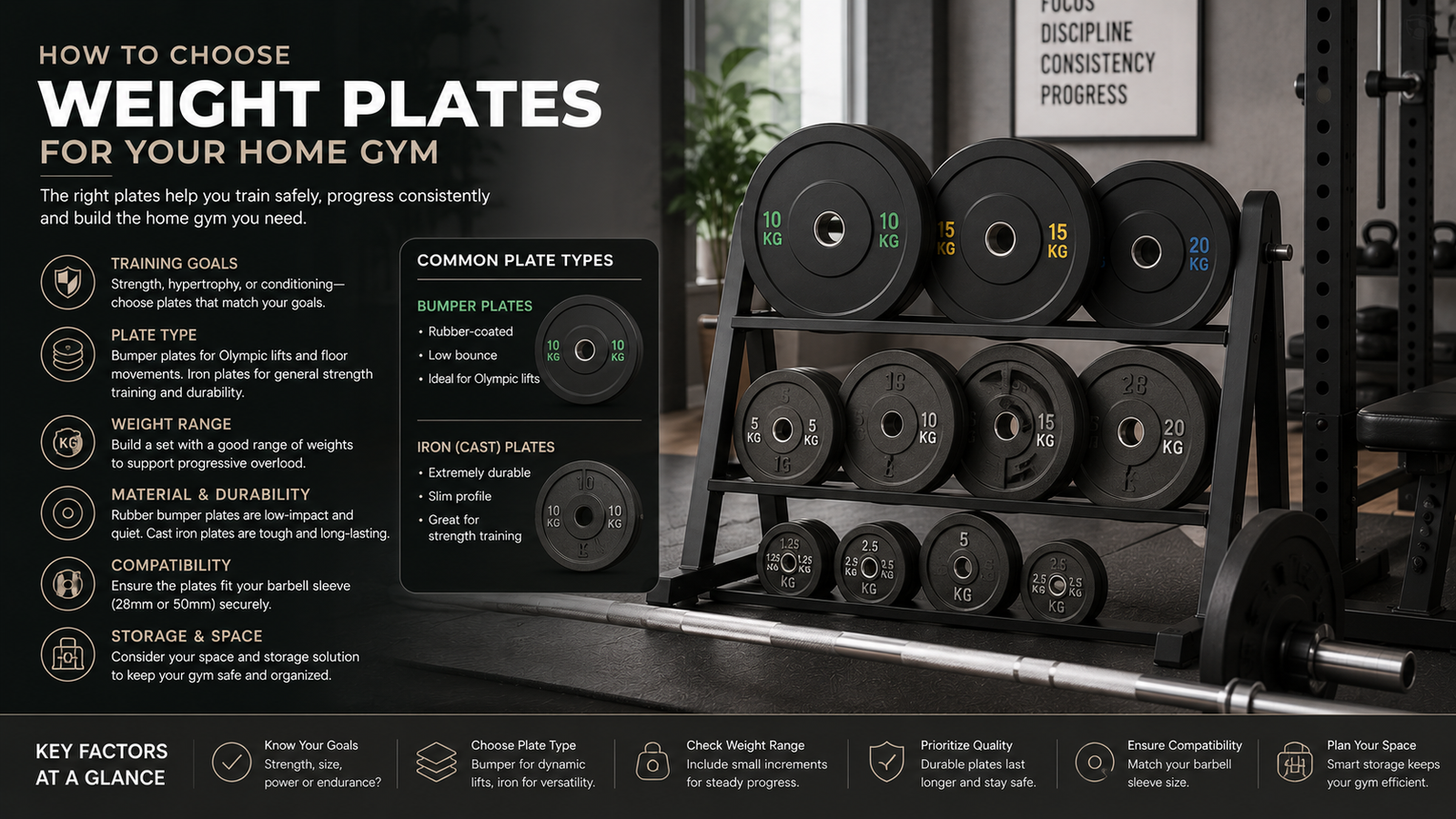
Weight plates are the foundation of any barbell-based strength-training setup.
A good set of plates allows you to progressively load exercises such as:
- squats;
- deadlifts;
- bench presses;
- overhead presses;
- rows;
- Olympic lifts;
- hip thrusts;
- loaded carries.
But weight plates vary much more than they first appear.
They differ in:
- hole diameter;
- material;
- plate thickness;
- outer diameter;
- weight accuracy;
- durability;
- noise;
- floor friendliness;
- grip design;
- intended training style;
- storage requirements.
A plate designed primarily for:
- Olympic weightlifting;
may be unnecessarily bulky for someone doing:
- powerlifting;
- bodybuilding;
- general home strength training.
A very thin steel plate may allow enormous amounts of weight on the bar but can be noisy and hard on floors.
A bumper plate may protect the floor better, but thick plates can limit how much weight fits on the bar.
The practical way to choose weight plates is:
confirm your barbell compatibility → decide whether you need bumper or iron plates → choose appropriate weight increments → check plate thickness and diameter → evaluate durability and weight accuracy → plan storage and flooring → then compare price
The best plates are not automatically:
- the thinnest;
- the most colourful;
- the most accurate;
- the most expensive.
They are the plates that work properly with your:
barbell → exercises → available space → flooring → future strength progression.
What Are Weight Plates?
Weight plates are removable discs or blocks loaded onto:
- barbells;
- dumbbell handles;
- plate-loaded machines.
They provide adjustable resistance.
For barbell training, plates are normally loaded symmetrically on both sides of the bar.
For example:
20 kg bar
plus:
- 10 kg plate on each side;
creates a total load of:
40 kg
This modular loading system is one reason barbells are so useful for long-term strength progression.
Start With Plate and Bar Compatibility
Before choosing material or colour, confirm:
What diameter are your barbell sleeves?
This is essential.
The two broad categories are:
- Olympic plates;
- standard plates.
Olympic Weight Plates
Olympic plates typically use a centre hole of approximately:
- 50 mm.
They are designed for Olympic-style barbells with sleeves of roughly the same diameter.
These are now the most common choice for:
- serious home gyms;
- commercial gyms;
- powerlifting;
- Olympic lifting.
Standard Weight Plates
Standard plates use smaller centre holes, commonly around:
- 25–30 mm;
depending on the system.
They are designed for:
- standard bars;
- smaller adjustable dumbbell handles.
Olympic and Standard Plates Are Not Interchangeable
An Olympic plate will not fit properly on a standard bar.
A standard plate will not fit onto a full Olympic sleeve.
Always verify:
- sleeve diameter;
- plate hole diameter.
Which System Is Better for a Home Gym?
For most people building a long-term strength setup:
Olympic plates are the better choice.
Advantages include:
- broader equipment compatibility;
- higher load potential;
- stronger bars;
- easier future expansion;
- more bumper-plate options.
Standard plates may still work for:
- light training;
- budget setups;
- adjustable dumbbells.
But many users outgrow them.
Main Types of Weight Plates
Common plate categories include:
- Cast-iron plates
- Rubber-coated iron plates
- Urethane-coated plates
- Bumper plates
- Competition bumper plates
- Steel calibrated plates
- Grip plates
- Change plates / fractional plates
Each serves a slightly different purpose.
Cast-Iron Plates
Traditional iron plates are simple:
- metal discs;
- painted or coated.
They are among the oldest and most practical plate designs.
Advantages of Cast-Iron Plates
- compact;
- inexpensive;
- durable;
- easy to load;
- excellent for general strength training.
Because iron is dense, plates can be relatively:
- thin.
This allows more weight to fit on a bar.
Disadvantages of Cast-Iron Plates
They can be:
- noisy;
- hard on flooring;
- prone to rust if coating is damaged.
They are not designed for repeated dropping.
Who Should Choose Cast Iron?
They are ideal for:
- powerlifting-style home gyms;
- bodybuilding;
- general strength work;
- users who lower the bar under control.
If you do not perform Olympic lifts, cast iron is often excellent value.
Rubber-Coated Iron Plates
These contain an iron core covered by:
- rubber.
They combine the compactness of iron with improved:
- floor protection;
- noise reduction.
Advantages of Rubber-Coated Plates
- quieter than bare iron;
- easier on flooring;
- generally durable;
- available with grip handles.
These are particularly practical for:
- home gyms.
Disadvantages
They can:
- smell strongly when new;
- be thicker than plain iron;
- crack or peel over time.
Lower-quality rubber may leave:
- marks;
- residue.
Rubber Odour
New rubber-coated plates sometimes produce a strong smell.
This is often more noticeable in:
- small rooms;
- bedrooms;
- enclosed home gyms.
Good ventilation usually helps it decrease over time.
Urethane-Coated Plates
Urethane is a premium coating often used in:
- commercial gyms.
Advantages
- highly durable;
- resistant to abrasion;
- less rubber smell;
- premium finish.
Disadvantages
- considerably more expensive.
For most home users, urethane is desirable but not necessary.
Who Benefits From Urethane Plates?
They make more sense for:
- high-use gyms;
- premium home setups;
- users who value low odour and long-term appearance.
Bumper Plates
Bumper plates are designed primarily for:
- Olympic weightlifting;
- functional fitness;
- deadlifting where controlled dropping may occur.
They are usually made mostly from:
- dense rubber;
- with a metal centre insert.
Why Are Bumper Plates Different?
Their defining characteristic is consistent outer diameter across many weights.
This means plates such as:
- 10 kg;
- 15 kg;
- 20 kg;
may all have approximately the same overall diameter.
Why Consistent Diameter Matters
It ensures the bar begins at a consistent height from the floor during:
- deadlifts;
- cleans;
- snatches.
This is important for Olympic lifting.
Advantages of Bumper Plates
- better suited to controlled drops;
- protect flooring more than iron;
- reduce noise;
- standardized bar height.
Disadvantages
- thicker;
- take more sleeve space;
- more expensive than basic iron;
- can bounce.
They are not automatically the best plate for every home gym.
Do You Need Bumper Plates?
Choose bumpers if you regularly perform:
- cleans;
- snatches;
- jerks;
- Olympic lifting;
- dynamic deadlifting where controlled dropping is expected.
If your training consists mainly of:
- squat;
- bench;
- controlled deadlift;
- rows;
iron plates may be more practical.
Bumper Plates for Deadlifts
Bumpers are excellent for deadlifting.
They create a standardized starting height and reduce:
- floor impact;
- noise.
But if you become very strong, their thickness can become limiting.
Thin Bumper Plates
Higher-quality bumpers may be designed with:
- higher-density rubber;
- narrower profiles.
This allows more weight on the bar.
Thick Budget Bumpers
Cheaper bumper plates are often thicker.
A heavy lifter may fill the entire bar sleeve before reaching their desired:
- deadlift weight.
Check dimensions before purchasing.
Plate Thickness Matters
This is one of the most overlooked specifications.
The thicker each plate is, the fewer plates you can fit on the bar.
Why Thickness Matters More for Heavy Lifters
Suppose your bar has limited loadable sleeve length.
If each 20 kg plate is extremely thick, you may fit only:
- four;
- five plates per side.
Thinner plates allow substantially more loading.
Thickness Matters Less for Beginners
If your heaviest lift is:
- 80 kg;
plate thickness is unlikely to matter.
But if you plan to deadlift:
- 200 kg+;
it may become important.
Competition Bumper Plates
Competition bumpers are precision-made plates designed for:
- Olympic weightlifting.
They usually offer:
- accurate weight;
- standardized dimensions;
- thinner construction;
- low bounce.
Advantages of Competition Bumpers
- high accuracy;
- excellent durability;
- consistent diameter;
- dense construction;
- relatively thin.
Disadvantages
- expensive.
For general home training, they are often unnecessary.
Colour Coding
Competition-style bumpers commonly follow colour conventions.
Typical examples may include:
- red;
- blue;
- yellow;
- green;
for specific weights.
This makes identification quick.
But always read:
- printed weight.
Do not rely only on colour.
Training Bumper Plates
These are less expensive than competition models.
They are still designed for:
- Olympic-style training.
Weight accuracy may be slightly looser.
For most home lifters who want bumpers:
training bumpers usually provide better value.
Crumb-Rubber Bumper Plates
Some bumpers use recycled crumb rubber.
These are often:
- thicker;
- softer;
- higher bounce.
Advantages
- durable;
- quieter;
- relatively inexpensive;
- good for outdoor/garage environments.
Disadvantages
- very thick;
- strong rubber smell possible;
- high bounce.
They are less suitable when sleeve space matters.
Virgin-Rubber Bumpers
Typically denser and smoother.
They often provide:
- lower bounce;
- thinner profiles;
- cleaner appearance.
Usually more expensive.
Bounce Matters
When a bumper plate is dropped, it can:
- rebound.
High bounce may create safety issues because the bar can move unpredictably.
Low-Bounce Plates
Preferable for:
- Olympic lifting;
- controlled training spaces.
Competition-style plates usually have lower bounce.
High-Bounce Plates
May be acceptable for:
- outdoor;
- garage gym training.
But keep enough surrounding space.
Never Assume Bumper Plates Make Dropping Safe Everywhere
Even with bumpers, dropping a loaded bar can damage:
- tile;
- wooden floors;
- concrete;
- apartment structures.
Use:
- lifting platform;
- dense rubber flooring.
Calibrated Steel Plates
These are precision steel plates commonly used in:
- powerlifting.
They are extremely thin and accurately weighted.
Advantages
- very thin;
- high weight accuracy;
- allows large loads on bar;
- competition-like feel.
Disadvantages
- expensive;
- noisy;
- hard on floors;
- generally no impact protection.
They are specialized.
Who Needs Calibrated Steel Plates?
Primarily:
- competitive powerlifters;
- extremely strong lifters;
- users wanting competition specificity.
For ordinary home training, normal iron plates are usually enough.
Why Powerlifters Prefer Thin Plates
The closer the plates sit toward the centre of the bar, the less dramatically the bar may:
- bend;
- oscillate.
Thin steel plates also allow enormous total weight to fit on the sleeves.
Grip Plates
Grip plates contain cut-outs or handles around the edge.
These make plates easier to:
- carry;
- load;
- remove.
Advantages
- easy handling;
- convenient for home gyms;
- useful for plate-loaded machines.
Disadvantages
Some designs are:
- thicker;
- more expensive.
They may not be ideal for Olympic lifting.
Grip Plates as Exercise Tools
Some people also use them for exercises such as:
- front raises;
- carries.
This is possible, but the main purpose is still:
- loading equipment.
Tri-Grip Plates
A common grip design uses three handles.
They are easy to:
- pick up;
- carry.
Excellent for general fitness gyms.
Change Plates
Change plates are small plates used to make modest increases in barbell weight.
Examples may include:
- 0.5 kg;
- 1 kg;
- 1.5 kg;
- 2 kg;
- 2.5 kg.
They are especially useful for:
- Olympic weightlifting;
- strength progression.
Why Change Plates Matter
Suppose you overhead press:
- 40 kg.
Adding a 2.5 kg plate to each side increases total weight by:
- 5 kg.
That is a large 12.5% jump.
Smaller plates allow:
- 1 kg;
- 2 kg;
total increases instead.
Fractional Plates
Fractional plates are even smaller.
Common options may include:
- 0.125 kg;
- 0.25 kg;
- 0.5 kg.
These are particularly useful for:
- bench press;
- overhead press;
- rehabilitation-style progression.
Microloading
Microloading means adding very small amounts of weight.
It can help when:
- progress slows;
- normal plate jumps become too large.
This is one of the cheapest ways to make a home barbell setup more useful.
Which Plate Weights Should You Buy?
A practical set should allow you to build many combinations.
Common plate sizes may include:
- 1.25 kg;
- 2.5 kg;
- 5 kg;
- 10 kg;
- 15 kg;
- 20 kg;
- 25 kg depending on system.
You do not necessarily need every denomination.
The Value of 1.25 kg Plates
A pair adds:
- 2.5 kg total.
This is one of the most useful progression steps in strength training.
For many home gyms:
1.25 kg plates are essential.
2.5 kg Plates
A pair adds:
- 5 kg.
Useful for:
- larger progression;
- building combinations.
5 kg Plates
Very versatile.
Useful for:
- moderate jumps;
- warm-ups;
- plate-loaded accessories.
10 kg Plates
Useful for:
- building load quickly.
If bumper plates, they may also provide standard starting height.
15 kg Plates
Common in Olympic systems.
They help reduce the number of plates required during heavier lifts.
20 kg Plates
A standard heavy plate.
Very useful for:
- squats;
- deadlifts.
25 kg Plates
Common in some powerlifting and commercial systems.
They reduce loading time during:
- heavy lifts.
But they are heavier to carry and may be unnecessary for most home users.
Which Plates Should a Beginner Buy First?
A practical starting combination may include:
- pair of 1.25 kg;
- pair of 2.5 kg;
- pair of 5 kg;
- pair of 10 kg;
- one or more pairs of 20 kg as strength requires.
The exact setup depends on:
- bar weight;
- current strength;
- exercises.
You Do Not Need Every Weight Immediately
Buy enough for your current program and near-term progression.
Then add:
- heavier plates;
as needed.
This reduces upfront cost.
Example Starter Plate Set
For a 20 kg bar:
Pair of 1.25 kg
Adds 2.5 kg.
Pair of 2.5 kg
Adds 5 kg.
Pair of 5 kg
Adds 10 kg.
Pair of 10 kg
Adds 20 kg.
Pair of 20 kg
Adds 40 kg.
This provides many useful combinations.
Maximum Available Load
Before buying a plate set, calculate:
total plate weight + bar
Example:
20 kg bar
plus 100 kg of plates
equals:
120 kg maximum loaded bar
If you already deadlift 110 kg, that setup leaves little progression room.
Plan Beyond Your Current Strength
For heavy compound lifts, strength can increase relatively quickly in beginners.
Choose enough plates that you do not immediately need another order.
But Do Not Overbuy
If your current maximum squat is:
- 50 kg;
you probably do not need 300 kg of plates immediately.
A staged approach is more efficient.
Plate Diameter
Outer plate diameter affects bar height from the floor.
This matters most during:
- deadlifts;
- Olympic lifts.
Standardized Olympic Plate Diameter
Full-size Olympic bumpers generally share a diameter around:
- 450 mm.
This creates a standardized bar height.
Small Iron Plates
Smaller denominations may have smaller outer diameters.
That is normal.
Deadlifting With Small Plates Only
If a beginner loads only small iron plates, the bar may sit:
- lower than standard deadlift height.
This can make the movement harder and alter technique.
Solutions for Light Deadlifts
You can use:
- full-diameter training plates;
- technique plates;
- blocks.
This preserves normal bar height at lighter weights.
Technique Plates
Lightweight full-diameter plates allow beginners to practice:
- deadlift;
- clean;
- snatch;
from normal height.
They may be made from:
- plastic;
- lightweight composites.
They are particularly useful in coaching environments.
Plate Thickness
Compare thickness for each denomination.
Do not assume all 20 kg plates are similar.
For example:
- calibrated steel 20 kg plate may be very thin;
- crumb bumper may be very thick.
Sleeve Capacity
Calculate:
loadable sleeve length ÷ plate thickness
to estimate how many plates fit.
Do not forget to leave room for:
- collars.
Bumper Plate Sleeve Limits
This is particularly important for strong deadlifters.
If your training may exceed:
- 180–200 kg;
choose thinner bumpers or mix with iron appropriately if your training style allows.
Mixing Bumper and Iron Plates
This can be done, but with caution.
If the bar is dropped, most of the initial impact may be carried by the:
- full-diameter bumper plates.
Adding too much iron can overload them.
Follow manufacturer guidance.
Do Not Use One Thin Bumper to Protect a Huge Stack of Iron
For example, loading:
- one 10 kg bumper;
- several heavy iron plates;
on each side and repeatedly dropping the bar can damage the bumper.
Use an appropriate plate system.
Plate Weight Accuracy
Not every plate weighs exactly what is printed.
Manufacturing tolerances vary.
A plate labelled:
- 20 kg;
might actually weigh slightly more or less.
Does Weight Accuracy Matter?
For ordinary strength training:
small differences usually do not matter.
For:
- competition;
- precise performance tracking;
accuracy becomes more important.
Weight Tolerance
Manufacturers may specify tolerances such as:
- ±1%;
- ±2%;
- tighter.
Lower tolerance means better accuracy.
Competition Plates
Typically have much tighter tolerances.
This is one reason they cost more.
Pair Matching
Ideally, plates on opposite sides of the bar should be similar in actual weight.
Large mismatches can create:
- uneven loading.
Reputable manufacturers usually maintain enough consistency for normal training.
Can You Weigh Your Plates?
Yes.
A reasonably accurate scale can help identify large discrepancies.
For home training, you do not need laboratory precision.
Plate Inserts
Olympic bumper plates use a metal insert around the centre hole.
This contacts the bar sleeve.
Insert Quality Matters
Poor inserts can:
- loosen;
- deform;
- separate from rubber.
This is a common failure point in cheap bumpers.
Stainless Inserts
Often provide good durability.
Steel Inserts
Also common.
Look for:
- secure construction;
- minimal wobble.
Hub Design
Competition bumpers may use larger metal hubs.
These improve:
- durability;
- plate alignment.
They also increase cost.
Plate Fit on the Bar
A good plate should slide on smoothly without:
- excessive force;
- excessive wobble.
Hole Too Tight
Can scratch or bind against the sleeve.
Loading becomes frustrating.
Hole Too Loose
Plate may move excessively.
Collars can reduce movement, but poor tolerances may still feel sloppy.
Plate-to-Sleeve Noise
Metal plates on ribbed sleeves can make:
- scraping;
- ringing sounds.
This is normal.
Rubber-coated plates generally reduce noise.
Noise Matters in Home Gyms
Consider:
- neighbours;
- family;
- floor structure.
Iron plates are significantly noisier than:
- bumpers;
- rubber-coated plates.
Apartment Training
For apartments, prioritize:
- controlled lifting;
- rubber flooring;
- rubber-coated or bumper plates.
But remember:
even bumper plates can transmit large amounts of impact through the floor.
Do Not Drop Barbells in Apartments
Unless the space is specifically engineered for it, repeated dropping may:
- disturb neighbours;
- damage flooring;
- affect structure.
Lower the bar under control.
Garage Gyms
Garages are ideal for heavier plate systems.
You may have more flexibility with:
- iron;
- bumper plates;
- lifting platforms.
But humidity and temperature still matter.
Humidity
Metal plates can rust in:
- humid garages;
- monsoon conditions.
Rubber coatings protect some surfaces but centre inserts may still corrode.
Weight Plates in Indian Home Gyms
Practical factors often include:
- limited indoor space;
- humidity;
- shipping costs;
- rubber smell;
- floor protection.
For many users, rubber-coated Olympic plates provide a strong balance of:
- durability;
- noise control;
- compactness.
If Olympic lifting is planned, bumpers are more appropriate.
Cast Iron in Humid Climates
Painted iron can rust if:
- chipped;
- scratched.
Wipe sweat and moisture promptly.
Plate Coatings
Common iron-plate finishes include:
- enamel paint;
- powder coating;
- rubber;
- urethane.
Enamel Paint
Affordable.
Can chip.
Once metal is exposed, rust may develop.
Powder Coat
Often more durable than simple paint.
Provides:
- textured finish.
Still not completely corrosion-proof.
Rubber
Improves:
- noise;
- floor protection.
Urethane
Premium durability and appearance.
Plate Odour
Rubber plates can produce an initial smell.
Look for products using:
- higher-quality rubber;
- low-odour compounds;
if using them indoors.
Reviews can be especially useful here.
Ventilating New Plates
If rubber smell is strong:
- unpack them;
- allow ventilation;
before placing them in a small enclosed room.
Do not expose them to unsuitable weather or direct heat.
Floor Protection
Even rubber-coated plates are heavy.
They can dent:
- wood;
- laminate;
- tile.
Use suitable flooring.
Dense Rubber Gym Flooring
One of the best options.
It protects against:
- scratches;
- moderate impact.
Thin Yoga Mats Are Not Weight-Room Flooring
They compress and tear.
Use proper:
- dense rubber mats;
- tiles.
Foam Puzzle Mats
May work under light equipment.
But heavy plates can leave:
- deep compression marks.
They may also separate during deadlifts.
Lifting Platforms
A platform provides a dedicated surface for:
- deadlifts;
- Olympic lifts.
It may combine:
- wood centre;
- rubber sides.
Why Platforms Are Useful
They:
- protect floor;
- distribute impact;
- provide stable footing.
For heavy barbell training, they can be an excellent investment.
Plate Storage
Plates are compact individually but become difficult to organize as a collection grows.
Common storage options include:
- plate trees;
- wall-mounted storage;
- rack-mounted pegs;
- horizontal stacks.
Plate Trees
Standalone vertical storage units.
Advantages:
- organized;
- easy access.
Rack-Mounted Plate Storage
Pegs attach to:
- power rack.
Advantages:
- saves separate floor space;
- keeps plates near bar.
Potential Rack Stability Benefit
Weight stored low on a rack can increase:
- overall rack stability.
But check manufacturer capacity and recommended positions.
Wall-Mounted Plate Storage
Useful for saving floor space.
But wall anchoring must be strong enough to support:
- substantial weight.
A few plates can easily exceed:
- 100 kg.
Do not mount to unsuitable wall materials.
Plate Stacks on the Floor
Simple and cheap.
But retrieving the bottom plate becomes inconvenient.
It can also create:
- trip hazards.
Store Heavy Plates Low
Avoid placing heavy 20–25 kg plates on high shelves.
Dropping them can cause serious injury.
Plate Handles
Grip plates make storage easier because you can:
- carry;
- remove them safely.
Thin competition plates may be harder to grasp.
Carrying Plates Safely
Hold them securely.
Do not carry several heavy plates in one hand simply to save time.
20 kg Plate Handling
A 20 kg plate is heavy enough to injure:
- toes;
- fingers.
Use controlled movements.
Footwear
Closed athletic shoes provide some basic protection, but they cannot fully protect from a dropped heavy plate.
Stay focused while loading.
Loading Plates on a Rack
Load the bar gradually and evenly.
Avoid putting an extreme amount on one side while the opposite sleeve is empty.
The bar can potentially:
- tip.
A Practical Loading Sequence
Add plates:
- alternating sides;
especially at heavier weights.
Unloading a Bar
Same principle.
Do not remove every plate from one side while the other side remains fully loaded.
Deadlift Plate Loading
Lifting the bar slightly to add plates can become difficult at heavy loads.
Tools such as:
- deadlift jack;
can help.
Deadlift Jack
A small lever lifts the bar slightly from the floor so plates can be:
- added;
- removed.
Useful for heavy training.
Not necessary for beginners.
Mini Deadlift Jack
Compact versions handle one side of the bar at a time.
Excellent for:
- home gyms.
Plate Collars
Collars prevent plates from moving outward.
Use them where appropriate.
Why Plate Movement Matters
A plate shifting changes:
- balance;
- bar behaviour.
This can be particularly problematic during:
- squats;
- Olympic lifts.
Spring Collars
Cheap and effective for:
- general use.
Clamp Collars
More secure and convenient.
A very good home-gym choice.
Competition Collars
Very secure but expensive and often unnecessary.
Plate Loading and Bar Sleeve Protection
Sliding plates on and off eventually scratches:
- sleeve coating.
This is normal wear.
Do not expect sleeves to remain cosmetically perfect.
Urethane and Rubber Contact
Coated plates may reduce:
- metal-on-metal noise.
But centre inserts still contact the sleeve.
Plate Rotation
During dynamic barbell movements, plates may rotate on the sleeves.
This is normal.
The bar’s sleeve system handles most rotational movement.
Bumper Plate Durability
Quality bumpers can tolerate many controlled drops.
But they still wear.
Common damage includes:
- cracked rubber;
- loose inserts;
- warped plates.
Thin Bumper Plates and Durability
Very thin plates require dense materials and quality construction.
Cheap thin bumpers may sacrifice durability.
Bumper Plate Warping
A warped plate may wobble or lean.
Severe warping can make loading unstable.
Replace badly deformed plates.
Loose Inserts
If the centre metal insert begins moving within the rubber:
- stop repeated dropping;
- inspect.
A loose insert can eventually separate.
Rubber Cracks
Small cosmetic marks may not matter.
Deep cracks near:
- centre;
- outer edge;
can worsen.
Iron Plate Durability
Cast iron can last decades.
The most common problems are:
- rust;
- chipped paint.
Structural damage is relatively uncommon with normal use.
Cracked Cast Iron
Do not use a plate with:
- structural cracks.
A broken plate could fall from the bar.
Urethane Durability
High-quality urethane tends to resist:
- abrasion;
- cracking.
This is one reason commercial facilities use it.
Plate Maintenance
Maintenance is generally simple.
Iron Plates
- wipe dry;
- inspect for rust;
- touch up coating where appropriate.
Rubber Plates
- wipe clean;
- avoid harsh solvents;
- keep dry.
Competition Plates
- inspect hubs;
- avoid unnecessary outdoor exposure.
Cleaning Weight Plates
Sweat and chalk can collect on:
- surfaces;
- handles.
Use a mild cleaner appropriate for the material.
Avoid Strong Solvents on Rubber
They can cause:
- drying;
- cracking;
- discoloration.
Use manufacturer-approved cleaning methods.
Plate Rust
Light surface rust is common on exposed steel.
It can often be managed.
Severe rust can damage:
- surfaces;
- fit.
Rust Around Inserts
Bumper plate hubs and inserts may rust in humidity.
Dry after exposure to:
- sweat;
- moisture.
Plate Storage Outdoors
Generally avoid long-term outdoor storage.
Sunlight, rain and temperature changes can degrade:
- rubber;
- paint;
- metal.
Do Not Leave Plates Wet
This is particularly important after:
- garage workouts;
- cleaning.
Dry before storing.
Weight Plate Markings
Good plates clearly show:
- weight;
- unit.
Embossed or raised markings last longer than:
- stickers.
Kilograms vs Pounds
Make sure your entire setup is easy to track.
Approximate conversion:
1 kg ≈ 2.2 lb
Mixing kilogram and pound plates is possible but makes:
- loading calculations;
more complicated.
Should You Buy All Kilogram Plates?
If you track your training in kilograms, yes.
This is generally simplest in India and many other countries.
Mixing Kilogram and Pound Plates
It will still physically work if hole size is compatible.
But programming becomes annoying.
Avoid it unless:
- necessary.
Plate Colour Coding
Colour can make identification faster.
Useful in:
- busy gyms;
- larger home setups.
But labels remain more important.
Black Plates
Simple and understated.
They may be easier to integrate aesthetically in a home gym.
Colour Does Not Affect Performance
Choose based on:
- function;
- visibility;
- preference.
Competition Colour Standards
If training specifically for competition, standard colours can improve familiarity.
Otherwise, this is optional.
Weight Accuracy for Progressive Training
Suppose two nominally identical 20 kg plates actually weigh:
- 19.3 kg;
- 20.7 kg.
That creates a meaningful imbalance.
Quality plates generally avoid such extreme mismatch.
Is Calibrated Accuracy Necessary?
No.
For most home users:
a reasonable manufacturer tolerance is sufficient.
Spend more on calibrated plates only if:
- competition specificity;
- precision;
matters to you.
Plate Thickness vs Accuracy Trade-Off
High-precision steel plates are often:
- very thin;
- expensive.
Training plates may be slightly less accurate but more:
- affordable;
- practical.
Bumper Plate Shore Hardness
Some manufacturers list rubber hardness.
This can influence:
- bounce;
- durability.
Higher-density compounds often bounce less.
But numbers are not standardized enough to choose from one specification alone.
Durometer Ratings
These measure hardness.
Useful when comparing within a brand.
Do not assume a higher number automatically means:
- better plate.
Plate Noise
Noise comes from:
- plate-to-plate contact;
- sleeve contact;
- floor impact.
Quietest Options
Typically:
- rubber-coated plates;
- bumpers;
- urethane.
Loudest Options
Usually:
- bare iron;
- steel competition plates.
Plate Rattle
Even with collars, some plate movement can occur.
High-quality tight-tolerance plates reduce this.
Home Gym Above Living Space
If your gym is upstairs, impact control becomes especially important.
Avoid repeated bar dropping.
Consider:
- thick rubber;
- platform;
- lower-impact training.
Plate Selection for Powerlifting
Powerlifters often prioritize:
- thin plates;
- accurate weight;
- compact loading.
Ideal options:
- iron;
- calibrated steel.
Plate Selection for Olympic Weightlifting
Prioritize:
- bumper construction;
- consistent diameter;
- low bounce;
- secure inserts.
Plate Selection for Bodybuilding
Rubber-coated iron plates are excellent.
You rarely need:
- competition bumpers;
- calibrated steel.
Plate Selection for General Fitness
Choose:
- durable Olympic plates;
- manageable increments.
Rubber-coated grip plates are particularly practical.
Plate Selection for Deadlifting
Bumpers provide consistent bar height.
Iron works equally well if correct-diameter plates are used and the floor is protected.
Plate Selection for Squats
Any compatible plate works.
Thin plates become useful as loads increase.
Plate Selection for Bench Press
Any compatible plate works.
Small increments are especially useful for progression.
Plate Selection for Overhead Press
Fractional and small plates become very valuable.
Plate Selection for Hip Thrusts
Large-diameter plates make it easier to roll the bar into position.
Bumpers can be convenient.
Plate Selection for Plate-Loaded Machines
Grip plates are often the most convenient because they are easier to:
- carry;
- load onto pegs.
Weight Plates for Adjustable Dumbbells
Check compatibility carefully.
Some dumbbell handles accept:
- standard plates;
- Olympic plates.
Plate diameter may interfere with:
- range of motion.
Large bumper plates are generally unsuitable for normal dumbbell handles.
Olympic Dumbbell Handles
These use 50 mm sleeves.
Small-diameter Olympic iron plates are preferable.
Large bumper plates would be extremely awkward.
Dumbbell Plate Thickness
Thin plates allow more resistance on short handles.
This can matter for heavy:
- adjustable dumbbells.
Weight Plates for Landmine Exercises
Any compatible Olympic plates generally work.
Grip plates can make loading easier.
Plate Selection for Sleds
Grip plates are convenient because you may need to:
- repeatedly add;
- remove them.
Bumper plates are also usable but may occupy more storage.
Plate Selection for Farmer Carry Handles
Thin iron plates can allow higher loading.
Do You Need Matching Plates?
Not aesthetically, but matching pairs are preferable for:
- weight balance;
- predictable thickness;
- easier loading.
Mixing Brands
Fine if:
- hole diameter;
- weight;
- size;
are compatible.
But different thicknesses and diameters may feel less organized.
Mixing Iron and Rubber Plates
Possible.
For controlled lifts:
- no problem.
For dropped lifts:
follow bumper-plate loading guidance.
Mixing Bumper Brands
Possible.
But plate diameters and bounce characteristics may differ slightly.
Not a major issue for general training.
How Many Plates Do You Need?
Base this on your heaviest current and expected lift.
Example:
If your target deadlift is:
- 180 kg;
with a 20 kg bar, you need:
- 160 kg in plates.
Add some extra capacity for progression.
Plate Quantity for a Beginner
You might start with:
- 60–100 kg in plates;
depending on current strength.
Heavier trainees may need more immediately.
Plate Quantity for Intermediate Lifters
Often:
- 120–200 kg;
or more depending on lifts.
Advanced Lifters
May require:
- 250 kg+.
At this level, plate thickness and sleeve capacity become important.
You May Need More Plates for Deadlift Than Bench
Your strongest lift typically determines:
- total plate inventory.
For many users, that is:
- deadlift.
Plate Sets
Manufacturers may sell bundles such as:
- 100 kg set;
- 150 kg set.
These can provide good value.
Check What the Set Actually Includes
A 100 kg set might contain:
- many small plates;
rather than the distribution you need.
Look at the exact breakdown.
Avoid Too Many Small Plates
Ten 5 kg plates technically provide 50 kg.
But loading becomes tedious.
Larger plates make heavy training more convenient.
Avoid Only Large Plates
If you own only 20 kg plates, progression options are poor.
You need smaller increments.
A Balanced Set
For many users, a useful plate collection includes:
- several large plates;
- several medium plates;
- small change plates.
This gives both:
- fast loading;
- precise progression.
Example Balanced 100 kg Plate Set
One possible distribution:
- 2 × 20 kg = 40 kg
- 2 × 15 kg = 30 kg
- 2 × 10 kg = 20 kg
- 2 × 2.5 kg = 5 kg
- 2 × 1.25 kg = 2.5 kg
Total:
97.5 kg
You could adjust denominations according to needs.
The point is not the exact bundle.
It is having:
- heavy loading;
- small increments.
Fractional Plates as a Later Addition
They are inexpensive and can extend progression significantly.
Useful once standard:
- 2.5 kg total increases;
become difficult.
Plate Storage Capacity
A 150 kg plate collection is physically heavy even when compact.
Make sure:
- rack;
- storage tree;
- floor;
can support it.
Floor Load
A small area holding:
- rack;
- bar;
- 300 kg plates;
- body weight;
can create substantial load.
For normal ground-floor concrete spaces this is often manageable, but upper floors may warrant structural consideration if creating a very heavy gym.
Do Not Assume Every Household Shelf Can Hold Plates
A shelf designed for:
- books;
may not safely hold multiple 20 kg plates.
Use equipment designed for heavy loads.
Moving Weight Plates
If relocating your home gym, plates create substantial:
- moving weight.
This matters for renters or people who move frequently.
Adjustable dumbbells or smaller setups may be easier.
Shipping Costs
Weight plates are expensive to ship because they are:
- heavy.
A lower online price may become less attractive after:
- freight;
- handling.
Local Pickup
Can sometimes provide better value.
But transport 100+ kg safely.
Do not overload:
- vehicle;
- lifting capability.
Buying Used Plates
Used plates can be excellent value because basic iron plates have few failure points.
Used Iron Plates
Check:
- cracks;
- hole damage;
- severe rust.
Cosmetic paint damage usually does not matter.
Used Rubber Plates
Check:
- rubber cracking;
- odour;
- loose inserts.
Used Bumpers
Inspect carefully for:
- warped edges;
- split rubber;
- loose hubs.
Ask whether they were used in:
- commercial gym;
- weightlifting facility.
High-drop volume accelerates wear.
Used Competition Plates
Often still usable.
But verify:
- hubs;
- weight accuracy if important.
Used Plate Price
Compare against new pricing after considering:
- shipping;
- wear.
Heavy iron often retains significant resale value because the material itself is durable.
Plate Resale Value
Quality Olympic plates generally resell more easily than:
- proprietary plate systems.
Another advantage of standardized equipment.
Proprietary Plates
Some machines or adjustable systems use unique plates.
These may be difficult to:
- replace;
- resell.
Standard Olympic equipment provides more flexibility.
Plate Warranty
Bumper plates may have warranties against:
- manufacturing defects;
- insert failure.
Dropping on unsuitable surfaces may invalidate coverage.
Iron Plate Warranty
Usually less important.
Cast iron can last for many years with minimal maintenance.
What Does Warranty Not Cover?
Common exclusions:
- cosmetic wear;
- rust;
- misuse;
- outdoor storage;
- improper dropping.
Read the actual terms.
Buying Plates Online
Check:
- hole diameter;
- plate thickness;
- outer diameter;
- actual plate weight;
- tolerance;
- material;
- warranty.
Do not choose only from product photos.
Check Whether the Price Is Per Plate or Pair
This is a very common mistake.
A listing showing two plates may price:
- one plate.
Read carefully.
Check Total Set Weight
A listing marked:
100 kg plates
may or may not include:
- bar;
- collars.
Confirm.
Shipping Damage
Inspect for:
- cracked bumpers;
- bent inserts;
- chipped iron.
Photograph damage immediately.
Common Weight-Plate Buying Mistakes
Buying Standard Plates for an Olympic Bar
They will not fit.
Buying Bumper Plates Without Checking Thickness
You may run out of sleeve space.
Buying Iron Plates for Frequent Olympic Drops
Wrong tool for the job.
Buying Competition Bumpers for Basic Bodybuilding
Unnecessary expense.
Buying Only Heavy Plates
Progression becomes difficult.
Buying Only Small Plates
Heavy loading becomes tedious.
Ignoring Weight Accuracy Entirely
Large pair mismatches can be annoying.
Ignoring Rubber Odour
Important in small indoor rooms.
Buying Cheap Bumpers With Weak Inserts
A common failure point.
Forgetting Storage
Plates quickly clutter the floor.
Common Weight-Plate Use Mistakes
Loading One Side Heavily First
The bar can tip.
Unloading One Side Completely
Same risk.
Dropping Iron Plates
Can damage:
- plates;
- floor;
- bar.
Dropping Bumpers on Poor Flooring
Bumpers do not make every floor safe.
Leaving Plates Outdoors
Accelerates deterioration.
Leaving Sweat on Metal Plates
Encourages rust.
Storing Heavy Plates High Up
Creates unnecessary risk.
Using Damaged Bumper Plates
Loose inserts can worsen.
Not Using Collars Where Needed
Plates may shift.
How to Choose Weight Plates Step by Step
Step 1 — Confirm Bar Compatibility
Olympic or standard?
Step 2 — Decide Training Style
General strength, powerlifting or Olympic lifting?
Step 3 — Choose Plate Material
Iron, rubber-coated or bumper?
Step 4 — Calculate Required Total Weight
Current strength + future progression.
Step 5 — Choose Useful Denominations
Include:
- large loading plates;
- small change plates.
Step 6 — Check Plate Thickness
Especially if you expect heavy loads.
Step 7 — Check Outer Diameter
Important for deadlifts and Olympic lifts.
Step 8 — Review Weight Tolerance
Precision should match your needs.
Step 9 — Consider Noise and Flooring
Home environment matters.
Step 10 — Plan Storage
Before delivery.
Step 11 — Evaluate Durability
Especially bumper inserts and coatings.
Step 12 — Compare Cost Per Useful Kilogram
Not just appearance.
A Simple Choice by Training Goal
General Home Strength
Choose:
rubber-coated Olympic iron plates
Powerlifting
Choose:
thin iron or calibrated steel plates
Olympic Weightlifting
Choose:
bumper plates
Cross-Training
Choose:
durable training bumpers
Apartment Training
Choose:
rubber-coated plates or bumpers with dense flooring and controlled lowering
Budget Strength Setup
Choose:
cast-iron Olympic plates
A Simple Choice by Plate Material
Lowest Cost
Cast iron.
Better Floor Protection
Rubber-coated iron.
Premium Durability
Urethane-coated iron.
Dynamic Lifting
Bumper plates.
Competition Powerlifting
Calibrated steel.
A Simple Choice by Noise
Lowest Noise
Bumpers / rubber-coated plates.
Moderate
Urethane.
Highest
Bare iron / steel.
A Simple Choice by Space
Very Limited Sleeve Space
Thin iron or calibrated plates.
Moderate Loads
Any suitable system.
Small Apartment Storage
Thin grip plates can save space.
Olympic Lifting
Bumpers regardless of greater thickness.
A Simple Choice for Beginners
For most beginners building a general barbell home gym:
- Olympic compatibility;
- rubber-coated or cast-iron plates;
- 1.25 kg;
- 2.5 kg;
- 5 kg;
- 10 kg;
- 20 kg denominations;
provide a practical foundation.
You do not need competition equipment.
A Simple Choice for Intermediate Lifters
Prioritize:
- additional 20 kg pairs;
- smaller change plates;
- reasonable plate thickness.
At this stage, your heaviest compound lift may start determining how many plates you need.
A Simple Choice for Advanced Lifters
Consider:
- thin plate profiles;
- calibrated plates;
- high total capacity.
If you lift very heavy with bumpers, sleeve space becomes a major specification.
Example Beginner Home-Gym Plate Setup
A practical starting collection might include:
- 2 × 1.25 kg;
- 2 × 2.5 kg;
- 2 × 5 kg;
- 2 × 10 kg;
- 2 × 20 kg.
Combined with a 20 kg bar, this provides many useful training loads.
Example Expanded Setup
Add:
- another pair of 20 kg plates;
- fractional plates.
This provides more heavy loading and finer progression.
Example Olympic-Lifting Setup
Use:
- full-diameter bumper plates;
- change plates;
- appropriate Olympic bar;
- lifting platform.
Example Powerlifting Setup
Use:
- thin iron or calibrated plates;
- fractional plates;
- power bar;
- rack;
- dense flooring.
Weight-Plate Buying Checklist
Before purchasing, ask:
1. Are these plates compatible with my bar?
Olympic vs standard is non-negotiable.
2. What type of training will I do?
General strength, powerlifting or Olympic lifting?
3. Do I need bumper plates?
Only if dynamic lifting or controlled dropping makes them useful.
4. What is my current heaviest lift?
Use it to estimate total required capacity.
5. How strong might I become over the next year?
Plan some progression room.
6. Do I have enough small plates?
1.25 kg and fractional options can be extremely useful.
7. Are the heavy plates thin enough?
Important as loads increase.
8. Is the outer diameter appropriate?
Especially for deadlifts.
9. Is weight tolerance acceptable?
Competition accuracy is not necessary for everyone.
10. Are bumper inserts durable?
A key quality point.
11. Will rubber odour matter in my room?
Consider ventilation.
12. Will the plates damage my flooring?
Use proper mats or a platform.
13. How noisy will they be?
Important for shared homes and apartments.
14. Where will I store them?
Plate tree, rack pegs or wall system?
15. Is the price per plate or per pair?
Verify carefully.
16. Are replacement or warranty options available?
More relevant for bumpers than basic iron.
When Should You Replace Weight Plates?
Replace or stop using a plate if it develops:
- major structural cracks;
- severely damaged centre hole;
- loose bumper insert;
- extreme warping;
- severe corrosion affecting structural integrity.
Cosmetic:
- scratches;
- chipped paint;
do not automatically require replacement.
When Should You Seek Professional Help With Your Home Gym?
If you are building a very heavy setup on:
- an upper floor;
- unusual flooring;
and are uncertain about structural load, appropriate building or structural guidance may be worthwhile.
Likewise, professional coaching can help if you are new to heavy:
- squats;
- deadlifts;
- Olympic lifts.
The plates determine resistance.
They do not determine whether the exercise is being performed safely.
The Physical Glow Takeaway
Weight plates should be chosen as part of your entire strength-training system rather than as isolated pieces of equipment.
Start with compatibility:
Olympic bar → Olympic plates
Then match plate type to your training:
- general home strength → cast-iron or rubber-coated Olympic plates;
- powerlifting → thinner iron or calibrated steel plates;
- Olympic lifting → bumper plates;
- mixed functional training → durable training bumpers.
After that, focus on the specifications that affect real use:
- total weight → enough for current training plus future progression;
- plate denominations → combine heavy loading with small increments;
- thickness → important when heavier loads must fit on the bar;
- diameter → particularly important for deadlift starting height;
- weight tolerance → useful, but competition-level accuracy is unnecessary for most people;
- durability → especially around bumper-plate inserts;
- noise → important for home gyms;
- floor protection → essential regardless of coating;
- storage → plan before your plate collection grows.
For most home lifters, a practical plate collection should include:
large plates for efficient loading + smaller plates for progression.
The smaller plates are easy to underestimate.
A pair of:
- 1.25 kg plates;
allows you to increase a barbell by only:
- 2.5 kg;
which can be far more useful than repeatedly making large 10 kg jumps.
And remember that bumper plates are not automatically superior simply because they look more modern.
If you never drop your bar and mostly train:
- squats;
- bench;
- controlled deadlifts;
compact iron or rubber-coated plates may actually be more practical.
Choose plates that match:
your bar → your training → your floor → your strength level → your future progression
and they can remain useful for decades while the amount of weight on the bar gradually increases.