How to Choose Exercise Accessories for Your Workouts
Learn how to choose exercise accessories that genuinely support your workouts, with practical guidance on training goal, usefulness, durability, portability and storage. This beginner-friendly guide helps you make a clear, informed choice without unnecessary complexity.
Exercise accessories can make workouts:
- more comfortable;
- easier to organize;
- more versatile;
- safer in certain situations;
- better suited to your training goals.
But accessories are also one of the easiest parts of fitness to overbuy.
A beginner may end up purchasing:
- gloves;
- straps;
- belts;
- sleeves;
- sliders;
- ankle weights;
- resistance bands;
- lifting hooks;
- massage tools;
- balance devices;
- multiple mats;
before establishing a consistent training routine.
Most of those products are optional.
The right approach is:
identify the limitation in your current workout → choose the accessory that solves that specific problem → make sure it fits your training style → avoid buying equipment simply because it appears professional
A useful accessory should either:
- improve comfort;
- increase exercise options;
- make setup easier;
- support a specific training need.
If it does none of those things, you probably do not need it.
What Counts as an Exercise Accessory?
Exercise accessories are smaller pieces of equipment used alongside your primary training.
They can include:
- exercise mats;
- resistance bands;
- sliders;
- workout gloves;
- lifting straps;
- wrist wraps;
- lifting belts;
- knee sleeves;
- ankle straps;
- ankle weights;
- weighted vests;
- aerobic steps;
- balance pads;
- foam rollers;
- massage balls;
- skipping ropes;
- heart-rate straps;
- phone armbands;
- towels;
- water bottles.
Some directly change the exercise.
Others simply make workouts more:
- convenient;
- comfortable.
Do You Need Exercise Accessories?
Not necessarily.
A highly effective workout can be built around:
- walking;
- bodyweight exercise;
- dumbbells;
- basic cardio equipment.
Accessories become useful when they solve a real training problem.
For example:
Problem
Your hands fatigue before your back during heavy pulling exercises.
Possible Accessory
Lifting straps.
Problem
You want to perform hamstring curls at home without a machine.
Possible Accessory
Exercise sliders.
Problem
Floor exercises hurt your knees.
Possible Accessory
A suitable exercise mat.
This is much better than buying accessories first and then trying to invent reasons to use them.
Start With Your Type of Training
Different workouts benefit from different accessories.
Home Bodyweight Training
Useful accessories may include:
- mat;
- resistance bands;
- sliders.
Strength Training
Potentially useful:
- straps;
- wrist wraps;
- belt;
- gloves depending on preference.
Cardio Training
Useful accessories may include:
- heart-rate strap;
- workout towel;
- hydration bottle.
Yoga and Mobility
Useful accessories may include:
- yoga mat;
- blocks;
- straps.
Running
Potential accessories:
- running belt;
- phone holder;
- reflective gear;
- hydration accessories.
Recovery
Useful tools may include:
- foam roller;
- massage ball.
Your accessories should match your actual workout.
The Best First Accessory for Many People: An Exercise Mat
A mat provides a clean and more comfortable surface for:
- floor exercises;
- stretching;
- mobility work;
- core training;
- bodyweight workouts.
But different mats are designed for different activities.
Exercise Mat vs Yoga Mat
These terms are often used interchangeably, but the designs may differ.
Yoga Mat
Usually prioritizes:
- grip;
- stability;
- floor connection.
Exercise/Fitness Mat
May prioritize:
- greater cushioning;
- comfort for knees and back.
If your routine involves:
- planks;
- push-ups;
- stretching;
- general floor exercise;
either may work.
If you perform balance-heavy yoga postures, excessive cushioning can reduce stability.
Mat Thickness
Thickness influences:
- cushioning;
- balance;
- portability.
Thin Mat
Better:
- floor feel;
- stability.
Medium Thickness
Good all-round choice.
Thick Mat
Useful for:
- sensitive knees;
- floor-based exercises.
But a very thick soft mat may feel unstable during:
- standing exercises;
- lunges.
Mat Grip
The mat should not slide across the floor.
Poor grip can become particularly problematic during:
- mountain climbers;
- planks;
- lunges.
Check both:
- top-surface grip;
- bottom-surface grip.
Mat Size
Standard yoga mats may feel narrow during general fitness workouts.
If you perform:
- burpees;
- crawling;
- wide-position exercises;
a larger fitness mat may be more comfortable.
Measure available space before buying an oversized mat.
Mat Material
Common materials include:
- PVC;
- TPE;
- natural rubber;
- foam-based materials.
Each differs in:
- grip;
- durability;
- smell;
- cushioning.
Material marketing matters less than:
- traction;
- comfort;
- durability.
Resistance Bands
Resistance bands are among the most versatile exercise accessories.
They can be used for:
- strength training;
- warm-ups;
- mobility;
- rehabilitation-style exercises where appropriate;
- exercise assistance.
They are relatively:
- inexpensive;
- portable.
Main Types of Resistance Bands
Common types include:
- loop bands;
- mini bands;
- tube bands with handles;
- long flat bands;
- fabric hip bands.
Each serves different purposes.
Mini Loop Bands
Small closed loops commonly used around:
- knees;
- thighs;
- ankles.
Useful for:
- lateral walks;
- glute exercises;
- activation drills.
They provide limited exercise variety compared with longer bands but are easy to use.
Fabric Hip Bands
These are thicker loops usually made from:
- woven fabric;
- elastic.
They are often used for:
- glute bridges;
- squats;
- lateral walks.
Advantages:
- less rolling;
- more comfortable against skin.
Disadvantages:
- limited stretch;
- less versatile.
Long Loop Resistance Bands
Long closed-loop bands can be used for:
- rows;
- presses;
- assisted pull-ups;
- squats;
- mobility exercises.
They are among the most versatile types.
Flat Therapy Bands
These are long strips without handles.
They can be useful for:
- mobility;
- rehabilitation;
- lighter resistance training.
They are easy to:
- wrap;
- tie;
- adjust.
Tube Bands With Handles
These resemble cable-machine handles attached to elastic tubing.
They may be used for:
- rows;
- presses;
- curls;
- triceps exercises.
Door anchors can greatly increase exercise options.
Resistance Levels
Bands may use:
- colour;
- weight labels;
- tension ranges.
Colour systems are not standardized.
A red band from one company may not equal a red band from another.
Compare the actual resistance specifications where available.
Should You Buy a Band Set?
Usually yes if resistance-band training will be a major part of your routine.
Multiple resistance levels allow you to match different exercises.
For example:
- lateral raise may require lighter resistance;
- squat may require heavier resistance.
One band is rarely ideal for every movement.
Resistance-Band Safety
Inspect bands regularly for:
- cracks;
- tears;
- thinning;
- damage.
Elastic bands can snap under tension.
Do not use a visibly damaged band.
Anchoring Resistance Bands
If attaching bands to:
- doors;
- posts;
- racks;
make sure the anchor is secure.
A band pulling free under tension can cause injury.
For door anchors:
- follow manufacturer placement instructions;
- make sure the door closes securely.
Exercise Sliders
Sliders are small discs placed under:
- hands;
- feet.
They reduce friction and allow sliding movement.
They can make bodyweight exercises considerably harder.
Exercises You Can Do With Sliders
Examples include:
- mountain climbers;
- hamstring curls;
- body saws;
- reverse lunges;
- plank variations.
They are inexpensive and require very little storage.
Slider Surface Compatibility
Some sliders are designed with:
- one side for carpet;
- another for hard floors.
Check where you will train.
A slider that works perfectly on hardwood may barely move on:
- rubber gym flooring.
Can You Use Towels Instead of Sliders?
On smooth flooring:
- sometimes.
Small towels can work for exercises such as:
- hamstring curls.
But purpose-built sliders usually provide more consistent:
- friction;
- durability.
Workout Gloves
Workout gloves are mainly used for:
- grip comfort;
- reducing friction;
- protecting the skin.
They are common during:
- dumbbell training;
- machine workouts;
- cycling.
Do You Need Workout Gloves?
No.
Many people lift comfortably without them.
Others prefer gloves because their hands develop:
- calluses;
- pressure points.
This is largely a comfort preference.
Do Gloves Improve Grip?
They may improve grip when:
- hands are sweaty;
- glove material provides traction.
But some thick gloves can actually reduce your ability to:
- feel;
- securely wrap around a bar.
Fit matters.
Full-Finger vs Fingerless Gloves
Fingerless
Common for gym training.
Advantages:
- ventilation;
- dexterity.
Full-Finger
May provide greater coverage.
Useful for:
- outdoor activities;
- certain equipment.
For ordinary strength training, fingerless gloves are more common.
Glove Padding
More padding can reduce pressure on the hands.
But excessive padding may:
- increase grip diameter;
- interfere with bar control.
Moderate padding is usually enough.
Glove Fit
A glove should feel:
- snug;
- secure.
It should not:
- bunch;
- slide.
Loose gloves can create more friction rather than less.
Wrist-Support Gloves
Some workout gloves include integrated wrist straps.
This can provide a mild sense of support.
But it is not equivalent to dedicated:
- wrist wraps.
Do not buy a glove solely because it claims to prevent wrist injuries.
Lifting Straps
Lifting straps help connect your hands to a bar when:
- grip becomes the limiting factor.
They are particularly useful in exercises such as:
- deadlifts;
- Romanian deadlifts;
- heavy rows;
- shrugs.
When Lifting Straps Make Sense
Suppose your back and legs can continue working, but your grip fails first.
Straps may allow the target muscles to receive more training volume.
They are especially useful for:
- bodybuilding;
- high-volume pulling work.
Do Straps Weaken Grip?
Not automatically.
The concern arises if you use straps for:
- every pulling exercise;
and never train grip directly.
A balanced approach:
- perform some work without straps;
- use straps when grip would unnecessarily limit target-muscle training.
Types of Lifting Straps
Common types include:
- loop straps;
- figure-eight straps;
- hook-style straps.
Loop Straps
Simple and versatile.
The strap wraps around:
- wrist;
- bar.
They work well for most gym users.
Figure-Eight Straps
These secure the wrist more strongly to the bar.
They are commonly used in:
- strongman;
- very heavy pulling.
They provide less ability to release the bar quickly.
They are unnecessary for most beginners.
Lifting Hooks
Hooks attach around the wrist and provide a metal or reinforced hook around the bar.
They can reduce grip demand dramatically.
But they may:
- feel bulky;
- change bar feel.
Traditional straps are usually more versatile.
Wrist Wraps
Wrist wraps provide external support around the wrist.
They are often used during:
- bench press;
- overhead press;
- heavy pressing.
Who Might Use Wrist Wraps?
They may be useful when heavy loads create uncomfortable:
- wrist extension.
They can provide:
- stiffness;
- support.
But they should not be used as a way to ignore persistent wrist pain.
Wrist Wrap Length
Longer wraps generally provide:
- more support;
- more layers.
Shorter wraps are:
- quicker;
- less restrictive.
Choose according to training intensity.
How Tight Should Wrist Wraps Be?
Secure enough to provide support.
Not so tight that they cause:
- numbness;
- tingling;
- circulation problems.
Loosen between sets if necessary.
Wrist Wraps vs Wrist Straps
These are different.
Wrist Wraps
Support:
- wrist joint during pressing.
Lifting Straps
Support:
- grip during pulling.
Do not confuse the two.
Lifting Belts
A lifting belt is used during heavy strength training to create a rigid surface around the trunk.
When used properly, it can help increase:
- intra-abdominal pressure;
- trunk stiffness.
It is not simply a device that physically holds your back in place.
Who Needs a Lifting Belt?
A belt may be useful if you regularly perform heavy:
- squats;
- deadlifts;
- overhead lifts.
Beginners do not need to buy one immediately.
First learn:
- breathing;
- bracing;
- exercise technique.
Does a Belt Prevent Back Injury?
No belt can guarantee injury prevention.
A belt may improve trunk bracing under heavy loads.
But injury risk also depends on:
- training load;
- technique;
- fatigue;
- individual factors.
Do not use a belt to justify lifting weights you cannot control.
Belt Width
Common belts may be:
- same width all around;
- narrower at the front.
Powerlifting belts often use consistent width.
General fitness belts may use more tapered designs.
Belt Thickness
Thicker belts are usually:
- stiffer;
- more supportive.
But they may also feel:
- uncomfortable;
- restrictive.
A beginner rarely needs the stiffest possible belt.
Lever vs Prong Belt
Prong Belt
Adjustable through buckle holes.
Advantages:
- easy to adjust if body size changes.
Lever Belt
Very fast to tighten and release.
Advantages:
- secure;
- convenient.
Disadvantage:
- changing tightness usually requires adjustment of the lever position.
Velcro Belts
Often lighter and easier to use.
They may work for:
- general training.
But they usually provide less rigid support than heavy:
- leather powerlifting belts.
How Tight Should a Lifting Belt Be?
Tight enough to brace against.
Not so tight that you cannot:
- breathe;
- create abdominal pressure.
The goal is to expand the torso into the belt.
Knee Sleeves
Knee sleeves are elastic or neoprene supports worn around the knees.
They may provide:
- warmth;
- compression;
- proprioceptive feedback.
They are common in:
- strength training;
- functional fitness.
Do Knee Sleeves Prevent Injury?
They do not guarantee injury prevention.
They may improve:
- comfort;
- perceived support.
But persistent knee pain should not simply be covered with thicker sleeves.
Knee Sleeve Thickness
Common thicknesses include:
- thinner flexible designs;
- thicker powerlifting-oriented designs.
Thicker sleeves provide more:
- compression;
- stiffness.
But they can restrict movement.
Knee Sleeves vs Knee Wraps
These are different.
Knee Sleeves
Elastic sleeves providing:
- warmth;
- compression.
Knee Wraps
Long elastic wraps used primarily in heavy strength sports.
Wraps can create significant mechanical assistance.
They are specialized equipment and unnecessary for most general exercisers.
Elbow Sleeves
Similar concept to knee sleeves.
They may provide:
- warmth;
- compression.
Some lifters like them during:
- pressing;
- arm training.
Again, they are optional.
Ankle Straps for Cable Machines
Ankle straps attach around the ankle and connect to:
- cable machines;
- resistance bands.
They can be useful for exercises such as:
- hip abduction;
- kickbacks;
- hip flexion.
What Makes a Good Ankle Strap?
Look for:
- adequate padding;
- strong stitching;
- secure closure;
- durable attachment ring.
The strap should remain secure without digging into the ankle.
Ankle Weights
Ankle weights add load around the lower leg.
They are commonly marketed for:
- walking;
- leg lifts;
- home workouts.
They should be used carefully.
Are Ankle Weights Good for Walking?
Adding weight at the ankles changes:
- limb mechanics;
- joint demand.
For ordinary walking, a weighted vest may distribute load more naturally than ankle weights.
Ankle weights are generally more useful for controlled exercises rather than long walking sessions.
Exercises With Ankle Weights
Possible uses:
- side-lying leg raises;
- controlled hip exercises;
- certain core exercises.
Start light.
Because weight is placed far from the hip, even a small load can create substantial leverage.
Wrist Weights
Similar concept.
They increase load around the hands or wrists.
They may be used during:
- light cardio;
- shadow boxing.
But they can alter movement mechanics.
For resistance training, dumbbells are usually more controllable.
Weighted Vests
Weighted vests distribute additional load around the torso.
They can make exercises such as:
- walking;
- push-ups;
- squats;
- pull-ups;
more challenging.
Who Should Consider a Weighted Vest?
Useful for people who already perform bodyweight exercises comfortably and want greater resistance.
It can also increase walking intensity.
Beginners generally do not need one immediately.
How Heavy Should a Weighted Vest Be?
Start conservatively.
A modest additional load can significantly change:
- cardiovascular effort;
- joint stress.
You do not need the heaviest vest available.
Adjustable Weighted Vests
These allow load to be added or removed.
Advantages:
- progressive resistance;
- different loads for different activities.
Often more versatile than fixed-weight models.
Vest Fit
The vest should remain close to the body.
Excessive bouncing can cause:
- discomfort;
- chafing.
Look for:
- adjustable straps;
- secure weight distribution.
Weighted Vest for Running
Running with additional body load significantly increases:
- impact;
- musculoskeletal demand.
This is unnecessary for most people.
Weighted walking is generally a more conservative way to use a vest.
Aerobic Step Platforms
An aerobic step is a raised platform used for:
- step-ups;
- cardio classes;
- strength exercises.
Many allow adjustable height through:
- risers.
What Makes a Good Step Platform?
Look for:
- non-slip surface;
- stable base;
- sufficient width;
- secure risers.
The platform should not:
- wobble;
- shift.
Step Height
A higher step increases:
- knee;
- hip demand.
Beginners should start lower.
More height is not automatically better.
Step Platforms for Strength Training
They can also be used for:
- split squats;
- calf raises;
- elevated push-ups.
Make sure the platform is rated for the intended:
- body weight;
- load.
Balance Pads
Balance pads are soft foam surfaces that create instability.
They are often used for:
- balance exercises;
- ankle rehabilitation;
- proprioception drills.
Do Balance Pads Build Strength?
They increase stability demands but usually reduce the amount of force you can produce.
They are not a replacement for:
- normal strength training.
Use them when balance itself is the goal.
Balance Boards
These create even more instability.
They can be useful for:
- coordination;
- recreational balance training.
But they also increase fall risk.
Beginners should use:
- stable support nearby.
Bosu-Style Trainers
A half-dome balance trainer can be used for:
- balance;
- certain core exercises;
- conditioning.
But many exercises become less stable without becoming more effective.
Do not assume instability automatically improves every movement.
Squatting on Unstable Surfaces
For developing leg strength, a stable floor generally allows greater:
- force;
- control.
Use unstable surfaces when:
- balance;
- proprioception;
is specifically the goal.
Push-Up Handles
Push-up handles raise the hands above the floor.
Potential advantages:
- neutral wrist position;
- greater range of motion.
They may be useful for people who experience wrist discomfort during:
- flat-palmed push-ups.
Push-Up Bars vs Parallettes
Push-Up Bars
Small handles for ordinary push-ups.
Parallettes
Larger bars used for:
- L-sits;
- handstands;
- deeper push-ups.
Parallettes are more versatile but require more:
- storage;
- skill.
Core Wheels / Ab Rollers
Ab wheels allow rollout movements that challenge:
- abdominal muscles;
- trunk stability;
- shoulders.
They can be highly demanding.
Are Ab Rollers for Beginners?
Not necessarily.
A full standing or kneeling rollout requires substantial:
- trunk control.
Beginners may first need:
- plank strength;
- partial range.
Poor technique can produce excessive:
- lower-back extension.
Ab Roller Technique
Keep the trunk controlled.
Do not allow the lower back to:
- sag dramatically.
Increase rollout distance gradually.
Medicine Balls
Medicine balls can be used for:
- throws;
- slams;
- rotational exercises;
- conditioning.
Different designs are built for different purposes.
Slam Balls vs Medicine Balls
Slam Ball
Designed to be thrown hard into the floor.
Usually:
- low bounce;
- durable.
Traditional Medicine Ball
May be designed for:
- throws;
- partner exercises.
Some are not intended for repeated slamming.
Check the manufacturer’s intended use.
Wall Balls
Larger soft medicine balls designed for:
- wall-ball exercises;
- throwing to targets.
They are not necessarily suitable for:
- high-impact floor slams.
Ball Weight
Choose enough resistance to challenge the movement without slowing it excessively.
For explosive training, the ball should still allow:
- speed;
- control.
Too heavy can turn an explosive drill into a slow strength movement.
Stability Balls
Also known as:
- Swiss balls;
- exercise balls.
They can be used for:
- mobility;
- core exercises;
- some supported movements.
Stability Ball Size
Ball diameter should fit:
- user height;
- exercise.
Manufacturers usually provide height charts.
When seated, the hips and knees should generally be in a comfortable position rather than being dramatically:
- above;
- below each other.
Stability Ball Safety
Check:
- weight rating;
- surface;
- inflation.
Use away from:
- sharp objects.
An unstable exercise ball should not be used for heavy loaded lifting unless the exercise is specifically appropriate and controlled.
Hand Grippers
Grip trainers provide resistance for the hands.
They can improve:
- crushing grip strength;
- forearm endurance.
Useful if grip is a specific goal.
But they are optional for general fitness.
Adjustable Grippers
Allow different resistance levels.
This can be useful for:
- progression.
But advertised resistance values may not always be perfectly calibrated across brands.
Grip Rings and Stress Balls
Provide lighter hand exercise.
Useful for:
- casual grip work.
They generally cannot provide the same progressive load as strong hand grippers.
Pull-Up Assistance Bands
Long resistance bands can assist:
- pull-ups;
- chin-ups.
The band supports more weight when stretched.
This can help beginners practice the movement.
Choosing Assistance Level
A thicker band generally provides:
- more assistance.
But band resistance systems differ.
Use enough assistance to perform controlled repetitions.
As strength improves:
- use a lighter band.
Pull-Up Grips
Some accessories attach to bars to create different:
- grip angles;
- thicknesses.
These are specialized.
Most users can progress well with ordinary bar grips.
Fat Grip Attachments
These increase handle diameter around:
- barbells;
- dumbbells.
They increase demand on:
- grip;
- forearms.
Useful for specialized training.
They are not necessary for ordinary strength work.
Cable Attachments
Accessories such as:
- ropes;
- straight bars;
- handles;
can change cable exercises.
For a home cable system, a few good attachments can increase versatility significantly.
Triceps Rope
Useful for:
- triceps pushdowns;
- face pulls;
- cable curls.
A quality rope should have:
- strong internal attachment;
- comfortable end stops.
D-Handles
Single handles can be used for:
- presses;
- rows;
- lateral raises;
- fly movements.
They are among the most versatile cable accessories.
Lat Pulldown Bar
Useful for:
- pulldowns;
- wide or moderate-grip pulling.
But an extremely wide bar does not automatically produce a better back workout.
Barbell Collars
Collars keep weight plates from sliding along the bar.
They are an important safety accessory for many barbell exercises.
Types of Collars
Common designs:
- spring clips;
- clamp collars;
- competition-style collars.
For home use, quick-lock clamp collars are often convenient.
Do You Always Need Collars?
For many barbell exercises, yes.
They help prevent plates from shifting.
However, in certain situations such as bench pressing without safety arms, some lifters intentionally avoid collars so plates can be dumped in an emergency.
A safer solution is:
- proper rack;
- safety arms;
- spotter.
Chalk
Gym chalk improves grip by absorbing:
- moisture.
It is commonly used for:
- deadlifts;
- pull-ups;
- heavy rows.
Block Chalk vs Liquid Chalk
Block/Powder Chalk
Effective but can be:
- messy.
Liquid Chalk
Applies as a liquid and dries onto hands.
Often:
- cleaner;
- more convenient for home gyms.
Does Chalk Replace Straps?
No.
Chalk improves friction.
Straps mechanically reduce grip demand.
They solve different problems.
Wrist Sweatbands
These can absorb sweat during:
- cardio;
- racket sports.
They are primarily comfort accessories.
Headbands
Useful if sweat frequently reaches:
- eyes.
Choose breathable, washable material.
Workout Towels
A simple but useful accessory.
They help:
- manage sweat;
- wipe equipment.
In shared gyms, use towels according to:
- facility hygiene rules.
Microfiber vs Cotton Towels
Microfiber
- lightweight;
- quick drying.
Cotton
- soft;
- absorbent.
Either can work.
Heart-Rate Chest Straps
Chest straps measure heart rate using electrical signals.
They are often more accurate and responsive during exercise than wrist-based optical sensors.
Who Might Benefit From a Chest Strap?
Useful for:
- structured cardio;
- interval training;
- endurance training;
- users who care about accurate heart-rate data.
Not necessary for ordinary fitness.
Chest Strap Fit
The strap should be:
- snug;
- secure.
It should not slide during exercise.
Sensor contact may improve when the electrode area is:
- slightly moist.
Follow manufacturer instructions.
Chest Strap Compatibility
Check whether your:
- treadmill;
- bike;
- rower;
- smartwatch;
- app;
supports the correct connection technology.
Common protocols may include:
- Bluetooth;
- ANT+.
Do not assume compatibility.
Phone Armbands
These hold a smartphone around the upper arm during:
- walking;
- running.
They can be useful but may feel:
- bulky;
- sweaty.
Running belts are another option.
Running Belts
Slim waist belts can hold:
- phone;
- keys;
- cards.
A good running belt should:
- fit securely;
- minimize bouncing.
Hydration Belts
These may carry:
- small bottles;
- soft flasks.
Useful for:
- longer outdoor cardio.
Unnecessary for short gym workouts.
Fitness Tracker Accessories
Bands, charging docks and protective cases may support:
- smartwatch;
- fitness tracker use.
But they do not improve training by themselves.
Buy only what improves:
- comfort;
- device security.
Timer and Interval Apps
Not every accessory needs to be physical.
A phone timer can replace expensive devices for:
- HIIT;
- circuits;
- rest periods.
Use equipment only when it meaningfully improves the workout.
Tripods for Workout Recording
A small tripod can be useful if you want to record:
- technique;
- exercise form.
This can help evaluate movements such as:
- squats;
- deadlifts.
Position it safely so it does not create a:
- trip hazard.
Mirrors
A home-gym mirror may help with:
- exercise setup;
- visual feedback.
But mirrors do not always provide reliable information about complex movement mechanics.
Use video or professional coaching when needed.
Foam Rollers
Foam rollers are often classified as recovery accessories.
They can be used for:
- self-massage;
- temporary changes in range of motion;
- relaxation after training.
They do not physically:
- break up scar tissue;
- lengthen muscles permanently.
Smooth vs Textured Foam Rollers
Smooth
Provides more even pressure.
Good for beginners.
Textured
Creates more concentrated pressure.
Not necessarily more effective.
Choose according to comfort.
Foam Roller Density
Softer
More comfortable.
Firmer
More intense pressure.
Start moderate if you are new.
Extreme pain is not necessary.
Massage Balls
Useful for more localized pressure on areas such as:
- glutes;
- upper back;
- feet.
Avoid rolling directly over:
- joints;
- acute injuries.
Lacrosse Balls
Firm sports balls are commonly used for self-massage.
They create concentrated pressure.
Beginners may find them too intense.
A softer massage ball may be preferable.
Mobility Sticks
Long sticks or rollers may be used to massage:
- thighs;
- calves.
They allow pressure to be controlled with the hands.
Useful but optional.
Stretching Straps
These help extend reach during:
- hamstring stretches;
- shoulder mobility.
They can be particularly useful for people with limited flexibility.
A towel can sometimes serve a similar function.
Yoga Blocks
Blocks bring the floor closer to the body.
They can support:
- mobility;
- stretching;
- yoga poses.
Useful for beginners who cannot comfortably reach the floor.
They are not only for advanced yoga.
Cork vs Foam Yoga Blocks
Foam
- lighter;
- softer.
Cork
- firmer;
- heavier;
- stable.
Both can work.
Choose according to:
- comfort;
- portability.
Mini Hurdles
Used for:
- agility;
- running drills;
- coordination.
They are useful for:
- athletic training.
Not necessary for ordinary home cardio.
Agility Ladders
Used for footwork drills.
They may improve:
- coordination;
- movement practice.
But they do not magically increase:
- speed;
- athleticism.
Real athletic performance still requires:
- strength;
- sprinting;
- sport-specific practice.
Cones
Simple cones can be used for:
- running drills;
- change-of-direction practice;
- circuits.
They are inexpensive and useful for outdoor training.
Suspension Trainers
Suspension systems use straps anchored above the body.
They allow exercises such as:
- rows;
- assisted squats;
- push-ups;
- core movements.
They are highly versatile.
Suspension Trainer Anchoring
This is critical.
The anchor must support:
- dynamic body weight.
Use only manufacturer-approved mounting or door systems.
Improper anchoring can cause serious falls.
Suspension Trainer for Beginners
It can be very useful because changing body angle changes difficulty.
For example:
- more upright row = easier;
- more horizontal row = harder.
This provides scalable resistance without many weights.
Door Anchors
Door-mounted accessories are popular for:
- resistance bands;
- suspension trainers.
Make sure:
- door;
- hinges;
- frame;
are structurally suitable.
Use the correct side of the door as specified.
Pull-Up Bars
Doorway pull-up bars are another common accessory.
They can enable:
- pull-ups;
- chin-ups;
- hanging exercises.
Doorway Pull-Up Bar Safety
Check:
- doorframe strength;
- correct installation;
- manufacturer weight rating.
Do not use on a damaged or unsuitable frame.
Inspect before every session.
Dip Belts
Dip belts allow weight plates to hang from the waist.
Useful for adding load to:
- dips;
- pull-ups.
They are primarily for experienced trainees who already perform high-quality bodyweight repetitions.
Weightlifting Shoes as an Accessory
Although technically footwear, lifting shoes are specialized equipment.
They use:
- rigid sole;
- elevated heel.
Useful for some:
- squats;
- Olympic lifts.
They are not general cardio shoes.
Fractional Plates
Very small plates allow gradual increases in barbell load.
Useful for:
- pressing;
- long-term strength progression.
They can be particularly valuable when the next standard weight increase is proportionally large.
Resistance-Band Bar Attachments
Some home-training systems use bands with:
- bars;
- platforms.
These can create more structured band-based workouts.
Evaluate the system’s:
- anchoring;
- durability;
- resistance range.
Ankle Cuffs for Resistance Bands
These can create exercises similar to cable-machine movements.
Look for:
- comfortable padding;
- secure closure.
They can be useful in small home gyms.
Exercise Accessories for Beginners
A beginner does not need a drawer full of equipment.
A practical starting set might include:
- exercise mat;
- resistance-band set;
- water bottle.
Depending on training:
- sliders;
- skipping rope;
can be added.
Build the routine first.
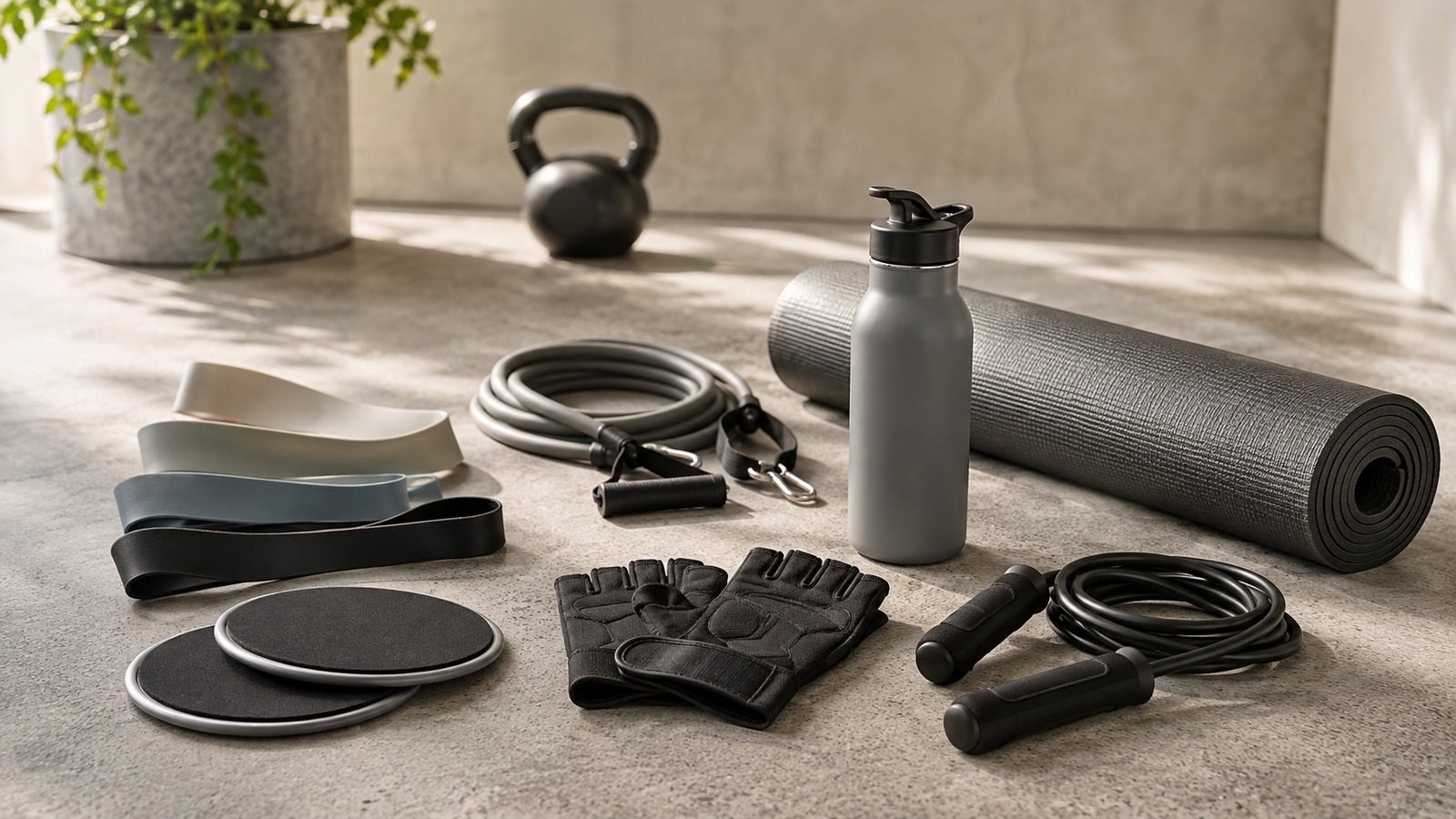
A Minimal Home-Workout Accessory Kit
For general fitness:
1. Exercise Mat
For:
- floor work;
- stretching.
2. Resistance Bands
For:
- additional resistance;
- warm-ups.
3. Sliders
For:
- bodyweight exercise variety.
4. Jump Rope
If you enjoy:
- compact cardio.
That small kit can support dozens of exercises.
Accessories for Dumbbell Training
Useful options:
- mat;
- gloves if desired;
- lifting straps for heavier pulling.
You usually do not need:
- belt;
- wrist wraps;
for light beginner dumbbell training.
Accessories for Barbell Training
Depending on experience:
- collars;
- lifting straps;
- belt;
- wrist wraps;
- knee sleeves;
- chalk.
But accessory use should increase with actual training needs.
Accessories for Cardio Machines
Useful accessories can include:
- equipment mat;
- heart-rate strap;
- towel;
- bottle holder accessories if needed.
For treadmills or bikes, a floor mat is particularly useful for:
- floor protection;
- sweat management.
Accessories for Jump-Rope Training
Useful:
- suitable rope;
- exercise mat designed for jumping;
- timer.
You do not need:
- weighted vest;
- ankle weights;
at the same time.
Accessories for Mobility Training
Useful:
- mat;
- yoga blocks;
- stretching strap;
- foam roller;
- massage ball.
Choose only the tools you actually use.
Accessories for Outdoor Exercise
Depending on activity:
- reflective gear;
- hydration belt;
- phone pouch;
- sun protection;
- weather-appropriate clothing.
Safety accessories can be more important than performance accessories.
Accessories for Hot-Weather Training
Useful items may include:
- breathable towel;
- insulated water bottle;
- sweatbands.
But no accessory replaces:
- sensible heat management;
- hydration;
- appropriate exercise intensity.
Accessories for Cold-Weather Training
Outdoor exercisers may use:
- gloves;
- hat;
- layered clothing;
- reflective accessories.
Avoid overdressing so heavily that you overheat once exercise begins.
Should You Buy Accessories as a Set?
Sometimes.
Sets can offer good value for products such as:
- resistance bands;
- yoga blocks;
- mobility tools.
But bundled accessories may include items you never use.
Compare:
- individual quality;
- actual need.
A cheap 15-piece kit is not necessarily better than three well-made accessories.
Quality Matters Most for Load-Bearing Accessories
Be particularly cautious with accessories that support:
- body weight;
- heavy loads.
Examples:
- pull-up bars;
- suspension trainers;
- lifting straps;
- belts;
- resistance-band anchors.
Failure of these items can cause injury.
Prioritize:
- stitching;
- hardware;
- rated capacity;
- reliable construction.
Weight Ratings
For load-bearing accessories, look for a clear manufacturer rating where applicable.
Do not assume:
looks strong = safely supports my weight
This is particularly important for:
- door anchors;
- pull-up bars;
- suspension systems.
Stitching Quality
Check sewn accessories for:
- loose threads;
- uneven stitching;
- weak seams.
This matters for:
- straps;
- belts;
- ankle cuffs;
- weighted vests.
Metal Hardware
Carabiners, rings and buckles should feel:
- solid;
- properly finished.
Sharp edges can damage:
- fabric;
- resistance bands.
Carabiners
If an accessory uses a carabiner, use the one designed for the system.
Do not replace load-bearing hardware with random decorative clips.
Fitness accessories can experience significant:
- dynamic force.
Velcro
Velcro closures are convenient but wear over time.
Check whether the closure remains secure.
Particularly relevant for:
- ankle straps;
- gloves;
- weighted vests.
Zippers
On weighted vests or belts, zippers should remain secure during:
- movement.
A failed zipper can allow weights or belongings to fall.
Accessory Comfort
A product should not require constant adjustment.
Watch for:
- rubbing;
- pinching;
- sliding;
- excessive pressure.
A technically strong accessory you hate wearing is unlikely to be used.
Breathability
For products worn directly on the body, such as:
- gloves;
- sleeves;
- vests;
breathability matters.
Sweat buildup can increase:
- discomfort;
- odour;
- skin irritation.
Washability
Accessories exposed to sweat should be easy to clean.
Check whether products such as:
- gloves;
- bands;
- sleeves;
- straps;
are:
- hand washable;
- machine washable.
Follow manufacturer instructions.
Cleaning Resistance Bands
Usually wipe with:
- damp cloth;
- mild soap if approved.
Avoid chemicals that may degrade:
- rubber;
- latex.
Do not leave bands in:
- direct sunlight;
- extreme heat.
Latex Allergies
Some resistance bands contain natural latex.
People with latex allergy should look for:
- latex-free bands.
Check product materials carefully.
Resistance-Band Storage
Keep bands away from:
- sharp objects;
- direct sunlight;
- high heat.
Fold or store loosely according to manufacturer guidance.
Inspect before use.
Cleaning Gloves and Sleeves
Sweat can cause:
- odour;
- skin irritation.
Wash regularly.
Dry fully before storing.
Do not leave wet accessories sealed inside:
- gym bag.
Belt Maintenance
Leather lifting belts may need:
- dry storage;
- occasional appropriate conditioning.
Synthetic belts may simply need:
- wiping;
- air drying.
Do not leave them permanently rolled tightly if the manufacturer advises otherwise.
Weighted Vest Maintenance
Check:
- weight pockets;
- stitching;
- fasteners.
Make sure removable weights are secure.
A loose weight falling during:
- jumping;
- running;
can be dangerous.
Smart Accessories and Batteries
Some accessories use:
- Bluetooth;
- batteries;
- rechargeable sensors.
Examples:
- heart-rate straps;
- smart ropes.
Check:
- battery life;
- replacement method;
- app support.
Do not pay more for tracking you will never review.
Do Smart Accessories Improve Results?
Not by themselves.
Data can help with:
- motivation;
- pacing.
But a heart-rate strap does not create fitness unless you:
- train.
Technology should support the routine rather than replace it.
Accessories and Exercise Form
Accessories should not be used to hide technique problems.
Examples:
Wrist Wraps
Should not compensate for consistently poor wrist position.
Lifting Belt
Should not compensate for poor bracing.
Knee Sleeves
Should not be used to ignore persistent knee pain.
Straps
Should not replace all grip training.
Use accessories strategically.
Can Accessories Prevent Injury?
Some may improve:
- comfort;
- stability;
- grip.
But no accessory can guarantee injury prevention.
Injury risk depends on:
- training progression;
- technique;
- fatigue;
- recovery;
- previous injury;
- individual physiology.
Avoid products promising:
injury-proof training
Accessories for Joint Pain
If an accessory reduces discomfort, that may be useful.
But recurring joint pain should not simply be:
- wrapped;
- compressed;
- ignored.
For example, if every squat requires:
- thick knee sleeves;
just to tolerate the movement, assess:
- technique;
- training load;
- underlying issue.
Accessories During Rehabilitation
Bands, balance pads and other tools are commonly used in rehabilitation.
But their effectiveness depends on:
- exercise selection;
- resistance;
- progression.
If recovering from injury or surgery, follow your:
- physiotherapist’s;
- clinician’s;
program rather than selecting accessories based on generic marketing.
Common Exercise-Accessory Marketing Claims
Be cautious with phrases such as:
- burn belly fat;
- sculpt instantly;
- activate 300% more muscle;
- prevent all injuries;
- correct posture automatically;
- detox muscles;
- melt fat;
- replace the gym.
An accessory can make an exercise:
- easier to perform;
- more comfortable;
- more challenging.
It cannot bypass basic physiology.
“Glute Activation” Accessories
Mini bands are often marketed as essential for:
- glute activation.
They can create useful tension.
But you do not need to perform 20 minutes of band exercises before every lower-body workout.
Your glutes already participate in movements such as:
- squats;
- lunges;
- hip hinges.
Use band drills when they have a specific purpose.
Posture-Correction Devices
Some wearable accessories claim to permanently correct posture by pulling the shoulders back.
They may provide:
- temporary awareness.
But lasting changes generally require:
- movement;
- strength;
- habit changes where appropriate.
A brace should not automatically replace assessment for persistent pain.
Sweat Belts
Waist belts marketed for:
- sweating;
- fat burning;
may make the covered area sweat more.
That does not mean they increase local:
- fat loss.
Any temporary reduction in body weight from sweating is primarily:
- fluid loss.
Waist Trainers During Exercise
Very restrictive waist trainers may interfere with:
- breathing;
- movement;
- comfort.
They are not necessary for fitness or fat loss.
Ankle Weights for Running
Adding weight to the lower limbs during running can alter:
- movement mechanics;
- joint loading.
This is generally not necessary.
Use controlled resistance exercises instead when the goal is stronger legs.
Wrist Weights for Punching
Adding wrist weights during fast punching can increase load on:
- shoulders;
- elbows.
Use caution.
For boxing-specific resistance, follow appropriate coaching rather than simply making punches heavier.
Weighted Vest for Push-Ups
A vest can be a very useful progression once standard push-ups become easy.
Advantages:
- load stays close to torso;
- hands remain free.
Start with moderate weight.
Weighted Vest for Pull-Ups
Also useful for advanced users.
Make sure the vest:
- fits securely;
- does not interfere with shoulder movement.
A dip belt is another option.
Resistance Bands vs Free Weights
Bands provide resistance that generally increases as they stretch.
Free weights provide resistance largely through gravity.
Both can build strength when exercises are:
- sufficiently challenging;
- progressively overloaded.
Bands are not merely:
- warm-up tools.
Accessories for Travel Workouts
A small travel kit might include:
- long resistance band;
- mini band;
- sliders.
This weighs very little and can provide substantial exercise variety.
A jump rope can add cardio if space allows.
Accessories for Office Workouts
Practical options:
- mini resistance band;
- light long band;
- mobility strap.
But office exercise accessories are useful only if you have enough space and privacy to use them consistently.
Accessories for Beginners Who Train at Home
Start with what solves the largest limitations.
For example:
Need Floor Comfort
Buy mat.
Need More Resistance
Buy bands.
Need Cardio
Buy jump rope if appropriate.
Need More Exercise Variety
Buy sliders.
You do not need to buy everything at once.
Accessories for Advanced Lifters
More specialized accessories become useful as training becomes more demanding.
Examples:
- straps;
- belts;
- wrist wraps;
- knee sleeves;
- fractional plates.
These tools should support:
- specific training demands;
rather than become mandatory for every set.
Should You Use a Belt on Every Set?
Usually no.
Many lifters reserve belts for:
- heavier working sets.
Lighter sets can provide opportunities to practice:
- natural bracing.
There is no universal rule.
Should You Use Straps on Every Pulling Exercise?
Not necessarily.
Use them when grip limits the target exercise.
For example:
- heavy Romanian deadlifts.
For lighter rows or warm-ups, you may not need them.
Should You Wear Knee Sleeves All Workout?
If comfortable, you can.
But there is no requirement.
They provide:
- warmth;
- compression;
rather than magical protection.
Should You Use Gloves and Straps Together?
You can, but it may feel bulky.
Most people using straps for heavy pulling often do not need gloves simultaneously.
Choose whichever solves your grip/comfort issue.
Accessory Duplication
Avoid buying several items serving the same function.
For example:
- gloves;
- hooks;
- straps;
all partly address grip.
You probably do not need all three.
Similarly:
- foam roller;
- massage ball;
- massage stick;
- massage gun;
may overlap considerably.
Build an Accessory Kit Gradually
A good rule:
buy one accessory only when you can clearly state why you need it
Example:
“My grip limits my Romanian deadlifts, so I need straps.”
This is more useful than:
“Serious lifters use straps, so I should own them.”
Budget Allocation
Spend more on accessories where failure matters.
Prioritize quality for:
- load-bearing suspension systems;
- pull-up bars;
- heavy lifting straps;
- belts;
- weighted vests.
You can often save money on simpler products such as:
- sliders;
- towels.
Expensive Accessories Are Not Always Better
Premium products may provide:
- better stitching;
- better materials;
- longer durability.
But a simple resistance band or exercise mat does not need luxury branding to work.
Evaluate:
- material;
- construction;
- warranty.
When Premium Accessories May Be Worth It
Possible examples:
Lifting Belt
Better:
- leather;
- hardware;
- fit.
Resistance Bands
Better:
- consistent tension;
- durability.
Heart-Rate Strap
Better:
- signal accuracy;
- connectivity.
Suspension Trainer
Better:
- rated hardware;
- anchoring;
- straps.
Spend where the quality difference affects:
- performance;
- safety;
- longevity.
When Budget Accessories Are Fine
Examples:
- sliders;
- exercise towel;
- simple stretching strap;
- basic mini bands from a reputable manufacturer.
These products do not need complex engineering.
Check Warranty
Warranty can be useful for products with:
- stitching;
- mechanical components;
- electronics.
Examples:
- weighted vest;
- heart-rate sensor;
- suspension system.
Return Policy
Fit-sensitive accessories include:
- gloves;
- sleeves;
- belts;
- vests.
Check whether you can exchange them if sizing is wrong.
Sizing Charts
Use manufacturer-specific sizing.
Do not assume:
- medium;
means the same across brands.
For sleeves and belts, measure according to the exact instructions.
Measuring for Knee Sleeves
Manufacturers may ask for circumference around:
- knee;
- calf;
at specific locations.
Follow their method.
Do not intentionally buy excessively small sleeves solely for more compression unless the product is designed for that use.
Measuring for Lifting Belts
Measure around the area where the belt will actually sit.
Do not rely only on:
- trouser waist size.
The belt may sit:
- higher;
- differently.
Measuring for Gloves
Measure:
- palm circumference;
- hand length;
according to the brand’s chart.
A glove that is too tight may restrict movement.
Too loose may bunch.
Exercise Accessory Hygiene
Any accessory in regular contact with:
- skin;
- sweat;
- floor;
should be cleaned.
Examples:
- gloves;
- mats;
- sleeves;
- straps.
Shared gym accessories deserve particular attention.
Cleaning an Exercise Mat
A simple method:
- Wipe after use.
- Use manufacturer-approved mild cleaner.
- Allow to air dry.
- Roll/store when completely dry.
Do not use harsh chemicals that damage the material.
Do Not Share Personal Accessories Unnecessarily
Items such as:
- gloves;
- sweatbands;
- towels;
can collect:
- sweat;
- skin oils.
Personal use is generally more hygienic.
Storage
Keep accessories:
- dry;
- organized;
- away from direct sunlight where appropriate.
A simple basket or rack can prevent:
- bands;
- straps;
- handles;
from becoming tangled or damaged.
Home-Gym Organization
Accessories are more likely to be used if they are:
- visible;
- easy to access.
Wall hooks can store:
- bands;
- straps;
- jump ropes.
A small rack can organize:
- yoga blocks;
- rollers.
Avoid Clutter
Too many accessories create:
- setup time;
- decision fatigue.
A well-designed home gym does not need to resemble a commercial equipment catalogue.
Keep only what supports your training.
A Beginner Accessory Setup
For someone starting general home fitness:
Essential
- exercise mat.
Very Useful
- resistance bands.
Optional
- sliders;
- jump rope.
This is enough for a wide range of workouts.
A Strength-Training Accessory Setup
For a regular lifter:
Useful
- barbell collars;
- chalk.
Depending on Need
- lifting straps;
- belt;
- wrist wraps;
- knee sleeves.
Do not treat every item as mandatory.
A Cardio Accessory Setup
For treadmill, bike or elliptical users:
- equipment mat;
- towel;
- water bottle;
- heart-rate strap if desired.
That is usually enough.
A Mobility Accessory Setup
A useful minimalist collection:
- exercise/yoga mat;
- stretching strap;
- yoga blocks;
- foam roller.
You do not need a large recovery-tool collection.
A Travel Fitness Accessory Setup
Pack:
- long resistance band;
- mini band;
- sliders;
- jump rope if appropriate.
This can fit into a small bag.
Common Exercise-Accessory Buying Mistakes
Buying Accessories Before Building a Routine
Train first.
Assuming More Equipment Means Better Workouts
It does not.
Buying Cheap Load-Bearing Equipment Without Checking Quality
Safety matters.
Choosing Resistance Bands Only by Colour
Colour is not standardized.
Buying Gloves That Are Too Thick
Can reduce bar control.
Using Straps for Every Exercise
Grip still needs training.
Buying a Belt Before Learning to Brace
Technique comes first.
Using Sleeves to Hide Joint Pain
Address the underlying issue.
Buying Heavy Ankle Weights for Walking
They can alter movement mechanics.
Buying a Heavy Vest Too Early
Progress gradually.
Buying Balance Equipment for Strength Exercises
Instability is not automatically better.
Purchasing Smart Accessories Because They Track Calories
The numbers are often estimates.
Common Exercise-Accessory Use Mistakes
Failing to Inspect Resistance Bands
Damaged bands can snap.
Using Unsafe Anchors
Load-bearing attachments must be secure.
Wearing Support Gear Too Tight
Compression should not cause:
- numbness;
- tingling.
Ignoring Weight Ratings
Especially on:
- pull-up bars;
- suspension systems.
Using Equipment on an Unstable Surface
Mats and steppers should sit securely.
Never Cleaning Sweat-Soaked Accessories
Hygiene and durability suffer.
Leaving Bands in Direct Sunlight
Can accelerate material degradation.
Assuming an Accessory Prevents Injury
No product guarantees this.
How to Choose an Exercise Accessory Step by Step
Step 1 — Identify the Problem
What is missing from your current training?
Step 2 — Choose the Simplest Tool That Solves It
Do not overcomplicate.
Step 3 — Check Compatibility
Does it work with:
- your equipment;
- floor;
- body size?
Step 4 — Check Safety
Particularly for:
- anchors;
- load-bearing accessories.
Step 5 — Check Adjustability
Can it progress with you?
Step 6 — Assess Storage
Will it become clutter?
Step 7 — Buy Only What You Will Actually Use
Training consistency is more valuable than accessory quantity.
Exercise Accessory Buying Checklist
Before purchasing, ask:
1. What specific problem does this accessory solve?
If you cannot answer, you may not need it.
2. Does it match my main type of training?
Strength, cardio, mobility or recovery?
3. Could something I already own perform the same function?
Avoid duplication.
4. Does it fit my body correctly?
Important for gloves, belts, sleeves and vests.
5. Is the resistance appropriate?
Particularly for bands and weighted accessories.
6. Is it rated for the loads I will place on it?
Critical for suspension and pull-up equipment.
7. Is the construction durable?
Check stitching, hardware and material.
8. Is it comfortable enough to use consistently?
A painful accessory will stay unused.
9. Can it be cleaned easily?
Important for sweat-exposed products.
10. Does it fit my workout space?
Even small accessories create clutter.
11. Is it easy to store?
Convenience matters.
12. Am I buying it to solve a real need or because it looks professional?
Be clear.
13. Does it have unrealistic marketing claims?
Avoid products promising targeted fat loss or guaranteed injury prevention.
14. Is a simpler version enough?
Often yes.
15. Will I still use it six months from now?
This is one of the best questions to ask.
When Should You Seek Professional Guidance?
Exercise accessories are not medical treatment.
Individualized guidance may be appropriate if you have:
- persistent joint pain;
- repeated injuries;
- recent surgery;
- significant balance limitations;
- rehabilitation needs.
A:
- physiotherapist;
- sports medicine professional;
- qualified trainer;
can help determine whether accessories such as:
- braces;
- bands;
- supports;
are appropriate for your situation.
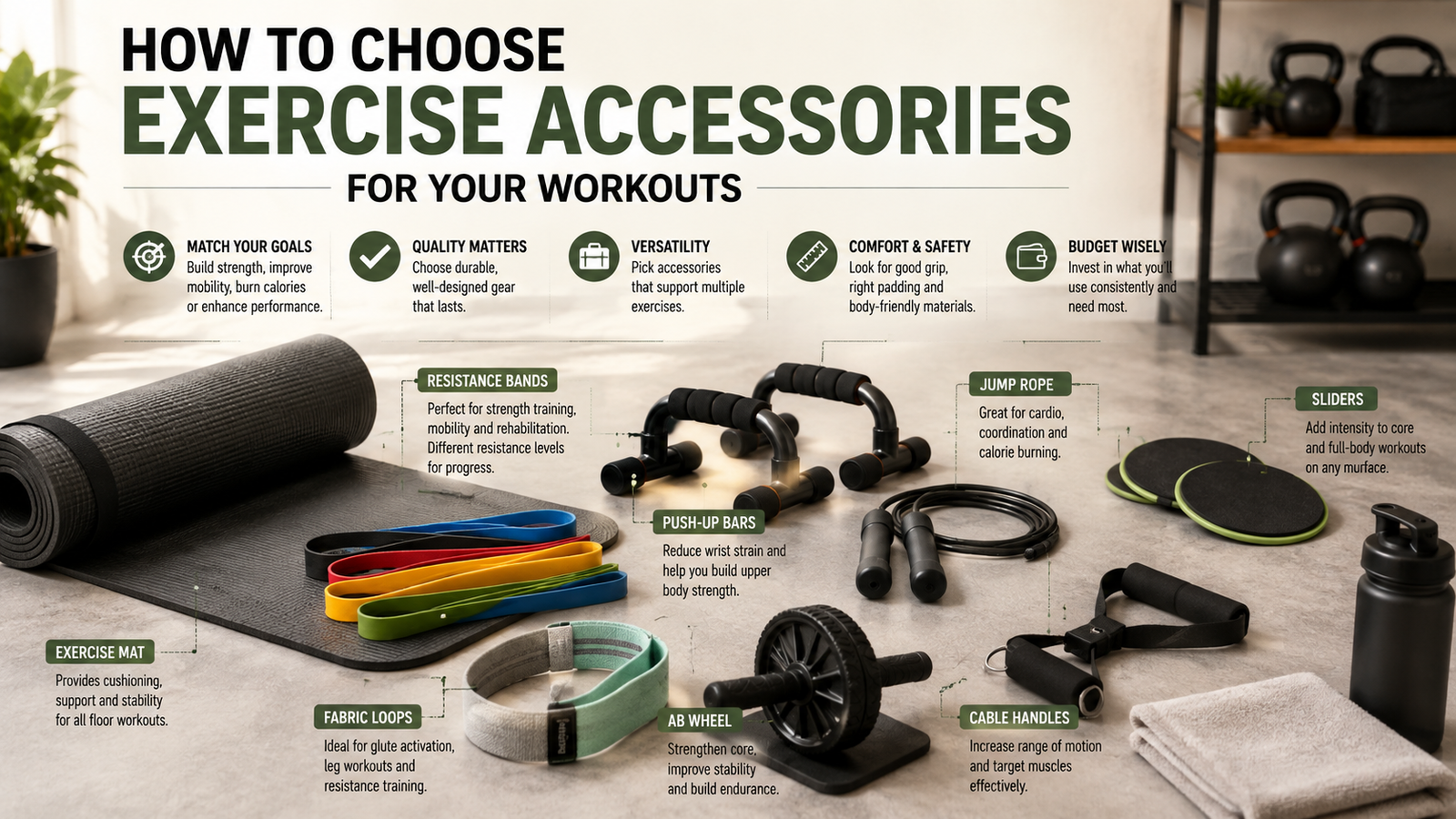
The Physical Glow Takeaway
Exercise accessories should make training simpler, more comfortable or more effective for a specific reason.
They should not make your workout unnecessarily complicated.
For most people, a small collection is enough:
- exercise mat → comfort and floor work;
- resistance bands → portable resistance and exercise variety;
- sliders → inexpensive bodyweight progression;
- jump rope → compact cardio where appropriate.
As training becomes more specialized, additional accessories may make sense:
- lifting straps → when grip limits heavy pulling;
- wrist wraps → support during heavy pressing;
- lifting belt → additional bracing support for appropriately trained heavy lifting;
- knee sleeves → warmth and compression;
- weighted vest → progressive bodyweight resistance;
- heart-rate strap → more accurate cardio monitoring;
- foam roller or massage ball → optional self-massage and mobility support.
But none of these accessories should be purchased simply because experienced athletes use them.
First establish:
what you train → what limits you → what accessory solves that limitation
Then buy accordingly.
A simple, well-selected accessory that you use several times each week is far more valuable than a cupboard filled with fitness gadgets.
Your workouts should be driven by:
consistent training → appropriate progression → good exercise selection
with accessories supporting that process—not replacing it.