How to Choose a Shaker Bottle for Protein and Gym Use
Compare shaker bottles by capacity, material, lid design, mixing system, cleaning and portability for protein shakes and gym drinks.
A shaker bottle looks like a simple gym accessory, but the wrong one can become frustrating very quickly.
Common problems include:
- leaking lids
- protein powder sticking to the bottom
- difficult cleaning
- lingering odours
- uncomfortable drinking spouts
- bottles that are too large or too small for your routine
The right shaker should be easy to mix, easy to clean and convenient to carry.
It should also match what you actually plan to use it for, whether that is:
- protein shakes
- pre-workout drinks
- electrolyte mixes
- meal-replacement powders
- everyday hydration
This guide explains how to choose a shaker bottle based on capacity, material, mixing system, lid design, portability and cleaning.
What Is a Shaker Bottle?
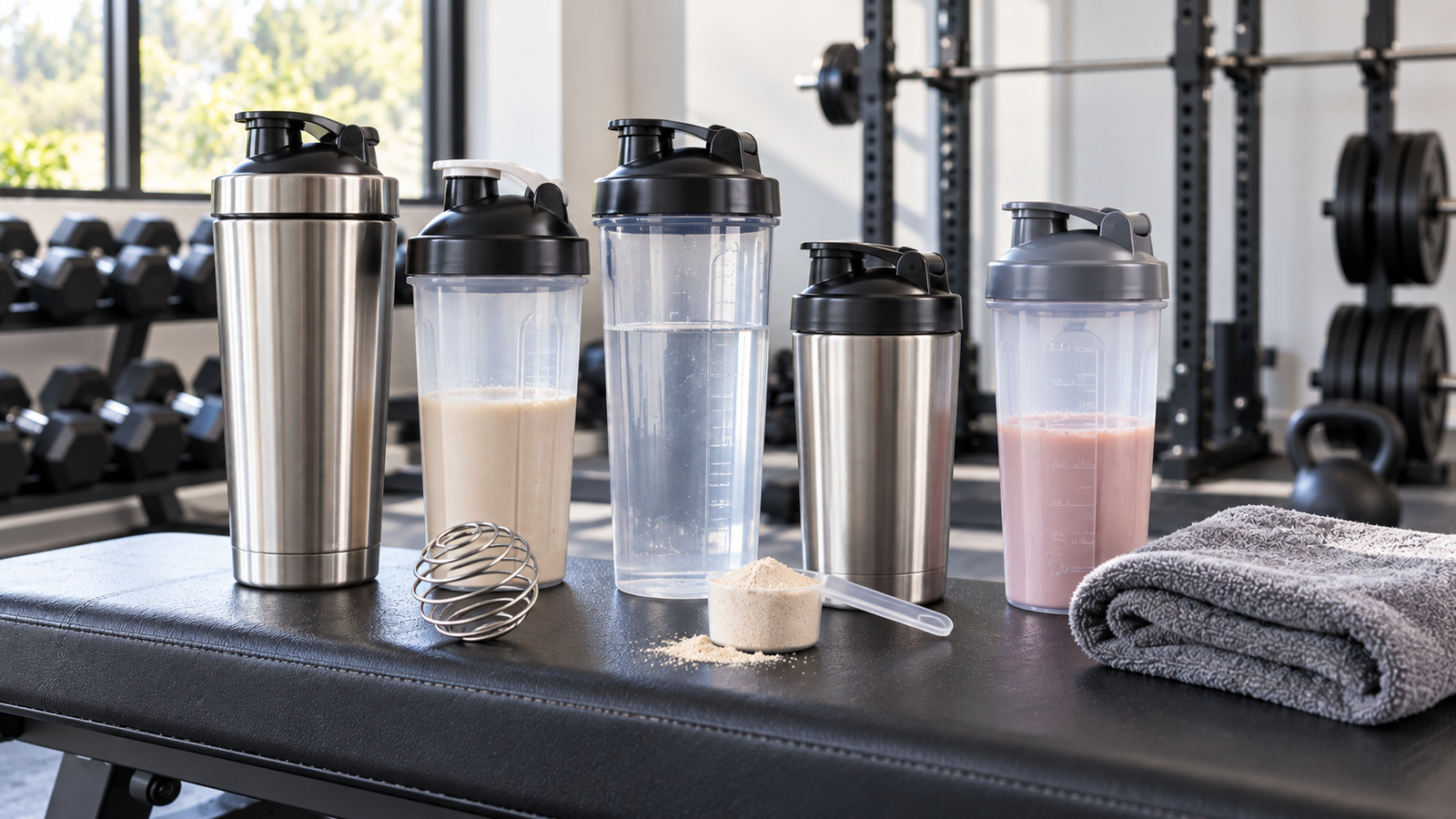
A shaker bottle is a reusable bottle designed to mix powdered supplements with liquids.
Most include some type of mixing mechanism such as:
- metal whisk ball
- plastic mixing grid
- internal agitator
- built-in blender-style insert
When the bottle is shaken, the mixing mechanism helps break up powder and reduce clumps.
A shaker can also be used as a normal water bottle when the mixing insert is removed or not required.
What Size Shaker Bottle Do You Need?
Capacity is one of the first things to consider.
Common shaker sizes generally fall into three broad ranges.
Small Shakers
Approximately:
- 400–500 ml
Useful for:
- single protein servings
- pre-workout drinks
- compact gym bags
- short workouts
Advantages:
- lighter
- easier to carry
- takes less space
Limitations:
- less room for larger shakes
- less space for vigorous mixing
Medium Shakers
Approximately:
- 600–750 ml
This is often the most versatile size.
Useful for:
- protein shakes
- general gym hydration
- pre-workout
- electrolyte drinks
This size usually provides enough empty space for effective shaking without becoming unnecessarily bulky.
Large Shakers
Approximately:
- 800 ml and above
Useful for:
- larger fluid intake
- meal-replacement shakes
- longer workouts
- people who want one bottle for both shakes and water
Advantages:
- more capacity
- fewer refills
Limitations:
- heavier when full
- takes more bag space
- may not fit every cup holder or bottle pocket
Why Empty Space Matters When Mixing
A shaker bottle should not be filled completely to the top before shaking.
Some empty space allows the liquid and powder to move more freely.
If a bottle is completely full:
- mixing may be less effective
- pressure may increase
- the drink can spill when opened
Choose a bottle slightly larger than the amount you normally drink.
Shaker Bottle Capacity by Use
| Use | Practical Starting Capacity |
|---|---|
| Pre-workout drink | 400–600 ml |
| Standard protein shake | 500–700 ml |
| Protein + extra water | 600–750 ml |
| Meal-replacement shake | 700–900 ml |
| Long gym session | 750 ml+ |
| Minimal gym bag | 400–600 ml |
These are general ranges rather than strict requirements.
Plastic vs Stainless Steel Shaker Bottles
Material affects:
- weight
- durability
- odour retention
- insulation
- price
Plastic Shaker Bottles
Plastic is the most common option.
Advantages:
- lightweight
- affordable
- easy to carry
- usually transparent or translucent
- easy to see liquid level
Disadvantages:
- may retain odours over time
- can stain depending on contents
- may scratch
Look for bottles made from food-contact materials appropriate for repeated drink use.
Stainless Steel Shaker Bottles
Stainless steel shakers are heavier but can offer advantages such as:
- better durability
- less visible staining
- less light exposure to contents
- insulation in some models
They may also feel more substantial.
Disadvantages:
- heavier
- usually more expensive
- harder to see the liquid level
- some models may not be suitable for every type of mixing insert
Choose stainless steel mainly if durability or insulation matters to you.
Does BPA-Free Matter?
Many modern plastic bottles are marketed as BPA-free.
This indicates the product is made without bisphenol A.
However, BPA-free does not automatically tell you everything about material quality.
Also consider:
- manufacturer reputation
- product instructions
- temperature limits
- cleaning guidance
- whether the bottle is intended for food and beverage use
Do not expose a plastic shaker to heat beyond the manufacturer’s recommendations.
Metal Whisk Ball vs Mixing Grid
The mixing mechanism is one of the biggest differences between shaker bottles.
Metal Whisk Ball
A metal whisk ball moves freely inside the bottle while shaking.
Advantages:
- simple
- removable
- effective for many protein powders
- easy to inspect and clean
It is one of the most common mixing systems.
Plastic Mixing Grid
A mixing grid usually sits near the top of the bottle or beneath the lid.
The liquid passes through it while shaking.
Advantages:
- no loose ball inside
- quieter
- stays in position
Both systems can work well.
The quality of mixing depends not only on the insert but also on:
- liquid amount
- powder type
- shaking technique
Built-In Agitators
Some shaker bottles use a fixed or removable agitator with blades, fins or other shapes.
These may improve turbulence inside the bottle.
They can work well, but more complicated designs may also be harder to clean.
A simple mixing system is often sufficient for everyday protein shakes.
Electric Shaker Bottles
Electric shaker bottles use a small motor to mix the drink.
They may be useful for people who want:
- less manual shaking
- smoother mixing
- convenience
However, they also introduce:
- charging
- battery maintenance
- more parts
- higher cost
- more complicated cleaning
For most gym users, a standard manual shaker is sufficient.
Leak-Proof Design Is Essential
A shaker bottle may spend time:
- inside a gym bag
- beside electronics
- in a car
- in a backpack
A leaking bottle can create a major mess.
Check the lid design carefully.
Useful features include:
- secure screw-on lid
- positive locking drinking cap
- tight seal
- strong hinge
- good gasket design where applicable
A bottle should feel secure when closed.
Screw Lid vs Snap Lid
Most shaker bottles combine a screw-on main lid with a smaller drinking cap.
Screw-On Main Lid
Advantages:
- secure attachment
- easy to tighten
- simple construction
Make sure the threads engage smoothly.
Cross-threading can cause leaks.
Snap Drinking Cap
A snap cap is convenient but should lock firmly.
A weak cap can open inside a bag.
Look for one that gives a clear:
- click
- lock
- secure resistance
when closed.
Carry Loop
A carry loop can make a shaker easier to:
- hold
- attach to a bag
- remove from a locker
- carry with other equipment
Some loops are fixed.
Others fold into the lid.
This is a small feature but can improve day-to-day convenience.
Drinking Spout Design
A good drinking spout should be:
- comfortable
- easy to open
- easy to clean
- large enough for smooth flow
Very narrow openings can be difficult to clean.
Very wide openings may allow liquid to pour too quickly.
Choose a design that suits how you prefer to drink during training.
Wide-Mouth Bottles
A wide bottle opening makes it easier to:
- add powder
- add ice
- fill with water
- clean the inside
This is especially useful if you scoop protein powder directly into the bottle.
A narrow opening increases the chance of spilling powder.
Measurement Markings
Measurement markings can be useful for:
- protein shakes
- electrolyte mixes
- supplement preparation
Look for:
- clear millilitre markings
- easy-to-read scale
- markings that do not wear off easily
You do not need laboratory-level precision.
The markings are mainly useful for consistent preparation.
Transparent vs Opaque Bottles
Transparent or Translucent
Advantages:
- easy to see liquid level
- easy to monitor mixing
- easy to identify residue
Opaque
Advantages:
- contents less visible
- may hide staining
- common in stainless-steel designs
This is mostly a preference issue.
Shaker Bottles With Storage Compartments
Some shakers include removable containers for:
- protein powder
- supplements
- snacks
These can be useful if you prepare drinks away from home.
For example, you can carry:
- dry protein powder separately
- water inside the bottle
- mix only when needed
However, storage compartments add:
- bulk
- extra parts
- more cleaning
Only choose them if you genuinely use the feature.
Are Supplement Compartments Worth It?
They may be worthwhile if you:
- commute to the gym
- train after work
- travel
- prepare shakes several hours later
They are less useful if you always mix your shake at home.
A simpler bottle is often easier to maintain.
Shaker Bottle for Protein Powder
For a basic protein shake, look for:
- 500–750 ml capacity
- secure lid
- wide mouth
- simple mixing system
- easy cleaning
- clear markings
You do not need a complicated design.
Reliable sealing and easy cleaning are usually more important.
Shaker Bottle for Pre-Workout
Pre-workout drinks often require less volume.
A smaller bottle can be convenient.
Look for:
- approximately 400–600 ml capacity
- strong seal
- measurement markings
- easy drinking spout
If you also want to use the same bottle for water during training, choose a larger capacity.
Shaker Bottle for Meal-Replacement Powders
Thicker shakes need more space.
A larger bottle may make mixing easier.
Consider:
- 700 ml or more
- wide mouth
- strong mixing system
- easy cleaning
Thick mixtures may leave more residue, so cleaning becomes especially important.
Shaker Bottle for Creatine
Creatine can be mixed in various drinks according to product directions.
A specialised shaker is not usually required.
Any clean bottle with:
- secure lid
- sufficient capacity
- easy mixing
can work.
Always follow the supplement’s instructions.
Shaker Bottle for Electrolyte Drinks
For electrolyte powders, you may not even need a mixing ball.
These powders often dissolve relatively easily.
Useful features include:
- larger water capacity
- measurement markings
- leak-resistant lid
The bottle may function more like a standard sports bottle.
How to Prevent Protein Powder From Clumping
Clumping can occur because of:
- adding ingredients in the wrong order
- insufficient liquid
- overfilling the bottle
- difficult-to-mix powder
- inadequate shaking
A practical approach is:
- Add liquid first.
- Add protein powder.
- Insert the mixing mechanism.
- Close the lid securely.
- Shake thoroughly.
Adding powder before liquid can cause some powders to stick to the bottom.
How Long Should You Shake a Protein Shake?
There is no universal time.
Shake until the mixture is evenly combined.
For many powders, vigorous shaking for a short period is enough.
Check the drink.
If clumps remain:
- shake again
- ensure enough liquid is present
- check whether powder is stuck to the bottom
Can You Put Ice in a Shaker Bottle?
Usually yes if:
- the bottle opening is large enough
- the manufacturer does not advise against it
Ice can help keep drinks cold and may also contribute to mixing.
However, very large ice cubes can interfere with some internal mixing mechanisms.
Can You Put Hot Liquids in a Shaker Bottle?
Do not assume a shaker bottle is suitable for hot liquids.
Sealing hot liquid inside a bottle and shaking it can create pressure.
This can make the lid:
- difficult to open
- leak
- release hot liquid suddenly
Follow the manufacturer’s temperature guidance.
Unless specifically designed for hot beverages, shaker bottles are generally better suited to cool or room-temperature drinks.
Do Not Shake Carbonated Drinks
Sealed carbonated liquids can build pressure when shaken.
This can cause the lid to release suddenly or the drink to spray when opened.
Avoid shaking carbonated beverages in a sealed shaker bottle.
Why Shaker Bottles Develop Bad Smells
Protein residue can produce strong odours if it remains inside the bottle.
This commonly happens when:
- a shake is left inside for hours
- the bottle stays closed after use
- the lid is not cleaned properly
- residue remains around seals or threads
The best solution is prompt cleaning.
How to Clean a Shaker Bottle
After use:
- Rinse the bottle as soon as possible.
- Separate removable parts.
- Wash the lid thoroughly.
- Clean the drinking spout.
- Clean the mixing ball or insert.
- Wash the main bottle.
- Allow all parts to dry completely before reassembly.
Follow the manufacturer’s dishwasher guidance if relevant.
Do Not Forget the Lid
The lid is often the area most likely to retain residue.
Protein shake can collect around:
- threads
- drinking cap
- hinges
- seals
- small corners
Cleaning only the main bottle is not enough.
Dishwasher-Safe Shakers
Dishwasher-safe construction can improve convenience.
However, check:
- which parts are dishwasher safe
- whether top-rack placement is required
- whether printed markings may fade
- whether insulated bottles require hand washing
Follow manufacturer guidance rather than assuming every part can go into the dishwasher.
How to Remove Persistent Odour
First clean the bottle thoroughly according to the manufacturer’s instructions.
Useful approaches may include:
- soaking with warm soapy water
- allowing it to air out completely
- using cleaning methods recommended by the manufacturer
If strong odour remains despite thorough cleaning, replacement may be the simplest option.
Avoid using harsh chemicals unless the bottle manufacturer specifically allows them.
Why Drying Matters
Closing a wet shaker immediately after cleaning can trap moisture.
This can contribute to:
- musty smell
- bacterial growth
- persistent dampness
Store the bottle with:
- lid open
- parts separated
until everything is completely dry.
Shaker Bottle Hygiene
A shaker comes into contact with:
- protein
- carbohydrates
- milk
- plant-based drinks
- saliva
It should therefore be treated like other reusable food-contact containers.
Do not:
- leave unfinished shakes inside for long periods
- repeatedly refill without washing
- share bottles without proper cleaning
- ignore residue around seals
Good hygiene matters more than premium features.
When Should You Replace a Shaker Bottle?
Consider replacement if:
- the lid no longer seals
- the bottle cracks
- the drinking cap becomes loose
- persistent odours remain
- deep scratches become difficult to clean
- the mixing system breaks
- the gasket becomes damaged
A shaker is not worth keeping if you no longer trust it inside your gym bag.
Shaker Bottle vs Regular Water Bottle
A regular water bottle is enough if you only carry water.
A shaker becomes useful when you regularly mix:
- protein
- supplements
- powdered drinks
The main differences are:
- larger opening
- mixing mechanism
- measurement markings
- specialised lid design
You may not need both if your shaker also works comfortably as a water bottle.
Can You Use a Shaker Bottle as a Water Bottle?
Yes.
Most shakers can be used for plain water.
However, consider:
- bottle size
- drinking comfort
- insulation
- weight
A dedicated water bottle may be better if hydration is the main purpose.
Shaker Bottle vs Blender
A shaker is designed for powders that can disperse through manual shaking.
A blender is more suitable when you want to mix:
- fruit
- oats
- nut butter
- ice
- thick ingredients
A shaker cannot replace a blender for solid-food smoothies.
Common Shaker Bottle Buying Mistakes
Choosing Too Small a Bottle
A bottle needs enough empty space for proper mixing.
Choosing Only by Appearance
Lid quality and cleaning matter much more.
Ignoring the Drinking Cap
The smaller cap is a common leak point.
Buying Too Many Compartments
More attachments can mean more cleaning.
Ignoring Bottle Width
Make sure it fits:
- your gym bag
- bottle pocket
- car cup holder if relevant
Choosing a Complicated Mixer
Simple systems are often easier to clean and work perfectly well.
Ignoring Cleaning Access
Narrow corners and complicated lids can retain residue.
What Features Matter Most?
A good shaker does not need dozens of features.
Prioritise:
- secure leak-resistant lid
- suitable capacity
- easy cleaning
- wide opening
- effective mixing system
- comfortable drinking spout
- durable material
Storage compartments, handles and insulation are secondary features.
Choosing a Shaker for a Gym Bag
If the shaker goes inside your gym bag, prioritise:
- reliable locking cap
- tight screw lid
- compact shape
- reasonable weight
Avoid overfilling.
If possible, keep the bottle upright.
Even a well-designed shaker should not be treated as completely impossible to leak.
Choosing a Shaker for Travel
For travel, consider:
- compact dimensions
- powder storage
- secure cap
- durable material
- easy cleaning
Remember that airport security rules may affect liquids when flying.
You can carry an empty bottle and prepare the drink later where appropriate.
How Much Should You Spend on a Shaker Bottle?
You usually do not need an expensive shaker.
Spend more only if you value features such as:
- stainless steel
- insulation
- premium locking mechanisms
- electric mixing
- modular storage
For basic protein use, a simple, well-built plastic shaker is often enough.
Basic Buying Checklist
Before buying, check:
Capacity
Does it hold your normal drink with room to shake?
Lid
Does it close securely?
Drinking Cap
Does it lock firmly?
Mixing System
Whisk ball, grid or agitator?
Opening
Is it wide enough for powder and cleaning?
Material
Plastic or stainless steel?
Markings
Do you need visible volume measurements?
Cleaning
Are all parts easy to reach?
Portability
Will it fit your gym bag and bottle pocket?
Storage
Do you actually need powder compartments?
Shaker Bottle by User Type
| User | Useful Starting Choice |
|---|---|
| Beginner gym user | 600–700 ml plastic shaker |
| Protein shake only | 500–700 ml |
| Pre-workout only | 400–600 ml |
| Long workouts | 700–900 ml |
| Gym commuter | Leak-resistant model with carry loop |
| Meal replacement user | Larger wide-mouth shaker |
| Frequent traveller | Compact model with storage compartment |
| Wants cold drinks | Insulated stainless-steel model |
Frequently Asked Questions
What size shaker bottle is best for protein?
For many users, around 500–750 ml provides enough capacity for a standard shake with room for effective mixing.
Is a metal shaker better than plastic?
Not necessarily. Stainless steel can be more durable and may offer insulation, while plastic is lighter and easier to monitor while mixing.
Do I need a mixing ball?
No. A mixing grid or other agitator can also work well. The important factor is whether the bottle mixes your powder effectively.
Why is my protein shake still clumpy?
Try adding liquid before powder, leaving enough empty space and shaking more thoroughly.
Can I leave a protein shake in the shaker all day?
It is better to follow safe storage guidance for the ingredients used. Dairy and other perishable liquids may require refrigeration. Clean the bottle promptly after use.
Can I put boiling water in a shaker?
Do not unless the manufacturer specifically states that the bottle is suitable for hot liquids. Pressure and heat can create a safety risk.
Can I put a shaker bottle in the dishwasher?
Only if the manufacturer identifies the relevant parts as dishwasher safe.
Why does my shaker smell even after washing?
Residue may remain in the lid, seals or other small areas. Disassemble and clean all accessible components thoroughly and dry them fully.
Final Takeaway
The best shaker bottle is not necessarily the one with the most compartments or the most advanced mixing mechanism.
For most gym users, prioritise:
- 500–750 ml capacity
- secure leak-resistant lid
- wide opening
- simple mixing system
- easy cleaning
- comfortable drinking spout
- durable construction
Choose a smaller shaker if you mainly prepare pre-workout drinks.
Choose a larger bottle if you use it for protein, hydration or meal-replacement shakes.
Choose stainless steel if durability or insulation matters more than low weight.
Most importantly, choose a bottle you can clean thoroughly after every use. A simple shaker that seals reliably and stays easy to maintain is usually more useful than a complicated bottle with features you rarely use.
If you are comparing specific options, continue to our Top 5 Shaker Bottles in India guide, where we compare shaker bottles for protein mixing, gym use, portability and everyday convenience.