Lifting Straps vs Gym Gloves: Grip, Comfort and When to Use Each
Compare lifting straps and gym gloves by purpose, grip coverage, bar contact, strap length and practical training considerations.
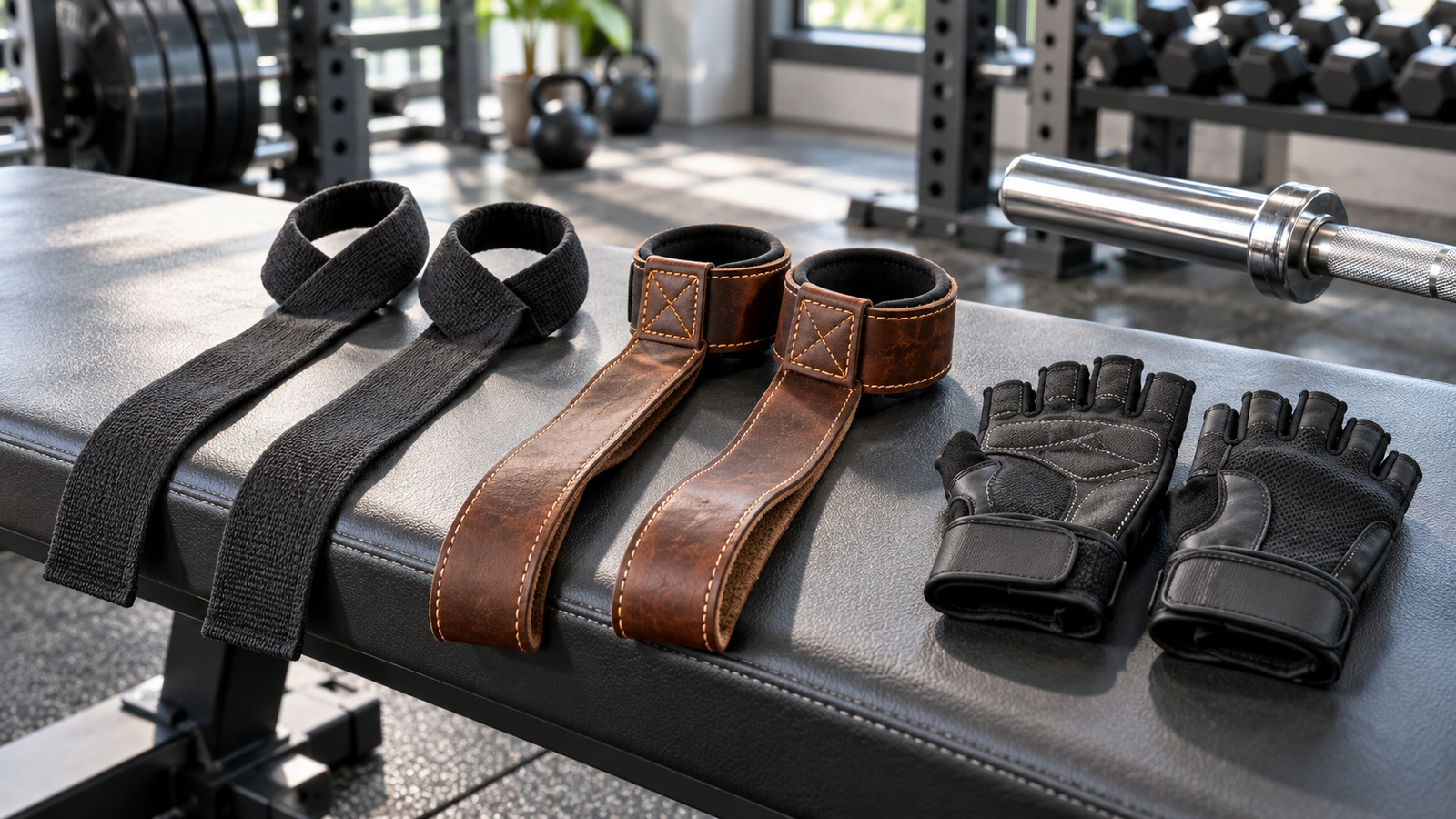
Lifting straps and gym gloves are both designed to make strength training more comfortable, but they solve different problems.
Lifting straps help secure your hands to the bar when grip strength starts limiting pulling exercises. Gym gloves mainly improve hand comfort, reduce friction and provide a more padded surface between your palms and the equipment.
One is primarily a grip-assistance tool. The other is primarily a hand-protection and comfort accessory.
The better option depends on the exercises you perform, how much weight you lift and whether your main issue is grip fatigue or palm discomfort.
What are lifting straps?
Lifting straps are lengths of strong fabric or leather that wrap around your wrist and then around a barbell, dumbbell or machine handle.
They are commonly used for:
- Deadlifts.
- Romanian deadlifts.
- Barbell rows.
- Dumbbell rows.
- Shrugs.
- Rack pulls.
- Heavy machine rows.
- Some pulldown exercises.
Their purpose is to reduce how much your fingers need to work to keep the weight from slipping.
What are gym gloves?
Gym gloves are fingerless or partially fingered gloves designed for resistance training.
They typically include:
- Palm padding.
- Grip-textured surfaces.
- Wrist closures.
- Breathable fabric.
- Reinforced stitching.
They are commonly used for:
- Dumbbell training.
- Resistance machines.
- Pull-ups.
- Cable exercises.
- General gym workouts.
Their main benefits are usually comfort, friction reduction and hand protection.
Lifting straps vs gym gloves at a glance
| Factor | Lifting straps | Gym gloves |
|---|---|---|
| Main purpose | Assist grip during pulling exercises | Improve comfort and palm protection |
| Best for | Heavy rows, deadlifts and shrugs | General gym training |
| Grip assistance | High | Low to moderate |
| Palm protection | Moderate | High |
| Callus reduction | Some | More |
| Wrist support | Depends on design | Sometimes included |
| Setup time | Requires wrapping | Simply wear them |
| Best for very heavy pulls | Usually yes | Usually limited |
| Best for all-round use | Less versatile | More versatile |
How do lifting straps work?
The strap creates an additional connection between your wrist and the bar.
Instead of relying entirely on your fingers to hold the weight, part of the load is transferred through the strap.
This becomes useful when your back or leg muscles are capable of continuing the exercise but your hands are beginning to fail.
For example, during a heavy Romanian deadlift, your hamstrings and back may still be strong enough for more repetitions even though the bar is starting to slip from your fingers.
Straps can allow you to continue training the intended muscles.
Do straps make the exercise easier?
They make the grip requirement easier.
They do not remove the muscular work required from:
- Back.
- Hips.
- Hamstrings.
- Traps.
- Other muscles involved in the exercise.
In some movements, reducing grip fatigue can actually help you focus more effectively on the muscles you intended to train.
That does not mean straps should be used for every repetition of every pulling exercise.
What are the main types of lifting straps?
Several designs are common.
Loop straps
These are the most familiar style.
A strap passes through a loop at one end, creating a wrist opening.
The remaining length wraps around the bar.
Advantages include:
- Simple design.
- Low cost.
- Easy storage.
- Wide availability.
They are useful for general strength training.
Figure-eight straps
These form two loops and create a more secure connection to the bar.
They are commonly associated with very heavy deadlifting and strongman-style training.
Advantages:
- Very secure.
- Less likely to unwind.
Potential disadvantage:
- Harder to release quickly.
- Less suitable for beginners who want more control over disengaging from the bar.
Lasso straps
Lasso straps are similar to loop straps but allow greater adjustment around the wrist.
They are widely used for bodybuilding and general heavy pulling.
Leather straps
Leather versions can be durable and provide a firm feel.
They may require some breaking in before becoming flexible.
Cotton or fabric straps
Cotton straps are usually softer and more comfortable immediately.
They can also absorb sweat.
Padded straps
Some straps include neoprene or similar padding around the wrist.
This can reduce pressure during heavy sets.
How do gym gloves help?
Gym gloves provide a barrier between your hands and the equipment.
They can help reduce:
- Friction.
- Skin pinching.
- Callus discomfort.
- Pressure from knurled bars.
- Sweat-related slipping.
They can make training more comfortable, especially for users whose hands become sore before the muscles they are training become fatigued.
Do gym gloves improve grip?
They can improve grip comfort and friction, but they do not usually provide the same level of grip assistance as straps.
A textured glove may help you hold a dumbbell more securely.
However, when your fingers are genuinely unable to keep a heavy deadlift or row from slipping, gloves usually do not solve the problem as effectively as straps.
Palm padding in gym gloves
Padding is one of the main design differences between gloves.
Thin padding
Advantages:
- Better bar feel.
- Less bulk.
- Easier to wrap your fingers around handles.
Suitable for users who want some protection without losing much contact with the equipment.
Thick padding
Advantages:
- Greater comfort.
- More cushioning against hard handles.
Potential disadvantages:
- Makes the effective handle diameter larger.
- Can make some bars harder to grip.
- May reduce feedback from the equipment.
More padding is not automatically better.
Glove material
Common materials include:
- Synthetic leather.
- Genuine leather.
- Neoprene.
- Mesh.
- Lycra-type fabrics.
- Rubberised grip material.
Leather
Usually durable and resistant to wear.
Can become warm during long sessions.
Synthetic leather
Often lighter and less expensive.
Quality varies widely.
Neoprene
Soft and flexible.
Can retain heat and sweat.
Mesh panels
Improve ventilation.
May reduce durability in high-stress areas.
Fingerless vs full-finger gloves
Most strength-training gloves are fingerless.
Advantages include:
- Better ventilation.
- Easier grip adjustment.
- Less bulk.
- Better finger contact with the bar.
Full-finger designs provide more coverage but can feel warmer and may reduce tactile feedback.
For general gym training, fingerless gloves are usually more common.
What about wrist-wrap gloves?
Some gym gloves include an extended wrist strap.
This can provide a more secure feeling around the wrist.
However, a wrist wrap does not guarantee injury prevention.
It should not be used to mask wrist pain or poor technique.
If you need dedicated wrist support for pressing exercises, proper lifting wrist wraps are a separate category.
Lifting straps vs wrist wraps
These are often confused.
Lifting straps
Used to improve grip during pulling exercises.
Wrist wraps
Used to support the wrist during pressing or heavy lifting.
They serve different purposes.
A strap helps keep the bar in your hands.
A wrist wrap helps limit excessive wrist movement.
Which is better for deadlifts?
Lifting straps are usually more useful for deadlifts when grip is the limiting factor.
Gym gloves may improve comfort, but they do not create the same mechanical connection to the bar.
Use straps when:
- Grip fails before the legs or back.
- You are doing high-repetition deadlifts.
- You want to focus on posterior-chain training.
- Heavy barbell holds cause premature hand fatigue.
You may still choose to perform some deadlift sets without straps to maintain grip-strength training.
Which is better for Romanian deadlifts?
Straps can be particularly useful for Romanian deadlifts.
The exercise often involves long periods of holding the bar while the hamstrings and hips work.
Grip fatigue can arrive before the target muscles are sufficiently challenged.
Straps can help keep the focus on the intended movement.
Which is better for rows?
Both can be useful.
Use straps if:
- Grip limits your heavy rows.
- Forearm fatigue dominates the set.
- You want to focus more on the back.
Use gloves if:
- The main issue is palm discomfort.
- The handle surface feels rough.
- You prefer more cushioning.
Some trainees use both simultaneously, although this is not always necessary.
Which is better for pull-ups?
Gym gloves are generally more practical for pull-ups if your main problem is palm discomfort.
Straps can be used for some pulling movements, but they are less convenient on a pull-up bar and can make disengaging more awkward.
For pull-up grip strength, training without straps is usually more specific.
Which is better for dumbbells?
Gym gloves are often more useful during general dumbbell training.
They can improve comfort during:
- Rows.
- Lunges.
- Farmer carries.
- Presses.
- Curls.
Lifting straps may still be useful for extremely heavy dumbbell rows or Romanian deadlifts.
Which is better for machines?
Gloves are usually easier.
Machine handles rarely require the same type of grip assistance as very heavy barbell pulling.
Straps can still be used on some row or pulldown machines if grip is clearly limiting the set.
Do straps weaken your grip?
Using straps does not automatically weaken grip strength.
However, if you use them for every pulling exercise and never train grip directly, your grip may receive less training stimulus.
A balanced approach can be:
- Perform warm-up sets without straps.
- Use your natural grip for moderate working sets.
- Add straps when grip becomes the limiting factor.
- Include separate grip work if grip strength is important to you.
This allows you to train the target muscles without completely neglecting the hands and forearms.
When should you put straps on?
You do not need straps from the first warm-up set.
A practical approach is to use them when:
- Your grip begins to fail.
- The target muscles can still continue.
- Heavy working sets begin.
- High-repetition pulling creates excessive forearm fatigue.
This makes straps a tool rather than a requirement.
How to use loop lifting straps
A typical setup is:
- Pass the loose end through the loop.
- Place your hand through the wrist opening.
- Position the loose strap so it follows the direction of your palm.
- Place your hand on the bar.
- Wrap the strap around the bar.
- Rotate the bar slightly to tighten the strap.
- Grip normally.
The strap should feel secure without cutting painfully into the wrist.
Which direction should straps wrap?
For most conventional straps, the loose end wraps around the bar in the direction opposite your fingers.
The goal is for the strap to tighten as you grip and rotate into position.
Follow the specific instructions supplied with your straps because construction varies.
How tight should lifting straps be?
Secure, but not painfully tight.
If the strap causes:
- Numbness.
- Tingling.
- Significant skin pinching.
- Sharp wrist pain.
reposition it.
Padded straps can improve comfort if standard fabric creates too much pressure.
Can straps get stuck?
Yes, particularly more secure designs such as figure-eight straps.
That is one reason beginners should understand how the strap releases before attempting heavy weights.
Practise wrapping and unwrapping an unloaded bar first.
When should you avoid straps?
Avoid using straps when:
- The exercise requires a rapid bar release.
- You have not learned how to wrap them correctly.
- The strap is torn.
- Your wrist or hand is injured.
- Grip strength itself is the training goal.
Also avoid relying on straps to compensate for unsafe lifting technique.
Do gym gloves prevent calluses?
They may reduce friction and can reduce callus formation for some users.
But they may not prevent calluses completely.
Calluses can still develop because of:
- Heavy gripping.
- Repeated pressure.
- Bar movement.
- Hand position.
Good bar placement in the hand can also reduce excessive skin pinching.
Are calluses bad?
Not necessarily.
A moderate callus is a normal adaptation to repeated gripping.
Problems occur when calluses become:
- Excessively thick.
- Torn.
- Painful.
- Cracked.
Basic hand care can be useful regardless of whether you use gloves.
Gloves and sweaty hands
Gloves can improve grip if the outer material provides good friction.
But some gloves absorb sweat internally and become slippery or uncomfortable.
Look for:
- Breathable backs.
- Moisture-resistant palms.
- Ventilation holes.
- Secure wrist closures.
Washable gloves can also be more practical for frequent use.
Chalk vs gloves
Chalk works differently.
It absorbs moisture and increases friction between the hand and bar.
Chalk advantages
- Maintains direct bar contact.
- Very effective for sweaty hands.
- Widely used in powerlifting, climbing and weightlifting.
Chalk disadvantages
- Can be messy.
- Some gyms prohibit it.
- Dries the skin.
Gloves are cleaner but alter the feel of the bar.
Chalk vs straps
Again, they solve different problems.
Chalk improves friction.
Straps reduce dependence on grip strength.
If the bar slips because your hands are sweaty, chalk may be enough.
If your fingers are simply exhausted, straps may help more.
Gloves vs bare hands
Training bare-handed provides direct contact with the equipment.
Advantages include:
- Better bar feedback.
- No added thickness.
- Easier grip adjustment.
Gloves can improve comfort but increase the effective diameter of the bar.
Some lifters dislike this feeling.
Preference matters.
How glove thickness affects grip
Thick padding creates a larger surface around the bar.
This can be particularly noticeable during:
- Deadlifts.
- Pull-ups.
- Heavy rows.
If your hands are small, thick gloves may make gripping harder.
Choose padding according to your main exercises.
Sizing gym gloves
Gloves that are too loose can:
- Fold.
- Slide.
- Create friction.
- Reduce grip control.
Gloves that are too tight can:
- Restrict finger movement.
- Cause pressure points.
- Become uncomfortable during swelling or heat.
Use the manufacturer’s hand measurement chart.
Do not rely only on generic small, medium or large labels.
How to measure your hand
Most size guides use palm circumference.
A common method is:
- Keep the hand relaxed.
- Wrap measuring tape around the widest part of the palm.
- Exclude the thumb.
- Compare the measurement with the manufacturer’s chart.
Sizing systems vary, so check each brand individually.
Choosing lifting-strap length
Longer straps provide more material to wrap around the bar.
This can create a more secure hold, but excessive length may:
- Take longer to wrap.
- Create unnecessary bulk.
- Be awkward for smaller hands.
A moderate-length strap is suitable for most general gym use.
Strap width
Wider straps distribute pressure over a larger surface.
Narrow straps can feel less bulky but may concentrate pressure at the wrist.
Look for a balance between:
- Comfort.
- Flexibility.
- Security.
Cotton vs leather lifting straps
Cotton
Advantages:
- Soft.
- Affordable.
- Easy to wrap.
- Comfortable quickly.
Potential drawbacks:
- Absorbs sweat.
- May wear faster.
Leather
Advantages:
- Durable.
- Firm.
- Strong feel.
Potential drawbacks:
- Requires breaking in.
- Can initially feel stiff.
- Usually costs more.
Neither material is automatically superior.
Neoprene padding on straps
Some straps include soft wrist padding.
This can help during high-volume pulling.
However, thick padding can also make the setup bulkier.
If you rarely perform heavy pulling exercises, simple unpadded straps may be enough.
How to clean gym gloves
Check the care label.
Some synthetic gloves can be hand washed.
Leather gloves may need different care.
Basic steps can include:
- Airing them after training.
- Wiping sweat.
- Allowing them to dry completely.
- Avoiding storage while damp.
This can reduce odour and material deterioration.
How to clean lifting straps
Cotton straps may often be hand washed, depending on the manufacturer.
Leather straps should usually not be treated the same way.
Allow straps to dry fully before storage.
Do not repeatedly use damp straps.
When should gloves be replaced?
Replace them when you notice:
- Torn palms.
- Loose seams.
- Worn grip material.
- Damaged wrist closures.
- Persistent odour that cleaning does not resolve.
A worn palm can make gripping less predictable.
When should straps be replaced?
Inspect for:
- Fraying.
- Torn stitching.
- Cracked leather.
- Damaged loops.
- Weak connection points.
Do not use a strap that looks structurally compromised during heavy lifting.
Common mistakes with lifting straps
Using them on every set
You may unnecessarily reduce natural grip training.
Wrapping them incorrectly
Learn the setup with a light bar first.
Using damaged straps
Inspect them regularly.
Treating straps as a substitute for technique
They assist grip only.
Using straps when fast release is important
Choose equipment appropriate to the movement.
Common mistakes with gym gloves
Buying excessive padding
Too much material can reduce grip comfort.
Choosing the wrong size
Loose gloves can bunch under the palm.
Never cleaning them
Sweat buildup affects comfort and hygiene.
Expecting gloves to solve grip weakness
They improve comfort more than actual grip capacity.
Wearing gloves to hide painful hands
Persistent hand or wrist pain should be addressed rather than simply padded.
Which is better for beginners?
Gym gloves are usually the more versatile first accessory.
They can make many exercises more comfortable without significantly changing the mechanics of the lift.
Straps become more useful once you begin performing heavier pulling movements and notice grip failing before the target muscles.
A beginner does not need straps simply because experienced lifters use them.
Which is better for bodybuilding?
Straps can be very useful in bodybuilding.
Exercises such as:
- Rows.
- Pulldowns.
- Romanian deadlifts.
- Shrugs.
are often intended to fatigue larger muscle groups.
If forearm grip fails first, straps can help keep the emphasis on those target muscles.
Gloves may still be useful for comfort.
Which is better for powerlifting?
Powerlifters often use straps during training but may not be allowed to use them in competition, depending on federation rules.
This means grip strength still matters.
Straps can be useful for:
- Extra deadlift volume.
- Rows.
- Assistance exercises.
But competition-specific training should also include strap-free lifting.
Which is better for general fitness?
Gym gloves tend to be more versatile.
They are suitable for:
- Machines.
- Dumbbells.
- Cable exercises.
- Pull-ups.
Lifting straps are more specialised.
If you do not regularly perform heavy pulls, you may rarely need them.
Can you use straps and gloves together?
Yes.
Some lifters wear gloves and then wrap straps over them.
However, this increases thickness around the wrist and bar.
It may also make setup slower.
Try each accessory individually first.
You may find that one already solves your problem.
How to decide what you need
Ask what is actually limiting your training.
If the bar is slipping because your forearms are exhausted:
Choose lifting straps.
If the bar feels painful against your palms:
Consider gym gloves.
If your hands are simply sweaty:
Chalk or a better grip surface may be enough.
If your wrists hurt during pressing:
Neither gloves nor lifting straps are necessarily the answer. Check technique and consider whether dedicated wrist support or professional assessment is appropriate.
How to compare lifting straps before buying
| Factor | What to check |
|---|---|
| Strap design | Loop, lasso or figure-eight |
| Material | Cotton, leather or synthetic |
| Length | Enough for secure wrapping |
| Width | Comfort at the wrist |
| Padding | None or neoprene |
| Stitching | Reinforced and secure |
| Ease of release | Important for your training style |
| Washability | Useful for frequent use |
How to compare gym gloves
| Factor | What to check |
|---|---|
| Size | Correct palm fit |
| Palm padding | Thin or thick |
| Grip surface | Leather, rubber or synthetic |
| Ventilation | Mesh or perforations |
| Wrist closure | Secure without excessive pressure |
| Finger coverage | Fingerless or full |
| Washability | Important for regular training |
| Stitching | Reinforced high-wear areas |
Frequently asked questions
Are lifting straps cheating?
No.
They are a training accessory.
Whether you should use them depends on the goal of the exercise.
If the goal is grip strength, train without them.
If the goal is to train the back or posterior chain beyond the point where grip fails, straps can be useful.
Do gym gloves make grip weaker?
Not automatically.
They may reduce direct skin contact with the bar, but they do not eliminate grip demand.
Are lifting straps necessary for deadlifts?
No.
Many people deadlift without straps.
They become useful when grip limits training volume or target-muscle work.
Should beginners use straps?
Only if there is a clear reason.
Beginners generally benefit from developing natural grip alongside learning lifting technique.
Do gloves stop all calluses?
No.
They may reduce friction but do not guarantee callus-free hands.
Can lifting straps prevent forearm training?
They reduce grip demand during the strapped exercise.
You can still train forearms separately.
Which is better for pull-ups?
Gloves are generally more convenient for comfort.
For grip improvement, bare hands or chalk may be more specific.
Which is better for heavy rows?
Straps usually provide more meaningful grip assistance.
Are leather straps better than cotton straps?
Not universally.
Leather is durable and firm, while cotton is softer and easier to break in.
Choosing between lifting straps and gym gloves
Choose according to the problem you are trying to solve.
If your grip fails before the muscles you are training, lifting straps are the more specialised solution.
If your main problem is palm discomfort, friction or calluses, gym gloves are usually more useful.
For many lifters, gloves are optional comfort equipment, while straps become a strategic tool for specific heavy pulling exercises.
You can also use neither. Bare-hand training remains completely practical if your grip and hand comfort are not limiting you.
Physical Glow’s Top 5 Lifting Straps and Training Grip Accessories in India comparison looks at cotton, leather and padded strap designs alongside other grip-support options. Use that comparison with this guide, then verify the current material, strap dimensions, padding, glove sizing and care instructions for the exact accessory you plan to buy.