How to Build a Simple Body Care Routine
Learn how to build a simple body care routine, with practical guidance on cleansing, moisturizing, exfoliation, sun-exposed areas and consistency. This beginner-friendly guide helps you make a clear, informed choice without unnecessary complexity.
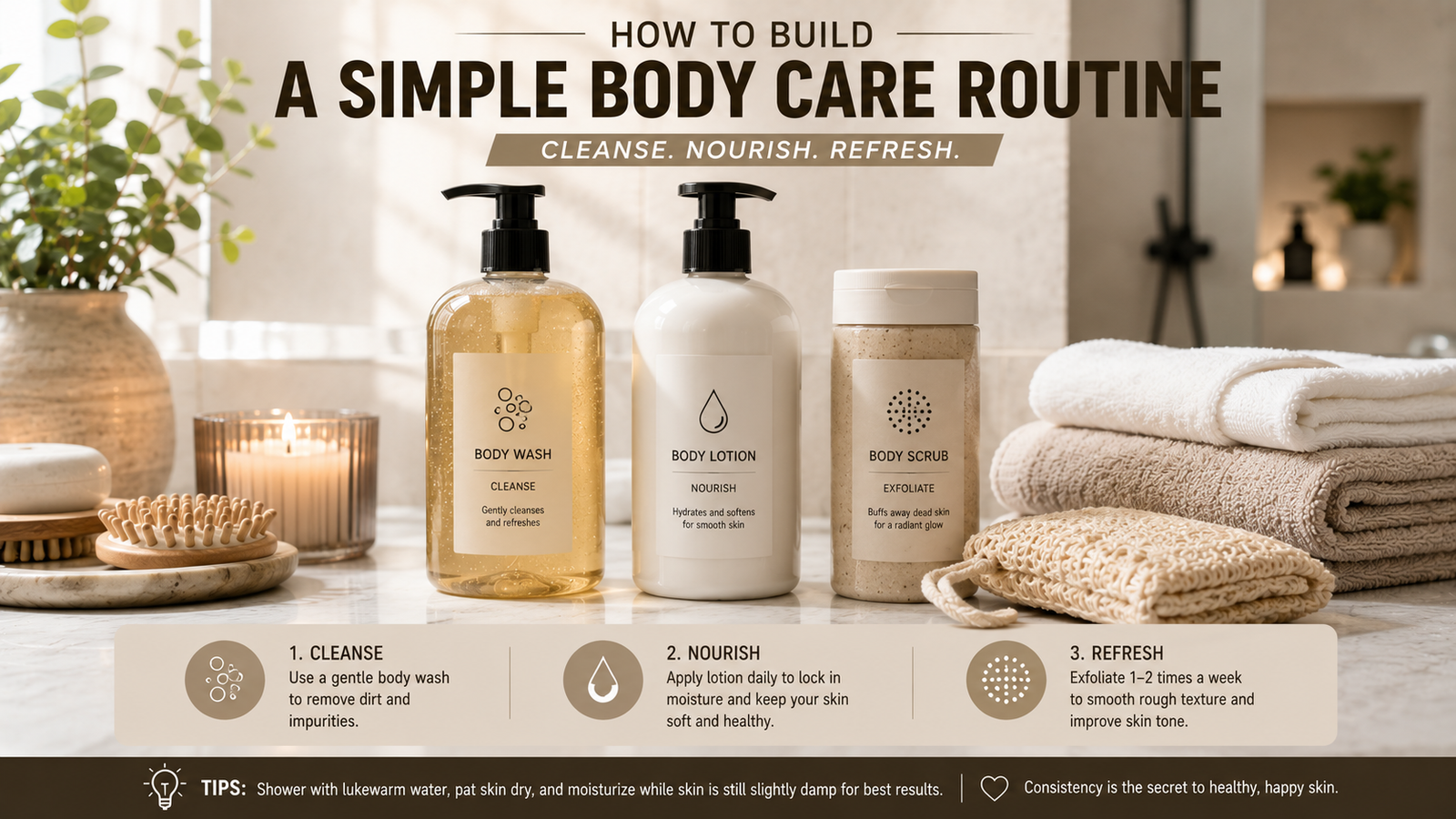
Body care does not need to involve a different cleanser, scrub, serum, oil and cream for every part of the body.
For most people, a useful routine can be built around a few basic steps:
- Clean the skin appropriately
- Moisturize when the skin needs it
- Protect exposed skin from the sun
- Use exfoliation or targeted treatments only for specific concerns
- Keep the routine simple enough to follow consistently
The useful question is not:
“How many body-care products should I use?”
It is:
“What does my skin actually need to stay clean, comfortable and protected?”
Someone with naturally comfortable skin may need little more than a suitable body cleanser, moisturizer when necessary and sunscreen on exposed areas. Someone with very dry, rough or acne-prone body skin may benefit from a few targeted additions.
The goal is to solve real problems without turning basic body care into an unnecessarily complicated skincare routine.
What Does a Body Care Routine Need to Accomplish?
A practical body-care routine usually has four jobs.
Cleansing
Remove:
- sweat;
- excess oil;
- dirt;
- sunscreen;
- environmental residue;
- odour-producing buildup.
Moisturizing
Help maintain comfortable skin and reduce:
- dryness;
- roughness;
- flaking;
- tightness.
Protection
Reduce avoidable environmental damage, particularly from ultraviolet exposure on uncovered skin.
Targeted Care
Address specific concerns such as:
- rough texture;
- body acne;
- very dry heels;
- shaving irritation;
- uneven-feeling skin.
Not everyone needs the fourth category.
If your body skin is already comfortable, there is no reason to continually treat it simply because products are available.
Start by Assessing Your Skin
Before building the routine, pay attention to how your skin behaves.
Ask:
- Does it feel tight after showering?
- Does it become flaky?
- Do my arms or legs feel rough?
- Do I develop breakouts on my back or chest?
- Do I experience bumps after shaving?
- Are my elbows, knees or feet much drier than the rest of my body?
- Does fragrance irritate my skin?
- Does the climate make my skin noticeably drier or oilier?
Your answers determine which steps deserve attention.
A Simple Daily Body Care Routine
For many people, the routine can be as simple as:
In the Shower
- Use comfortably warm water.
- Clean the areas that need cleansing.
- Avoid unnecessary aggressive scrubbing.
- Rinse thoroughly.
After the Shower
- Gently dry the skin.
- Apply moisturizer if needed.
- Apply sunscreen to exposed body areas when appropriate.
That is already a complete basic routine.
Everything else should have a reason for being added.
Step 1: Clean the Skin Without Over-Cleansing
Body cleansing removes material that accumulates during normal daily life.
This can include:
- sweat;
- skin oils;
- dirt;
- deodorant;
- body products;
- sunscreen.
But skin does not need to feel aggressively stripped to be clean.
If your skin feels:
- tight;
- itchy;
- unusually dry;
immediately after showering, your routine may be too harsh.
Possible contributors include:
- very hot water;
- long showers;
- strong cleansers;
- excessive product;
- aggressive scrubbing.
Focus Cleansing Where It Is Needed Most
You do not necessarily need to scrub every part of the body equally.
Areas that commonly need deliberate cleansing include:
- underarms;
- feet;
- groin;
- skin that sweats heavily;
- areas covered in sunscreen;
- visibly dirty areas.
Arms, legs and torso may need gentler cleansing depending on your skin and activity.
The goal is appropriate hygiene, not maximum detergent exposure.
How Often Should You Shower?
There is no universal number that applies to everyone.
Shower frequency depends on:
- climate;
- activity;
- sweating;
- occupation;
- skin type;
- personal preference.
Someone exercising daily in a hot, humid environment may reasonably shower more frequently than someone spending the day indoors in cool weather.
If you shower more than once per day, consider making some showers shorter and gentler rather than using a strong cleanser over the entire body every time.
Water Temperature Matters
Extremely hot showers can feel relaxing, but they may make dry skin more uncomfortable.
If you experience dryness, try:
- warm rather than very hot water;
- shorter showers;
- moisturizing afterwards.
You do not need cold showers for healthy skin.
Comfortably warm water is sufficient for routine cleansing.
Choose a Cleanser That Leaves Your Skin Comfortable
Body cleansers come in forms such as:
- bars;
- gels;
- creams;
- shower oils.
No format is automatically best.
The important question is how your skin feels after use.
A cleanser is probably fitting your routine if your skin feels:
- clean;
- comfortable;
- not excessively tight;
- not persistently itchy.
Dry or sensitive-feeling skin may benefit from milder, creamier cleansing.
People who sweat heavily may prefer a gel that rinses quickly.
Bar Soap vs Body Wash
Both can clean effectively.
The better choice depends on formulation rather than whether the cleanser is solid or liquid.
A mild cleansing bar may be gentler than a strong body wash.
A creamy body wash may be more comfortable than some traditional soaps.
Choose based on:
- skin feel;
- convenience;
- fragrance preference;
- cost;
- packaging.
Do You Need Antibacterial Body Wash?
For routine everyday bathing, most people do not need a specialized antibacterial body cleanser.
Ordinary cleansing is usually sufficient.
Specialized products may have roles in particular situations, but stronger antimicrobial positioning does not automatically make a cleanser better for daily body care.
Do You Need a Loofah or Sponge?
No.
Your hands can distribute cleanser effectively.
Optional tools include:
- washcloths;
- bath sponges;
- loofahs.
If you use one:
- avoid excessive pressure;
- rinse thoroughly;
- allow it to dry;
- replace or clean it appropriately.
A damp shower accessory that remains wet continuously can become difficult to keep hygienic.
Avoid Scrubbing Until the Skin Feels “Squeaky”
A squeaky-clean sensation is not a health target.
Over-cleansing can remove more surface lipids than necessary and leave the skin uncomfortable.
This is especially relevant if you:
- shower frequently;
- have naturally dry skin;
- live in a dry climate;
- use exfoliating products.
Step 2: Moisturize According to Need
Moisturizer helps reduce water loss and improve skin softness.
You may especially benefit if your skin:
- feels tight after bathing;
- becomes flaky;
- looks ashy;
- becomes itchy in dry weather;
- feels rough.
You do not necessarily need the same amount of moisturizer everywhere.
The Best Time to Apply Body Moisturizer
A convenient time is soon after bathing.
Try:
- patting the skin gently;
- leaving it slightly damp;
- applying moisturizer.
This can help retain some of the water present after bathing.
You do not need to wait until the skin is completely dry and uncomfortable.
Lotion, Cream or Ointment?
The categories mainly differ in richness.
Lotion
Usually:
- lightweight;
- easy to spread;
- quick to absorb.
Useful for:
- normal skin;
- mild dryness;
- humid weather.
Cream
Richer than most lotions.
Useful for:
- dry skin;
- legs;
- arms;
- cooler weather.
Ointment or Balm
Usually much more occlusive.
Useful for:
- very dry areas;
- cracked heels;
- elbows;
- localized patches.
You do not need to use the richest texture over your entire body.
Use Different Richness on Different Areas
One of the easiest ways to simplify body care is to use a general lotion over most of the body and a richer product only where required.
For example:
light lotion: arms and legs
rich cream: elbows and knees
heavier balm: heels
This often works better than forcing one heavy cream to suit everything.
What Ingredients Can Support Moisturization?
Useful ingredient groups include:
Humectants
Such as:
- glycerin;
- urea;
- hyaluronic-acid-related ingredients.
These help attract or retain water.
Emollients
Such as:
- oils;
- fatty alcohols;
- esters;
- squalane.
These improve softness and smoothness.
Occlusives
Such as:
- petrolatum;
- mineral oil;
- wax-like ingredients.
These help reduce water loss.
You do not need all of these as separately purchased products.
A well-formulated moisturizer may combine them.
Step 3: Protect Exposed Body Skin From the Sun
Sun protection is not only a facial-skincare concern.
Frequently exposed areas can include:
- arms;
- hands;
- neck;
- chest;
- shoulders;
- legs;
- feet.
If those areas receive meaningful UV exposure, appropriate sun protection matters.
When Body Sunscreen Becomes Important
Consider sunscreen especially during:
- outdoor exercise;
- commuting;
- walking;
- beach or pool time;
- outdoor work;
- travel;
- prolonged daylight exposure.
Clothing can also provide useful protection.
A practical strategy may combine:
- sunscreen;
- sleeves;
- hats;
- shade.
Sunscreen Should Be Applied Adequately
A common problem is using far too little sunscreen.
For exposed body areas, apply enough to cover the skin evenly.
Reapplication becomes particularly important after:
- swimming;
- heavy sweating;
- towel drying;
- prolonged outdoor exposure.
Follow the product instructions.
Do You Need Sunscreen on the Entire Body Every Day?
Not necessarily.
The priority is exposed skin.
If an area is fully covered by clothing throughout the day, applying sunscreen underneath it may offer little practical benefit unless the fabric provides inadequate protection or you expect exposure later.
Make the routine practical rather than automatic.
Hands Are Easy to Forget
Hands receive substantial environmental exposure and are frequently washed.
If you spend considerable time outdoors, consider sunscreen on the backs of the hands.
Reapplication may be needed after repeated hand washing.
Step 4: Exfoliate Only When There Is a Reason
Exfoliation can improve the feel of rough skin by helping remove surface cells.
But exfoliation is optional.
You do not need to exfoliate simply because a routine online includes it.
It may be useful for concerns such as:
- rough texture;
- flaky surface skin;
- certain types of body bumps;
- ingrown-hair tendency.
Physical Exfoliation
Physical exfoliation uses friction.
Examples include:
- scrubs;
- textured cloths;
- exfoliating gloves;
- brushes.
Use gentle pressure.
Aggressive scrubbing can contribute to:
- redness;
- irritation;
- abrasions;
- worsening pigmentation after inflammation.
If your skin is red and sore afterwards, the routine is too aggressive.
Chemical Exfoliation
Chemical exfoliants may use ingredients such as:
- lactic acid;
- glycolic acid;
- salicylic acid;
- urea at appropriate concentrations.
These can be useful for specific concerns.
They may appear in:
- washes;
- lotions;
- targeted treatments.
Start gradually.
You generally do not need a scrub, acid cleanser and exfoliating lotion all at the same time.
Do You Need to Exfoliate Every Day?
Usually not.
Frequency depends on:
- product strength;
- skin tolerance;
- concern being treated.
If you notice:
- stinging;
- redness;
- increased sensitivity;
- worsening dryness;
reduce the frequency or stop.
Body Scrubs: Are They Necessary?
No.
A body scrub can provide a temporary smoother feel and may be enjoyable as part of bathing.
But skin health does not depend on regular scrubbing.
If you enjoy one:
- use moderate pressure;
- avoid injured skin;
- avoid combining with several other strong exfoliants.
Body Brushes and Dry Brushing
Dry brushing is often marketed with claims involving:
- detoxification;
- circulation;
- lymphatic drainage;
- cellulite reduction.
A brush can certainly exfoliate the skin surface.
But broad “detox” claims should be treated cautiously.
If you dry brush:
- use gentle pressure;
- avoid irritated skin;
- stop if you develop scratches or redness.
You do not need dry brushing for a healthy body-care routine.
Body Care for Rough or Bumpy Skin
Rough bumps can have different causes.
One common pattern involves keratin accumulating around hair follicles.
A simple approach may include:
- gentle cleansing;
- regular moisturizing;
- targeted products containing ingredients such as urea, lactic acid or salicylic acid.
Improvement often requires consistency.
Aggressively scraping the bumps generally does not help.
If the area is:
- inflamed;
- painful;
- suddenly worsening;
have it assessed rather than continually increasing exfoliation.
Body Care for Dry Skin
Dry body skin usually benefits more from strengthening the basic routine than from adding numerous treatment products.
Start with:
- shorter, warm showers;
- mild cleanser;
- regular moisturizer;
- richer cream on very dry areas.
Only then consider more specialized products.
Body Care for Sensitive Skin
If your skin reacts easily, simplify.
Consider:
- fragrance-free cleanser;
- fragrance-free moisturizer;
- fewer exfoliating products;
- introducing one new product at a time.
“Natural” does not automatically mean less irritating.
Essential oils, botanical extracts and fragrance can also cause reactions.
Body Care for Oily or Sweat-Prone Skin
Oily facial skin does not necessarily mean every part of your body is oily.
If your chest or back becomes sweaty or breakout-prone:
- shower after heavy sweating where practical;
- wear clean clothing;
- avoid leaving sweaty clothes on for long periods;
- use a suitable cleanser.
Do not try to strip the skin with increasingly harsh cleansers.
Body Acne
Body breakouts commonly affect areas such as:
- back;
- shoulders;
- chest.
A practical routine may involve:
- showering after heavy sweating;
- changing workout clothing;
- avoiding excessive friction;
- using an appropriate acne-focused cleanser.
Ingredients sometimes used include:
- salicylic acid;
- benzoyl peroxide.
These can cause dryness or irritation, so follow the product directions.
Benzoyl peroxide can also bleach some fabrics.
When Body Acne Needs More Than a Body Wash
Seek appropriate professional advice if acne is:
- painful;
- cystic;
- widespread;
- scarring;
- persistent despite reasonable care.
A wash-off product may not be sufficient for more significant acne.
Exercise and Body Care
Exercise changes the routine because sweat and friction increase.
After a workout:
- change out of damp clothing;
- shower when practical;
- clean sweat-prone areas;
- moisturize if showering frequently causes dryness.
Pay particular attention to:
- chest;
- back;
- groin;
- feet.
Gym Clothing Is Part of Body Care
Sweat trapped in clothing can contribute to:
- odour;
- friction;
- discomfort.
Do not repeatedly re-wear heavily sweat-soaked gym clothes without washing them.
Allow:
- shoes;
- gloves;
- protective equipment;
to dry between uses.
Body Care After Swimming
Pool water can leave some skin feeling dry.
After swimming:
- rinse the skin;
- use cleanser if needed;
- moisturize afterwards.
If swimming outdoors, sun protection also becomes important.
For frequent swimmers, regular moisturization may be more useful than aggressive post-swim cleansing.
Body Care After Shaving
Shaving can temporarily make the skin more sensitive.
A simple shaving routine includes:
- soften the hair with warm water;
- use adequate lubrication;
- use a clean, sharp blade;
- shave with controlled pressure;
- rinse;
- moisturize if needed.
Avoid immediately applying very strong:
- fragrance;
- exfoliating acids;
- alcohol-heavy products;
if they cause stinging.
Razor Bumps and Ingrown Hairs
Ingrown hairs can occur when hairs curve back into the skin or become trapped.
To reduce risk:
- avoid shaving excessively close;
- use sharp blades;
- minimize repeated passes;
- reduce friction;
- consider gentle exfoliation where appropriate.
Do not repeatedly dig at ingrown hairs with needles or sharp tools.
Persistent inflamed bumps may require professional advice.
Body Hair Does Not Need to Be Removed for Hygiene
Body hair itself is not unhygienic.
Removing or keeping hair on the:
- legs;
- arms;
- chest;
- underarms;
is primarily a personal preference.
Normal cleansing is sufficient regardless of whether body hair is present.
Underarm Care
Basic underarm care may include:
- cleansing;
- deodorant;
- antiperspirant if sweat control is desired.
If the underarms become irritated, consider:
- gentler shaving;
- lower-fragrance deodorant;
- allowing the skin to recover.
Do not repeatedly scrub darkened underarms aggressively.
Inflammation can make discoloration more noticeable.
Elbows and Knees
These areas naturally have thicker skin and often experience more friction.
They may benefit from:
- regular moisturizer;
- richer cream;
- urea or gentle exfoliating ingredients if roughness is significant.
Do not expect the natural colour or texture of knees and elbows to match the surrounding skin perfectly.
Aggressive bleaching or scrubbing can make irritation worse.
Hand Care
Hands experience:
- washing;
- sanitizer;
- detergents;
- sun exposure.
If they become dry:
- use hand cream;
- moisturize after repeated washing;
- use protective gloves for irritating household tasks where appropriate.
If hands are frequently exposed outdoors, remember sun protection.
Foot Care
Basic foot care includes:
- washing;
- drying well;
- changing socks;
- keeping footwear dry;
- moisturizing dry areas.
Dry particularly carefully between the toes.
Moisturizer is often better concentrated on:
- heels;
- soles;
rather than heavily between toes where excess moisture may be undesirable.
Dry and Cracked Heels
For rough heels, try:
- regular rich moisturizer;
- urea-containing foot product;
- gentle filing where appropriate.
Avoid aggressively cutting thick skin yourself.
Deep cracks, bleeding or pain may need professional care.
This is particularly important for people with diabetes, poor circulation or reduced sensation.
Fragrance in Body Care
Fragrance can make body products more enjoyable.
If your skin tolerates it, scented products are a legitimate preference.
But fragrance is not necessary for:
- cleansing;
- moisturizing;
- healthy skin.
If you develop:
- itching;
- redness;
- burning;
consider simplifying to fragrance-free products.
Body Oils: Do You Need One?
Body oil can reduce water loss and improve softness.
It can be useful for:
- dry skin;
- massage;
- people who enjoy a richer finish.
But it is optional.
A body oil does not necessarily replace a moisturizer containing water and humectants.
Some people prefer:
lotion → small amount of oil
Others need only lotion.
Do not add oil simply because a multi-step routine recommends it.
Body Serum: Is It Necessary?
Body serums increasingly contain ingredients such as:
- niacinamide;
- acids;
- retinoid-related ingredients;
- antioxidants.
These can be useful when targeting a specific concern.
But most people do not need a body serum as a default step.
Ask:
What problem is this treating that my existing routine does not address?
If there is no clear answer, skip it.
Do You Need Different Morning and Evening Body Routines?
Usually not.
A practical difference is:
Morning
- cleanse as needed;
- moisturize if needed;
- protect exposed skin from the sun.
Evening
- remove sweat/sunscreen if necessary;
- moisturize;
- use targeted treatment if part of your routine.
There is little reason to create completely different product collections unless your skin requires them.
Adjust Your Routine by Season
Skin needs can change throughout the year.
Hot and Humid Weather
You may prefer:
- lighter body wash;
- lightweight lotion;
- more frequent showering;
- better sweat management.
Cool or Dry Weather
You may prefer:
- shorter showers;
- richer moisturizer;
- less frequent full-body cleansing;
- more attention to hands and legs.
You do not need to remain loyal to one texture throughout the year.
Hard Water and Body Care
Hard water may affect how:
- cleansers lather;
- skin feels after bathing.
If your skin becomes dry, avoid compensating by using increasingly large quantities of cleanser.
Focus instead on:
- mild cleansing;
- thorough rinsing;
- moisturizer after bathing.
Avoid Constantly Changing Products
If you change:
- cleanser;
- moisturizer;
- exfoliant;
- deodorant;
all at once, it becomes difficult to know what helped or caused irritation.
Introduce changes one at a time when practical.
This is especially important if your skin is reactive.
Give the Routine Time
Body-care improvements are not always immediate.
Moisturization can improve comfort quickly, but concerns such as:
- rough texture;
- clogged follicles;
- uneven appearance;
may require consistent care over several weeks.
Do not switch products every few days because the skin has not transformed immediately.
When to Stop a Product
Stop or reconsider a product if it causes:
- persistent burning;
- swelling;
- significant rash;
- worsening itching;
- blistering;
- painful irritation.
Do not continue using a product simply because temporary irritation is described online as “purging.”
Body moisturizers and ordinary cleansers should not need to make your skin significantly worse before they work.
When Body Care Needs Medical Advice
Body-care products are useful for ordinary hygiene and cosmetic concerns.
They are not substitutes for evaluation of:
- persistent rashes;
- severe itching;
- infected-looking skin;
- rapidly spreading redness;
- painful cysts;
- non-healing wounds;
- significant unexplained pigmentation changes;
- suspicious skin lesions.
Seek appropriate professional advice when a concern is persistent, severe or uncertain.
Common Body Care Mistakes
Using Too Many Products
More layers do not automatically create healthier skin.
Taking Very Hot, Long Showers
This can worsen dryness for some people.
Scrubbing Too Hard
Physical irritation can create more problems than the roughness you were trying to remove.
Exfoliating Every Day Without a Reason
Skin does not need constant removal of its surface layer.
Ignoring Moisturizer Because the Skin Is “Only a Little Dry”
A simple moisturizer may prevent mild dryness from becoming uncomfortable.
Applying Rich Cream Everywhere
Use heavy products where they are actually needed.
Forgetting Body Sunscreen
Face-only sun protection leaves frequently exposed areas unprotected.
Using Body Care to Treat Medical Problems Indefinitely
Know when routine care has reached its limit.
A Minimal Body Care Routine
If you want the simplest possible version:
Daily or as needed
1. Cleanse
Use a suitable cleanser during bathing.
2. Moisturize
Apply lotion to areas that feel dry.
3. Protect
Use sunscreen on exposed skin when appropriate.
Optional
4. Target
Use one appropriate treatment for a specific problem such as:
- body acne;
- roughness;
- very dry heels.
That is enough for most people to build from.
A Routine for Dry Body Skin
Shower
- warm water;
- mild cleanser;
- short-to-moderate shower.
After Shower
- moisturizer over dry areas;
- richer cream on elbows, knees or heels.
Daytime
- sunscreen on exposed skin.
Avoid automatically adding scrubs and acids while the skin is already irritated.
A Routine for Rough or Bumpy Skin
Cleanse
Use a comfortable cleanser.
Treat
Choose one targeted ingredient such as:
- urea;
- lactic acid;
- salicylic acid;
depending on the concern and product.
Moisturize
Maintain regular hydration.
Protect
Use sun protection on exposed treated areas.
Avoid simultaneously using several aggressive exfoliating products.
A Routine for Sweat-Prone Skin
After Heavy Sweating
- change damp clothing;
- shower;
- cleanse high-sweat areas.
Daily
- deodorant or antiperspirant according to need.
Moisturize
Use a lightweight lotion if frequent showering creates dryness.
Quick Body Care Routine Guide
| Concern | Start with |
|---|---|
| Normal comfortable skin | Gentle cleansing |
| Dry skin | Mild cleanser + moisturizer |
| Very dry areas | Rich cream/ointment |
| Rough texture | Moisturizer + controlled exfoliation |
| Body acne | Appropriate acne cleanser/treatment |
| Heavy sweating | Cleansing + clean clothes + deodorant/antiperspirant |
| Shaving irritation | Gentler technique + simple moisturizer |
| Sun-exposed skin | Sunscreen + clothing/shade |
| Sensitive skin | Simple low-fragrance routine |
| Cracked heels | Rich targeted moisturizer |
Before Adding a New Body Care Product
Ask yourself:
- What specific concern am I treating?
- Is my skin currently comfortable without this product?
- Does another product already perform this function?
- Am I exfoliating too often?
- Is fragrance causing irritation?
- Will I realistically use this consistently?
- Does it make the routine easier or more complicated?
- Is the concern cosmetic, or could it need medical attention?
Frequently Asked Questions
Do I need a body care routine every day?
Basic hygiene occurs regularly, but not every body-care step needs to happen daily. Moisturizing, exfoliating and targeted treatments should be adjusted to your skin’s needs.
Should I moisturize after every shower?
If your skin becomes dry or tight, moisturizing after bathing is a useful habit. People with comfortable skin may need it less often.
Do I need body wash on my entire body?
Not necessarily at the same intensity. Focus cleansing particularly on sweat-prone and dirty areas while adjusting the rest according to your skin.
Is body scrub necessary?
No. It is optional and mainly provides physical exfoliation.
How often should I exfoliate my body?
There is no universal schedule. Start conservatively and adjust according to the product and skin tolerance.
Can I use salicylic acid on the body?
Yes, appropriately formulated body products containing salicylic acid are commonly used for concerns such as rough texture and some body breakouts. Follow the product directions.
Is body lotion enough for dry skin?
For mild dryness, often yes. Very dry areas may need a richer cream or ointment.
Should I use body oil before or after lotion?
If using both, oil is often applied after lotion to add occlusion, although product directions can vary. Many people do not need both.
Do I need sunscreen on my arms and legs?
If those areas are exposed to meaningful sunlight, sun protection is appropriate.
Can I use face sunscreen on my body?
Yes, provided it offers suitable protection and you can apply enough. Body-specific sunscreen is often simply more economical for larger areas.
How do I prevent body acne after workouts?
Change out of sweaty clothes, shower when practical, reduce unnecessary friction and consider an appropriate acne-focused cleanser if breakouts persist.
Can shaving make skin darker?
Repeated irritation can contribute to visible pigmentation changes in some people. Gentler technique and reducing inflammation may help.
Are dark elbows and knees caused by dirt?
Not necessarily. These areas naturally experience more friction and can have thicker or darker-looking skin. Aggressive scrubbing may worsen irritation.
Do I need different body products for summer and winter?
Not necessarily, but many people prefer lighter products in humid weather and richer moisturizers during dry or cooler periods.
When should I see a dermatologist?
Seek appropriate advice for concerns such as persistent rashes, significant itching, painful or scarring acne, infected skin, non-healing wounds or skin changes you are unsure about.
The Physical Glow Takeaway
A useful body-care routine is built around cleansing, moisturizing and protection—not the number of products on your bathroom shelf.
Clean the skin according to your activity and climate without trying to strip it. Moisturize areas that become dry, using lighter lotions for general use and richer products only where necessary. Protect exposed body skin from meaningful UV exposure, and introduce exfoliation or active treatments only when you have a specific concern.
Avoid turning ordinary body care into a cycle of aggressive scrubbing, constant exfoliation and increasingly complicated product layering.
For most people, the best routine is:
cleanse appropriately → moisturize where needed → protect exposed skin → treat specific concerns selectively.
When those steps are simple enough to repeat consistently, body care becomes much easier to maintain—and far less dependent on buying another product every time a new trend appears.