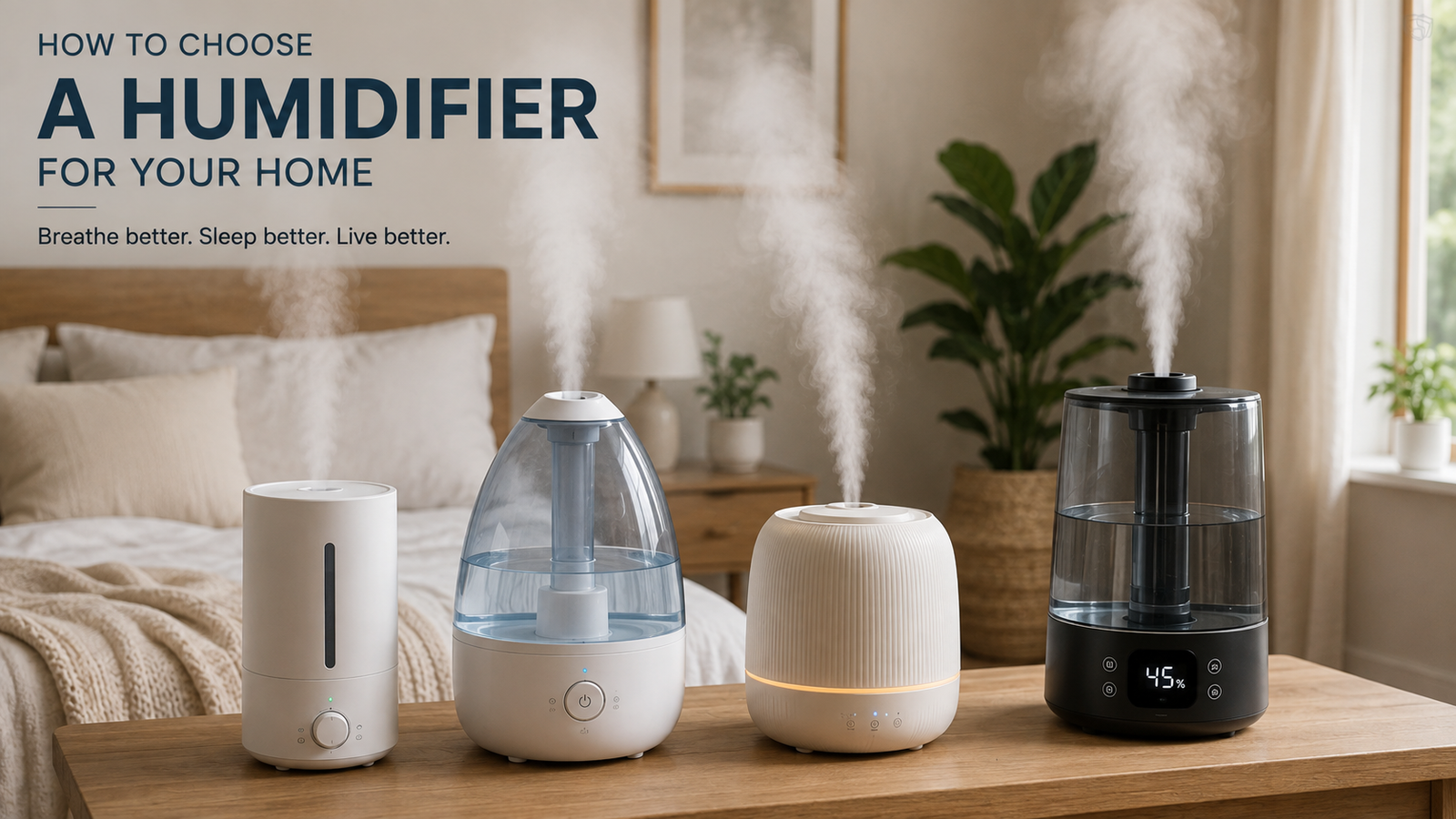
How to Choose a Humidifier for Your Home
Learn how to choose a humidifier for your home, with practical guidance on room size, mist type, tank capacity, cleaning, noise and humidity control. This beginner-friendly guide helps you make a clear, informed choice without unnecessary complexity.
A humidifier can make a dry indoor environment feel more comfortable, but it is also one of the easiest home-wellness devices to misuse.
If indoor air is genuinely dry, adding moisture may help reduce discomfort such as dry skin, dry lips, throat irritation and the general feeling of overly dry heated or air-conditioned air.
But if the home is already humid, using a humidifier can create new problems.
Too much indoor moisture can contribute to:
- condensation;
- mould;
- dust mites;
- musty smells;
- damp surfaces.
That means the useful question is not:
“Which humidifier produces the most mist?”
It is:
“Is my indoor air actually too dry, how large is the room, and which type of humidifier can maintain comfortable humidity without becoming difficult to clean or over-humidifying the space?”
A good humidifier should solve a measured or clearly observed dryness problem. It should also be easy enough to clean that you can maintain it properly.
This guide explains how to choose a humidifier based on humidity level, room size, technology, maintenance, noise, water quality and everyday practicality.
First Confirm That You Actually Need a Humidifier
Do not buy a humidifier simply because:
- the weather is cold;
- the air feels uncomfortable once;
- a wellness routine recommends one;
- you have seen them used in bedrooms online.
Measure indoor humidity first if possible.
A simple hygrometer can tell you the relative humidity in the room.
For many homes, a broad indoor range around 30–60% relative humidity is generally considered comfortable.
You do not need to maintain one exact number.
The important point is to avoid the extremes.
Signs Indoor Air May Be Too Dry
Possible signs include:
- dry skin;
- dry lips;
- scratchy throat;
- dry nasal passages;
- static electricity;
- very dry-feeling heated rooms;
- wooden materials shrinking or cracking in very dry environments.
These signs are not specific enough to prove low humidity by themselves.
That is why measurement is useful.
Signs You May Already Have Too Much Humidity
Look for:
- condensation on windows;
- damp-feeling rooms;
- musty odour;
- visible mould;
- walls or ceilings that stay damp;
- towels taking unusually long to dry.
If these are already present, a humidifier is unlikely to be appropriate.
The priority should be reducing moisture or fixing the source.
Understand Relative Humidity
Relative humidity describes how much moisture the air contains compared with the maximum amount it could hold at that temperature.
Warmer air can generally hold more water vapour than colder air.
This is why indoor humidity can change when:
- weather changes;
- heating is used;
- air conditioning runs;
- doors and windows are opened;
- people shower or cook.
A room that feels dry in winter may not need added humidity during the monsoon or humid summer.
Humidifier use should therefore be seasonal and responsive, not automatic.
Choose the Right Type of Humidifier
There are several major humidifier technologies.
Each has different advantages and disadvantages.
Ultrasonic Humidifiers
Ultrasonic humidifiers use high-frequency vibrations to create a fine mist.
They are extremely common.
Advantages
- usually quiet;
- often energy-efficient;
- available in many sizes;
- visible mist makes operation easy to see;
- commonly available with adjustable output.
Potential drawbacks
- minerals in tap water may be released into the air;
- can produce white dust in hard-water areas;
- require regular cleaning;
- stagnant water can become contaminated if neglected.
Ultrasonic models can work very well, but water quality and cleaning are especially important.
Evaporative Humidifiers
Evaporative humidifiers use a fan to move air through a wet wick or filter.
Water evaporates naturally into the air.
Advantages
- generally less likely to create visible mineral dust;
- evaporation naturally slows as humidity rises;
- straightforward technology.
Potential drawbacks
- fan noise;
- wick or filter replacement;
- recurring maintenance cost;
- filters can develop odour if neglected.
These can be a good option if you prefer a more self-limiting humidification process.
Warm-Mist Humidifiers
Warm-mist models heat water before releasing steam or warm vapour.
Advantages
- warm mist may feel comfortable in cold weather;
- heating reduces some microorganisms in the water before vapour is released.
Potential drawbacks
- higher electricity use;
- hot water and steam create burn risk;
- generally less suitable around young children;
- mineral buildup may occur.
Safety should be a major consideration.
For homes with children or pets, cool-mist technologies are often more practical.
Cool-Mist Humidifiers
“Cool mist” is a broad category that includes:
- ultrasonic;
- evaporative;
models.
The mist or moisture released is not heated.
These are generally easier to place in family environments because they do not contain boiling water.
However, cool mist does not mean low maintenance.
The water tank still needs regular cleaning.
Central or Whole-Home Humidifiers
Some heating and HVAC systems can integrate whole-home humidification.
These are very different from portable room humidifiers.
They may make sense in:
- large homes;
- consistently dry climates;
- homes with central HVAC.
They also require:
- professional installation;
- proper humidity controls;
- regular servicing.
For a single bedroom or small apartment, a portable humidifier is usually much simpler.
Which Type Is Best?
There is no universally best technology.
A simple comparison:
| Humidifier type | Main strength | Main concern |
|---|---|---|
| Ultrasonic | Quiet operation | Mineral dust + cleaning |
| Evaporative | More naturally self-regulating | Fan noise + wick replacement |
| Warm mist | Warm vapour | Burn risk + energy use |
| Central | Whole-home coverage | Cost + professional maintenance |
Choose according to your environment and willingness to maintain the device.
Room Size Matters
A humidifier needs to be appropriately sized for the space.
Manufacturers commonly classify units for:
- small rooms;
- medium rooms;
- large rooms.
A bedroom may require much less output than an open living area.
Check the manufacturer’s recommended room coverage.
But treat very large coverage claims cautiously.
Consider:
- actual floor area;
- ceiling height;
- doors left open;
- ventilation;
- baseline dryness.
A humidifier designed for a small bedroom may struggle in a large open-plan room.
Do Not Automatically Buy the Highest-Output Model
More mist is not automatically better.
An oversized humidifier may increase humidity too quickly.
This can lead to:
- condensation;
- damp bedding;
- wet furniture;
- mould risk.
The objective is controlled humidity, not maximum visible mist.
If you choose a powerful unit, look for adjustable output or automatic humidity control.
Look for a Built-In Humidistat
A humidistat measures relative humidity.
Some humidifiers use this information to automatically adjust or stop mist production.
This can be useful because it reduces the risk of over-humidifying the room.
However, built-in sensors may not be perfectly accurate.
The humidity immediately around the humidifier may be higher than humidity on the other side of the room.
A separate hygrometer placed away from the unit can provide a useful comparison.
Tank Capacity
Tank size affects how often you need to refill the humidifier.
Common capacities range from small bedside tanks to several litres.
A larger tank can provide:
- longer runtime;
- less frequent refilling.
But larger is not automatically better.
Large tanks are:
- heavier when full;
- harder to carry;
- sometimes harder to clean.
Choose a tank you can comfortably:
- lift;
- fill;
- empty;
- scrub.
A slightly smaller tank that is easy to maintain may be a better long-term choice.
Runtime Claims
Manufacturers may advertise:
- 12 hours;
- 24 hours;
- 40 hours;
- longer.
These figures usually depend on the lowest mist setting.
At higher output, runtime can be much shorter.
So do not compare humidifiers based only on advertised hours.
Look at:
- tank size;
- output rate;
- expected setting;
- room size.
Top-Fill vs Bottom-Fill Design
Tank design can make a major difference to everyday use.
Top-Fill Humidifiers
These can often be filled by:
- removing the top;
- pouring water directly into the reservoir.
Advantages:
- convenient;
- easier for large tanks;
- potentially easier to clean.
Bottom-Fill Tanks
These usually require you to:
- remove the tank;
- turn it upside down;
- unscrew the cap;
- refill it.
They can work perfectly well but may be:
- heavier;
- messier;
- harder to handle.
For daily use, easy filling is worth prioritizing.
Cleaning Access Is More Important Than Appearance
One of the most important buying criteria is:
Can you actually reach the inside of the tank and clean it properly?
Avoid designs with:
- narrow openings;
- hidden corners;
- complicated internal channels;
- surfaces you cannot reach.
A humidifier that looks elegant but is nearly impossible to clean can become frustrating quickly.
Look for:
- wide tank opening;
- removable components;
- simple reservoir design;
- clear cleaning instructions.
Why Humidifier Cleaning Matters
Water sitting in a humidifier can support the growth of microorganisms.
If the device is poorly maintained, contaminated water can become part of the mist or airflow.
That is why routine cleaning is not optional.
A humidifier should not simply be:
refilled → topped up → refilled again indefinitely
Instead:
- empty old water;
- rinse regularly;
- clean according to manufacturer instructions;
- allow components to dry where appropriate.
Do Not Keep Topping Up Old Water
A good habit is to empty remaining water rather than repeatedly adding fresh water to old water.
Standing water can accumulate:
- microorganisms;
- minerals;
- residue.
Refilling with fresh water is generally better than maintaining the same tank continuously for many days.
What Water Should You Use?
Water quality matters, particularly with ultrasonic humidifiers.
Tap Water
Tap water may contain dissolved minerals.
In hard-water areas, ultrasonic humidifiers can disperse some of these minerals into the room as fine white dust.
You may notice it on:
- furniture;
- screens;
- nearby surfaces.
Distilled or Demineralized Water
Using lower-mineral water can reduce white dust.
However, buying distilled water continuously can increase operating cost.
You need to consider whether that is realistic for regular use.
Filtered Water
Not all household filters remove dissolved minerals.
A standard carbon filter may improve:
- taste;
- odour;
without substantially reducing hardness.
Do not assume ordinary filtered water is equivalent to distilled water.
What Is White Dust?
White dust is most commonly associated with mineral-rich water being aerosolized by ultrasonic humidifiers.
It can settle on:
- furniture;
- electronics;
- dark surfaces.
It is usually a sign that the device is dispersing minerals from the water.
Possible solutions include:
- distilled or demineralized water;
- a compatible demineralization cartridge;
- switching to an evaporative humidifier.
Humidifiers and Hard Water
If your local water is hard, consider this before choosing ultrasonic technology.
Look at:
- mineral buildup;
- cleaning frequency;
- replacement cartridge costs.
Hard water can also produce scale inside warm-mist units.
A humidifier that is easy to descale will be much easier to maintain.
Noise Matters in the Bedroom
For bedroom use, noise can determine whether you actually keep the humidifier running.
Ultrasonic models are generally among the quietest.
Evaporative units have a fan and may produce more noticeable sound.
Check:
- lowest operating noise;
- medium setting;
- maximum setting.
A nearly silent device may be preferable for:
- light sleepers;
- nurseries;
- quiet bedrooms.
Display Brightness
Bright displays can be annoying at night.
Useful bedroom features include:
- display-off mode;
- dimming;
- sleep mode.
If the screen cannot be turned off, check whether it is likely to disturb your sleep environment.
Do You Need a Timer?
A timer can be useful if you do not want the unit running continuously.
For example, you may choose:
- several hours before sleep;
- part of the night;
- specific daytime periods.
However, an automatic humidistat is often more useful than a simple timer because it responds to actual humidity.
Automatic Shut-Off
A humidifier should ideally stop operating when the tank becomes empty.
This is particularly important with:
- warm-mist units;
- overnight operation.
Check for an automatic low-water shut-off feature.
Where Should You Place a Humidifier?
Placement matters because concentrated mist can make nearby surfaces damp.
A good location is usually:
- on a stable surface;
- away from direct contact with the bed;
- away from electronics;
- away from curtains;
- away from walls that become damp.
Do not place it where mist continuously lands on:
- bedding;
- wooden furniture;
- books;
- electronic devices.
Avoid Putting It Directly on the Floor
A slightly elevated position often allows mist to disperse more effectively.
However, it must remain stable.
Never balance a humidifier on:
- unstable stools;
- narrow shelves;
- furniture where it can fall.
Follow the manufacturer’s placement instructions.
Keep It Away From Electrical Equipment
Water and electronics do not mix well.
Avoid positioning the humidifier directly beside:
- power strips;
- computers;
- televisions;
- chargers;
- electrical outlets.
Also check for condensation around nearby surfaces.
Humidifier for the Bedroom
Bedroom priorities typically include:
- quiet operation;
- easy cleaning;
- automatic humidity control;
- display-off option;
- sufficient tank size for overnight use.
A bedroom humidifier does not need:
- extreme output;
- dozens of smart features.
Simple and reliable is often better.
Humidifier for Children
Humidifiers are commonly used in children’s rooms, but safety matters.
Prefer avoiding hot-steam models where a child could access the unit.
Also:
- secure the power cord;
- place the device out of reach;
- keep the tank clean;
- avoid excessive humidity.
Do not add medications, essential oils or other substances unless the device is specifically designed for them and appropriate guidance supports their use.
Humidifier for Babies
The same basic principles apply:
- use clean water;
- clean the device frequently;
- avoid excessive humidity;
- keep hot-water devices away.
If a baby has persistent:
- breathing difficulty;
- wheezing;
- fever;
- feeding problems;
- significant congestion;
a humidifier should not replace medical assessment.
Humidifier and Dry Skin
Dry indoor air can contribute to skin discomfort.
Increasing humidity may help the environment feel less drying.
But a humidifier is not a substitute for basic skincare.
For dry skin, also consider:
- shorter showers;
- warm rather than very hot water;
- mild body wash;
- regular body lotion.
Environmental humidity and moisturization can work together.
Humidifier and Dry Nose or Throat
Dry air can make nasal passages and the throat feel uncomfortable.
Moderate humidification may help.
But persistent:
- throat pain;
- nosebleeds;
- breathing difficulty;
- severe congestion;
should not simply be attributed to humidity.
If symptoms continue, seek appropriate professional advice.
Humidifiers for Colds and Congestion
Humidified air may make the environment feel more comfortable during respiratory illness.
However, a humidifier:
- does not cure a cold;
- does not eliminate infection;
- does not replace treatment.
The device should remain clean because poor maintenance can make indoor air worse rather than better.
Can Humidifiers Help With Snoring?
Some people find dry air worsens:
- throat dryness;
- nasal discomfort.
Humidification may improve comfort when dryness is contributing.
But snoring can have many causes.
Persistent loud snoring, choking or pauses in breathing during sleep may require medical evaluation rather than simply adding a humidifier.
Humidifiers and Allergies
The relationship is more complicated than simply “more humidity is better.”
Moderate humidity may improve dry-air comfort.
But excessive humidity can encourage:
- dust mites;
- mould.
Both can worsen allergies.
If allergies are a concern, careful humidity control matters more than maximizing moisture.
Humidifiers and Asthma
Dry air may be uncomfortable for some people with asthma, but excessive humidity can also increase:
- mould;
- dust mites.
If asthma is present, a humidifier should be considered part of environmental management—not treatment.
Continue prescribed medications and seek medical advice if symptoms are not controlled.
Essential Oils in Humidifiers
Do not add essential oils to a standard humidifier unless the manufacturer specifically states that the machine supports them.
Oils can:
- damage plastic;
- clog components;
- interfere with sensors;
- shorten device life.
Some humidifiers have a separate:
- aroma tray;
- essential-oil compartment.
Use only as directed.
Also remember that essential oils can irritate some people and pets.
Do Not Put Medication Into the Tank
Avoid adding:
- inhalation solutions;
- vapour rub;
- medicines;
- disinfectants;
unless the appliance is specifically designed and approved for that substance.
Standard humidifiers are designed primarily for water.
Smart Humidifiers
Smart models may offer:
- app controls;
- scheduling;
- humidity monitoring;
- remote adjustment;
- voice-assistant integration.
These can be convenient.
But they do not improve basic humidification if:
- output is inadequate;
- the sensor is inaccurate;
- the tank is difficult to clean.
Buy smart features only after checking core performance.
Filtered vs Filter-Free Humidifiers
Some humidifiers require:
- wicks;
- filters;
- demineralization cartridges.
Others are marketed as filter-free.
Filtered Models
Potential benefits:
- better mineral management;
- certain evaporative designs.
Potential cost:
- recurring filter replacement.
Filter-Free Models
Potential benefits:
- fewer consumables.
Potential drawbacks:
- more frequent manual cleaning;
- white dust with hard water in some ultrasonic models.
There is no universally cheaper option.
Calculate long-term ownership cost.
Replacement Parts Matter
Before buying, check whether you can easily obtain:
- filters;
- wicks;
- demineralization cartridges;
- tank caps;
- other replacement parts.
A humidifier can become unusable if a small proprietary component fails and cannot be replaced.
Electricity Use
Most cool-mist humidifiers use relatively modest amounts of electricity.
Warm-mist units usually consume more because they heat water.
If you plan to run a humidifier for many hours every day, power consumption becomes more relevant.
Compare wattage alongside:
- output;
- room size;
- runtime.
How Often Should You Clean a Humidifier?
Always follow the manufacturer’s specific instructions.
A practical approach generally involves:
Daily or frequent care
- empty standing water;
- rinse the tank;
- refill with fresh water.
Regular deeper cleaning
- remove mineral deposits;
- clean the reservoir;
- clean accessible components;
- disinfect where the manufacturer recommends.
Periodic maintenance
- replace wicks or filters;
- inspect seals;
- descale components.
Do not wait until the humidifier smells bad before cleaning it.
Mineral Scale
Hard water can leave deposits on:
- heating elements;
- tanks;
- ultrasonic plates.
These deposits can reduce performance.
Descaling may be required.
Use only cleaning methods recommended by the manufacturer.
Avoid harsh chemicals that may damage the device.
What Should You Avoid When Choosing a Humidifier?
Avoid Buying Without Measuring Humidity
You may already have enough moisture.
Avoid Choosing by Mist Volume Alone
Visible mist is not a measure of good humidity control.
Avoid Oversizing Without Automatic Control
Too much output can create condensation.
Avoid Hard-to-Clean Designs
Maintenance determines long-term hygiene.
Avoid Ignoring Water Quality
Hard water can create white dust and scale.
Avoid Warm-Mist Units Where Burn Risk Is a Concern
Especially around children.
Avoid Adding Oils to Standard Tanks
Unless explicitly allowed.
Avoid Letting Water Sit for Days
Fresh water and regular cleaning are essential.
Common Humidifier Buying Mistakes
Buying the Cheapest Device Without Checking Cleaning Access
A difficult-to-clean humidifier may quickly become unusable.
Buying a Huge Tank
Large tanks sound convenient but can be heavy and awkward to wash.
Believing “24-Hour Runtime” Without Checking Output Level
The claim may apply only at minimum mist.
Ignoring Replacement Filters
Recurring consumable cost can exceed the purchase price over time.
Running It Continuously Regardless of Humidity
Humidity should be monitored.
Placing It Too Close to the Bed
Repeated direct mist can dampen:
- pillows;
- mattresses;
- walls.
How to Compare Humidifier Value
Compare:
- purchase price;
- tank capacity;
- room coverage;
- output control;
- humidistat;
- noise;
- cleaning access;
- filter cost;
- water requirements;
- electricity use.
The cheapest humidifier is not necessarily the cheapest to own.
For example, an inexpensive ultrasonic model may require frequent distilled water in a hard-water area.
An evaporative model may require replacement wicks.
Both have operating costs.
Quick Humidifier Decision Guide
| Your priority | What to look for |
|---|---|
| Quiet bedroom use | Ultrasonic cool mist |
| Hard-water area | Evaporative or easy mineral-control system |
| Child’s room | Cool mist + stable placement |
| Easy humidity control | Built-in humidistat |
| Long overnight use | Adequate tank capacity |
| Easy maintenance | Wide-opening, simple tank |
| Low consumable cost | Check filter requirements |
| Dry winter climate | Adequate output + humidity monitoring |
| Small room | Appropriately sized compact unit |
| Large room | Higher output with automatic control |
Before You Buy: Final Checklist
Ask yourself:
- Have I measured the room’s humidity?
- Is the air genuinely too dry?
- What is the room size?
- Which humidifier technology suits my situation?
- Do I have hard water?
- Could an ultrasonic unit create white dust?
- Is the tank easy to remove and clean?
- Can I fit my hand or cleaning tool inside?
- Does it have adjustable output?
- Does it have a humidistat?
- Can the display be turned off at night?
- Is it quiet enough for the bedroom?
- How much water does it hold?
- Can I comfortably lift the full tank?
- Does it require replacement filters?
- How much will those filters cost?
- Am I willing to clean it regularly?
Frequently Asked Questions
Do I need a humidifier?
Only if indoor humidity is low enough to create a genuine need. Measuring humidity is better than guessing.
What humidity should I aim for?
A broad indoor range of around 30–60% relative humidity is commonly comfortable. Avoid consistently excessive humidity.
Is cool mist or warm mist better?
Neither is universally better. Cool mist avoids hot-water burn risk, while warm-mist units heat the water. Maintenance remains important for both.
Are ultrasonic humidifiers good?
Yes, they can be quiet and effective. Hard water may create mineral dust, so water quality matters.
Can I use tap water?
It depends on the humidifier and local water hardness. Tap water can cause mineral buildup or white dust in some models.
Is distilled water better?
For ultrasonic units in hard-water areas, distilled or demineralized water can reduce mineral dust.
Should I leave a humidifier on all night?
You can if the device is designed for extended use and humidity remains within a comfortable range. Automatic humidity control is helpful.
How close should a humidifier be to the bed?
Avoid directing mist onto bedding. Follow the manufacturer’s placement guidance and allow enough distance for proper dispersion.
Can a humidifier cause mould?
Yes, if it raises indoor humidity excessively or repeatedly leaves surfaces damp.
Can a humidifier help dry skin?
It may improve environmental dryness, but body moisturizer and gentler bathing are still important.
Can humidifiers help congestion?
Moderate humidity may improve comfort, but humidifiers do not cure respiratory infections.
Can I put essential oils in my humidifier?
Only if the manufacturer specifically designed the unit for them.
Why is my humidifier leaving white powder everywhere?
This is often mineral dust from hard water, particularly with ultrasonic humidifiers.
How often should I change the water?
Fresh water should generally be used regularly rather than continuously topping up standing water. Follow the manufacturer’s instructions.
Is a humidifier safe for babies?
Cool-mist units can be used in children’s rooms when properly maintained and safely positioned. Avoid hot-water burn hazards and excessive humidity.
The Physical Glow Takeaway
Choose a humidifier only after establishing that your indoor air is genuinely too dry.
Measure humidity where possible and aim for a comfortable range rather than maximum mist output. Ultrasonic humidifiers are quiet and convenient, evaporative models can be useful where mineral dust is a concern, and warm-mist models require additional caution because of hot water and steam.
Room size, humidity control and tank capacity matter, but ease of cleaning may be the most important long-term buying factor. A humidifier that cannot be cleaned properly is difficult to use responsibly.
Consider local water quality, replacement-filter costs and noise before purchasing. Use fresh water, clean the device regularly and monitor for condensation or dampness.
The best humidifier is not the one producing the largest cloud of mist. It is the one that can maintain comfortable humidity safely, quietly and hygienically without creating excess moisture or becoming a maintenance burden.