How to Choose an Air Purifier for Your Home
Learn how to choose an air purifier for your home, with practical guidance on room size, filtration, airflow, noise, filter costs and placement. This beginner-friendly guide helps you make a clear, informed choice without unnecessary complexity.
Air purifiers are often marketed as an easy solution for dust, pollution, allergies, smoke and general indoor air quality.
But buying one without understanding the actual problem can lead to an expensive machine that is too small for the room, too noisy to use, costly to maintain or simply solving the wrong issue.
The useful question is not:
“Which air purifier has the most features?”
It is:
“What airborne problem am I trying to reduce, how large is the room, and can this purifier move and filter enough air to make a meaningful difference?”
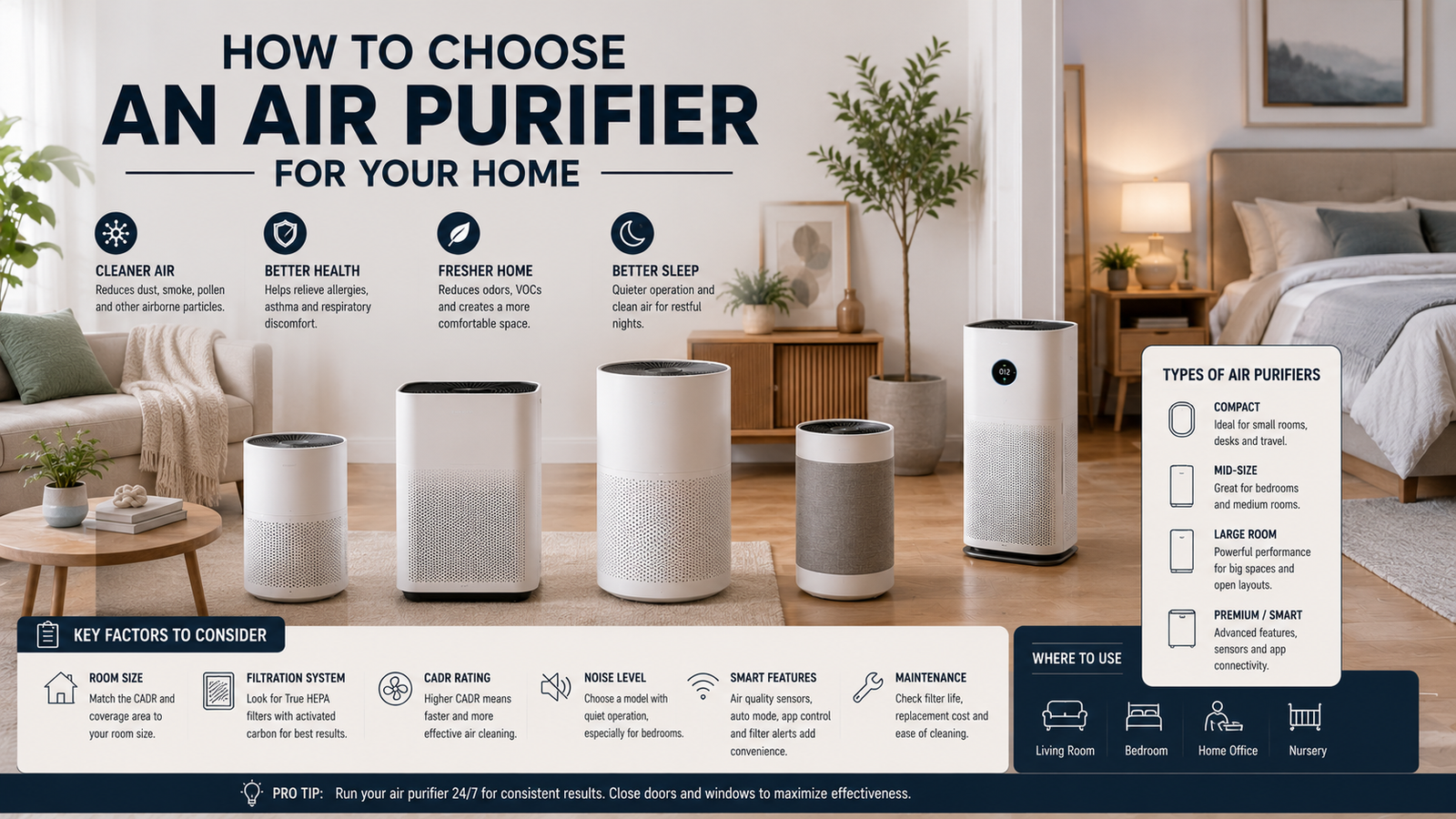
For most homes, the factors that matter most are surprisingly practical:
- particle filtration;
- airflow;
- room coverage;
- clean-air delivery;
- noise;
- filter replacement cost;
- ease of maintenance.
Smart displays, app controls and extra sensors can be useful, but they should come after the fundamentals.
This guide explains how to choose an air purifier based on real household needs rather than marketing claims.
What Does an Air Purifier Actually Do?
A portable air purifier continuously pulls room air through one or more filters and returns filtered air to the space.
Depending on the filtration system, it may help reduce airborne particles such as:
- fine dust;
- pollen;
- pet dander;
- smoke particles;
- some outdoor pollution entering the home;
- some airborne particles associated with indoor activities.
Certain models also contain activated-carbon material intended to help with:
- some odours;
- some gases;
- some volatile compounds.
However, a purifier does not solve every indoor-air problem.
It cannot replace:
- ventilation;
- cleaning;
- fixing water leaks;
- mould remediation;
- kitchen exhaust;
- source control.
The first step is therefore identifying what you actually want the purifier to address.
Start With the Problem You Want to Solve
Outdoor Air Pollution
If outdoor air quality is frequently poor, a purifier may be useful in rooms where you spend significant time.
This can be particularly relevant when:
- windows need to remain closed;
- traffic pollution is high;
- seasonal pollution is common;
- smoke or construction dust enters the home.
For particulate pollution, filtration and airflow should be the priorities.
Dust
An air purifier can help reduce airborne dust.
But it will not remove dust that has already settled on:
- shelves;
- floors;
- furniture;
- bedding.
For dusty homes, combine filtration with:
- regular vacuuming;
- damp dusting;
- cleaning air-conditioner filters;
- reducing obvious dust sources.
Pollen and Allergens
People affected by airborne pollen or pet allergens may find particle filtration useful.
However, allergen control usually involves more than an air purifier.
You may also need to manage:
- bedding;
- carpets;
- upholstery;
- pet areas;
- outdoor pollen entering through windows.
A purifier can reduce part of the exposure, not eliminate every source.
Smoke
Fine-particle filtration can be particularly valuable for smoke particles.
Activated carbon may also help with some odours and gases, but carbon performance varies substantially between products.
A thin decorative carbon sheet should not be assumed to perform like a purifier containing a substantial amount of activated carbon.
Pet Dander
Air purifiers may reduce airborne pet-related particles.
But pets also leave allergens and hair on:
- sofas;
- beds;
- carpets;
- floors.
You will still need cleaning and grooming.
Cooking Pollution
A purifier can help with some airborne cooking particles, but it should not replace a functioning kitchen exhaust system.
The better order is:
capture pollution near the cooking source first → use room filtration as additional support
Mould
An air purifier may capture some airborne mould-related particles.
It cannot remove mould growing on:
- walls;
- ceilings;
- furniture;
- building materials.
If mould is present, fix the moisture source.
Filtration is not a substitute for remediation.
Understand HEPA Filtration
HEPA filtration is one of the most important features to understand when choosing an air purifier for particles.
A proper high-efficiency particulate filter is designed to capture a very high proportion of small airborne particles passing through it.
This is useful for:
- pollution particles;
- pollen;
- dust;
- smoke;
- some airborne allergens.
Do Not Focus Only on the Word “HEPA”
A purifier needs more than a good filter.
The machine must also:
- move enough air;
- direct that air through the filter;
- minimize leakage around it.
A tiny purifier with excellent filter material may still perform poorly in a large room because it simply cannot process enough air.
The whole system matters.
HEPA-Type vs True HEPA
Marketing terminology can be inconsistent.
You may see:
- HEPA;
- True HEPA;
- HEPA-type;
- HEPA-like;
- high-efficiency filter.
If particle removal is important, look for clear specifications rather than relying on vague language.
A manufacturer should ideally provide information about:
- filter standard;
- particle-removal efficiency;
- airflow or CADR;
- replacement-filter availability.
The more transparent the performance data, the easier the product is to evaluate.
What Is CADR?
CADR stands for Clean Air Delivery Rate.
It is one of the most useful specifications when comparing particle air purifiers.
In simple terms, CADR tells you approximately how much filtered air the purifier can deliver.
Higher CADR generally means the purifier can clean a given room more quickly.
This is more useful than claims such as:
- “covers large rooms”;
- “up to 1,000 sq ft”;
- “powerful purification.”
Those claims may depend on very different assumptions.
Why Room Coverage Claims Can Be Misleading
Manufacturers may calculate room coverage using different air-change rates.
For example, one purifier may claim coverage for a large room based on cleaning the air once per hour.
Another may quote a much smaller room because it is designed to provide several air changes per hour.
Both claims might technically be correct.
That is why you should look beyond the headline room-size number.
Consider:
- CADR;
- room floor area;
- ceiling height;
- desired air-change frequency.
Think in Terms of Air Changes
Air changes per hour describe how many times the purifier can theoretically process the room’s air volume in one hour.
For example:
- 1 air change per hour = slow;
- 2 air changes = moderate;
- 4–5 air changes = substantially more active filtration.
For bedrooms and areas where pollution or allergens are an important concern, a purifier capable of several air changes per hour is generally more useful than one sized only for minimal circulation.
Estimate Your Room Size
Measure:
length × width
For example:
A room measuring:
4 m × 5 m = 20 square metres
Then consider ceiling height.
A room with unusually high ceilings contains more air than a standard-height room with the same floor area.
You do not need a perfect engineering calculation, but avoid buying based only on a purifier’s physical appearance.
A small-looking machine can be powerful, while a large decorative unit may have modest airflow.
When in Doubt, Slightly Oversize
Choosing a purifier with somewhat more capacity than the minimum requirement can be useful because you may be able to run it at:
- medium speed;
- lower noise;
- lower fan stress;
while still maintaining useful filtration.
An undersized purifier may need to run at maximum speed constantly.
That can mean:
- more noise;
- more annoyance;
- poorer real-world use.
A purifier you switch off because it is too loud provides no benefit.
Activated Carbon: What Does It Do?
Particle filters and carbon filters perform different jobs.
HEPA-Type Filtration
Primarily targets particles.
Activated Carbon
Can adsorb some:
- odours;
- gases;
- volatile compounds.
Carbon can be useful for:
- cooking smells;
- smoke odours;
- some chemical smells.
However, carbon quality varies dramatically.
Performance depends partly on:
- amount of carbon;
- type of carbon;
- contact time;
- airflow;
- contaminant.
A very thin carbon layer may provide modest odour control but should not be expected to remove substantial gas pollution.
Air Purifiers and VOCs
VOCs, or volatile organic compounds, can come from:
- paints;
- furniture;
- adhesives;
- cleaning products;
- fragrances;
- solvents.
A standard HEPA filter does not remove gases simply because it removes particles.
Carbon or other gas-phase filtration is required for that.
Even then, source control and ventilation are often important.
If a strong chemical smell appears after:
- painting;
- renovation;
- new furniture installation;
ventilation and removing the source where possible should generally be prioritized.
Do You Need an Ionizer?
Some purifiers include:
- ionizers;
- electrostatic systems;
- plasma features;
- other electrically generated treatment methods.
These features require more caution than ordinary mechanical filtration.
Some technologies may generate ozone or other reactive compounds.
For most households, a straightforward purifier using:
fan + effective particle filter + optional carbon
is easier to evaluate.
If a model includes ionization, check whether:
- it can be disabled;
- the manufacturer provides emissions information;
- the device meets relevant safety standards.
Do not assume extra air-treatment technologies automatically make a purifier better.
Avoid Ozone-Producing Air Cleaners
Ozone should not be treated as a desirable indoor-air purification feature.
Ozone can irritate the respiratory system and should not be intentionally generated in occupied indoor spaces as a routine cleaning strategy.
If a product emphasizes ozone production as a benefit, it is generally not the type of everyday residential air purifier to choose.
Noise Is More Important Than It Looks
Air purifiers work best when they run consistently.
That makes noise one of the most important real-world factors.
Manufacturers may provide noise levels in decibels.
Check:
- sleep-mode noise;
- medium-speed noise;
- maximum-speed noise.
Do not judge only from the lowest advertised number.
The quietest figure may correspond to a fan speed that provides very little airflow.
Air Purifier for the Bedroom
Bedroom priorities usually include:
- adequate airflow;
- low noise;
- dim or switchable display;
- easy filter access;
- reliable overnight operation.
A purifier that produces bright lights or loud fan noise may disturb sleep.
Useful bedroom features include:
- display-off mode;
- sleep mode;
- timer;
- low-speed operation.
But remember that a very quiet mode may also reduce filtration.
It can be better to buy a slightly larger purifier and run it comfortably at medium speed.
Air Purifier for a Living Room
Living rooms may require more capacity because they are often:
- larger;
- open-plan;
- connected to hallways or kitchens.
A purifier rated for a small closed bedroom may not perform well in a large open living area.
If the space is open to several rooms, calculate based on the effective combined area rather than one small section.
Air Purifier for Children’s Rooms
The same core principles apply:
- effective particle filtration;
- low noise;
- stable construction;
- no unnecessary ozone-producing technology;
- safe cord placement.
Keep the purifier where:
- air can circulate freely;
- it cannot easily be knocked over;
- young children cannot interfere with the controls or filter compartment.
Air Purifier for Pets
For pet households, prioritize:
- strong particle filtration;
- sufficient airflow;
- washable pre-filter where available;
- easy maintenance.
Pet hair is large compared with the particles targeted by HEPA filters.
A pre-filter can help capture larger material before it reaches the main filter.
Regular vacuuming remains necessary.
The Importance of the Pre-Filter
Many purifiers include a pre-filter.
Its job is to capture larger material such as:
- hair;
- lint;
- coarse dust.
This helps protect the more expensive main filter.
A washable or vacuumable pre-filter can reduce maintenance costs.
Follow the manufacturer’s cleaning instructions.
Do not wash a filter unless it is explicitly designed to be washed.
Filter Replacement Cost Can Change the Whole Buying Decision
Air purifier ownership is not just the purchase price.
You may need to replace:
- HEPA filters;
- carbon filters;
- combined filter cartridges.
Before buying, check:
- replacement-filter price;
- expected replacement frequency;
- availability in your country;
- whether third-party filters are required or optional.
A cheap purifier with expensive filters may cost more over three years than a more expensive machine with reasonably priced replacements.
Calculate Approximate Long-Term Cost
Consider:
purchase price + filters + electricity
For example:
If a purifier costs ₹10,000 but requires a ₹4,000 filter every year, the filter expense over three years could exceed the original purchase price.
This does not make the purifier bad.
It simply means you should evaluate ownership cost honestly.
Filter-Life Indicators
Many purifiers provide filter-life alerts.
These may be based on:
- operating hours;
- estimated usage;
- actual sensor readings.
Treat them as useful reminders rather than perfect measurements.
If the manufacturer recommends replacement but the filter still looks visually clean, that does not necessarily mean it is functioning like new.
Fine particles may not be obvious to the eye.
Washable HEPA Filters
Be cautious when you see claims of fully washable HEPA filters.
Many high-efficiency particle filters should not be washed because water can damage the filter structure.
If the manufacturer specifically states that a component is washable, follow those instructions.
Otherwise, assume:
- pre-filter may be cleanable;
- main HEPA filter may require replacement.
Air Quality Sensors
Some purifiers include particulate sensors that display values such as:
- PM2.5;
- air-quality colour;
- particle concentration.
These can be useful for:
- seeing pollution changes;
- understanding cooking spikes;
- observing how quickly the purifier clears the room.
However, built-in consumer sensors should not be treated as laboratory instruments.
Their main value is often showing trends rather than providing perfect scientific measurement.
Automatic Mode
Auto mode adjusts fan speed based on sensor readings.
It can be convenient, but it has limitations.
For example:
- a sensor may not detect every pollutant;
- odour and gas pollution may not trigger a particle sensor;
- the machine may reduce speed too aggressively.
If outdoor pollution is consistently high, running the purifier manually at an appropriate speed may provide more predictable filtration.
Do You Need Wi-Fi and an App?
App features may allow:
- remote control;
- air-quality monitoring;
- schedules;
- filter reminders.
These are convenience features.
They are not purification features.
A purifier without Wi-Fi can clean air just as effectively if its airflow and filtration are comparable.
Do not pay a significant premium for connectivity unless you will actually use it.
Display and Controls
Useful controls can include:
- fan-speed selection;
- child lock;
- display-off function;
- timer;
- filter indicator.
The interface should be simple enough that everyone in the household can operate it.
Complicated controls rarely improve air-cleaning performance.
Where Should You Place an Air Purifier?
Placement affects airflow.
Avoid placing it:
- inside cabinets;
- behind curtains;
- tightly against furniture;
- underneath tables;
- directly in a corner if the air intake is blocked.
Leave enough clearance around the intake and outlet according to the manufacturer’s recommendations.
The purifier needs access to room air.
Does It Need to Be in the Middle of the Room?
Usually not.
It simply needs:
- unobstructed intake;
- unobstructed outlet;
- good circulation.
A practical location near a wall can work well if the machine’s airflow design allows it.
Should You Place It Near the Window?
Not automatically.
If outdoor pollution is entering through a window, locating the purifier nearby may help capture some particles.
But the best placement depends on:
- room airflow;
- furniture;
- purifier design.
Do not block the machine simply to place it closer to the pollution source.
Should Doors and Windows Stay Closed?
If outdoor air is heavily polluted, a purifier usually works more effectively with windows and doors reasonably closed.
Otherwise, it is constantly trying to filter newly entering polluted air.
But ventilation is still important at appropriate times.
A practical routine may be:
- ventilate when outdoor air is better;
- close windows during poor outdoor conditions;
- run the purifier.
How Long Should an Air Purifier Run?
Air purification works continuously.
Running a purifier for ten minutes and then switching it off for the rest of the day is unlikely to maintain clean air.
Many people run purifiers:
- for several hours;
- during sleep;
- continuously during pollution events.
Most modern portable purifiers are designed for extended operation.
Follow the manufacturer’s guidance.
Should You Run It at Maximum Speed?
Maximum speed can clean the room more quickly.
A useful strategy can be:
- run on high when pollution is elevated;
- reduce to medium or low once conditions improve.
If high speed is too noisy, choose a purifier with enough capacity to provide useful airflow at a lower setting.
Air Purifiers and Air Conditioning
Air purifiers and air conditioners serve different primary purposes.
An air conditioner mainly controls:
- temperature;
- sometimes humidity.
A portable purifier primarily filters room air.
Some air conditioners contain filters, but these may be intended mainly to protect the appliance rather than provide high-efficiency room purification.
You can use both together.
Air Purifier vs Humidifier
These are completely different devices.
Air Purifier
Removes certain airborne pollutants.
Humidifier
Adds moisture to the air.
A humidifier does not clean particulate pollution.
An air purifier does not correct dry humidity.
Do not buy a combination device unless both functions are genuinely needed.
Air Purifier vs Dehumidifier
Again, different purposes.
Air Purifier
Filters airborne particles.
Dehumidifier
Removes moisture from the air.
If the problem is:
- condensation;
- dampness;
- high humidity;
a dehumidifier or moisture-source correction may be more appropriate.
Air Purifiers and Allergies
A purifier may reduce airborne allergen exposure, particularly when the relevant particles are actually suspended in the room air.
But allergies may also involve material in:
- bedding;
- carpets;
- furniture;
- pets.
Filtration works best as one part of a broader environmental strategy.
If allergy symptoms are persistent or significant, appropriate medical evaluation may be useful.
Can Air Purifiers Prevent Illness?
Air filtration can reduce concentrations of some airborne particles and aerosols.
But an air purifier should not be treated as a guarantee against infection.
For infectious-disease risk, other factors can also matter, including:
- ventilation;
- occupancy;
- exposure duration;
- hygiene;
- appropriate public-health measures.
Use filtration as one layer of risk reduction rather than a complete protective system.
Air Purifier and Asthma
Some people with asthma may benefit from reducing airborne triggers such as:
- smoke;
- dust;
- pollen;
- pet allergens.
However, an air purifier is not a replacement for prescribed asthma treatment.
Avoid devices intentionally producing ozone, which can irritate the respiratory system.
If symptoms are not well controlled, seek appropriate medical advice.
Common Air Purifier Buying Mistakes
Buying Only by Room-Coverage Marketing
Always check airflow or CADR where possible.
Buying Too Small
An undersized purifier may need to run loudly at maximum speed and still provide insufficient air cleaning.
Ignoring Replacement Filters
A purifier is only useful if you can maintain it.
Paying for Smart Features Instead of Performance
Apps and displays do not compensate for inadequate airflow.
Assuming Carbon and HEPA Do the Same Job
HEPA handles particles.
Carbon targets some gases and odours.
Expecting It to Remove Surface Dust
You still need to clean.
Expecting It to Fix Mould
Fix the moisture source.
Blocking the Air Intake
A purifier cannot process air effectively when hidden behind furniture.
Running It Only Occasionally
Consistent operation generally provides more useful filtration.
Choosing Based Only on Noise at Sleep Mode
Check whether sleep mode still provides meaningful airflow.
How to Compare Air Purifier Value
Compare more than purchase price.
A practical comparison should include:
- CADR;
- recommended room size;
- main filter type;
- carbon amount;
- filter price;
- replacement interval;
- energy consumption;
- noise;
- warranty.
A cheaper purifier with poor replacement-filter availability may be worse value than a slightly more expensive model supported for many years.
Power Consumption
Air purifiers generally use much less electricity than large cooling appliances, but they may run for many hours.
Look at:
- wattage;
- typical operating speed;
- expected daily usage.
Energy consumption becomes more important if you plan to operate the purifier 24/7.
Warranty and Service
Consider:
- warranty duration;
- local service availability;
- replacement parts;
- filter supply.
An air purifier is a long-term appliance.
Buying a discontinued model with no replacement filters can make the machine unusable long before the motor fails.
Quick Air Purifier Decision Guide
| Your priority | What to look for |
|---|---|
| Fine-particle pollution | High-efficiency particle filtration + adequate CADR |
| Dust | Particle filtration + cleaning routine |
| Pollen/allergens | Effective HEPA-class filtration |
| Smoke particles | Strong particle filtration |
| Odours | Meaningful activated-carbon filtration |
| Pets | HEPA + washable/cleanable pre-filter |
| Bedroom | Quiet operation + adequate airflow |
| Large room | High CADR and appropriate sizing |
| Smart monitoring | PM sensor/app only after core performance |
| Budget | Compare purifier + replacement filters |
| Sensitive respiratory system | Avoid ozone-producing products |
Before You Buy: Final Checklist
Ask yourself:
- What specific air-quality problem am I trying to reduce?
- Is the problem actually airborne?
- How large is the room?
- What is the ceiling height?
- What is the purifier’s CADR?
- How many air changes can it realistically provide?
- Does it use proper high-efficiency particle filtration?
- Do I need meaningful carbon filtration?
- Does it have an ionizer, and can it be disabled?
- Is the purifier quiet enough to run for long periods?
- How much do replacement filters cost?
- Are filters easily available?
- How often will they need replacement?
- Is the purifier easy to maintain?
- Am I paying for performance or mostly extra features?
Frequently Asked Questions
Do air purifiers really work?
A properly sized purifier with effective particle filtration can reduce concentrations of airborne particles in the room where it operates.
Is HEPA filtration important?
Yes, if your main concern is fine particles such as pollution, pollen, smoke or airborne allergens.
Does a bigger air purifier work better?
Not automatically, but higher airflow and CADR generally allow a purifier to clean a larger room more effectively.
Can an air purifier remove dust?
It can capture airborne dust particles, but settled dust still needs to be cleaned from surfaces.
Can an air purifier remove smells?
Models with adequate activated-carbon filtration may reduce some odours. Particle filters alone do not remove most gases.
Can an air purifier remove smoke?
A good particle filter can reduce smoke particles. Carbon can help with some associated odours and gases.
Can an air purifier remove mould?
It may capture some airborne mould particles, but it cannot remove the underlying mould source or moisture problem.
Should I leave my air purifier on all night?
Many purifiers are designed for extended operation, including overnight use. Choose a model quiet enough for your bedroom and follow the manufacturer’s instructions.
Should windows be open while the purifier runs?
During heavy outdoor pollution, closed windows generally allow the purifier to work more effectively. Ventilate when outdoor conditions are better.
Does an air purifier replace ventilation?
No. Filtration and ventilation perform different functions.
Is an ionizer necessary?
No. Mechanical filtration can work effectively without ionization.
Are ozone air purifiers safe?
Ozone should not be intentionally generated in occupied indoor spaces as a routine air-cleaning strategy.
Do I need one purifier for every room?
Not necessarily. Start with the rooms where you spend the most time or where air-quality problems are greatest.
How often should filters be replaced?
Follow the manufacturer’s recommendations and account for how heavily the purifier is used and how polluted the environment is.
Is CADR more important than room-size claims?
It is often a more useful comparison because it reflects how much clean air the purifier can deliver rather than relying on an undefined coverage claim.
The Physical Glow Takeaway
Choose an air purifier based on filtration performance, airflow and room size before considering smart features or design.
For particle pollution, dust, pollen and smoke, effective high-efficiency filtration combined with adequate CADR is the foundation. If odours or gases are important, look for meaningful activated-carbon filtration rather than assuming every carbon layer provides the same performance.
Size the purifier for the actual room, and consider buying enough capacity that you can operate it at a comfortable noise level. Check replacement-filter prices and availability before purchasing because ongoing maintenance can become a larger expense than the machine itself.
Most importantly, use an air purifier for problems it can actually solve. It can reduce airborne particles, but it cannot repair mould, remove settled dust, fix high humidity or replace kitchen ventilation.
The best air purifier is therefore not the one with the longest feature list. It is the one that can quietly, consistently and economically move enough filtered air through the room where you actually need it.