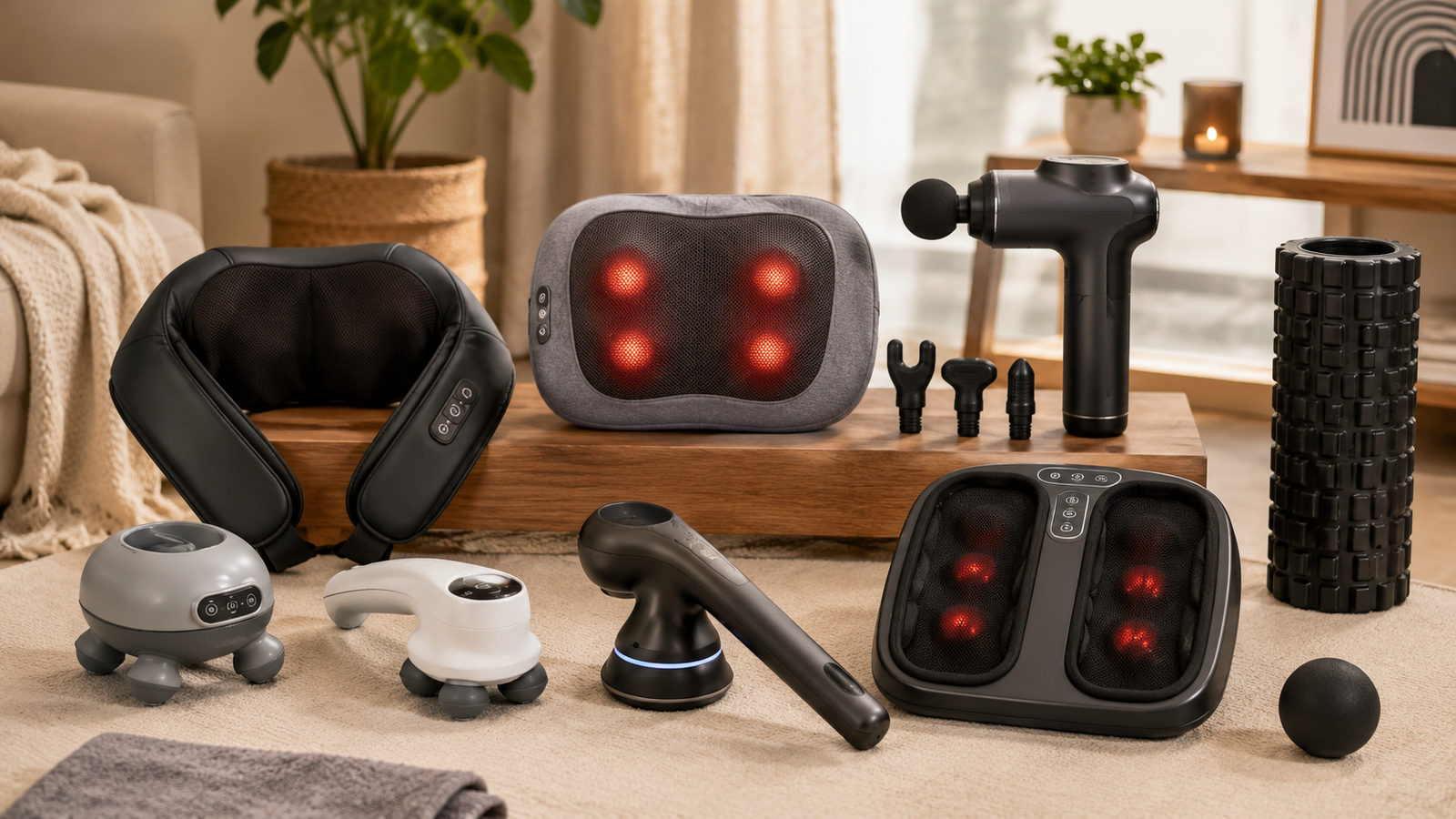
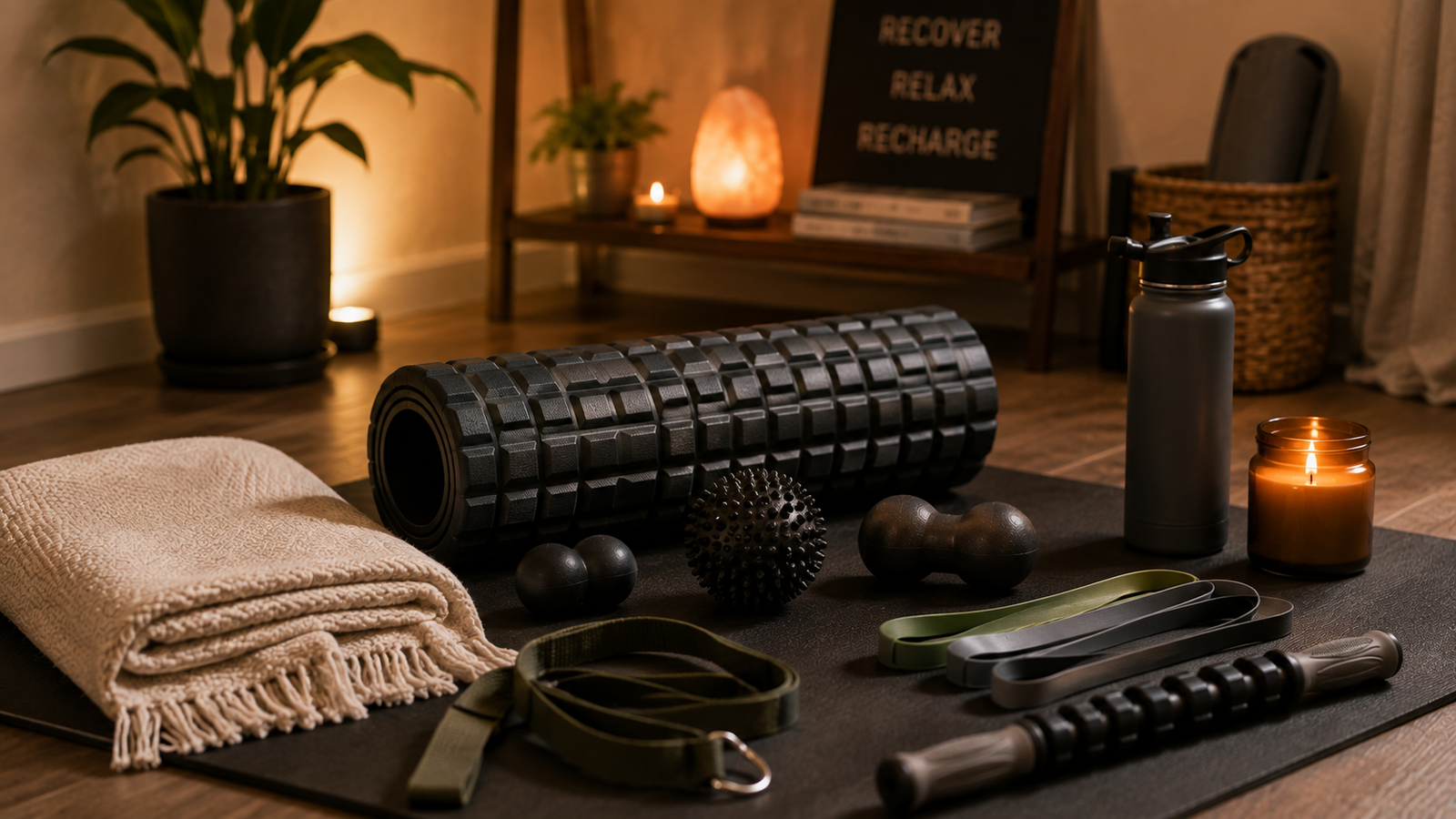
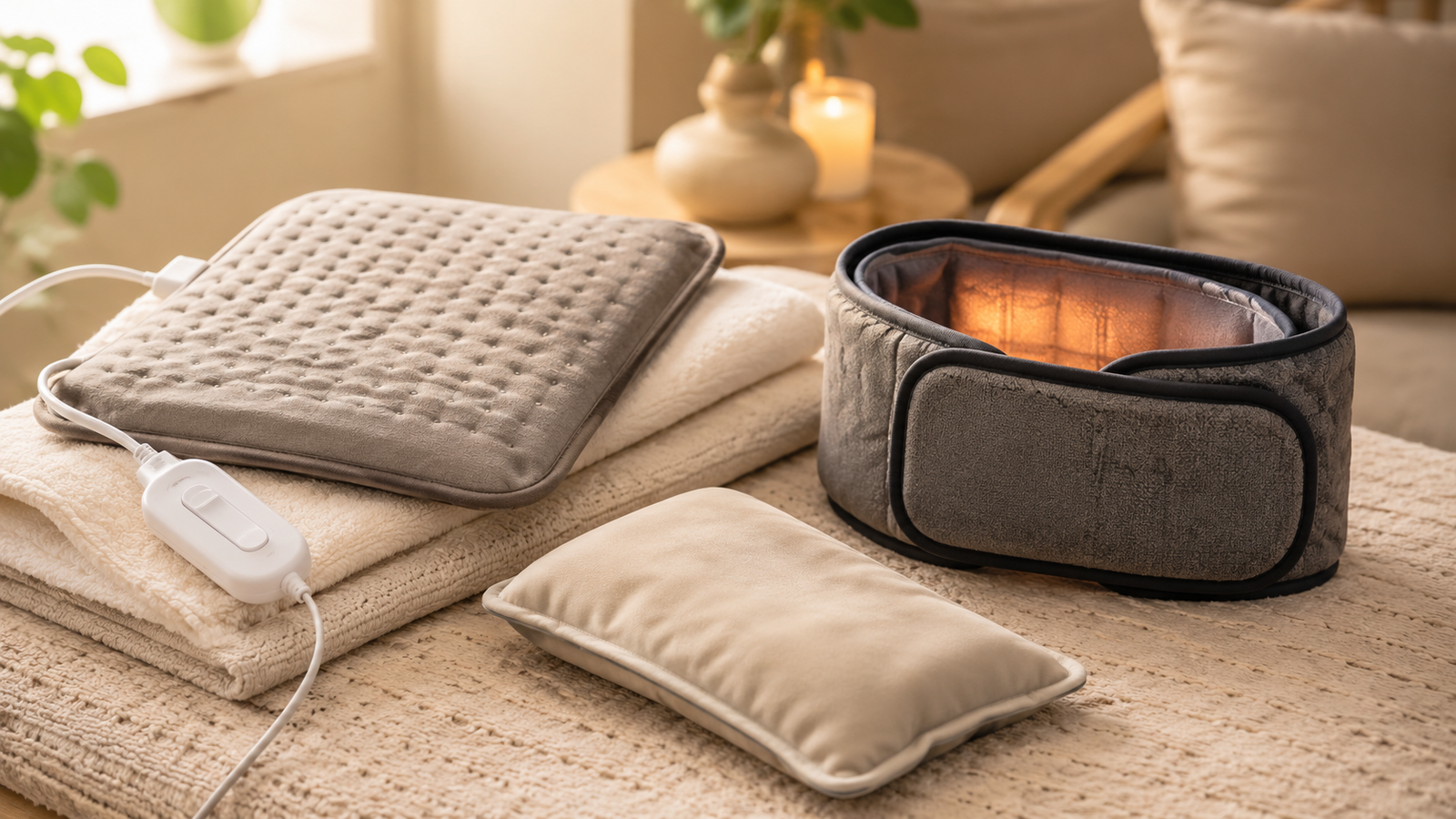
How to Choose a Massage Gun for Recovery
Learn how to choose a massage gun for recovery, with practical guidance on speed settings, attachments, amplitude, noise, battery life and comfort. This beginner-friendly guide helps you make a clear, informed choice without unnecessary complexity.
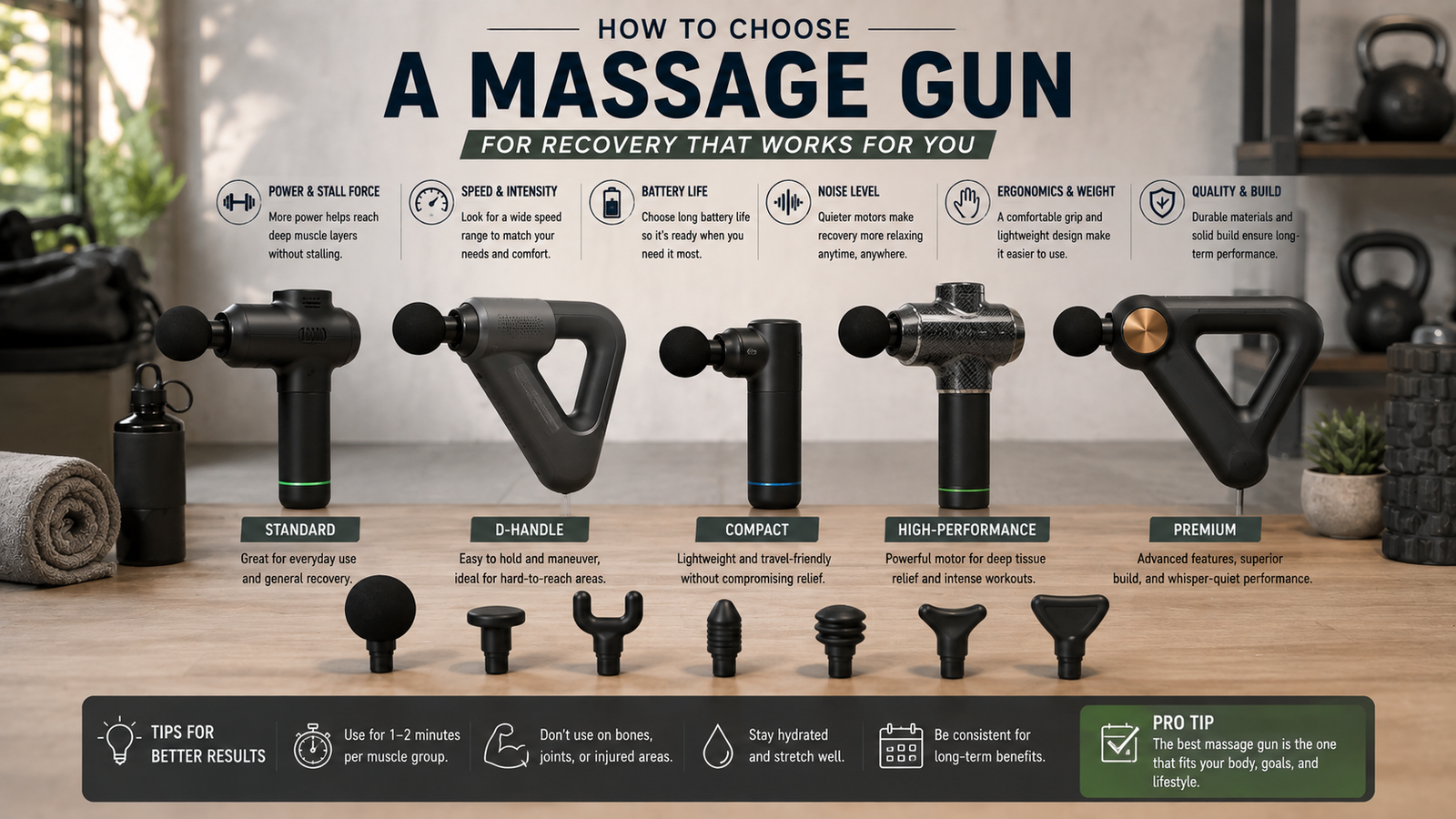
Massage guns have become one of the most recognizable recovery tools in gyms, homes and physiotherapy-style recovery setups.
They use rapid repetitive movement—often called percussion or percussive massage—to apply pressure to muscles. Depending on the person and how the device is used, this can make muscles feel:
- less stiff;
- more relaxed;
- easier to move;
- temporarily less sore.
But the category has also become increasingly complicated.
One massage gun may advertise:
- 30 speed settings;
- 12 attachments;
- extremely high stall force;
- deep amplitude;
- app connectivity;
- heated heads;
- digital pressure meters.
Another may offer only three speeds and four attachments.
The more complicated device is not automatically the better one.
The useful question is:
“What type of massage do I actually want, and which combination of intensity, amplitude, weight, noise and attachments will make the device comfortable enough to use regularly?”
A good massage gun should make self-massage easier. It should not require maximum power, create significant pain or become another expensive recovery tool that remains unused.
This guide explains which specifications actually matter, how to choose the right attachments and how to use a massage gun safely as part of a broader recovery routine.
What Does a Massage Gun Actually Do?
A massage gun contains a motor that repeatedly moves an attachment head forward and backward.
When placed against a muscle, this produces a rapid mechanical stimulus.
People commonly use massage guns:
- before exercise as part of a warm-up;
- after training;
- on rest days;
- when muscles feel stiff;
- as a convenient form of self-massage.
The device primarily provides mechanical stimulation and pressure.
It should not be viewed as something that:
- repairs an injury;
- removes “toxins”;
- eliminates the need for rest;
- replaces physiotherapy;
- guarantees faster muscle growth.
Its most realistic role is helping with temporary comfort, movement and relaxation.
Start With Your Main Reason for Buying One
Before comparing specifications, decide why you want a massage gun.
Common goals include:
General Relaxation
You may want a device that provides comfortable massage after:
- work;
- exercise;
- long periods of sitting.
You probably do not need extreme amplitude or very high force.
Prioritize:
- quiet operation;
- comfortable grip;
- manageable weight;
- gentle speed settings.
Post-Workout Muscle Comfort
If you plan to use it after strength training or cardio, look for:
- several useful intensities;
- attachments for different muscle groups;
- good battery life;
- comfortable handling.
Warm-Up
Some people use a massage gun briefly before training to make specific muscles feel more ready for movement.
For this purpose:
- moderate intensity;
- easy portability;
- quick adjustment;
may matter more than maximum power.
Deep, Firm Self-Massage
If you already know you prefer substantial pressure on large muscle groups, you may want:
- greater amplitude;
- stronger motor performance;
- higher stall force.
However, stronger is not automatically better.
If the device is so intense that you tense up while using it, the additional power is not helping.
The Specifications That Actually Matter
When comparing massage guns, focus on:
- Amplitude
- Speed range
- Stall force or usable pressure
- Attachments
- Weight and ergonomics
- Noise
- Battery life
- Size and portability
Features beyond these are usually secondary.
What Is Massage Gun Amplitude?
Amplitude describes how far the massage head travels forward and backward during each stroke.
It is often expressed in millimetres.
A device with greater amplitude produces a deeper physical movement with each percussion.
For example, you may see models offering approximately:
- 6–8 mm;
- 10 mm;
- 12 mm;
- 14–16 mm.
These numbers do not represent quality scores.
They describe different massage characteristics.
Lower Amplitude
A lower-amplitude device generally feels:
- lighter;
- more surface-focused;
- less aggressive.
It may suit:
- beginners;
- general relaxation;
- sensitive users;
- smaller muscle groups.
Higher Amplitude
Greater amplitude can feel:
- deeper;
- more forceful;
- more intense.
It may appeal to people who:
- train heavily;
- prefer firm massage;
- use the device mainly on large muscles.
But deeper movement does not automatically mean better recovery.
Choose the intensity you can tolerate comfortably.
Do You Need 16 mm Amplitude?
Not necessarily.
Deep-amplitude massage guns are often marketed as more professional or powerful.
For many recreational users, a moderate-amplitude device may be easier to use.
Ask:
- Do I actually enjoy deep massage?
- Will several members of the household use the device?
- Will I use it mainly for relaxation or very firm self-massage?
If you prefer gentle recovery work, paying extra for maximum amplitude may provide little benefit.
Speed Settings
Massage-gun speed is usually measured as percussion movements per minute.
Manufacturers may advertise ranges such as:
- 1,200–2,800 percussions per minute;
- 1,800–3,200;
- or similar ranges.
The exact number matters less than having a useful range.
Lower Speeds
Can be useful for:
- gentle introduction;
- sensitive areas;
- relaxation.
Medium Speeds
Often provide a practical balance for:
- general recovery;
- larger muscle groups.
Higher Speeds
May feel more stimulating.
However, maximum speed does not automatically provide greater benefit.
How Many Speed Settings Do You Need?
Probably fewer than the marketing suggests.
Three to five well-spaced speed levels can be enough for many people.
A massage gun advertising:
30 speeds
may not provide 30 meaningfully different experiences.
Ask whether you can easily select:
- gentle;
- moderate;
- strong.
That is often more important than the number displayed on the box.
What Is Stall Force?
Stall force describes how much pressure can be applied before the motor slows significantly or stops.
A stronger motor allows you to press the device more firmly into tissue.
This can matter for people who prefer substantial pressure.
But it is also one of the easiest specifications to misuse.
A massage gun is not more effective simply because you can press extremely hard.
In many situations, the device should be allowed to move across the muscle with moderate pressure rather than being forced deeply into one spot.
More Pressure Is Not Better
A common mistake is thinking:
“If it hurts more, it must be working more.”
That is not a useful recovery principle.
Excessive pressure can cause:
- pain;
- tenderness;
- bruising;
- irritation.
Use enough pressure to create a comfortable massage sensation.
If you are:
- holding your breath;
- pulling away;
- experiencing sharp pain;
reduce the pressure.
Massage Gun Attachments Explained
Massage guns often include interchangeable heads.
You rarely need every attachment that comes in the box.
The most useful ones are usually:
- ball;
- flat;
- bullet;
- fork.
Ball Attachment
The round ball is usually the most versatile attachment.
It can work well for larger muscle groups such as:
- quadriceps;
- hamstrings;
- glutes;
- calves;
- upper back muscles.
If you only used one attachment, the ball would probably cover much of ordinary home use.
Flat Attachment
A flat head spreads pressure across a relatively broad area.
It can be useful for:
- larger muscles;
- general massage;
- people who want something firmer than a soft ball.
It may feel more direct because the surface is harder.
Bullet Attachment
The bullet or pointed attachment concentrates pressure into a smaller area.
This makes it more intense.
It may be useful for carefully targeted work around certain muscular areas.
Use caution.
Do not use a pointed attachment aggressively over:
- joints;
- bones;
- sensitive areas;
- the spine.
For beginners, this attachment is usually less important than the ball or flat head.
Fork Attachment
A fork or U-shaped attachment is often marketed for use around areas where you want pressure on either side of a structure rather than directly over it.
It is sometimes used around larger muscle groups.
Avoid treating it as permission to massage directly over the spine or other sensitive anatomical areas.
The fact that an attachment exists does not mean every body area is appropriate for percussion massage.
Cushioned or Air-Filled Attachments
Some devices include softer attachments designed to reduce harsh impact.
These can be useful for:
- sensitive users;
- lower-intensity massage;
- areas where standard hard heads feel uncomfortable.
If comfort is your priority, a softer attachment may be more useful than another high-intensity head.
Heated Massage Gun Attachments
Some premium devices include heated attachments.
Heat may make massage feel:
- more relaxing;
- more comfortable.
But it is a convenience feature rather than a fundamental massage-gun requirement.
Consider:
- temperature control;
- heating time;
- safety shut-off;
- added cost.
If you already own a heating pad, you may not need heat built into the massage gun.
Cold Attachments
Some models similarly offer cooling heads.
Again, this combines two different recovery approaches in one device.
It may be convenient, but do not assume it produces superior recovery.
A reusable cold pack may provide a simpler solution when cold therapy is actually appropriate.
How Many Attachments Do You Need?
For most people:
3–5 useful attachments are more than enough.
A device with 12 heads is not automatically more versatile if eight of them are rarely used.
Prioritize:
- ball;
- flat;
- perhaps fork;
- perhaps bullet or soft head.
Ask what each attachment will genuinely add to your routine.
Weight Matters More Than You Think
Massage guns are held in the hand while the motor is actively vibrating.
A device that seems manageable when you pick it up for ten seconds in a shop may feel much heavier after several minutes.
Weight matters particularly when reaching:
- shoulders;
- upper back;
- legs.
A heavy device can lead to:
- wrist fatigue;
- forearm fatigue;
- awkward positioning.
For most home users, a slightly lighter massage gun may be more useful than a heavier device with greater maximum power.
Handle Design and Ergonomics
Look at how the device can be held.
Some designs use:
- straight handles;
- angled handles;
- triangular multi-grip frames.
A multi-grip design can help when reaching different body areas.
But good ergonomics depend on your own hand size and mobility.
Useful questions include:
- Can I hold it comfortably with one hand?
- Can I change grip easily?
- Does the handle become slippery?
- Can I reach my upper back without twisting awkwardly?
Can You Massage Your Own Back?
Some areas of the back are difficult to reach safely and comfortably.
Trying to force your arm into an awkward position can defeat the purpose of relaxation.
If back massage is your main goal, consider whether another product may be easier, such as:
- massage cushion;
- massage ball against a wall;
- partner-assisted massage.
A massage gun is excellent for accessible muscles but not necessarily every body area.
Noise Level
Noise is one of the most important real-world specifications.
A massage gun can be mechanically effective and still become frustrating if it sounds like power equipment.
Quiet operation matters if you plan to use it:
- while watching television;
- during an evening relaxation routine;
- around other people;
- in an apartment.
Manufacturers may publish noise levels in decibels.
Compare them cautiously because measurements may be taken:
- at different distances;
- at different speeds.
Check real-world feedback regarding noise at medium and maximum settings.
A Quiet Motor Often Improves Actual Use
The best massage gun is the one you actually reach for.
If a noisy device makes you avoid using it late in the evening, a quieter model may provide more practical value even if it has slightly less maximum power.
Battery Life
Most massage guns use rechargeable lithium-ion batteries.
Advertised runtime can vary substantially.
You might see claims such as:
- 2 hours;
- 4 hours;
- 6 hours.
Remember that battery duration usually depends on:
- speed;
- pressure;
- usage pattern.
A few hours of actual runtime can already represent many massage sessions.
You generally do not need extraordinary battery capacity for home use.
Charging Time
Check both:
- runtime;
- charging time.
A battery lasting four hours but requiring many hours to recharge may still be fine if you use the device only 10 minutes at a time.
Convenience matters more than headline battery specifications.
USB-C Charging
USB-C charging can be useful for:
- travel;
- reducing charger clutter;
- using common cables.
Some high-powered massage guns still require proprietary chargers.
Neither is automatically better, but standard charging can make travel easier.
Replaceable Batteries
Some devices allow battery replacement.
This can potentially extend product life.
With sealed batteries, an otherwise functional massage gun may eventually become less useful if battery capacity deteriorates.
If you expect to keep the device for many years, battery serviceability can be worth considering.
Mini Massage Guns
Compact massage guns can be useful for:
- travel;
- gym bags;
- office use;
- light recovery.
Advantages include:
- low weight;
- easy storage;
- portability.
Trade-offs may include:
- shorter battery life;
- lower stall force;
- lower amplitude.
For many people, that trade-off is perfectly reasonable.
Full-Size Massage Guns
Larger models may offer:
- stronger motors;
- greater amplitude;
- larger batteries.
They can suit people who:
- use the device frequently;
- prefer stronger massage;
- mainly use it at home.
The disadvantage is portability and weight.
Mini vs Full-Size: Which Is Better?
A simple guide:
| Priority | Better direction |
|---|---|
| Travel | Mini |
| Light relaxation | Mini/moderate model |
| Easy handling | Lightweight model |
| Strong deep massage | Full-size |
| Large athletes/heavy use | Full-size |
| Shared household | Moderate versatile model |
Do not buy the largest device simply because it appears more professional.
Display and Controls
Some massage guns use:
- physical buttons;
- LED indicators;
- touchscreen displays.
The controls should allow you to change intensity without interrupting the session.
Fancy displays add little if you cannot quickly:
- turn the device on;
- adjust speed;
- check battery.
Simple controls are often better.
Pressure Sensors
Some devices display how firmly you are pressing.
This can be useful as feedback, particularly for people who tend to press excessively.
But a pressure meter is not essential.
Your own comfort remains the most important guide.
App Connectivity
Certain premium massage guns connect to apps that may provide:
- guided routines;
- body-area instructions;
- timers;
- speed recommendations.
These can be useful for beginners.
But ask whether you want to:
- open an app;
- pair Bluetooth;
- follow a phone routine;
every time you use the device.
A massage gun works perfectly well without an app.
Do You Need a Carrying Case?
A case can be useful because massage guns often include:
- charging cable;
- several attachments;
- device itself.
It helps keep everything organized.
A compact case is particularly useful if you travel or take the device to the gym.
For home-only use, a storage drawer may be enough.
How to Use a Massage Gun Before Exercise
If you enjoy percussion massage as part of your warm-up, keep the application relatively brief.
A practical approach is:
- Start on a low or moderate setting.
- Move across the target muscle.
- Avoid staying aggressively on one point.
- Follow with dynamic movement relevant to the workout.
The massage gun should complement—not replace—the warm-up.
For example, before squats you may still need movements that prepare:
- hips;
- knees;
- ankles;
- the actual squat pattern.
How to Use a Massage Gun After Exercise
After training, you may use it for temporary comfort.
A simple approach:
- low-to-moderate intensity;
- move slowly over large muscles;
- keep sessions relatively short;
- stop if the area becomes painful.
There is no requirement to massage every muscle used during the workout.
Use it where it actually feels useful.
How Long Should You Use It?
More time is not automatically better.
Short sessions can be sufficient.
Depending on the device and body area, manufacturers may recommend anything from:
- tens of seconds;
- a few minutes;
per muscle group.
Follow the specific product instructions.
Avoid holding powerful percussion on one small area for prolonged periods.
Should You Use a Massage Gun Every Day?
It can be used regularly if:
- the tissue feels comfortable;
- you use appropriate intensity;
- there are no contraindications.
But daily use is not mandatory for recovery.
You do not need to massage muscles simply because the device is available.
What Areas Can You Use a Massage Gun On?
Massage guns are generally intended for muscular soft tissue.
Common areas may include:
- quadriceps;
- hamstrings;
- glutes;
- calves;
- some shoulder and upper-back muscles;
- forearms.
Always follow the manufacturer’s body-area guidance.
Areas to Avoid
Do not use a massage gun directly over areas such as:
- bones;
- joints;
- spine;
- front of the neck;
- throat;
- head;
- open wounds;
- bruised or acutely injured tissue.
Also avoid applying it directly over areas where you experience:
- unexplained swelling;
- significant inflammation;
- severe pain.
The Neck Requires Particular Caution
The neck contains sensitive structures including:
- blood vessels;
- nerves;
- the cervical spine.
Do not use powerful percussion on the:
- front;
- side;
of the neck.
If you use a device near the shoulder/upper trapezius area, stay on muscular tissue and follow product guidance.
Persistent neck symptoms are better assessed appropriately than treated with increasingly aggressive massage.
Massage Guns and Injuries
Do not use a massage gun as a way to push through an acute injury.
For example, avoid aggressively massaging an area with:
- suspected muscle tear;
- severe strain;
- acute swelling;
- fracture;
- significant bruising.
Pain can be protective information.
Masking it temporarily does not mean the injury has healed.
Blood Clots and Circulation Conditions
Percussive massage may not be appropriate for people with certain vascular conditions or suspected blood clots.
If you have:
- known clotting disorder;
- history of deep vein thrombosis;
- unexplained calf swelling;
- significant vascular disease;
seek professional guidance before using powerful massage devices.
Never massage an area where a blood clot is suspected.
Reduced Sensation
People with reduced sensation may not recognize excessive:
- pressure;
- heat;
- tissue irritation.
This can occur with certain neurological conditions.
If you cannot reliably judge sensation in an area, seek appropriate professional guidance before using a percussion device there.
Pregnancy
Pregnancy changes circulation, body mechanics and health considerations.
If pregnant and considering massage-gun use, discuss appropriate areas and precautions with a qualified healthcare professional rather than assuming ordinary routines remain suitable.
Varicose Veins
Avoid aggressively applying percussion directly over prominent or painful veins.
If you have significant vascular concerns, seek individualized advice.
Medications and Bleeding Risk
People taking medication that substantially affects blood clotting may bruise more easily.
Strong percussive pressure could be inappropriate.
Discuss use with your healthcare professional if you have concerns about:
- anticoagulants;
- easy bruising;
- bleeding disorders.
Massage Gun vs Foam Roller
Both are self-massage tools.
Massage Gun
Advantages:
- less physical effort;
- targeted application;
- adjustable intensity;
- easy to use while seated.
Potential disadvantages:
- more expensive;
- needs charging;
- noisy;
- easier to apply excessive force.
Foam Roller
Advantages:
- inexpensive;
- no battery;
- broad muscle coverage;
- simple construction.
Potential disadvantages:
- requires more body positioning;
- harder for people with mobility limitations.
Neither is universally better.
Massage Gun vs Manual Massage
A massage gun provides repetitive mechanical pressure.
Manual massage provides:
- greater variation;
- potentially better adjustment to tissue response;
- human judgement if performed professionally.
A massage gun wins mainly on:
- convenience;
- availability;
- self-use.
It is not automatically equivalent to professional treatment.
Massage Gun vs Handheld Massager
Traditional handheld massagers may use:
- vibration;
- rotating heads;
- kneading mechanisms.
They often feel gentler than percussion devices.
If relaxation is your primary goal rather than intense muscle work, a conventional massager may actually be more comfortable.
Massage Gun vs Heat Therapy
Heat and percussion work differently.
Heat may be useful for:
- warmth;
- relaxation;
- stiffness.
Massage guns provide:
- mechanical pressure;
- vibration/percussion.
You do not need both.
Choose according to the sensation and goal you prefer.
Does a Massage Gun Remove Lactic Acid?
The popular idea that delayed muscle soreness happens because lactic acid remains trapped in muscles is incorrect.
Lactate produced during exercise is processed relatively quickly.
Delayed muscle soreness develops through other processes associated with exercise stress.
A massage gun may make sore muscles feel better, but it is not “breaking up stored lactic acid.”
Can a Massage Gun Break Up Scar Tissue?
Claims about “breaking up scar tissue” are often oversimplified.
A consumer percussion device should not be treated as a tool for independently treating surgical scars or significant tissue injuries.
Rehabilitation after:
- surgery;
- tendon injury;
- muscle tear;
should follow appropriate professional guidance.
Does It Improve Circulation?
Percussive massage can temporarily increase local blood flow associated with mechanical stimulation.
But this does not mean a massage gun should be used to treat vascular disease or circulation disorders.
Be cautious when broad “improves circulation” claims are used without context.
Does a Massage Gun Speed Muscle Recovery?
Massage and percussion may help with:
- perceived soreness;
- comfort;
- temporary mobility.
But overall recovery still depends much more fundamentally on:
- sleep;
- nutrition;
- hydration;
- appropriate training load.
Do not buy a massage gun expecting it to compensate for inadequate recovery habits.
Massage Gun for Beginners
A beginner should prioritize:
- lightweight design;
- lower intensity option;
- straightforward controls;
- ball attachment;
- quiet motor;
- comfortable grip.
You generally do not need:
- maximum stall force;
- dozens of attachments;
- extremely deep amplitude.
Start gently and learn how different muscles respond.
Massage Gun for Strength Training
Strength-training users may prefer:
- moderate-to-high power;
- several intensities;
- useful large-muscle attachments;
- good battery life.
Common target muscles might include:
- quadriceps;
- glutes;
- hamstrings;
- calves.
Again, massage should support—not replace—appropriate rest between hard training sessions.
Massage Gun for Runners
Runners may use massage guns around muscles such as:
- calves;
- quadriceps;
- hamstrings;
- glutes.
Portability may matter if the device travels to:
- races;
- training sessions.
Avoid applying aggressive percussion directly over:
- knees;
- ankle bones;
- Achilles tendon;
- painful injury sites.
Persistent running pain deserves appropriate assessment.
Massage Gun for Office Workers
If your goal is mainly relaxation after sitting, you may not need a high-powered sports model.
Prioritize:
- quietness;
- light weight;
- comfortable low speeds.
Also remember that a massage device cannot replace:
- regular movement;
- workstation adjustment;
- breaks from prolonged sitting.
How Much Should You Spend?
Massage-gun pricing varies enormously.
Instead of deciding by price alone, compare:
- amplitude;
- usable speed range;
- motor strength;
- weight;
- noise;
- attachments;
- battery;
- warranty.
For many users, a well-built mid-range model offers a better balance than either:
- very cheap high-spec marketing;
- expensive professional-positioned models.
When a Budget Massage Gun May Be Enough
A budget model may work well if you need:
- occasional self-massage;
- moderate intensity;
- simple attachments.
Check carefully for:
- motor consistency;
- excessive noise;
- battery quality;
- warranty;
- replacement availability.
A very low purchase price is poor value if the battery or motor fails quickly.
When Paying More Can Make Sense
A premium model may justify its price through:
- quieter motor;
- better ergonomics;
- lower weight;
- stronger build quality;
- better battery;
- better warranty;
- reliable replacement parts.
Paying more simply for:
- dozens of speeds;
- extra screens;
- unnecessary attachments;
may provide less practical value.
Warranty and Support
Massage guns combine:
- electric motors;
- rechargeable batteries;
- moving mechanical parts.
That makes warranty more relevant than for simple recovery tools.
Check:
- warranty duration;
- local service;
- replacement policy;
- battery support.
If purchasing an expensive device, after-sales support matters.
Cleaning a Massage Gun
Attachments contact the skin and may collect:
- sweat;
- oils;
- lotions.
Follow the manufacturer’s cleaning instructions.
Generally:
- wipe attachments;
- keep the motor housing dry;
- avoid immersing the device unless explicitly waterproof.
If several people share the massage gun, clean attachments between users.
Can You Use It With Massage Oil?
Be cautious.
Oil can make surfaces slippery and may enter:
- attachment connections;
- motor housing.
Unless the manufacturer specifically supports use with oils or lotions, dry use is usually simpler.
Storage
Store the massage gun:
- dry;
- away from excessive heat;
- with attachments organized.
Avoid leaving lithium-battery devices:
- in very hot cars;
- exposed to direct heat for extended periods.
A case can help prevent attachments from being lost.
Common Massage Gun Buying Mistakes
Choosing Maximum Power
You may never need it.
Buying by Number of Speeds
Five useful settings can be better than 30 nearly identical ones.
Buying Too Heavy a Device
Weight becomes noticeable during real sessions.
Ignoring Noise
A loud device is often used less.
Buying Too Many Attachments
Most users rely on only a few.
Assuming Deeper Massage Is Always Better
Comfort matters more.
Treating Pain as a Sign of Effectiveness
Sharp or severe pain is a reason to stop.
Using It Over Joints and Bones
Massage guns are primarily intended for muscular soft tissue.
Expecting It to Fix Injuries
Recovery equipment is not a diagnostic or rehabilitation substitute.
Quick Massage Gun Decision Guide
| Your priority | What to look for |
|---|---|
| Beginner use | Moderate amplitude + gentle speeds |
| Relaxation | Quiet + lightweight |
| Strength training | Moderate/high power + ball/flat heads |
| Deep massage | Greater amplitude + adequate stall force |
| Travel | Compact mini model |
| Long sessions | Low weight + ergonomic grip |
| Shared household | Wide intensity range |
| Evening use | Low noise |
| Simple routine | 3–5 speeds + 3–5 attachments |
| Long-term value | Warranty + battery + replacement support |
Before You Buy: Final Checklist
Ask yourself:
- Why do I want a massage gun?
- Do I prefer gentle or deep massage?
- What is the amplitude?
- Does it offer useful low and medium speeds?
- Is the motor strong enough without being unnecessarily aggressive?
- Which attachments will I genuinely use?
- How heavy is the device?
- Can I hold it comfortably for several minutes?
- How noisy is it at normal speeds?
- How long does the battery last?
- How does it charge?
- Is there a useful warranty?
- Are replacement parts available?
- Can I clean the attachments easily?
- Am I paying for practical performance or mostly extra specifications?
Frequently Asked Questions
Are massage guns good for recovery?
They can be useful for temporary muscle comfort, perceived soreness and mobility. They are optional tools rather than a replacement for sleep, nutrition and sensible training.
Does a massage gun actually loosen muscles?
Percussive massage can temporarily make muscles feel less tight and may improve comfortable range of motion.
Should a massage gun hurt?
It may feel firm, but it should not cause sharp or severe pain. Reduce intensity or stop if it becomes painful.
How long should I use a massage gun?
Follow the manufacturer’s guidance. Short periods over individual muscle groups are generally more appropriate than prolonged aggressive use.
Can I use a massage gun every day?
Regular use may be comfortable for some people, provided appropriate intensity and body areas are used. Daily use is not necessary for recovery.
Should I use it before or after exercise?
It can be used either way. Before exercise, keep it brief and combine it with an appropriate warm-up. After exercise, it can be used for comfort.
What amplitude should I choose?
Lower-to-moderate amplitude usually suits gentle general use, while higher amplitude creates deeper percussion. Choose according to tolerance rather than assuming maximum depth is better.
How many speeds do I need?
A few meaningfully different settings are sufficient for most users.
Which massage-gun attachment is most useful?
The round ball attachment is generally one of the most versatile options for large muscle groups.
Can I use a massage gun on my neck?
Avoid powerful percussion over the front or sides of the neck and other sensitive structures. Follow manufacturer guidance and stay on appropriate muscular areas.
Can I use it on my spine?
Do not apply a massage gun directly over the spine.
Can I use it on my knee?
Do not use percussion directly over the knee joint or bones. Work only on appropriate surrounding muscle tissue if suitable.
Can I use a massage gun on an injury?
Do not aggressively use percussion over an acute injury, severe pain, swelling or suspected tissue damage. Seek appropriate assessment when needed.
Does a massage gun remove lactic acid?
No. Delayed muscle soreness is not caused by lactic acid remaining trapped in the muscles.
Is a massage gun better than a foam roller?
Neither is universally better. Massage guns are convenient and targeted; foam rollers are simpler, cheaper and provide broad self-massage.
Is a mini massage gun powerful enough?
It can be sufficient for light-to-moderate self-massage and travel. People wanting very deep percussion may prefer a full-size device.
Are expensive massage guns worth it?
Sometimes, particularly when the additional price improves ergonomics, motor quality, noise, durability, battery and warranty. Premium pricing alone does not guarantee better results.
Who should ask a clinician before using one?
Seek individualized guidance if you have concerns involving:
- blood-clot risk;
- significant circulation problems;
- bleeding disorders;
- reduced sensation;
- implanted medical devices where relevant;
- recent surgery;
- significant injury;
- pregnancy-related considerations.
The Physical Glow Takeaway
Choose a massage gun according to comfort, usable intensity and how realistically it fits into your recovery routine—not according to the largest numbers on the specification sheet.
Amplitude determines how deep each percussion stroke feels, while speed controls how rapidly the head moves. Stall force matters if you prefer firmer pressure, but maximum force should never become the goal. For most people, a versatile ball attachment, several genuinely useful speeds, manageable weight and a quiet motor matter more than dozens of accessories.
Start gently, keep the device moving over appropriate muscular tissue and avoid bones, joints, the spine, the front and sides of the neck, acute injuries and other sensitive areas.
Most importantly, remember where the massage gun belongs in the recovery hierarchy:
sleep → nutrition and hydration → sensible training → movement and rest → optional recovery tools.
A massage gun can make self-massage more convenient and may help muscles feel more comfortable, but its value comes from making an already sensible recovery routine easier—not from replacing the fundamentals that actually allow the body to recover.