How to Choose the Right Pillow for Your Sleep Position
Learn how to choose a pillow for your sleep position and comfort needs, with practical guidance on sleep position, pillow loft, firmness, material, temperature and support. This beginner-friendly guide helps you make a clear, informed choice without unnecessary complexity.
A pillow can look simple, but choosing one becomes surprisingly complicated once you start comparing:
- loft;
- firmness;
- memory foam;
- latex;
- fibre fill;
- adjustable fill;
- contour shapes;
- cooling materials;
- cervical designs;
- side-sleeper pillows;
- back-sleeper pillows.
The problem is that there is no single pillow height, material or firmness that works for everybody.
A pillow that feels supportive to a broad-shouldered side sleeper may feel far too high for someone who sleeps on their back. A soft pillow that works well on a firm mattress may collapse too much when paired with a softer mattress.
The useful question is therefore not:
“What is the best pillow?”
It is:
“What pillow height, firmness and shape help keep my head and neck comfortable in the position I actually sleep in?”
Your sleeping position is an important starting point, but it is not the only factor.
The right pillow also depends on:
- shoulder width;
- body size;
- mattress firmness;
- how much the pillow compresses;
- whether you change positions;
- whether you sleep hot;
- personal comfort.
This guide explains how pillow loft, firmness, fill and sleep position work together so you can choose a pillow based on practical fit rather than marketing labels.
What Is a Pillow Supposed to Do?
The primary purpose of a pillow is to support the head and neck comfortably while you sleep.
Ideally, the pillow should help prevent the head from being pushed excessively:
- upward;
- downward;
- forward;
- sideways.
The goal is not to force your neck into one supposedly perfect position.
It is to provide enough support that your sleeping posture feels:
- natural;
- relaxed;
- comfortable.
A pillow should also allow you to change position during the night without constantly needing to rebuild or rearrange it.
Start With Your Main Sleep Position
Your usual sleep position provides the clearest starting point.
Most people primarily sleep:
- on their side;
- on their back;
- on their stomach;
or move between several positions.
The amount of space between your head and mattress changes dramatically between these positions.
That is why the same pillow rarely feels identical to every sleeper.
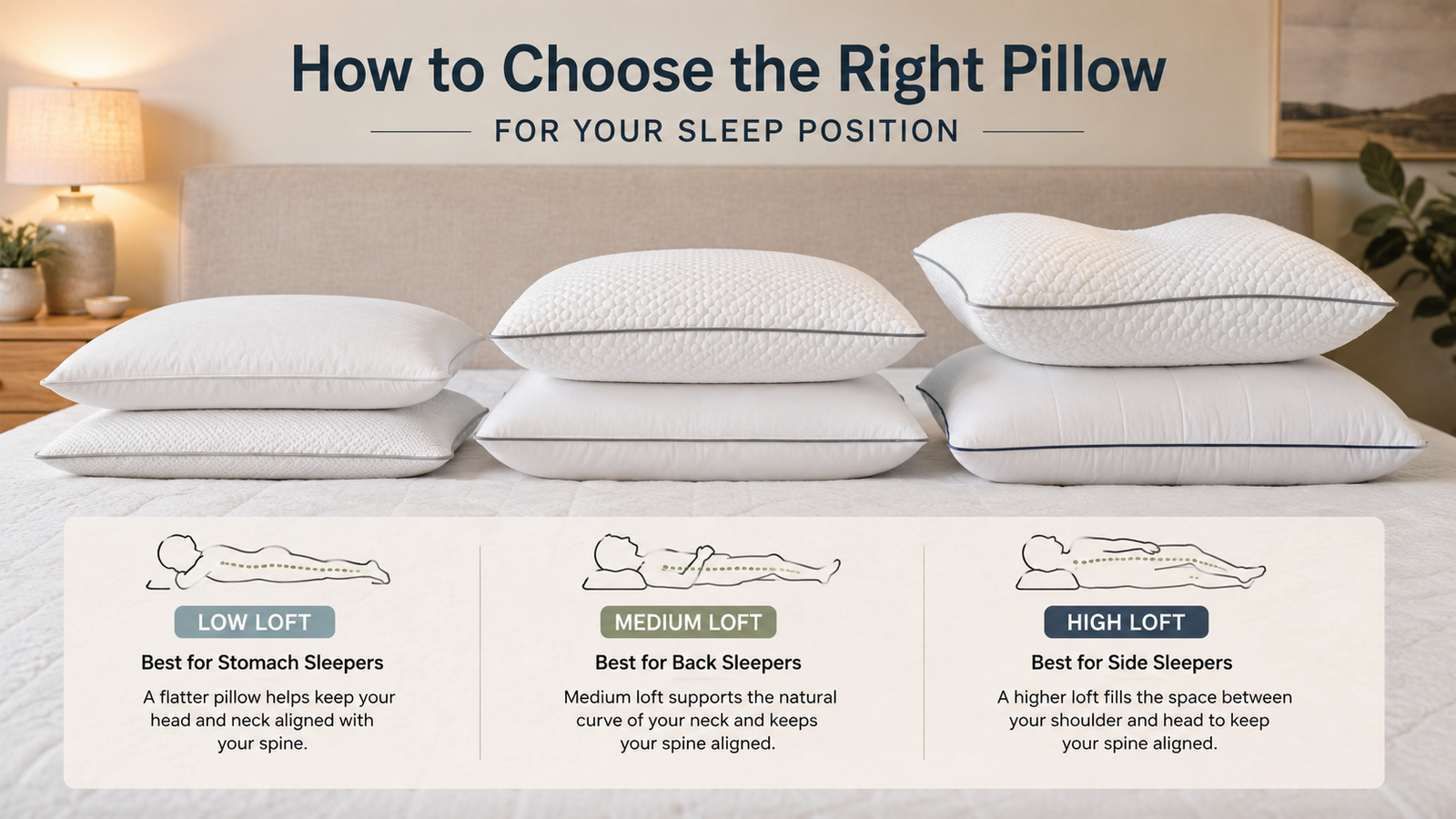
Side Sleepers
Side sleeping creates the largest gap between the head and mattress because of the width of the shoulder.
A pillow generally needs enough loft to support the head without letting it drop toward the mattress.
At the same time, it should not be so tall that it pushes the head upward.
What Side Sleepers Should Consider
Prioritize:
- medium-to-higher loft;
- sufficient firmness to prevent excessive collapse;
- enough width to support position changes;
- material that maintains its shape.
Your ideal loft depends heavily on:
- shoulder width;
- mattress firmness.
Shoulder Width Matters
A person with broader shoulders generally creates a larger space between:
- mattress;
- head.
That can make a thicker pillow more comfortable.
Someone with narrower shoulders may need less loft.
This is why buying a pillow simply because it says:
“Designed for side sleepers”
does not guarantee correct fit.
Side sleepers themselves vary considerably.
Mattress Firmness Changes Pillow Needs
Mattress firmness is one of the most overlooked factors in pillow selection.
On a soft mattress, your shoulder may sink deeper into the bed.
That reduces the gap between your head and mattress.
You may therefore need less pillow loft.
On a firm mattress, your shoulder remains higher.
That creates a larger gap.
You may need more pillow loft.
The pillow and mattress work as a system.
Do not evaluate one without considering the other.
Signs a Side-Sleeper Pillow May Be Too Low
You may notice:
- your head dropping toward the mattress;
- the neck bending downward;
- repeatedly folding the pillow;
- putting your hand underneath it;
- wanting a second pillow for height.
These are clues that additional loft or support may feel better.
Signs a Side-Sleeper Pillow May Be Too High
You may notice:
- your head being pushed upward;
- pressure around the side of the neck;
- feeling that your shoulder cannot settle comfortably;
- repeatedly pushing the pillow away.
A larger pillow is not automatically a more supportive pillow.
Correct height matters more than maximum thickness.
Back Sleepers
Back sleeping generally requires less pillow loft than side sleeping.
The pillow should support the natural space behind the head and neck without forcing the head excessively forward.
A very thick pillow may place the chin closer to the chest.
A pillow that is too flat may leave the neck feeling unsupported.
Back Sleepers Often Prefer
- low-to-medium loft;
- medium support;
- gentle contouring;
- enough neck support without excessive head elevation.
Again, these are starting points rather than strict rules.
Contoured Pillows for Back Sleepers
Some pillows have a curved or wave-like design with:
- a lower area for the head;
- raised section for the neck.
These are commonly marketed as:
- cervical;
- ergonomic;
- orthopaedic pillows.
Some people find the shape comfortable.
Others dislike feeling locked into one position.
A contoured pillow may be worth considering if you:
- primarily sleep on your back;
- prefer structured support;
- do not move around extensively.
But the shape itself does not automatically make it medically superior.
Do “Cervical” Pillows Fix Neck Problems?
Be cautious with claims that a particular pillow can:
- correct your neck;
- realign the spine permanently;
- eliminate chronic neck pain.
A pillow may improve comfort when poor pillow fit contributes to symptoms.
But neck pain can also involve:
- muscle strain;
- joint problems;
- nerve irritation;
- injury;
- workstation factors;
- other medical causes.
A pillow is a comfort and positioning tool, not a diagnosis or treatment for every neck problem.
Stomach Sleepers
Stomach sleeping creates a very different challenge.
The head is generally turned to one side.
A thick pillow can push the head and neck farther upward while they are already rotated.
For this reason, stomach sleepers often prefer:
- low loft;
- soft-to-medium firmness;
- easily compressible pillows.
Some stomach sleepers prefer:
- a very thin pillow;
- no head pillow at all.
Comfort still matters.
Why Thick Pillows Can Be Difficult for Stomach Sleepers
Imagine lying face down while placing a tall pillow underneath your head.
The pillow lifts the head away from the mattress while the neck remains rotated.
That can create an uncomfortable combination of:
- rotation;
- extension.
Reducing pillow height may feel more natural.
Combination Sleepers
Many people do not remain in one position all night.
You may start:
- on your side;
and wake:
- on your back.
Combination sleepers need a compromise.
A pillow that is perfect for one position but unusable in another may become frustrating.
Combination Sleepers Should Look For
- moderate loft;
- responsive material;
- easy repositioning;
- sufficient width;
- adjustable fill where useful.
Adjustable pillows can be particularly helpful because they let you experiment with height.
What Is Pillow Loft?
Loft simply means pillow height or thickness.
Manufacturers may classify pillows as:
- low loft;
- medium loft;
- high loft.
Some provide actual measurements.
For example, you might see:
- 7 cm;
- 10 cm;
- 13 cm;
- 15 cm.
But the listed height alone does not tell you how high the pillow will feel under your head.
Loft vs Compressed Loft
Two pillows can both measure 12 cm when lying unused.
But one may compress to:
5 cm
under your head while another remains near:
10 cm.
That difference can be substantial.
This is why you should consider:
- loft;
- firmness;
- material;
together.
Soft Pillows Effectively Become Lower
A very soft pillow can collapse substantially under body weight.
That can make a high-looking pillow behave more like a medium or low pillow.
A firmer pillow maintains more height.
Do not judge support by appearance alone.
What Is Pillow Firmness?
Firmness describes how resistant the pillow is to compression.
Common descriptions include:
- soft;
- medium;
- firm.
A soft pillow:
- compresses more;
- allows greater sinking.
A firm pillow:
- holds shape more strongly;
- usually maintains more effective loft.
Firmness preference also depends on what sensation you enjoy.
Firm Does Not Mean More Supportive for Everyone
A very firm pillow may provide plenty of structural support but still feel:
- uncomfortable;
- rigid;
- pressure-heavy.
A softer pillow may be perfectly supportive if it maintains the correct height.
Think in terms of:
appropriate support
rather than:
maximum firmness.
Pillow Size
Common sizes include:
- standard;
- queen;
- king;
depending on the market.
Larger pillows provide more space for:
- movement;
- combination sleepers.
But they also:
- cost more;
- require larger pillowcases;
- occupy more bed space.
Choose a size that matches both:
- bed dimensions;
- your movement pattern.
Bigger Is Not Automatically Better
An oversized pillow can become difficult to position.
If your bed is smaller, a very wide pillow may interfere with:
- a partner;
- additional pillows;
- normal movement.
The pillow needs enough space to support you—not fill the entire bed.
Pillow Materials Explained
Pillow feel depends heavily on what is inside.
Common fill materials include:
- Memory foam
- Shredded memory foam
- Latex
- Polyester or fibre fill
- Down
- Down alternative
- Buckwheat or other specialty fills
Each behaves differently.
Memory Foam Pillows
Memory foam softens in response to:
- pressure;
- warmth.
It tends to contour around the head and neck.
Advantages
Memory foam can provide:
- stable support;
- contouring;
- relatively predictable shape.
Potential Drawbacks
Some users find it:
- warm;
- slow to respond;
- too firm;
- difficult to reshape.
Solid memory foam is usually less adjustable than loose filling.
Solid Memory Foam
A solid foam pillow has one molded block.
It may be:
- flat;
- contoured;
- perforated.
The major benefit is stable structure.
The disadvantage is limited adjustment.
If the loft is wrong, you usually cannot simply remove some foam.
Shredded Memory Foam
Shredded foam consists of small foam pieces inside the pillow.
It usually feels:
- more moldable;
- more adjustable;
- somewhat more breathable than a solid block.
Many designs allow you to:
- remove fill;
- add fill.
That makes them attractive for sleepers who are unsure about loft.
Adjustable Pillows
An adjustable pillow allows the amount of filling to be changed.
This can be one of the most useful pillow features.
You can:
- try the original fill;
- remove some;
- sleep on it;
- adjust again.
This allows you to personalize loft without buying another pillow.
Keep Spare Fill
If you remove filling, store it rather than discarding it immediately.
Your preferences may change depending on:
- mattress;
- sleep position;
- physical changes.
Keeping the fill allows later adjustment.
Latex Pillows
Latex usually feels more:
- responsive;
- springy;
- resilient;
than memory foam.
Instead of slowly sinking, it tends to push back gently.
Potential Advantages
Latex may offer:
- good shape retention;
- responsive support;
- durability;
- less deep sinking.
Potential Drawbacks
It may be:
- expensive;
- heavy;
- too springy for some people.
Material preference is highly individual.
Natural vs Synthetic Latex
Products may use:
- natural latex;
- synthetic latex;
- blends.
Marketing terminology can be confusing.
If material composition matters to you, look for specific information rather than relying only on terms such as:
natural-inspired
or:
latex feel.
Polyester Fibre Pillows
Synthetic fibre pillows are widely available and often inexpensive.
They usually offer:
- soft feel;
- relatively low weight;
- easy handling.
Potential drawbacks include:
- flattening over time;
- less consistent support;
- needing frequent fluffing.
They can still provide excellent comfort if they fit your needs.
Down Pillows
Down pillows use soft under-feathers, commonly from:
- ducks;
- geese.
They tend to be:
- soft;
- moldable;
- compressible.
They may suit sleepers who enjoy being able to shape the pillow manually.
Downsides of Down
Potential issues include:
- high price;
- significant compression;
- animal-origin concerns;
- maintenance requirements.
People who need strong structural support may find very soft down insufficient unless the construction is appropriately supportive.
Feather Pillows
Feathers are different from down.
Feather fill generally has more structure but may also:
- develop noticeable quills;
- require fluffing.
Some products combine:
- feather;
- down.
Check the actual fill composition.
Down Alternative
Down-alternative pillows usually use synthetic fibres designed to mimic the soft feel of down.
They can offer:
- softer feel;
- lower cost;
- easier availability.
But they may flatten with use.
Again, pillow construction matters more than the marketing category alone.
Buckwheat Pillows
Buckwheat pillows contain hulls that shift around and can be shaped.
They generally feel:
- firm;
- highly adjustable;
- structured.
They can also be:
- heavy;
- noisy when moving.
This is a very distinctive feel.
People tend either to appreciate the adjustability or dislike the texture and sound.
“Cooling” Pillows
Cooling is a major pillow marketing category.
Products may use:
- cooling fabric;
- gel layers;
- perforated foam;
- phase-change materials;
- breathable construction.
Some can make the surface feel cooler initially.
But no pillow can completely compensate for an excessively hot bedroom.
Temperature Depends on the Entire Sleep Setup
If you sleep hot, consider:
- room temperature;
- humidity;
- mattress;
- mattress protector;
- sheets;
- blankets;
- sleepwear;
alongside the pillow.
Replacing one pillow may not solve a whole-bed heat problem.
Breathability
Pillows with better airflow may feel more comfortable to people who sleep warm.
Features that may influence airflow include:
- perforations;
- shredded fill;
- open-cell structures;
- breathable covers.
However, marketing claims are difficult to compare directly.
Real-world comfort matters more than one “cooling” label.
Pillow Covers
A removable outer cover can make maintenance easier.
Look for:
- washable material;
- easy zipper access;
- comfortable fabric.
If the internal foam itself cannot be washed, a removable cover becomes especially useful.
Pillow Protectors
A pillow protector sits underneath the normal pillowcase.
It can help protect against:
- sweat;
- skin oils;
- spills.
A breathable protector can extend pillow cleanliness.
Avoid very thick waterproof protectors if they make the pillow:
- noisy;
- hot;
- uncomfortable.
Washability
Not every pillow can be put in a washing machine.
Some fibre pillows may be washable.
Solid foam often cannot be machine washed.
Latex also usually has specific care requirements.
Always check the manufacturer’s instructions.
Washing an unsuitable foam pillow can:
- damage the material;
- trap moisture;
- cause deterioration.
Keeping Pillows Hygienic
At minimum:
- use a clean pillowcase;
- wash pillowcases regularly;
- keep the pillow dry;
- clean according to manufacturer instructions.
Pillows accumulate:
- sweat;
- skin oils;
- hair products;
- moisture.
Routine bedding hygiene matters more than frequently replacing a perfectly functional pillow.
How Often Should You Replace a Pillow?
There is no universal expiry date.
Replace or reconsider a pillow when it:
- has permanently flattened;
- no longer returns to shape;
- has damaged filling;
- has persistent odour that cannot be cleaned appropriately;
- no longer feels comfortable;
- no longer provides adequate support.
Condition matters more than an arbitrary calendar rule.
The Fold Test Is Not Universal
You may encounter advice telling you to:
- fold a pillow;
- see whether it springs back.
This may tell you something about certain fibre pillows.
It does not meaningfully evaluate every:
- foam;
- latex;
- specialty pillow.
Judge the pillow based on:
- condition;
- comfort;
- support.
Pillow and Neck Pain
If you regularly wake with neck discomfort, pillow fit is worth examining.
Ask whether:
- the pillow is too high;
- it is too low;
- it collapses during the night;
- your sleep position has changed;
- the mattress is affecting shoulder sink.
But do not assume the pillow is always the cause.
Persistent Neck Pain Needs Proper Attention
Seek appropriate medical assessment when neck pain is:
- severe;
- persistent;
- worsening;
- following significant trauma.
Additional concern is appropriate when symptoms include:
- arm weakness;
- persistent numbness;
- tingling;
- loss of coordination;
- severe headache;
- fever.
Changing pillows repeatedly should not delay appropriate assessment.
Pillow for Shoulder Pain
Side sleepers with shoulder discomfort sometimes assume they need a softer pillow.
But pillow height may be equally important.
If the head is poorly supported, the shoulder may experience awkward positioning.
Also consider:
- mattress pressure;
- sleep position;
- shoulder condition.
A pillow cannot fix every source of shoulder pain.
Pillow for Back Pain
A head pillow has a relatively indirect relationship with lower-back comfort.
Other pillow positions may be useful.
For example:
Back Sleepers
Some people prefer a pillow beneath the knees.
Side Sleepers
Some prefer a pillow between the knees.
These can make the overall sleep position feel more comfortable.
You can test this with a normal pillow before purchasing a specialized positioning product.
Knee Pillows
Knee pillows are typically designed for side sleepers.
They may help maintain a comfortable distance between the legs.
Common shapes include:
- hourglass;
- wedge;
- contoured foam.
They are optional.
If an ordinary pillow works, there may be little reason to buy a specialized one.
Body Pillows
A body pillow is a long pillow that can support:
- arms;
- legs;
- torso;
depending on position.
Side sleepers may use one to reduce the feeling of the upper arm and leg collapsing forward.
They can also provide comfort for people who simply enjoy hugging a pillow.
Body Pillow Size
Consider:
- your height;
- bed width;
- whether you share the bed.
A very large body pillow can occupy significant space.
Measure before buying.
Pregnancy Pillows
Pregnancy pillows can support multiple body areas simultaneously.
Shapes may include:
- C-shaped;
- U-shaped;
- wedge sections;
- full-length pillows.
They can support:
- belly;
- back;
- knees;
- hips.
Comfort needs vary throughout pregnancy.
Because these pillows are large, consider:
- heat retention;
- bed space;
- washable covers.
Pillows for Children
Children’s pillow needs differ from adults.
Very young infants have specific safe-sleep recommendations that generally do not include ordinary adult-style pillows.
Parents and caregivers should follow current pediatric safe-sleep guidance rather than adapting adult pillow advice.
For older children, pillow size and loft should match:
- body size;
- sleeping position;
- comfort.
Pillows for Older Adults
Older adults may have specific comfort or mobility needs.
A pillow that is easy to:
- adjust;
- reposition;
may be useful.
If getting in or out of bed is difficult, avoid creating overly complicated stacks of pillows that could interfere with movement.
Pillow Stacking
Using two pillows does not automatically provide better support.
Two soft pillows can create:
- excessive height;
- unstable support.
If you constantly stack pillows because one feels too low, you may be better served by one pillow with appropriate loft.
But Stacking Can Be Useful for Specific Needs
Temporary elevation may sometimes be used for:
- comfort;
- certain medical situations.
If elevation has been medically recommended, purpose-designed wedges may provide more stable support than a loose pile of pillows.
Wedge Pillows
A wedge pillow raises part of the upper body.
It may be used by some people for:
- reading;
- positional comfort;
- certain reflux-management routines.
Its function is different from a normal head pillow.
A wedge should not automatically be purchased for ordinary sleep unless you have a reason to use elevation.
Reflux and Pillow Height
Simply stacking several head pillows does not always provide effective upper-body elevation because it may mainly bend:
- neck;
- upper back.
People managing persistent nighttime reflux should discuss appropriate strategies with a healthcare professional.
A pillow is not a substitute for evaluating frequent reflux symptoms.
Anti-Snoring Pillows
Some pillows are marketed as reducing snoring through positioning.
Snoring can be influenced by sleep position in some people.
But loud, persistent snoring can also be associated with obstructive sleep apnoea.
Warning signs include:
- witnessed breathing pauses;
- gasping;
- choking during sleep;
- excessive daytime sleepiness;
- morning headaches.
Do not repeatedly buy anti-snoring pillows while ignoring those symptoms.
Sleep Apnoea Is Not a Pillow Problem
A pillow may improve comfort or influence sleeping position.
It does not diagnose or reliably treat obstructive sleep apnoea.
Possible sleep-disordered breathing requires proper evaluation.
Pillow Height and Side Sleeping With CPAP
People using CPAP may have different pillow considerations because:
- masks;
- hoses;
can interfere with ordinary side sleeping.
Specialized CPAP pillows have cut-outs intended to provide space for the mask.
These can be useful if ordinary pillows repeatedly:
- dislodge the mask;
- create pressure.
But they are convenience products rather than substitutes for proper CPAP fitting.
Pillow for Ear Pressure
Side sleepers can sometimes experience pressure around the ear.
Options may include:
- softer surface;
- specialized pillows with ear cut-outs.
If ear pain is persistent, do not assume pressure alone is responsible.
Seek appropriate assessment when needed.
Pillow for People Who Sleep Hot
Prioritize the complete pillow design rather than one cooling feature.
Look at:
- breathable fill;
- air channels;
- cover material;
- foam density.
An adjustable pillow may allow you to reduce excessive dense filling.
But room cooling still has much greater influence on overall thermal comfort.
Pillow Odour
Some new foam products produce an initial manufacturing odour.
If instructions recommend airing the pillow:
- unpack it;
- allow ventilation;
- follow the stated period before use.
Persistent unusual chemical odour or irritation is a reason to reconsider the product.
Allergies and Pillows
People concerned about allergens may benefit from:
- washable bedding;
- pillow protectors;
- regular cleaning.
Do not assume a product labelled:
hypoallergenic
guarantees that no person will react to it.
The term does not mean zero allergy risk.
Dust Mites
Dust mites can accumulate in bedding environments.
Practical measures may include:
- regular bedding washing;
- appropriate covers;
- managing excessive humidity.
Buying a new pillow alone does not necessarily address the full environment.
Pillow Certifications
Some foam products carry certifications related to:
- chemical emissions;
- material standards.
These can provide useful manufacturing information.
But a certification does not tell you whether the pillow:
- fits your sleep position;
- has the correct loft;
- will feel comfortable.
Material safety and personal fit are different questions.
Adjustable Loft Is Often More Useful Than Complex Marketing
If you are uncertain about pillow height, a simple adjustable-fill design may provide more practical value than buying a pillow described as:
- biomechanically engineered;
- advanced cervical;
- AI-designed;
- chiropractor-inspired.
Being able to physically change the height can solve a real fitting problem.
How to Test Pillow Height at Home
When lying in your normal sleeping position, ask:
- Does my head feel pushed upward?
- Does it feel like it is falling downward?
- Do I want to put my hand underneath the pillow?
- Do I need to scrunch the pillow to become comfortable?
- Can my shoulders relax?
You do not need to achieve a visually perfect geometric line.
Comfort and neutral-feeling support are practical guides.
Give a New Pillow Some Time—but Not Forever
A new pillow can feel unfamiliar for several nights.
It may take time to adjust, particularly when changing:
- material;
- loft;
- firmness.
But discomfort should not be ignored indefinitely.
If the pillow repeatedly causes:
- pain;
- headaches;
- poor sleep;
reassess the fit.
Trial Periods Matter
Pillow comfort can be difficult to determine in:
- a shop;
- five minutes.
When possible, check:
- return policy;
- sleep trial;
- exchange rules.
Be particularly careful with hygiene-related exclusions because some retailers do not accept opened pillows.
What Should You Spend?
Pillow prices range enormously.
Higher cost may reflect:
- premium materials;
- adjustable construction;
- better cover;
- stronger warranty;
- brand positioning.
But expensive does not automatically mean better-fitting.
The practical value is determined by:
- comfort;
- durability;
- adjustability;
- actual use.
When a Budget Pillow May Be Enough
A simple fibre pillow may be perfectly adequate if:
- loft is correct;
- firmness suits you;
- it remains comfortable.
You do not need memory foam or latex merely because they are marketed as more advanced.
When Paying More May Make Sense
A higher price may be reasonable when it provides something you genuinely value, such as:
- adjustable fill;
- durable latex;
- better temperature management;
- high-quality washable cover;
- stronger construction.
Pay for usable features rather than health claims.
Pillow Price vs Lifespan
A cheaper pillow replaced frequently may eventually cost more than a durable pillow.
But you cannot judge durability entirely from price.
Look at:
- fill quality;
- stitching;
- warranty;
- repeated long-term user feedback.
Common Pillow Buying Mistakes
Buying by Sleep Position Label Alone
“Side sleeper” is only a starting point.
Consider:
- shoulder width;
- mattress firmness;
- pillow compression.
Choosing the Highest Pillow for Side Sleeping
Too high can be just as uncomfortable as too low.
Assuming Firm Means Supportive
Correct loft matters just as much.
Ignoring the Mattress
Soft and firm mattresses change how much the shoulder sinks.
Buying for Material Before Fit
A perfectly made latex pillow with the wrong height is still the wrong pillow.
Buying an “Orthopaedic” Pillow Expecting It to Cure Pain
Marketing language does not diagnose the cause of symptoms.
Buying Several Pillows at Once
Change one variable at a time so you know what improves comfort.
Ignoring Return Policies
Pillow comfort often requires real sleep testing.
Ignoring Heat
Dense foam may feel uncomfortable for hot sleepers.
Keeping a Collapsed Pillow Too Long
Once support is permanently lost, fluffing may no longer solve the problem.
Quick Pillow Selection Guide
| Main sleep style | General starting point |
|---|---|
| Side sleeper | Medium-to-higher loft with adequate support |
| Back sleeper | Low-to-medium loft |
| Stomach sleeper | Low, compressible pillow |
| Combination sleeper | Medium/adjustable loft |
| Broad-shouldered side sleeper | Consider greater effective loft |
| Side sleeper on soft mattress | May need less loft |
| Side sleeper on firm mattress | May need more loft |
| Hot sleeper | Prioritize breathability and room temperature |
| Unsure about height | Adjustable-fill pillow |
| Prefer structured shape | Consider contoured foam/latex |
| Prefer moldability | Fibre, down or shredded fill |
These are starting points, not fixed prescriptions.
Before You Buy: Final Pillow Checklist
Ask yourself:
- What position do I actually sleep in most often?
- Do I change positions frequently?
- How broad are my shoulders?
- Is my mattress soft or firm?
- How much does the pillow compress?
- What is the effective loft under my head?
- Do I prefer soft, medium or firm support?
- Do I sleep hot?
- Is the pillow adjustable?
- Can the cover be washed?
- What are the care requirements?
- Is the pillow size appropriate for my bed?
- Does it contain material I know I dislike?
- Is there a trial or return period?
- Am I buying it for comfort or because of an unsupported medical claim?
A Simple Way to Choose Between Two Pillows
If two pillows appear similar, prioritize them in this order:
1. Correct loft
The height should fit your sleeping position and mattress.
2. Comfortable firmness
The pillow should not collapse too much or feel rigid.
3. Material preference
Choose the feel you enjoy.
4. Temperature
Consider breathability if you sleep warm.
5. Adjustability
Useful if you are uncertain about loft.
6. Maintenance
A practical pillow should be easy enough to keep clean.
Additional technology matters much less.
How to Set Up a Pillow for Side Sleeping
- Lie on your side in your normal position.
- Let your shoulder settle naturally into the mattress.
- Position the pillow beneath the head and neck rather than under the shoulder.
- Check whether the head feels supported rather than tilted significantly.
- Adjust loft if possible.
- Try the setup for several nights before making small changes.
If desired, place another normal pillow between the knees for additional positioning comfort.
How to Set Up a Pillow for Back Sleeping
- Lie comfortably on your back.
- Position the pillow beneath the head and neck.
- Check that the head is not pushed dramatically forward.
- Adjust height until the neck feels relaxed.
- If lower-body positioning feels uncomfortable, experiment with a small pillow beneath the knees.
Again, comfort matters more than achieving an exact visual posture.
How to Set Up a Pillow for Stomach Sleeping
- Start with a low pillow.
- Notice whether the head feels pushed upward.
- Reduce loft if necessary.
- Choose a compressible material if you like to reposition the pillow.
Some stomach sleepers also experiment with a thin pillow beneath the:
- pelvis;
- abdomen;
for comfort, although this is optional.
When Your Pillow Is Probably Not the Main Problem
Consider other factors if you continue sleeping poorly despite a comfortable pillow.
The issue may involve:
- mattress comfort;
- sleep habits;
- bedroom temperature;
- stress;
- sleep-disordered breathing;
- musculoskeletal problems.
Do not keep purchasing new pillows indefinitely if symptoms do not change.
Frequently Asked Questions
What pillow is best for side sleepers?
Side sleepers generally need enough loft to fill the space created by the shoulder, with sufficient firmness to prevent excessive collapse. Exact height depends on shoulder width and mattress firmness.
What pillow is best for back sleepers?
Many back sleepers prefer low-to-medium loft with enough support to keep the head comfortable without pushing it excessively forward.
What pillow is best for stomach sleepers?
A low, relatively compressible pillow often works better because stomach sleeping already places the head in a rotated position.
How high should my pillow be?
There is no universal height. It depends on sleep position, body dimensions, mattress firmness and how much the pillow compresses.
Should side sleepers use firm pillows?
They often need enough firmness to maintain useful loft, but the pillow should still feel comfortable. Maximum firmness is unnecessary.
Do broad shoulders require a thicker pillow?
Often, particularly when sleeping on a firm mattress, because broader shoulders create a larger space between the head and mattress.
Does mattress firmness affect pillow height?
Yes. A softer mattress lets the shoulder sink farther, which may reduce the loft needed. A firmer mattress can require more pillow height.
Are memory-foam pillows good?
They can provide stable contouring and support, but some people find them warm or too structured.
Is latex better than memory foam?
Neither is universally better. Latex is generally more responsive, while memory foam provides slower contouring.
Are adjustable pillows worth it?
They can be very useful if you are uncertain about loft because you can add or remove filling.
Are expensive pillows better?
Not necessarily. Correct fit matters more than price.
Do cooling pillows work?
Some materials can improve surface feel or airflow, but bedroom temperature, mattress and bedding remain important.
How often should I replace my pillow?
Replace it when it has become permanently flattened, damaged, unhygienic despite proper care or no longer feels supportive and comfortable.
Can the wrong pillow cause neck discomfort?
Poor pillow fit may contribute to uncomfortable sleeping positions, but persistent neck pain can have many causes.
Will an orthopaedic pillow cure neck pain?
No pillow can guarantee treatment of neck pain. A suitable pillow may improve sleeping comfort, while persistent symptoms may require professional assessment.
Is sleeping without a pillow healthy?
There is no universal answer. Some stomach sleepers prefer little or no pillow under the head, while side sleepers usually need substantially more support.
Should my shoulder be on the pillow?
For most ordinary head pillows, the pillow primarily supports the head and neck. Side sleepers generally allow the shoulder to rest on the mattress rather than pushing the whole shoulder onto the pillow.
Can I use two pillows?
You can, but stacking may create excessive or unstable height. One pillow with appropriate loft is often simpler.
Is a body pillow useful for side sleepers?
It can provide additional support for the arms and legs and may improve comfort, but it is optional.
Do knee pillows improve sleep?
Some people find them comfortable. An ordinary pillow between the knees can be tested before buying a specialized product.
Can a pillow stop snoring?
Position may influence snoring in some people, but persistent loud snoring or breathing pauses should be medically evaluated rather than managed solely through pillow changes.
When should neck symptoms be assessed professionally?
Seek appropriate evaluation for persistent or severe neck pain, particularly when associated with:
- weakness;
- numbness;
- tingling;
- loss of coordination;
- significant trauma;
- severe headache;
- worsening symptoms.
The Physical Glow Takeaway
The right pillow is determined primarily by how much support your head and neck need in the position you actually sleep in.
Start with sleep position:
side sleepers generally need more loft → back sleepers usually need moderate loft → stomach sleepers often need less.
Then refine the choice according to:
shoulder width → mattress firmness → pillow compression → firmness preference → material → temperature comfort.
Do not choose a pillow solely because it is labelled “orthopaedic,” “cervical,” “premium” or “designed for side sleepers.” Those labels cannot account for your individual proportions or mattress.
If you are uncertain about height, an adjustable-fill pillow can be especially useful because it lets you fine-tune loft rather than guess correctly on the first attempt.
Most importantly, judge a pillow by what happens when you actually sleep on it. Your head and neck should feel comfortably supported without being pushed noticeably upward or allowed to collapse downward.
The best pillow is not the one with the most advanced foam, strongest medical claims or highest price. It is the one whose loft, firmness and shape fit your sleeping position well enough that you can stop thinking about the pillow and simply sleep.