How to Choose a Smart Scale: Features That Actually Matter
Learn how to choose a smart scale and which features are actually useful, with practical guidance on measurement consistency, app support, user profiles, connectivity and body-composition estimates. This beginner-friendly guide helps you make a clear, informed choice without unnecessary complexity.
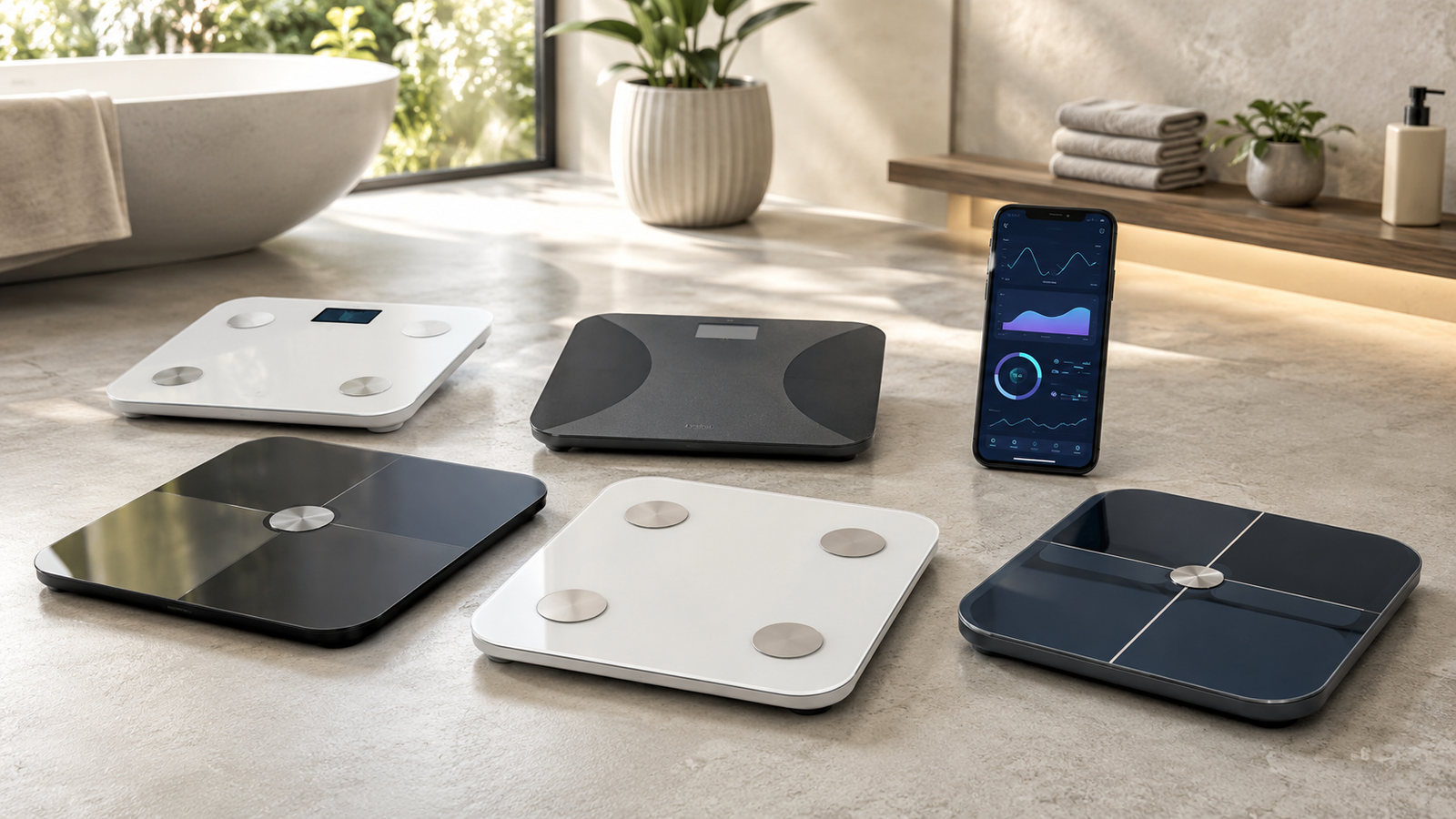
Smart scales promise much more than a simple body-weight reading.
Depending on the model, they may estimate:
- body-fat percentage;
- muscle mass;
- body water;
- visceral fat;
- bone mass;
- metabolic age;
- BMI;
- protein percentage;
- basal metabolic rate;
- dozens of other health-related metrics.
That can make an ordinary bathroom scale look outdated.
But more measurements do not automatically mean better information.
Most consumer smart scales use bioelectrical impedance analysis, or BIA, to estimate body composition. These estimates can be useful for observing broad trends, but they should not be treated as precise clinical measurements of your body fat, muscle or overall health.
The useful question is therefore not:
“Which smart scale gives me the most metrics?”
It is:
“Which scale measures weight consistently, tracks useful trends reliably and integrates into my routine without making me overinterpret estimates that are inherently imperfect?”
For many users, the most valuable smart-scale features are actually quite simple:
- consistent weight measurement;
- easy app syncing;
- clear long-term trends;
- multiple-user recognition;
- reliable connectivity;
- a stable platform;
- straightforward data export;
- good battery life.
This guide explains what smart scales can realistically tell you, which features matter and which specifications are mostly marketing.
What Is a Smart Scale?
A smart scale is a digital weighing scale that connects to an app or other device, usually through:
- Bluetooth;
- Wi-Fi;
- or both.
At minimum, it records body weight automatically.
Many models also use electrodes built into the platform to estimate body composition.
These estimates can include:
- body-fat percentage;
- fat-free mass;
- muscle mass;
- body water;
- visceral-fat rating;
- bone mass;
- BMI;
- basal metabolic rate.
The app then stores measurements over time so you can see trends rather than relying on one isolated reading.
That long-term tracking is often the real advantage of a smart scale.
Start With What You Actually Want to Track
Before comparing models, decide what information you genuinely need.
If You Mainly Want to Track Body Weight
You may only need:
- accurate weight measurement;
- automatic app syncing;
- clear graphs;
- multiple profiles if sharing.
A scale advertising 30 additional metrics may add little practical value.
If You Are Trying to Change Body Composition
You may be interested in:
- weight trend;
- estimated body-fat trend;
- estimated lean-mass trend.
But the key word is trend.
Consumer smart-scale body-composition estimates can fluctuate because of:
- hydration;
- food intake;
- exercise;
- time of day;
- skin temperature;
- recent bathing;
- menstrual-cycle changes;
- alcohol intake;
- device algorithms.
That means a single body-fat reading such as 24.8% should not be treated as a precise measurement of your actual body-fat percentage.
The more useful question is whether readings move consistently over several weeks or months under similar conditions.
If You Want General Health Tracking
A smart scale can be one piece of a broader routine, but it cannot evaluate your overall health.
Body weight alone does not tell you:
- cardiovascular fitness;
- blood pressure;
- blood sugar;
- cholesterol;
- nutritional quality;
- sleep;
- strength;
- mobility.
Do not give the scale more authority than it deserves.
Weight Accuracy Should Come First
Before evaluating body-composition features, make sure the basic scale performs its primary job well.
A good scale should provide:
- repeatable readings;
- stable measurements;
- appropriate maximum capacity;
- suitable measurement increments.
Many household scales display weight in increments such as:
- 0.05 kg;
- 0.1 kg.
For ordinary home tracking, that is generally sufficient.
More decimal places do not necessarily mean greater real-world accuracy.
Accuracy vs Precision
These terms are related but different.
Accuracy
How close the measurement is to the true value.
Precision
How consistently the scale produces similar readings.
For home weight tracking, repeatability is especially important.
For example, if you step on the scale three times within a few minutes and receive:
- 72.4 kg;
- 72.4 kg;
- 72.5 kg;
that is more useful than a scale that produces:
- 72.1 kg;
- 72.8 kg;
- 72.3 kg.
A stable trend matters more than unnecessary decimal precision.
Use the Scale on a Hard, Level Surface
Even a good smart scale can produce poor measurements if used incorrectly.
Place it on:
- tile;
- hardwood;
- other firm, level flooring.
Avoid:
- thick carpet;
- uneven flooring;
- soft mats.
Some scales include carpet feet or accessories, but follow the manufacturer’s instructions.
The scale should remain in the same location whenever possible.
Weigh Under Similar Conditions
Body weight naturally changes throughout the day.
It can be affected by:
- food;
- fluids;
- clothing;
- bowel movements;
- exercise;
- sodium intake.
For more useful trends, measure under reasonably consistent conditions.
A common approach is:
morning → after using the bathroom → before breakfast → similar clothing
You do not have to follow this exact routine.
The important part is consistency.
Do Not Overreact to Daily Weight Changes
Day-to-day fluctuations are normal.
Body weight can change quickly because of:
- hydration;
- carbohydrate intake;
- sodium;
- digestion;
- hormonal changes.
A change of one kilogram over a short period does not necessarily represent one kilogram of gained or lost body fat.
This is one reason smart scales can be useful: the app can show a longer-term trend rather than forcing you to interpret each individual measurement.
How Smart Scales Estimate Body Composition
Most consumer smart scales use bioelectrical impedance analysis.
The scale sends a very small electrical current through the body via electrodes.
The device measures resistance to that current and combines the result with information such as:
- height;
- weight;
- age;
- sex entered into the profile.
An algorithm then estimates body composition.
These are estimates, not direct measurements.
Why Hydration Changes the Reading
Water conducts electricity differently from body fat.
Because BIA depends on electrical impedance, changes in hydration can influence the calculation.
Your estimated body-fat percentage may therefore change depending on:
- whether you just exercised;
- how much water you drank;
- alcohol consumption;
- sweating;
- food intake;
- time of day.
This does not necessarily mean your actual body fat changed.
It may simply mean the conditions changed.
Foot-to-Foot vs Hand-and-Foot Scales
Most bathroom smart scales use electrodes only under the feet.
These devices send current primarily through the lower body and use algorithms to estimate whole-body composition.
Some more advanced models add a handheld bar with additional electrodes.
These can measure through more of the body and may provide segmental estimates for:
- arms;
- legs;
- trunk.
They may offer additional information, but they are usually:
- more expensive;
- more complicated;
- unnecessary for ordinary weight tracking.
Do not assume that having more electrodes automatically creates clinical-grade accuracy.
Body-Fat Percentage
Estimated body-fat percentage is one of the most popular smart-scale metrics.
It can potentially help you observe directional change.
For example, over several months:
- weight decreases;
- estimated body-fat trend decreases;
- strength is maintained;
may provide a more useful picture than weight alone.
But avoid interpreting small changes too literally.
A shift from:
24.1% → 23.8%
may simply reflect measurement variation.
Look at trends across weeks rather than single decimal points.
Muscle Mass
Many smart scales report “muscle mass.”
This number should also be treated as an algorithmic estimate.
The scale is not directly measuring individual muscles.
Changes in:
- hydration;
- glycogen;
- body weight;
can affect the estimate.
If you are strength training, better indicators of progress may include:
- strength performance;
- exercise capacity;
- body measurements;
- photographs;
- long-term weight trends.
Smart-scale muscle estimates can be supplementary rather than definitive.
Skeletal Muscle Percentage
Some apps distinguish skeletal muscle from total muscle mass.
Again, this is estimated rather than directly measured.
Treat it as a trend metric if the scale reports it consistently.
Do not make major nutrition or training decisions based on a one-day change.
Visceral Fat Rating
Some smart scales provide a “visceral fat” score.
This can sound particularly medical.
Consumer scales generally estimate this metric from the same broader impedance and profile data.
It is not the same as imaging techniques that directly assess internal abdominal fat.
Treat the number as a proprietary estimate unless the manufacturer provides validated methodology.
Body Water Percentage
Body-water estimates are also derived from impedance.
They can change naturally according to:
- hydration;
- sodium;
- exercise;
- illness;
- alcohol.
This metric may help explain why other BIA values are fluctuating.
It should not be used to diagnose dehydration or fluid-related medical problems.
Bone Mass
Smart scales may display estimated bone mass.
They are not measuring bone density.
This is important.
A smart scale cannot diagnose:
- osteoporosis;
- osteopenia;
- fracture risk.
Bone density requires appropriate clinical assessment, such as DEXA when medically indicated.
Do not confuse “bone mass estimate” with a medical bone-density test.
BMI
BMI is simply calculated from:
weight ÷ height²
The scale does not measure BMI independently.
Because height is usually entered into the app, BMI is mathematically derived.
It can be useful as a population-level screening measure but has limitations for individuals.
For example, highly muscular people may have higher BMI without high body fat.
Treat BMI as one data point rather than a complete health assessment.
Basal Metabolic Rate
Many smart scales estimate BMR.
This is the approximate amount of energy your body would use at rest.
The number is usually calculated using:
- age;
- sex;
- height;
- weight;
- sometimes estimated body composition.
It is not a direct metabolic measurement.
Do not treat the scale’s BMR as an exact calorie target.
Actual daily energy needs also depend on:
- activity;
- movement;
- training;
- digestion;
- individual physiology.
Metabolic Age
“Metabolic age” appears on some smart scales.
This is generally a proprietary comparison metric.
It may compare your estimated metabolism or body composition with population averages.
It should not be interpreted as your biological age or medical health age.
For most users, it has limited practical value.
Protein Percentage and Other Extra Metrics
Some scales provide increasingly long lists of measurements such as:
- protein percentage;
- body age;
- fat-free body weight;
- subcutaneous fat;
- body score;
- obesity level;
- physique rating.
Many of these are calculated from the same underlying data.
A scale offering 25 metrics is not necessarily gathering 25 independent measurements.
Often, one weight measurement and one impedance reading are processed through several formulas.
Do not confuse the number of displayed metrics with the amount of genuinely independent information collected.
Which Smart Scale Features Actually Matter?
1. Reliable Weight Measurement
This remains the foundation.
Without consistent weight readings, the rest of the data becomes less useful.
2. Automatic Data Syncing
The strongest reason to buy a smart scale instead of a standard digital scale is often automatic record keeping.
You should not have to manually enter every weigh-in.
Good syncing should be:
- quick;
- reliable;
- simple.
3. Clear Trend Charts
The app should make it easy to view:
- 7-day trends;
- monthly trends;
- longer-term changes.
Trend presentation matters more than decorative health scores.
4. Multiple User Profiles
If several people share the scale, automatic user recognition can be useful.
Check:
- maximum number of profiles;
- how users are identified;
- what happens when two people have similar weights.
Some systems ask the user to confirm ambiguous measurements.
5. Guest Mode
Guest mode allows someone to use the scale without adding their measurement to your long-term record.
This is useful in shared households.
6. Wi-Fi or Bluetooth
Both can work well, but they behave differently.
Bluetooth Smart Scales
Bluetooth scales communicate directly with your phone.
Advantages:
- simple;
- lower power requirements;
- often cheaper.
Potential drawback:
Your phone may need to be:
- nearby;
- connected;
- app open depending on the model.
Some scales store a limited number of readings and sync later.
Wi-Fi Smart Scales
Wi-Fi models can often upload measurements directly to the cloud.
Advantages:
- phone does not always need to be nearby;
- easier automatic syncing;
- convenient for multiple users.
Potential drawbacks:
- more complicated setup;
- dependence on Wi-Fi;
- potentially higher price.
Neither connection type makes the actual weight measurement more accurate.
App Quality Matters More Than Many Buyers Expect
The scale may last for years, but you interact with the app constantly.
Before buying, consider:
- app reviews;
- update frequency;
- ease of navigation;
- data history;
- export options;
- account requirements.
A physically excellent scale paired with an unreliable app can become frustrating.
Health-App Integration
Some smart scales can sync with platforms such as:
- Apple Health;
- Google Health Connect;
- Fitbit;
- Samsung Health;
- other fitness ecosystems.
Integration can be useful if you already track:
- activity;
- workouts;
- nutrition;
- sleep.
It allows weight data to appear alongside other health information.
But check exactly which metrics sync.
Some integrations transfer:
- weight only;
while others may transfer:
- body fat;
- BMI;
- other measurements.
Data Export
This is an underrated feature.
Look for the ability to export your data in formats such as:
- CSV;
- spreadsheet-compatible files.
This can be useful if you:
- change devices;
- change apps;
- want your own long-term record.
A health device should ideally not trap years of your measurements inside one proprietary app.
Privacy Matters
Smart scales can collect personal health-related data.
Before connecting one to an account, consider:
- what information the app collects;
- whether an account is mandatory;
- whether data is stored in the cloud;
- deletion controls;
- sharing settings.
Avoid automatically linking every possible service unless there is a clear reason.
Convenience should be balanced with privacy.
Rechargeable vs Replaceable Batteries
Smart scales commonly use either:
- AAA batteries;
- rechargeable internal batteries.
Replaceable Batteries
Advantages:
- simple;
- easy to replace;
- no charging cable needed.
Potential drawback:
- ongoing battery purchases.
Rechargeable Scale
Advantages:
- fewer disposable batteries;
- convenient if battery life is long.
Potential drawback:
If the internal battery degrades after several years, replacement may be difficult.
Neither approach is inherently superior.
Battery Life
Good battery life reduces friction.
A scale that needs frequent charging becomes annoying quickly.
Check whether the claimed battery life is:
- weeks;
- months;
- many weigh-ins.
Connectivity and display type can affect power consumption.
Display Quality
The scale should show at least your body weight clearly.
Useful display characteristics include:
- readable digits;
- good contrast;
- visibility in low light.
Some scales show several metrics directly on the device.
This is convenient but not essential if you mainly review trends in the app.
Platform Size
A stable platform matters.
Look at:
- length;
- width;
- foot placement;
- maximum user capacity.
People with:
- large feet;
- balance concerns;
- mobility limitations;
may prefer a wider platform.
Very compact scales may be easier to store but less comfortable to stand on.
Tempered Glass Platforms
Many smart scales use tempered glass.
Advantages:
- modern appearance;
- easy cleaning.
Potential drawback:
Glass can become slippery when wet.
Use the scale with dry feet and keep it away from puddles.
Do not use a damaged glass scale.
Maximum Weight Capacity
Check the manufacturer’s weight limit.
Common capacities may be around:
- 150 kg;
- 180 kg;
- sometimes higher.
Choose a scale comfortably above the expected user weight.
Do not exceed the stated capacity.
Units
If different household members prefer different units, check whether the scale supports:
- kilograms;
- pounds;
- stones.
Switching should be straightforward.
Automatic User Recognition
This feature can make a shared scale much easier to use.
The device estimates which profile is standing on it based mainly on weight history.
Potential problems occur when two users weigh similar amounts.
Check whether the app allows:
- reassignment;
- confirmation;
- correction.
Incorrectly assigned measurements can distort trends.
Athlete Mode
Some smart scales offer an “athlete mode.”
This adjusts the BIA algorithm for users with certain activity or body-composition characteristics.
Do not enable it simply because you exercise several times a week.
Manufacturers may define “athlete” differently.
Check their criteria.
Incorrect profile selection may make body-composition estimates less meaningful rather than more accurate.
Pregnancy Mode
Some scales provide pregnancy-related modes.
These may disable:
- BIA measurements;
- certain body-composition features.
If pregnant, follow the manufacturer’s safety instructions and medical guidance.
Body weight may be useful to monitor during pregnancy when recommended, but standard body-fat interpretations are generally less useful because body composition and fluid distribution are changing.
Pacemakers and Implanted Medical Devices
Because BIA scales pass a small electrical current through the body, manufacturers may advise people with:
- pacemakers;
- implanted electronic medical devices;
not to use impedance features.
Check the specific product’s safety guidance.
If uncertain, use a standard weight-only scale or seek medical advice.
Do You Need Segmental Body Composition?
Premium models may estimate body composition separately for:
- left arm;
- right arm;
- left leg;
- right leg;
- trunk.
This can sound highly advanced.
For most home users, it is unnecessary.
It may appeal to:
- serious athletes;
- people tracking rehabilitation;
- users particularly interested in body-composition data.
But the estimates still have limitations.
Do not pay substantially more for segmental readings unless you know how you will use them.
Smart Scale vs Standard Digital Scale
A normal digital scale may be the better choice if you:
- only care about body weight;
- do not want an app;
- prefer greater privacy;
- dislike health tracking;
- want the simplest possible device.
A smart scale is more useful when:
- automatic tracking matters;
- you want trend graphs;
- several people share the scale;
- integration with another health platform is valuable.
There is nothing inherently healthier about owning a smart scale.
Smart Scale vs Professional Body-Composition Testing
Consumer smart scales should not be treated as substitutes for professional methods.
Clinical or specialist body-composition assessments may include:
- DEXA;
- air displacement;
- professional multi-frequency BIA;
- anthropometric measurements.
Even professional methods have limitations.
Home scales prioritize:
- convenience;
- accessibility;
- trend tracking.
That can still be valuable.
Just use the tool for what it is designed to do.
How Often Should You Weigh Yourself?
There is no universal ideal frequency.
Options include:
- daily;
- several times per week;
- weekly.
More frequent measurement produces more data but also more natural fluctuation.
Daily weighing can work well if you focus on averages and trends.
Weekly weighing may be better if daily changes become distracting.
The best schedule is one you can interpret calmly and consistently.
Use Weekly Averages When Possible
Suppose your daily weight is:
- Monday: 74.1 kg
- Tuesday: 74.6 kg
- Wednesday: 73.9 kg
- Thursday: 74.4 kg
- Friday: 74.0 kg
Looking at one day could suggest substantial changes.
The weekly average provides a more stable picture.
Smart-scale apps that emphasize moving averages can therefore be particularly useful.
When Smart-Scale Tracking Becomes Unhelpful
Health tracking should support your goals, not dominate them.
Consider reducing weighing frequency if the scale causes:
- significant anxiety;
- compulsive checking;
- repeated restriction based on daily fluctuations;
- distress around normal weight changes.
For some people, not owning a scale is the healthier choice.
If weight or food monitoring becomes emotionally difficult, professional support may be appropriate.
Weight Loss: What Should You Actually Watch?
If your goal is weight loss, focus on the longer trend.
Useful indicators might include:
- average body weight over weeks;
- waist measurement;
- clothing fit;
- energy;
- exercise performance.
Estimated body-fat readings can provide supplementary information but should not become the only measure of progress.
Muscle Gain: What Should You Track?
If your goal is gaining muscle, the scale should be combined with:
- training records;
- strength progression;
- body measurements;
- photographs where useful.
A small increase in body weight alongside improved performance may be meaningful even if the smart scale’s muscle estimate fluctuates.
How to Improve Measurement Consistency
For more comparable readings:
- Keep the scale in the same location.
- Use a hard, level floor.
- Measure at a similar time.
- Use similar clothing.
- Measure before rather than immediately after exercise.
- Avoid comparing readings taken under very different hydration conditions.
- Keep the electrodes clean.
- Stand in the position recommended by the manufacturer.
Consistency cannot make BIA perfectly accurate, but it can make trends more useful.
Clean the Scale Properly
Bathroom scales need basic maintenance.
Use:
- a soft cloth;
- slightly damp cleaning where permitted.
Avoid:
- soaking;
- pouring water onto the scale;
- abrasive cleaners.
Keep electrode surfaces clean because residue may affect contact.
Follow the manufacturer instructions.
Do Not Use With Wet Feet Unless Specifically Designed for It
Bathroom floors can be slippery.
Use the scale:
- on a dry surface;
- with dry feet;
- away from shower water.
This also helps improve electrode consistency on many BIA scales.
Smart Scale Placement
Avoid moving the scale constantly.
Even different parts of the same floor can behave slightly differently.
Choose one stable location and leave it there.
If the scale is stored vertically, some manufacturers recommend recalibration when it is placed back on the floor.
Follow the instructions.
Calibration
Some digital scales automatically calibrate when stepped on or moved.
Others may require:
- place scale on floor;
- tap it;
- allow it to return to zero;
- weigh yourself.
Understanding the calibration procedure can prevent inconsistent readings.
Common Smart Scale Buying Mistakes
Choosing by Number of Metrics
Twenty measurements are not necessarily better than five.
Many are derived from the same impedance reading.
Treating Body-Fat Percentage as Exact
Use it mainly for trend tracking.
Ignoring the App
A poor app can make a good scale frustrating.
Ignoring Privacy
Health-related data deserves thoughtful handling.
Buying Wi-Fi When Bluetooth Is Enough
Connectivity should solve a practical problem.
Paying Extra for Features You Will Never Use
Segmental analysis, metabolic age and advanced graphs may sound impressive but may not change your decisions.
Measuring Under Random Conditions
Inconsistent timing creates more noise in your data.
Panicking Over Daily Weight Changes
Short-term fluctuations are normal.
Using a Smart Scale as a Medical Diagnostic Device
Consumer scales cannot diagnose body-composition or metabolic conditions.
How to Compare Smart Scale Value
A useful comparison includes:
- price;
- weight repeatability;
- connectivity;
- app quality;
- user profiles;
- integrations;
- data export;
- battery type;
- warranty;
- platform size.
Do not compare solely on:
number of body metrics
because many additional numbers are calculated rather than independently measured.
When a Budget Smart Scale Is Enough
A basic model may be perfectly adequate if it provides:
- consistent weight;
- Bluetooth syncing;
- clear app trends;
- enough user profiles.
For many households, this delivers most of the practical benefit.
When Paying More May Be Worth It
A premium model may make sense if you genuinely value:
- Wi-Fi syncing;
- better ecosystem integration;
- larger display;
- segmental measurements;
- premium construction;
- better data export;
- more robust multi-user support.
Pay for workflow improvements rather than simply a longer metrics list.
Quick Smart Scale Decision Guide
| Your priority | What to look for |
|---|---|
| Basic weight tracking | Consistent weight + simple display |
| Automatic records | Reliable Bluetooth/Wi-Fi syncing |
| Weight-loss trend | Clear averages and long-term graphs |
| Multiple users | Automatic profile recognition |
| Fitness tracking | Health-app integration |
| Privacy | Local/simple data options and clear policies |
| Simple use | Weight + app without unnecessary metrics |
| Advanced body composition | Multi-frequency/segmental features with realistic expectations |
| Budget | Reliable weight measurement first |
| Long-term use | Stable app, export and replacement/support availability |
Before You Buy: Final Checklist
Ask yourself:
- Do I actually need body-composition estimates?
- Is reliable weight tracking enough?
- Does the scale provide repeatable readings?
- What is its maximum capacity?
- Is the platform large enough?
- Does it support multiple users?
- Is automatic user recognition reliable?
- Does it use Bluetooth, Wi-Fi or both?
- Does the app have useful trend charts?
- Can I export my data?
- Does it integrate with the health platform I already use?
- What personal data does the app collect?
- Is an account mandatory?
- How is the scale powered?
- Do I understand that body-fat and muscle measurements are estimates?
- Am I paying for features I will actually use?
Frequently Asked Questions
Are smart scales accurate?
They can provide useful and reasonably consistent body-weight measurements. Body-composition measurements such as body fat and muscle mass are estimates and can vary with hydration and other factors.
Is smart-scale body fat accurate?
It should not be treated as an exact clinical measurement. It is generally more useful for observing trends under consistent measurement conditions.
Why does my body-fat percentage change overnight?
Hydration, food intake, exercise and other short-term factors can change electrical impedance and therefore the estimate.
Is muscle mass on a smart scale accurate?
It is estimated from impedance and other profile information rather than directly measured. Use it cautiously as a trend.
Can a smart scale measure visceral fat?
It can provide an estimated visceral-fat score, but it does not directly image or measure internal abdominal fat.
Can a smart scale measure bone density?
No. Estimated bone mass is not equivalent to bone-density testing such as DEXA.
Is Wi-Fi better than Bluetooth?
Not for measurement accuracy. Wi-Fi can make syncing more automatic, while Bluetooth is simpler and often less expensive.
Should I weigh myself every day?
You can if daily tracking helps and you focus on trends rather than individual readings. Weekly or less frequent weighing may suit others better.
What time of day should I weigh myself?
Consistency matters most. Many people prefer morning measurements after using the bathroom and before eating.
Should I weigh myself before or after exercise?
For consistent body-composition tracking, before exercise is generally preferable because sweating and fluid shifts can affect BIA estimates.
Can several people use the same smart scale?
Most models support multiple profiles. Check how many users are supported and how ambiguous measurements are assigned.
Can pregnant women use smart scales?
Follow the manufacturer’s guidance. Some models provide pregnancy or weight-only modes, and body-composition estimates are less meaningful during pregnancy.
Can someone with a pacemaker use a smart scale?
Because BIA models use a small electrical current, manufacturers may advise users with implanted electronic medical devices not to use impedance features. Follow product and medical guidance.
Is BMI from a smart scale more accurate than an online calculator?
No. BMI is calculated from your height and weight. The formula is the same.
Do I need an expensive smart scale?
Not necessarily. A reliable basic scale with automatic trend tracking may provide most of the useful functionality for everyday users.
The Physical Glow Takeaway
Choose a smart scale primarily for consistent weight measurement, useful trend tracking and an app you can realistically live with for years.
Body-fat percentage, muscle mass, body water and other composition metrics can add context, but they remain estimates influenced by hydration, timing and the manufacturer’s algorithm. Use them to observe broad trends rather than interpreting every decimal point as a precise change in your body.
Features such as reliable syncing, multiple-user recognition, health-app integration, data export and a stable platform are often more valuable than an extremely long list of calculated health scores.
Measure under similar conditions, focus on weekly and monthly trends, and remember that body weight and body composition are only parts of health.
The best smart scale is not the one that produces the most numbers. It is the one that gives you consistent, understandable information that supports useful decisions without encouraging you to overinterpret normal day-to-day fluctuations.